June 8, 2026
When Mines Outlast Their Plans: The Structural Trap Facing Long-Gestation PGM Projects
There is a category of mining project that the industry rarely discusses openly: the perpetual developer. These are operations that absorb capital across multiple commodity cycles, survive management changes and macroeconomic shocks, yet never quite cross the threshold into commercial production. In South Africa's platinum belt, where deep-level geology and complex labour dynamics interact with currency volatility and energy constraints, this phenomenon is more common than industry observers typically acknowledge.
Understanding why these projects fail to launch is arguably more instructive than celebrating those that succeed on schedule. Furthermore, the PGM supply constraints that characterise this sector make each stalled project a missed opportunity at a critical time for global metal supply chains.
The story unfolding at the Bakubung platinum mine in North West Province is, in many respects, a masterclass in how compounding operational decisions and deferred governance obligations can transform a genuinely promising PGM asset into a crisis requiring radical intervention. Wesizwe Platinum to cut staff 70% is not simply a cost reduction exercise. It represents a wholesale rejection of the operational philosophy that has governed the project for nearly two decades.
When big ASX news breaks, our subscribers know first
Seventeen Years and Counting: Understanding the Bakubung Development Trap
The Bakubung mine sits within the Bushveld Igneous Complex, which hosts the world's most significant known concentrations of platinum group metals. This geological formation, stretching across much of South Africa's interior plateau, contains the Merensky Reef and UG2 chromitite layer, the two principal ore horizons from which PGMs are extracted. The Bushveld's mineralisation is extraordinary in global terms, yet the structural complexity of individual deposits within it can vary enormously, and that variability has historically caught developers off guard.
Bakubung was originally conceived as a project capable of producing 420,000 ounces of platinum group metals per year, positioning it among the more significant standalone PGM developments of its era. That target, however, required a phased production ramp-up that assumed consistent geological conditions, stable labour relations, functional processing infrastructure, and reliable capital commitment. All four of these assumptions eventually proved flawed.
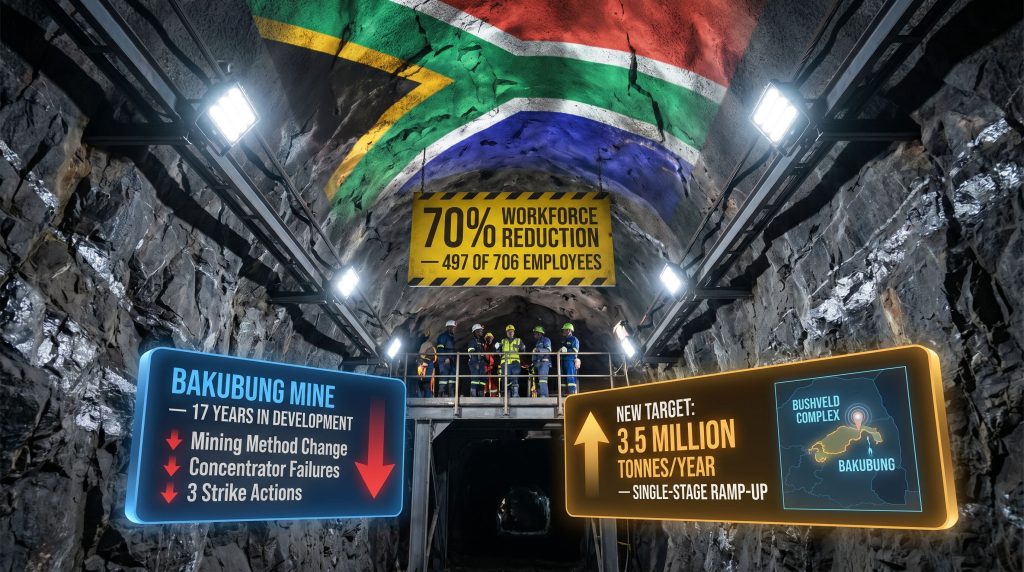
After more than 17 years of development, the mine has not achieved its originally intended production rate of 1 million tonnes of metal-bearing ore per year under the phased model, let alone the headline ounce target that justified the project's original investment thesis. For context, a typical Bushveld PGM operation of similar scale would ordinarily be expected to move from development to commercial production within eight to twelve years. Bakubung has consumed roughly double that timeline without delivering corresponding output.
The Technical Failures That Cascaded Into a Crisis
What distinguishes Bakubung's difficulties from ordinary project delays is the breadth of the technical problems that accumulated over time. In underground PGM mining, the choice of mining method is one of the most consequential decisions a developer makes. Methods such as conventional breast mining, mechanised scattered mining, or hybrid approaches each have distinct implications for development rates, workforce requirements, ventilation design, and ultimately ore extraction geometry.
When Wesizwe changed its mining method mid-development, it effectively reset a significant portion of the prior infrastructure investment. Lateral development completed under the previous method may not be fully compatible with the replacement approach, requiring additional capital expenditure and technical redesign before ore can be extracted at meaningful rates. This kind of mid-project pivot is extraordinarily disruptive and is, in most cases, an indicator that original feasibility assumptions were insufficiently stress-tested.
Compounding this was a persistent failure at the mine's ore concentrator, the facility responsible for the first stage of PGM beneficiation. In the processing chain for platinum group metals, run-of-mine ore typically contains PGM concentrations measured in grams per tonne, and the concentrator's role is to crush, grind, and float this ore to produce a concentrate with dramatically higher PGM grades suitable for smelting. A malfunctioning concentrator does not merely slow production; it eliminates the mine's ability to generate saleable product entirely, severing the revenue line regardless of how much ore is extracted underground.
The sequence of events that follows a concentrator failure in a mine of this type is predictable and painful: underground production continues building inventory, but without the processing facility functioning, stockpiles accumulate without generating cash, operational losses mount, and workforce morale deteriorates. For a project already operating without JSE-disclosed financials, this creates a compounding information vacuum that investors find deeply unsettling.
The Ownership Dimension: What a Sino-African Joint Venture Means in Practice
Wesizwe Platinum's 45% ownership by China-Africa Jinchuan Investments adds a layer of strategic complexity that is rarely examined in depth by mainstream market commentary. Jinchuan Group, the Chinese state-linked mining conglomerate that underpins this stake, is one of China's largest nickel and cobalt producers and has been an active participant in African resource development for over a decade. Its involvement in Bakubung reflects a broader Chinese strategic calculus around securing upstream PGM exposure, given the metals' importance in catalytic converter manufacturing and, increasingly, hydrogen fuel cell applications.
Chinese-backed mining ventures operating in Africa have historically demonstrated a higher tolerance for extended development timelines than Western institutional investors typically permit. This patience is not altruistic; it reflects a different capital cost framework and, in many cases, a strategic priority that places resource security above short-term financial returns. The critical question for Bakubung is whether nearly two decades of development expenditure, combined with governance failures and operational setbacks, has exhausted even this extended investment patience.
The decision to completely overhaul Bakubung's production blueprint after 17 years may reflect internal pressure from Chinese stakeholders to finally extract operational returns from a project that has consumed substantial capital without reaching commercial viability.
The revised strategy, targeting a direct single-stage ramp-up to 3.5 million tonnes of ore per year rather than the previously staged approach, could be interpreted as a response to this pressure. It signals a preference for definitiveness over incrementalism, accepting higher short-term disruption in exchange for a cleaner, more predictable operational trajectory. The broader South Africa mining decline in recent years has, however, made this kind of high-conviction bet considerably harder to execute.
Dissecting the 70% Workforce Reduction: Numbers, Mechanics, and Legal Obligations
The scale of the proposed retrenchment is significant by any measure in South Africa's PGM sector. With 497 of 706 employees affected, the post-restructuring workforce of approximately 209 people represents a fraction of what was required under the phased production model. According to Bloomberg, a reduction of 70.4% at a single mine site is virtually without precedent outside of full care-and-maintenance transitions or mine closures in the Bushveld Complex.
| Metric | Before Restructuring | After Restructuring |
|---|---|---|
| Total workforce | 706 employees | ~209 employees |
| Employees affected | N/A | ~497 employees |
| Reduction percentage | N/A | ~70% |
| Mining rate target | 1 million t/year (phased) | 3.5 million t/year (single-stage) |
| Production target (original) | 420,000 oz PGM/year | Not restated |
| Mine development duration | 17+ years | Ongoing |
| JSE listing status | Suspended | Suspended |
Under South Africa's Labour Relations Act, specifically the Section 189A consultation mechanism, any employer proposing to retrench more than 10 employees must engage in a formal, structured consultation process with recognised unions and affected workers. This process includes prescribed timeframes, information disclosure obligations, and requirements to consider alternatives to retrenchment before any final decisions are made. For a retrenchment of this magnitude, the process is likely to be protracted and may involve facilitation by the Commission for Conciliation, Mediation and Arbitration.
This legal framework does not prevent retrenchments from proceeding, but it does impose meaningful process requirements that can extend the timeline by weeks or months. Given that Wesizwe has already experienced three separate industrial strike actions, including one illegal underground sit-in that created acute safety risks, the prospect of contentious Section 189A consultations adds another variable to an already complex restructuring timeline.
The Labour Relations Legacy and Its Operational Consequences
It is worth understanding why labour relations at Bakubung deteriorated as severely as they did. The 2022 to 2025 PGM sector downturn forced Wesizwe into earlier rounds of workforce reductions, eroding the trust and goodwill that stable employment ordinarily generates in mining communities. In the Rustenburg labour market, where mining employment supports extensive household and community networks through wage multiplier effects, even modest job losses create visible economic distress.
When a company then returns to the same workforce with proposals for further and far more severe retrenchments, the psychological and industrial relations environment is already damaged. Union negotiators entering Section 189A consultations in this context are likely to face intense member pressure to resist or slow the process, potentially triggering the kinds of industrial action that have historically compounded Bakubung's operational difficulties.
The Single-Stage Strategy: Higher Risk, Potentially Higher Reward
The abandonment of the phased ramp-up model in favour of a direct push to 3.5 million tonnes of ore per year represents a fundamentally different operational philosophy. In orthodox mine development practice, phased approaches are preferred precisely because they allow operators to identify and correct problems at smaller production scales before committing to full infrastructure deployment.
The single-stage model inverts this logic. It accepts that the phased approach has already failed and that the accumulated problems are severe enough to justify a complete strategic reset. By targeting a production rate 3.5 times higher than the previously sought 1 million tonne per year milestone, Wesizwe is making a high-conviction bet that a concentrated, unified deployment of capital and operational focus can succeed where an incremental approach could not.
Key distinctions between the two approaches:
-
The phased model required larger workforce pools during successive development stages, creating permanent cost pressures during extended ramp-up periods
-
The single-stage model concentrates workforce deployment around a single production target, theoretically reducing the fixed cost base per tonne of ore processed
-
A higher targeted mining rate, if achieved, would improve the mine's unit economics and potentially make Bakubung competitive with established Bushveld operators on a cost-per-ounce basis
-
The risks of failure are correspondingly higher: if the single-stage ramp-up encounters the same technical obstacles that defeated the phased model, there is no fallback position
For PGM investors assessing Wesizwe's revised strategy, the critical question is not whether the new plan is theoretically superior to the old one, but whether the operational and governance foundations required to execute it are now genuinely in place.
Governance Failures That Compound the Operational Crisis
The suspension of Wesizwe's JSE listing due to late financial reporting is, in many respects, the most structurally damaging element of the company's current predicament. Share suspensions of this nature are not administrative inconveniences. They signal to capital markets that the company's internal financial controls, board oversight mechanisms, or external auditor relationships have broken down to the point where statutory reporting obligations cannot be met.
For a company simultaneously navigating a major operational overhaul, a significant retrenchment process, and a complex ownership structure spanning South African and Chinese stakeholders, the inability to publish financial results on time suggests that the management and governance infrastructure has been overwhelmed. In addition, these management red flags are precisely the kind of warning signals that experienced investors should monitor closely when evaluating any resource project.
The publication of 2025 interim results in March 2026 and full-year results in May 2026, both months after standard JSE reporting deadlines, confirms that the delays were substantial. Until the JSE reinstatement is achieved through regularised reporting, Wesizwe cannot access equity capital markets in any conventional sense, limiting its funding options to existing shareholders, debt facilities, or Chinese investor capital.
The next major ASX story will hit our subscribers first
PGM Market Context: Sector Strength Versus Company-Specific Weakness
One of the more important analytical distinctions to draw in assessing Wesizwe's situation is that Bakubung's crisis is idiosyncratic rather than systemic. The broader PGM sector, at the time of the restructuring announcement, was operating in a relatively supportive price environment. Furthermore, understanding the platinum and palladium dynamics that underpin current valuations helps contextualise why a well-run project in this jurisdiction could still attract capital. Platinum group metals continue to benefit from durable demand across multiple end-use categories:
-
Autocatalysis: Platinum and palladium remain essential in catalytic converters for internal combustion and hybrid vehicles, with demand supported by tightening global emissions standards
-
Hydrogen economy: Platinum is a critical catalyst material in proton exchange membrane fuel cells, with long-term demand growth expected as hydrogen infrastructure expands
-
Industrial applications: Platinum's chemical stability makes it valuable across glass manufacturing, petroleum refining, and electronics applications
-
Investment demand: Physical platinum investment, including exchange-traded products, provides an additional demand layer sensitive to macroeconomic and currency conditions
The fact that Wesizwe is restructuring during a period of sector-level price support, rather than during a trough, underscores that its difficulties are structural and operational rather than market-driven. This distinction matters for investors assessing recovery potential: a company whose problems are commodity-price-dependent can recover passively when prices rise, but a company whose problems are operational and governance-related must actively fix those underlying deficiencies.
Risk and Recovery: Mapping the Path Forward
| Risk Category | Specific Concern | Assessed Severity |
|---|---|---|
| Operational | Single-stage ramp-up fails to achieve 3.5 Mt/year | High |
| Processing | Concentrator problems persist under new model | High |
| Governance | Delayed reporting continues, JSE reinstatement stalls | High |
| Financial | Capital access restricted during suspension period | High |
| Labour | Section 189A process delays or is contested | Medium |
| Geopolitical | Chinese investor priorities shift away from project | Medium |
| Reputational | Community and union relations in Rustenburg deteriorate further | Medium |
The upside scenarios, while contingent on successful execution, are genuinely meaningful. A functioning single-stage production model at 3.5 million tonnes per year would, if the concentrator issues are resolved, position Bakubung as a volume producer within one of the world's premier PGM jurisdictions. JSE reinstatement would restore investor access and potentially attract renewed institutional interest at a point when PGM demand fundamentals remain constructive. Completing a robust definitive feasibility study under the new production model would, furthermore, be an essential step in restoring credibility with institutional capital markets.
Frequently Asked Questions: Wesizwe Platinum Staff Cuts and Bakubung Mine
How many jobs is Wesizwe Platinum cutting at Bakubung?
Wesizwe Platinum has proposed cutting approximately 497 positions from a total workforce of 706 employees at the Bakubung mine, representing a reduction of roughly 70% of the site's total headcount. Reporting from Mining.com confirms the scale of the proposed retrenchments and the operational context driving them.
Why has Wesizwe Platinum announced a 70% staff cut?
The reduction is directly tied to a fundamental overhaul of the mine's production strategy. The company is replacing a multi-phase development approach with a single-stage ramp-up targeting 3.5 million tonnes of ore per year, a model that requires a significantly smaller establishment workforce. Wesizwe Platinum to cut staff 70% is, consequently, an operational necessity under the revised production blueprint rather than a purely financial decision.
Where is Bakubung located and what does it produce?
Bakubung is located near Rustenburg in South Africa's North West Province, within the Bushveld Igneous Complex. The mine targets platinum group metals, including platinum, palladium, and rhodium.
Is Wesizwe Platinum still listed on the JSE?
As of the June 2026 restructuring announcement, Wesizwe Platinum's shares remain suspended on the JSE due to the company's failure to publish financial results within required regulatory timeframes. Interim and full-year 2025 results were only published in March and May 2026 respectively.
Who owns Wesizwe Platinum?
Wesizwe Platinum is 45% owned by China-Africa Jinchuan Investments, a Chinese state-linked mining investment entity, with the remainder held by other shareholders.
How long has Bakubung been in development?
The mine has been in development for more than 17 years and has not achieved the commercial production levels envisaged in its original design, making it one of the longest-running uncommissioned PGM development projects in the Bushveld Complex. The decision by Wesizwe Platinum to cut staff 70% signals that patience with the original model has finally been exhausted.
Disclaimer: This article is intended for informational purposes only and does not constitute financial or investment advice. Forecasts, scenario analyses, and risk assessments presented herein involve inherent uncertainty. Readers should conduct their own due diligence and consult a licensed financial adviser before making investment decisions. References to commodity price environments and market conditions reflect publicly available information at the time of writing and are subject to change.
Want To Be First When The Next Major PGM Discovery Hits The ASX?
Discovery Alert's proprietary Discovery IQ model delivers real-time alerts on significant ASX mineral discoveries — cutting through complex geological and commodity data to surface actionable opportunities the moment they are announced. Start your 14-day free trial today and explore historic discovery returns on Discovery Alert's dedicated discoveries page to understand just how transformative early positioning in a major find can be.