June 8, 2026
The Hidden Cost of Distance in Heavy Equipment Manufacturing
In capital-intensive manufacturing sectors, the physical geography of a factory campus rarely makes headlines. Yet for producers of large-scale underground mining equipment, the distance between a warehouse and a production line is not an administrative footnote — it is a measurable drag on productivity, safety, and ultimately, customer satisfaction. When components weighing several tonnes must travel kilometres between facilities multiple times during an assembly cycle, every transfer point introduces cost, risk, and time that compound across thousands of production events each year.
This operational reality forms the foundation of one of the more strategically significant infrastructure investments in the global mining equipment sector in 2026. Sandvik plans new logistics hub in Finland — specifically at its Turku manufacturing facility, the company's primary production centre for underground load-and-haul equipment including loaders and trucks. The announcement, reported by the Canadian Mining Journal on June 8, 2026, signals more than a construction project. It reflects a fundamental rethinking of how supply chain infrastructure creates competitive advantage in the mining equipment market.
When big ASX news breaks, our subscribers know first
Why the 13-Kilometre Gap Was No Longer Acceptable
The Real Cost of Fragmented Logistics in Mining Equipment Production
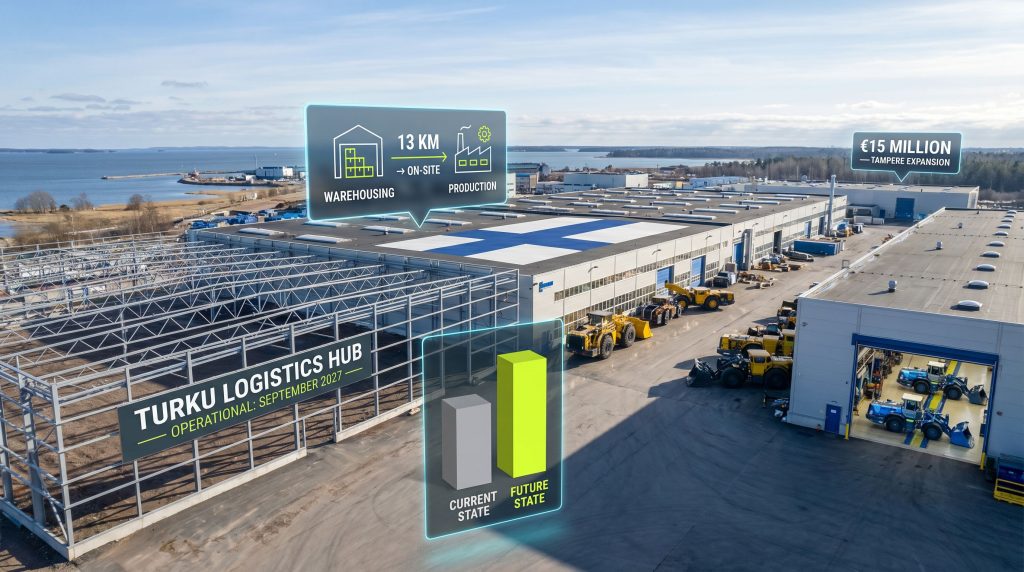
The central problem Sandvik is solving is deceptively simple: its current warehousing and materials handling operations are located approximately 13 kilometres from the Turku factory. For a manufacturer producing complex underground machinery — equipment that requires precise sequencing of hundreds of components across assembly lines — this separation creates a cascading series of inefficiencies.
Consider the operational reality of a single production cycle for a large underground loader:
- Components must be retrieved from the remote warehouse and transported to the factory.
- Each transport leg requires specialised vehicles, handling equipment, and logistics coordination.
- Every additional handling event introduces the possibility of component damage, delay, or misalignment with production scheduling.
- If a component arrives late or incorrectly staged, production line stoppages follow.
- Those stoppages ripple through to customer delivery timelines.
In manufacturing environments where assembly sequences are tightly scheduled, even modest delays at the logistics interface can inflate lead times significantly. The decision to build a purpose-built hub directly on the Turku campus eliminates these transfer points entirely, consolidating the materials flow within a single integrated environment. Furthermore, this geomechanics research on delivery impacts illustrates just how significantly parts lead times affect mining operations globally.
What the Current State vs. Future State Actually Looks Like
| Operational Dimension | Current Configuration | Post-Hub Configuration |
|---|---|---|
| Warehousing distance from factory | ~13 km | On-site, integrated campus |
| Inter-facility transport legs | Multiple per production cycle | Eliminated |
| Component handling touchpoints | Elevated | Significantly reduced |
| Parts availability speed | Extended by transport time | Immediate proximity |
| Safety exposure from transport | Higher vehicle movement risk | Substantially reduced |
| Production scheduling alignment | Reliant on logistics coordination | Direct integration possible |
The transformation from the left column to the right is not incremental — it represents a structural redesign of how production inputs are managed, with downstream benefits for both internal operations and external customer commitments.
Sandvik Plans New Logistics Hub in Finland as Part of a Broader Nordic Strategy
Turku and Tampere: A Two-City Investment Programme
The Turku logistics hub does not exist as an isolated capital allocation decision. It sits within a broader programme of investment Sandvik is executing across its Finnish manufacturing footprint. In parallel with the Turku announcement, Sandvik has committed to a €15 million expansion of its Tampere facility, enlarging that site's manufacturing and development capacity.
Together, these investments reflect a deliberate strategy to entrench Finland as the operational backbone of Sandvik's underground equipment division — a hub-and-spoke model where Turku anchors production and logistics for load-and-haul equipment while Tampere strengthens the broader engineering and manufacturing base.
Why Finland Provides Structural Advantages for Global Equipment Distribution
Finland's role as a manufacturing anchor for underground mining equipment is not accidental. Several structural factors make it a compelling base for a global supplier:
- Industrial ecosystem depth: Finland has a well-established precision engineering and heavy equipment manufacturing sector, providing access to specialised suppliers, subcontractors, and technical expertise that support complex production requirements.
- Coastal logistics access: Turku is a coastal city with established port infrastructure, providing efficient access to global shipping routes that reduce the cost and complexity of distributing large equipment internationally.
- Technical workforce quality: Finland consistently ranks among the highest globally for engineering education outcomes and industrial skills, reducing recruitment risk for technically demanding manufacturing roles.
- Regulatory stability: A predictable and transparent regulatory environment reduces operational risk for long-cycle infrastructure investments, which is particularly important for projects with multi-year implementation timelines.
- Supplier network maturity: Established local and regional supplier networks reduce procurement complexity and lead times for production inputs.
Finland's combination of port access, engineering talent, and industrial infrastructure makes it one of the more strategically sound locations in Europe for a global mining equipment manufacturer to concentrate capital investment.
Safety by Design: The Underappreciated Dimension of Logistics Consolidation
Why Reducing Transport Frequency Is a Safety Intervention
A frequently overlooked element of Sandvik's logistics hub announcement is its explicit framing as a workplace safety improvement. The company has stated that the development will contribute to a safer working environment by reducing unnecessary transport, handling, and movement between separate locations.
This framing reflects an important evolution in how leading manufacturers approach operational safety. Rather than treating safety as a compliance requirement layered over existing workflows, the most sophisticated operations now embed safety outcomes directly into infrastructure design decisions.
In the context of underground mining equipment manufacturing, the safety case for logistics consolidation is compelling:
- Heavy components for loaders and trucks can weigh several tonnes, making every handling event a potential safety exposure point.
- Inter-facility transport of oversized industrial equipment involves vehicle movement on public or industrial roads, introducing traffic-related incident risk.
- Multiple handling events multiply the cumulative probability of a materials handling injury across a production year.
- Reducing transport frequency directly reduces the total number of high-risk handling events, producing a statistically meaningful improvement in incident probability.
By designing the logistics hub to eliminate inter-facility transport, Sandvik is simultaneously improving operational efficiency and reducing workplace risk — a dual outcome that reflects genuinely integrated operational thinking rather than siloed optimisation.
The Electrification Connection: Why Battery-Electric Equipment Demands Better Logistics
How the Shift to Battery-Electric Underground Equipment Increases Parts Complexity
The Turku logistics hub has been explicitly described by Sandvik as building upon recent investments in underground equipment electrification and digitisation at the factory. This connection is more than contextual — it points to a fundamental challenge that battery-electric mining equipment creates for supply chain management. In addition, the broader mining's transformation through electrification is reshaping how manufacturers must plan their entire operational infrastructure.
Conventional diesel underground loaders and trucks, while mechanically complex, have parts inventories that are well-understood and relatively standardised across the industry. Battery-electric equivalents introduce a substantially different inventory profile:
- Battery systems and battery management electronics require dedicated storage conditions and handling protocols distinct from conventional mechanical components.
- Electric drivetrains incorporate power electronics, motor controllers, and high-voltage cabling that demand different inventory management practices than hydraulic or mechanical drivetrain components.
- Charging infrastructure components add an entirely new parts category with no equivalent in diesel equipment supply chains.
- Software-defined control systems require coordinated management of hardware and firmware versions, adding a digital layer to physical inventory management.
As Sandvik's underground equipment portfolio transitions toward battery-electric platforms, the complexity of managing parts inventory at the Turku facility will increase substantially. A purpose-built logistics hub with modern warehouse management systems is therefore a necessary infrastructure layer to support this transition at production scale.
Digital Integration: The Technology Architecture Behind a Modern Mining Logistics Hub
While Sandvik has not publicly specified the exact technology stack for the Turku hub, the phased implementation approach — with system installation explicitly preceding operational ramp-up — strongly suggests a technology-first deployment philosophy. Furthermore, electric vehicles transforming mining operations globally are creating analogous pressure on manufacturers to modernise their logistics infrastructure in parallel. Leading-edge logistics facilities in the mining equipment sector now typically incorporate:
- Real-time inventory tracking across all parts categories, enabling production schedulers to see component availability without manual stocktaking.
- Automated picking and replenishment systems that reduce processing time and human error in high-volume parts environments.
- Digital integration between warehouse management systems and production scheduling platforms, aligning parts availability with assembly line demand in real time.
- Customer-facing order visibility tools that provide mining operators with accurate, current information on delivery timelines.
The system installation phase planned ahead of the September 2027 ramp-up suggests that Sandvik intends to have the digital infrastructure fully validated before transitioning operational responsibility from the existing dispersed facilities.
Customer Value as Competitive Architecture
Rethinking What Mining Equipment Customers Are Actually Buying
Wayne Scrivens, President of Load-and-Haul at Sandvik, characterised the logistics hub investment in terms that reveal a strategic perspective on competitive positioning. His emphasis on efficient logistics as a core component of customer value — not merely an internal operational matter — reflects an industry-wide shift in how major original equipment manufacturers define their competitive advantage.
For mining operators running large underground fleets, the calculus of equipment procurement has evolved beyond product specifications. Automation has transformed mining technology in comparable ways, raising customer expectations across the entire supply and service chain:
- Equipment downtime cost in deep underground mining operations can reach tens of thousands of dollars per hour, making parts availability and delivery speed direct financial variables in procurement decisions.
- Fleet reliability depends not only on the quality of the original equipment but on the speed and predictability with which service parts and replacement components can be delivered.
- Total cost of ownership calculations now routinely incorporate supply chain reliability metrics alongside capital acquisition costs and maintenance schedules.
- Long-term partnerships between miners and OEMs are increasingly evaluated on service delivery performance, not only initial equipment quality.
By framing the Turku hub as a customer value investment, Sandvik is explicitly acknowledging that supply chain performance is now a contract-winning capability — and that the company's long-term competitiveness depends on being able to guarantee faster, more reliable parts and equipment delivery to mining operations globally.
The next major ASX story will hit our subscribers first
Phased Construction: How Sandvik Will Rebuild Without Stopping Production
A Four-Phase Approach to Minimising Disruption
Constructing new logistics infrastructure adjacent to an active production facility requires careful sequencing. Sandvik's phased construction approach addresses this challenge by progressively building toward the improved operational state while maintaining current delivery commitments. The implementation sequence follows a logical progression:
- Design and Approvals: Site planning, engineering design, and any required regulatory or permitting processes for the new facility footprint within the Turku campus.
- Construction: Physical build-out of the logistics hub, including warehousing bays, materials handling infrastructure, and loading and unloading facilities.
- System Installation: Integration of warehouse management systems, digital inventory platforms, and operational technology before any production workflows are migrated.
- Operational Ramp-Up (Post-September 2027): Transition of current off-site logistics operations into the new hub, with parallel running during the cutover period to protect continuity.
This sequencing reflects hard-won industry experience with logistics migrations in live manufacturing environments. Moving too quickly risks disrupting production schedules and customer deliveries; moving too slowly leaves operational inefficiencies in place longer than necessary. The September 2027 target provides a clear external milestone while allowing the internal project team flexibility in managing the phased build-out.
How This Investment Benchmarks Against Industry Trends
Sandvik's Turku Hub in the Context of Sector-Wide Logistics Evolution
| Industry Trend | Direction of Travel | Turku Hub Alignment |
|---|---|---|
| On-site logistics consolidation | Accelerating among Tier 1 OEMs | Direct alignment |
| Electrification-driven parts complexity | Increasing inventory management demands | Infrastructure designed to support EV transition |
| Safety-by-design in operations | Embedding risk reduction into infrastructure | Explicitly stated design objective |
| Digital warehouse management systems | Standard for new logistics builds | System installation phase planned ahead of ramp-up |
| Customer lead time compression | Core competitive differentiator | Primary stated investment rationale |
| Integrated manufacturing campuses | Growing adoption globally | Turku hub consolidates previously dispersed functions |
The convergence of these trends suggests that Sandvik's Turku investment is not a unique strategic experiment but rather a well-timed execution of a direction the industry has been moving toward for several years. Consequently, data-driven mining operations and AI-powered efficiency tools are reinforcing the same underlying need for integrated, technology-first infrastructure that Sandvik is now building into its Turku campus. The companies that build this infrastructure first, and integrate it most effectively with production and customer service systems, are likely to establish durable advantages in markets where delivery reliability increasingly influences purchasing decisions.
Key Takeaways for the Mining Equipment Sector
The Sandvik logistics hub announcement carries implications that extend beyond a single construction project in Finland:
- Logistics is becoming a product in its own right. Leading OEMs are treating supply chain infrastructure as a core element of customer value, not a secondary back-office function.
- Electrification increases the strategic importance of inventory management. Battery-electric underground equipment introduces fundamentally greater parts complexity than diesel predecessors, making integrated logistics hubs a necessity rather than a luxury for manufacturers serious about the transition.
- Finland is consolidating as a global underground equipment manufacturing centre. Sandvik's parallel investments in Turku and Tampere reinforce the country's strategic importance to the company's long-term operational footprint.
- Safety and efficiency are increasingly designed together. The reduction of unnecessary transport and handling delivers simultaneous productivity gains and workplace safety improvements, reflecting modern operational design thinking.
- September 2027 is the milestone to watch. The phased ramp-up timeline provides a clear marker for when the full operational and customer-facing benefits of the investment will begin to materialise.
This article draws on reporting by the Canadian Mining Journal (June 8, 2026). Readers seeking additional coverage of underground mining equipment supply chains and Nordic manufacturing investments can explore related reporting at the Canadian Mining Journal. This article contains forward-looking statements and projections based on publicly available information. Readers should conduct independent research before making investment or commercial decisions.
Want to Stay Ahead of the Next Major Mining Discovery?
Discovery Alert's proprietary Discovery IQ model scans ASX announcements in real time, instantly translating complex mineral data across 30+ commodities into clear, actionable insights for both short-term traders and long-term investors — start your 14-day free trial and explore historic discoveries that have generated extraordinary returns.