June 9, 2026
The Hidden Steel Demand Signal Inside Every Truck Rolling Off a U.S. Assembly Line
Most conversations about steel demand focus on construction pipelines, infrastructure spending, or broad macroeconomic cycles. Rarely does a single labour dispute at a mid-sized Michigan parts facility enter the conversation. Yet the mechanics of how automotive steel gets consumed reveal something important: demand does not flow from steelmakers directly to vehicle buyers. It moves through a layered network of suppliers, component manufacturers, and assembly plants, and a fracture at any point in that chain can compress steel orders in ways that are structurally logical even when they appear indirect.
That is precisely the lens through which the American Axle UAW strike and automotive steel demand need to be examined together — not as a headline labour story, but as a case study in how Tier 1 supplier disruptions translate into real-world steel market dynamics. Furthermore, understanding this relationship matters increasingly in a market shaped by tariff impacts on iron ore and shifting global trade flows.
When big ASX news breaks, our subscribers know first
Why Automotive Steel Demand Is More Complex Than Production Volume Suggests
The U.S. automotive sector ranks as the third-largest consumer of steel in the country, but its influence on steel markets extends well beyond headline vehicle production figures. The composition of what gets built matters enormously. Full-sized pickup trucks, for example, consume significantly more steel per unit than passenger sedans or crossover SUVs. Their heavier chassis architecture, reinforced underbody structures, and safety-critical drivetrain components require a wider range of specialised steel grades, each sourced through distinct supply chains.
Understanding which steel grades go into which vehicle components is essential for assessing where demand risk concentrates when production slows:
| Steel Type | Primary Application in Trucks |
|---|---|
| Special Bar Quality (SBQ) Steel | Axles, driveshafts, transmission components |
| Cold-Finished Bar Steel | Engine and safety-critical parts |
| Ultra-High Strength Steel (UHSS) | Structural rigidity, rollover protection |
| Mild/Low-Carbon Steel | Body frames, floor panels |
| Galvanised Steel | Rust-resistant underbody components |
| High-Carbon Steel | Chassis, door panels, support beams |
This breakdown matters because different steel grades serve different nodes in the supply chain. A disruption targeting axle and driveline production, for instance, hits SBQ and cold-finished bar steel first, before any impact reaches the body panel or chassis steel supply chains. Understanding this grade-level granularity is what separates a surface-level analysis from an actionable one.
How Tier 1 Disruptions Propagate Upstream
A critical but often underappreciated dynamic is that automotive steel demand is not simply a function of final assembly volumes. It flows backward through multiple supplier tiers, and a stoppage at a Tier 1 component manufacturer can create what market participants describe as a demand vacuum — an abrupt compression of steel orders that propagates upstream through service centres and ultimately reaches steelmakers.
The speed and severity of this cascade depend on two key variables: how deep the OEM's inventory buffer is at the time of the stoppage, and how long the disruption persists. These two variables define the risk window entirely.
The American Axle UAW Strike: What Happened and Why It Matters
Approximately 1,000 UAW-represented workers at American Axle's Three Rivers, Michigan facility initiated strike action on June 1, 2026, following the breakdown of contract negotiations. The facility is not a generic parts plant. It manufactures axles, driveline systems, and safety-critical drivetrain components that feed directly into General Motors' Flint, Michigan assembly operations, which produce the Chevrolet Silverado and GMC Sierra heavy-duty pickup trucks.
American Axle's customer concentration makes this dispute particularly consequential. The company derives more than 75% of its total revenue from the Big Three automakers, with General Motors alone representing approximately 44% of its customer base, according to Wayne State University business professor Marick Masters. Ford and Stellantis account for a meaningful share of the remaining Big Three-related revenue, meaning prolonged disruption could introduce secondary demand effects across multiple OEM supply chains. The UAW members at American Axle laid out their demands publicly ahead of the contract expiration, signalling the depth of the grievances involved.
The Production Exposure at GM's Flint Plant
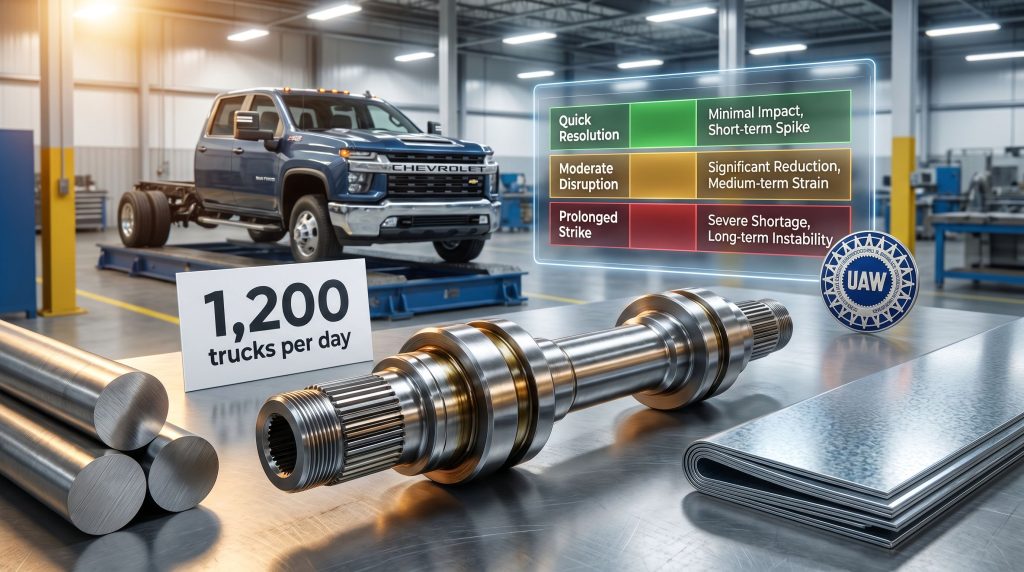
GM's Flint facility produces approximately 1,200 heavy-duty Silverado and Sierra trucks per day. According to vehicle forecasting analysis from AutoForecast Solutions, the Silverado and Sierra together generate roughly $2.7 billion in annual profits for General Motors, making these two models among the highest-margin vehicle programmes in North American manufacturing. The financial stakes of production continuity cannot be overstated.
At the time the strike commenced, industry estimates suggested GM held approximately a two-week parts inventory buffer for the affected axle components. That two-week window is the critical threshold. Once that buffer is exhausted, GM's Flint operation faces the potential loss of more than 1,000 trucks per day — a production gap that cannot be absorbed by redirecting assembly to alternative models in the short term.
Combined, the Silverado and Sierra represented approximately 2% of total North American vehicle production in 2025, a figure that provides important scale context for assessing the strike's broader market significance.
Translating a Labour Stoppage Into Steel Demand Signals
The connection between the American Axle UAW strike and automotive steel demand is indirect but structurally sound. The mechanism follows a clear logical sequence:
- Strike action halts axle and driveline component manufacturing at Three Rivers
- GM's Flint assembly plant draws down its parts inventory buffer over approximately two weeks
- Heavy-duty truck assembly volumes at Flint decline or pause entirely
- Demand softens for steel grades used in truck production, including SBQ bar, UHSS, galvanised sheet, and high-carbon structural steel
- Steel service centres supplying GM's truck platform reduce order intake from mills
- Near-term steel demand metrics for affected grades reflect reduced pull-through volumes
Which Steel Grades Carry the Greatest Exposure
Not all steel grades face equal risk in this scenario. The grade-level demand exposure breaks down as follows:
-
Special Bar Quality (SBQ) steel carries the most direct risk, as it is the primary feedstock for axle and driveline component manufacturing at facilities like Three Rivers
-
Cold-finished bar steel faces similar near-term pressure given its role in precision-engineered drivetrain and safety-rated components
-
Galvanised sheet steel faces softened demand if Flint assembly volumes decline, as it is used extensively in rust-resistant underbody truck applications
-
Ultra-high strength steel and high-carbon grades used in structural truck architecture represent secondary but meaningful demand exposure if the stoppage extends beyond the inventory buffer period
Analyst Perspectives: Does the Strike Move the Needle on Steel Markets?
Market analysts are divided on whether the American Axle UAW strike will produce a material impact on U.S. automotive steel demand, and that division reflects genuinely different assumptions about strike duration and OEM response options. However, both the global crude steel outlook and the china steel and iron ore market provide important context for understanding the wider environment in which this disruption is unfolding.
The Disruption Case: Duration Drives Everything
The more cautious analytical view holds that if the strike extends meaningfully beyond the two-week inventory buffer, the demand signal for SBQ bar, galvanised sheet, and structural truck grades will become measurable. GlobalData Automotive's vice president for the Americas, Bill Rinna, has noted that a significant production impact on the Silverado and Sierra platform becomes probable if the stoppage is prolonged, though he also acknowledges that any demand deferral is likely to be recovered once assembly resumes and OEMs rebuild inventory.
AutoForecast Solutions' vice president of global vehicle forecasting, Sam Fiorani, has argued that American Axle faces acute incentive to resolve the dispute rapidly, precisely because the risk of losing General Motors as a customer is existential. Fiorani has also raised the scenario where a prolonged strike accelerates GM's efforts to qualify alternative axle suppliers — a long-term structural risk for American Axle that goes well beyond any single contract cycle.
The Resilience Case: Deferred Demand, Not Destroyed Demand
The more sanguine view rests on two observations. First, the Silverado and Sierra's combined 2% share of North American production limits the systemic steel market exposure. Second, demand disrupted by a short-cycle production stoppage is typically deferred rather than permanently eliminated. Steel volumes are recovered as assembly resumes and manufacturers rebuild component and finished vehicle inventories.
KeyBanc Capital Markets metals analyst Samuel McKinney observed on June 1 that GM's stock declined by less than 1% on the day the strike was announced, which he interpreted as a signal that financial markets were not pricing in a severe or prolonged disruption outcome.
Scenario Comparison: How Strike Duration Shapes Steel Market Impact
| Scenario | Strike Duration | Steel Demand Impact | Recovery Timeline |
|---|---|---|---|
| Quick Resolution | Under 2 weeks | Negligible, within inventory buffer | Immediate |
| Moderate Disruption | 2 to 6 weeks | Modest softening in SBQ, galvanised grades | 1 quarter |
| Prolonged Strike | 6+ weeks | Measurable demand reduction; GM seeks alternative sourcing | 2 to 3 quarters |
The Labour Economics Behind the Dispute: A Decade of Wage Compression
To understand why UAW members at Three Rivers walked out, it is necessary to look back to 2008, when the financial crisis forced deep concessions across the U.S. auto parts sector. Workers at the facility accepted wage cuts that, in some cases, reduced hourly pay from approximately $29 per hour to $14.50 per hour overnight. Those cuts were framed as a sacrifice to preserve the company's viability, and by the union's own accounting, they succeeded in helping American Axle survive and ultimately generate substantial profits.
Yet the wage recovery promised implicitly by that sacrifice has not materialised. Current production workers at Three Rivers top out at approximately $22 per hour after five years of employment. UAW Local 2093 bargaining committee chairman Josh Jager has publicly noted that adjusted for inflation, that pay rate represents a significant real-terms decline relative to both the original 2008 wage and even the already-reduced post-concession rate.
The original $29 per hour from 2008 would equate to approximately $44 per hour in today's dollars, while even the reduced $18 per hour rate from 2008 represents approximately $27 in real terms today. Notably, auto parts workers have been battling wage cuts dating back to that crisis period, and the Three Rivers dispute reflects the unresolved legacy of that era.
The arithmetic of wage compression over 15 years of inflation is striking. Three Rivers workers are not simply seeking a raise. They are seeking partial restoration of purchasing power that was surrendered during an industrial crisis that no longer exists.
What This Strike Signals for the Broader UAW Agenda
Wayne State University's Marick Masters has positioned the Three Rivers dispute as a strategic test case for UAW bargaining power across the auto parts sector. The auto parts manufacturing segment has historically lagged behind OEM assembly plants in compensation levels, and the union has framed this strike as part of a wider campaign to raise wage floors industry-wide.
The outcome will be closely watched by UAW rank-and-file members as they prepare for upcoming national conventions and leadership elections, amplifying the political stakes considerably beyond the immediate contract.
The next major ASX story will hit our subscribers first
Structural Outlook: What Underpins U.S. Automotive Steel Demand Long-Term
The American Axle UAW strike and automotive steel demand story exists within a broader structural framework that remains fundamentally intact. In addition, several durable forces continue to support U.S. automotive steel consumption over the medium term:
-
Vehicle safety regulation compliance drives ongoing adoption of advanced high-strength and ultra-high-strength steel grades, as crashworthiness standards become progressively more demanding
-
Full-sized truck and SUV market dominance sustains demand for steel-intensive vehicle architectures that face limited near-term substitution risk from aluminium-intensive or composite alternatives
-
EV platform transitions introduce new steel demand vectors, particularly in battery enclosure structures, chassis reinforcement, and body-in-white architecture, though the net effect on total steel intensity per vehicle remains an active area of analytical debate
Near-term U.S. automotive steel demand growth through 2027 is projected to remain positive but modest, with domestic vehicle production volumes expected to be broadly flat. Furthermore, US steel and aluminum tariffs continue to shape the competitive environment in which domestic steelmakers operate, adding another layer of complexity to demand forecasting. Consequently, green steel pricing trends are also emerging as a variable that automotive supply chains will increasingly need to factor into longer-term procurement strategies.
Key Variables Steel Market Participants Should Monitor
For those tracking the American Axle UAW strike and automotive steel demand implications, the following variables represent the most important monitoring priorities:
-
Strike duration relative to the two-week buffer threshold: outcomes diverge sharply beyond this point, and the two-week window is the single most important variable in any scenario model
-
GM's progress in qualifying alternative axle suppliers: a prolonged strike could accelerate supplier diversification with longer-term structural implications for American Axle's market position and its steel procurement volumes
-
Spillover UAW activity across the auto parts sector: if the Three Rivers outcome energises further industrial action elsewhere in the parts supply chain, cumulative steel demand effects could become more material than any single-facility analysis suggests
-
U.S. consumer demand for full-sized trucks: underlying truck demand remains the primary driver of steel-intensive vehicle production, and any consumer-level softening would compound the strike's supply-side effect
Disclaimer: This article contains forward-looking assessments, analyst projections, and scenario analyses that involve inherent uncertainty. Outcomes related to strike duration, steel demand volumes, and OEM production decisions may differ materially from the scenarios described. This content is for informational purposes only and does not constitute financial or investment advice.
For independent pricing data and market analysis across the steel supply chain and automotive sector, Fastmarkets provides commodity intelligence and forecasting resources at fastmarkets.com.
Want To Know Which ASX Mineral Discoveries Could Deliver Exceptional Returns?
Discovery Alert's proprietary Discovery IQ model scans ASX announcements in real time, instantly identifying significant mineral discoveries and translating complex data into actionable investment insights — explore the historic returns major discoveries have generated to understand the opportunity, then start your 14-day free trial at Discovery Alert to position yourself ahead of the broader market.