
June 9, 2026
The Steel Trap Tightening Around North American Trade
When global tariff architectures shift, the effects rarely stay contained within the borders that designed them. The history of twentieth-century protectionism is littered with examples of trade barriers generating unintended consequences in third-party markets, redirecting commodity flows, distorting competitive dynamics, and forcing industrial restructuring far removed from the original policy target. The current convergence of US tariffs amplify China steel pressure on Mexico, and understanding this requires examining not just the tariffs themselves, but the structural geometry of North American trade that makes Mexico uniquely vulnerable to this particular combination of forces.
When big ASX news breaks, our subscribers know first
Why Mexico Occupies a Uniquely Exposed Position in This Trade Architecture
The Dual-Pressure Problem Facing Mexican Industry
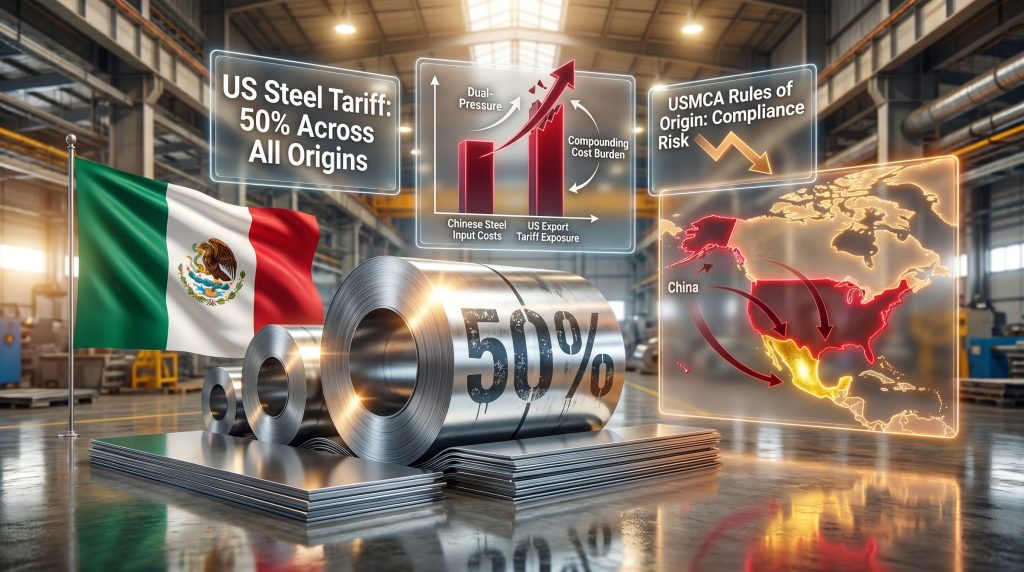
Mexico's industrial economy faces a challenge that few other nations must navigate simultaneously: it is both a major destination for diverted Chinese industrial inputs and a primary export platform serving the US market. This dual positioning creates a structural tension that standard trade policy tools are poorly equipped to resolve. Furthermore, when Washington imposes sweeping tariffs on steel, aluminum, and copper imports across all origins, the immediate effect on Mexico's export-oriented manufacturers is a sharp increase in the cost of accessing their primary market.
When Beijing responds by accelerating exports to alternative markets, one of the most accessible and structurally open destinations is Mexico itself. The US steel and aluminum tariffs have consequently created a compounding pressure dynamic. Mexican manufacturers face higher barriers selling finished goods northward while simultaneously confronting an intensifying flood of below-cost Chinese steel inputs pushing into their domestic market.
How the US-China Trade Conflict Became Mexico's Problem
The mechanism through which US-China trade tensions transmit into Mexican industrial conditions is often misunderstood. The direct channel is the most visible: US tariffs raise costs for Mexican exporters of metal-intensive goods because the inputs those goods contain may not qualify for preferential treatment under the United States-Mexico-Canada Agreement (USMCA) if they originate from outside the trade bloc.
The indirect channel is subtler but equally significant. As Chinese steel producers lose access to the US market, they must redirect production toward markets with lower trade barriers. Latin America, and Mexico in particular, becomes an absorption zone for this displaced volume. The US-China trade war impact intensifies competitive pressure on domestic producers at exactly the moment when those producers are most needed to supply USMCA-compliant inputs to the export manufacturing sector.
Breaking Down the 50% US Tariff Regime and Its Structural Consequences
What the Tariff Architecture Actually Does to Mexican Exporters
The United States has imposed 50% tariff rates on steel, aluminum, and copper imports across all origins, representing one of the most aggressive applications of Section 232 authority in recent trade history. For Mexican exporters of vehicles, appliances, industrial equipment, and construction materials, these rates function as a structural tax on the metal content embedded in finished goods. Even when the final assembly occurs within Mexico, the tariff exposure depends critically on whether the steel and aluminum inputs satisfy USMCA rules of origin requirements.
Critical Structural Point: USMCA rules of origin require that steel and aluminum used in manufactured goods destined for the US market must be melted and poured within the USMCA region to qualify for preferential tariff treatment. Goods containing Chinese-origin steel, regardless of where they are assembled, face potential loss of preferential access.
This rules-of-origin squeeze creates a fundamental problem for manufacturers who built their nearshoring supply chains around cost-competitive Chinese steel inputs. The very economics that made Mexico an attractive nearshoring destination — specifically the ability to combine low-cost Asian inputs with proximity to the US market — are now structurally undermined by the tariff architecture. In addition, the global commodity tariff effects extend well beyond steel alone, affecting a broad range of industrial inputs that feed into Mexico's export manufacturing base.
Why Blanket Global Tariffs Hit Export-Oriented Manufacturing Hardest
Unlike targeted tariffs that create space for supply chain substitution, blanket global tariffs remove the competitive advantage of sourcing from third-party origins. A manufacturer using Brazilian or Korean steel faces the same tariff exposure as one using Chinese steel when selling into the US market, provided those inputs do not satisfy USMCA origin requirements.
This design feature forces manufacturers toward a binary choice: restructure procurement entirely around USMCA-region suppliers, or accept permanent cost disadvantage in the US market. Consequently, the China steel market outlook remains critical context for understanding how much displaced Chinese volume is actively seeking new destinations like Mexico.
Mexico's Policy Response: A Staged Defensive Strategy
The Timeline and Logic of Mexico's Tariff Increases on Chinese Goods
Mexico's response to the escalating tariff environment has been structured, deliberate, and clearly oriented toward preserving US market access rather than purely protecting domestic producers. The government has implemented staged tariff increases on Chinese industrial goods, with steel products among the primary targets. This staged approach reflects both the political complexity of restricting Chinese imports and the strategic calculation that demonstrating trade compliance posture reduces the risk of further US trade restrictions targeting Mexican exports.
| Policy Measure | Target Sector | Strategic Objective |
|---|---|---|
| Staged tariff increases on Chinese goods | Steel, aluminum, industrial inputs | Reduce transshipment risk, preserve US market access |
| Expanded anti-dumping investigations | Chinese flat and long steel products | Defend domestic producers from below-cost pricing |
| Domestic steel preference in public procurement | Infrastructure construction projects | Signal compliance with US trade concerns |
| Rules of origin enforcement tightening | Export manufacturing supply chains | Maintain USMCA eligibility for finished goods |
Anti-Dumping Investigations and Their Significance
Mexico's expansion of anti-dumping investigations targeting Chinese steel products reflects a technical trade policy mechanism that operates differently from standard tariffs. Anti-dumping duties are imposed when imported goods are found to be sold below their cost of production in the exporting country, with the duty designed to offset the margin of dumping. For Chinese flat and long steel products, the structural overcapacity of China's steel sector — estimated at hundreds of millions of tonnes of excess annual production capacity — creates persistent conditions conducive to below-cost export pricing.
Research from the Federal Reserve Bank of Dallas has documented that anti-dumping measures implemented in previous periods successfully slowed the growth of Chinese steel imports into the Mexican market, providing meaningful protection to domestic producers. However, the effectiveness of these measures depends on enforcement capacity, the speed of investigation procedures, and the willingness to impose retroactive duties that deter import surges during the investigation period itself.
Steel as the Fault Line: Why This Sector Bears the Greatest Exposure
Mexico's Import Dependency and the Export Paradox
Mexico's steel sector occupies a structurally paradoxical position: the country is simultaneously a significant importer of Chinese steel products and a major exporter of steel-intensive manufactured goods to the United States. This paradox is not irrational from a purely commercial perspective. Chinese steel prices have historically been substantially below domestic Mexican production costs due to China's scale advantages, state support for the sector, and chronic overcapacity.
Under the current tariff architecture, however, that commercial logic inverts. The input cost saving from Chinese steel is now more than offset by the tariff risk on the output side. This creates a situation where manufacturers who optimised their supply chains for cost efficiency now face structural competitive disadvantage, a dynamic well captured by analysis of tariff impacts on iron ore and broader commodity trade flows across the region.
How Compounding Tariff Layers Create a Cost Spiral
The layered tariff structure affecting Chinese steel flowing through Mexico into US-bound goods creates a compounding cost burden that is difficult to model in advance:
- Mexican import tariffs on Chinese steel increase the landed cost of the input material
- USMCA origin disqualification eliminates preferential access to the US market for finished goods containing non-compliant steel
- US 50% tariff exposure applies to the full value of the finished good, not merely the steel content, when USMCA eligibility is lost
- Competitive displacement from domestic producers who have transitioned to USMCA-compliant inputs creates additional market pressure
This cost spiral does not affect all manufacturers equally. Large, capital-intensive operations with established relationships with domestic or North American steel suppliers are best positioned to restructure procurement. Smaller manufacturers with limited capital for supply chain restructuring face the greatest margin compression.
Nearshoring Viability Under Pressure: Three Strategic Scenarios
What Made Mexico Attractive and What Now Complicates That Calculation
The nearshoring proposition that drove substantial foreign direct investment into Mexico over the preceding decade rested on several intersecting advantages: geographic proximity to the US market, USMCA preferential access, competitive labour costs, and the ability to combine North American market access with globally sourced inputs. The tariff architecture now challenges the final element of that equation directly.
Investor Note: The fundamental nearshoring value proposition has not disappeared, but its economics have become more complex. Manufacturers who can transition to USMCA-compliant supply chains retain significant advantages. Those who cannot face a structurally altered cost model that requires reassessment of the original investment thesis.
Scenario Analysis for Manufacturers Operating in Mexico
Scenario 1: Supply Chain Localisation
- Transition procurement to domestically produced or USMCA-region steel sources
- Higher input costs in the short term, estimated at 15–25% premium over Chinese alternatives, but full tariff exemption on US exports
- Requires capital investment in supplier qualification and potentially longer procurement lead times
- Viable for large-scale manufacturers with sufficient capital and contractual flexibility
Scenario 2: Absorb the Cost Premium
- Continue using Chinese steel inputs while absorbing the compounding tariff burden
- Margin compression likely to be severe, particularly for lower-value-added product categories
- Short-term viability only; structurally unsustainable as tariff permanence becomes established
Scenario 3: Production Relocation
- Exit Mexico for alternative manufacturing jurisdictions with different tariff exposure profiles
- Risk of losing USMCA proximity advantages, established logistics infrastructure, and workforce investment
- Most relevant for smaller, more mobile manufacturers without deep fixed-asset commitment
The next major ASX story will hit our subscribers first
The Broader Trade Flow Dynamic: Where Diverted Chinese Steel Goes
Latin America as an Absorption Zone for Displaced Chinese Steel
When high-barrier markets close to Chinese steel, the displaced export volume does not simply disappear from global trade. Chinese producers, operating under structural pressure to maintain utilisation rates at mills with enormous fixed cost bases, actively seek alternative markets. Latin America, with generally lower average tariff barriers than the United States or European Union, has historically served as a significant destination for Chinese steel exports. Analysis from Credendo further highlights how the global steel sector is under increasing strain from the cumulative weight of new tariff regimes.
Regional Risk Assessment: The intensification of US and European trade barriers against Chinese steel increases the probability that Latin American markets absorb a larger share of global Chinese steel export volume. Countries with less developed anti-dumping frameworks or lower average MFN tariff rates face the greatest exposure to import surges that can severely damage domestic steel producers.
Mexico, despite its more developed trade policy apparatus, remains partially exposed to this dynamic because the sheer volume of potential Chinese steel diversion exceeds the capacity of anti-dumping investigations to respond quickly. Investigation timelines typically span twelve to eighteen months, during which import volumes can surge substantially before provisional measures take effect.
Mexico's Domestic Steel Sector: Positioning and Outlook
Capacity Utilisation, Competitive Dynamics, and the Infrastructure Opportunity
Mexico's domestic steel industry, anchored by major producers with integrated facilities capable of producing flat and long steel products, faces a period of significant strategic opportunity alongside considerable near-term challenge. The challenge is the intensified import competition from Chinese producers seeking alternative markets. The opportunity is the potential demand stimulus from Mexico's National Infrastructure Plan, which includes substantial construction programmes where government procurement preference for domestically produced steel can provide a meaningful demand catalyst.
The government's stated preference for domestic steel in public infrastructure projects represents a demand-side complement to the supply-side protection provided by anti-dumping measures and import tariffs. Together, these policies create conditions where domestic producers can potentially expand capacity utilisation at the same time that export manufacturers are restructuring procurement toward USMCA-compliant sources.
The USMCA Renegotiation Dimension: 2026 and Beyond
How Trade Compliance Will Define the Renegotiation Agenda
The USMCA review process scheduled for 2026 introduces a significant additional variable into Mexico's strategic calculus. US trade negotiators have consistently indicated that rules of origin enforcement, particularly for steel and aluminum, will be a central focus of review discussions. Mexico's demonstrated willingness to restrict Chinese steel imports and tighten origin verification procedures may become a prerequisite for maintaining favourable terms in the renegotiated agreement.
This creates a situation where Mexico's domestic trade policy decisions carry implications far beyond their immediate industrial effects. The trajectory of anti-dumping case outcomes, the stringency of import tariff enforcement, and the effectiveness of procurement preference policies will all be assessed by US trade counterparts as indicators of Mexico's overall compliance posture.
| Indicator | Current Status | Strategic Significance |
|---|---|---|
| US steel/aluminum/copper tariff rate | 50% across all origins | Defines cost exposure for metal-intensive exporters |
| Mexico's Chinese goods tariff trajectory | Staged increases underway | Signals compliance intent to US trade partners |
| Anti-dumping investigation pipeline | Expanding | Key enforcement mechanism for domestic protection |
| USMCA rules of origin for steel | Melt-and-pour requirement | Determines eligibility of manufactured goods for preferential access |
| National Infrastructure Plan steel preference | Domestically produced preference | Demand catalyst for Mexican producers |
| Latin American Chinese steel absorption risk | Elevated and rising | Regional vulnerability to import surge dynamics |
Strategic Takeaways for Industry Participants and Policymakers
Near-Term Indicators That Demand Monitoring
- Monthly Chinese steel import volume data entering Mexico, particularly flat-rolled and structural categories
- Anti-dumping investigation outcomes and the speed of provisional measure implementation
- US trade compliance audit activity targeting USMCA origin claims from Mexican exporters
- Capacity utilisation rates at major Mexican integrated steel producers
Medium-Term Structural Shifts to Track
- Foreign direct investment decisions by nearshoring manufacturers regarding supply chain localisation timelines
- Mexican domestic steel capacity expansion announcements and investment commitments
- USMCA renegotiation language on rules of origin thresholds and enforcement mechanisms
- Chinese steel export volume data disaggregated by destination, tracking Latin American share growth
The Long-Term Question That Defines Mexico's Industrial Future
The structural question underlying all of these near-term dynamics is whether Mexico emerges from this period as a genuinely domestically supplied industrial economy, or whether it remains structurally dependent on Chinese inputs in ways that permanently compromise its USMCA positioning. The answer will be determined not by policy declarations but by the actual procurement decisions of manufacturers operating in Mexico over the next three to five years.
Strategic Conclusion: The forces currently bearing down on Mexico's steel supply chain represent a durable realignment of North American industrial trade architecture. The reality that US tariffs amplify China steel pressure on Mexico is not a temporary disruption awaiting policy normalisation. Rather, the 50% US tariff regime establishes a new cost baseline that manufacturers and policymakers must treat as the permanent operating environment rather than an aberration to be waited out.
This article contains forward-looking analysis and scenario projections based on publicly available trade policy information. It should not be construed as investment advice. Trade policy environments are subject to rapid change, and outcomes may differ materially from scenarios described. Readers should conduct independent analysis before making decisions based on the trade dynamics discussed above.
Want to Track the ASX Mining Stocks Positioned to Benefit From Global Commodity Shifts?
As trade architecture reshapes global steel, aluminium, and copper flows, significant mineral discoveries on the ASX can emerge rapidly as the market reprices commodity exposure — and Discovery Alert's proprietary Discovery IQ model ensures subscribers receive real-time alerts the moment those discoveries are announced. Explore how historic discoveries have generated substantial returns on Discovery Alert's dedicated discoveries page, and begin a 14-day free trial today to position yourself ahead of the broader market.