June 9, 2026
When Logistics Break Down, Prices Go Up: The Iron Ore Paradox in 2026
Commodity markets have a long history of confounding conventional wisdom. The instinctive assumption during armed conflict is straightforward: war destroys economic activity, disrupts industrial production, and suppresses raw material consumption. Yet the unfolding dynamics of the Iran conflict in 2026 have demonstrated something far more nuanced. Vale metals demand during the Middle East war has become one of the most discussed topics in commodity circles precisely because of this paradox.
When hostilities choke a critical maritime corridor rather than a major consuming economy, the net effect on globally diversified commodity producers can be surprisingly positive. This is not simply a theoretical observation. The world's largest iron ore producer has revised its full-year financial outlook upward by a substantial margin, citing conflict-driven price escalation as the primary driver. Understanding why this happens, and what it means for metals markets over the remainder of 2026, requires looking well beyond the headlines.
When big ASX news breaks, our subscribers know first
The Strait of Hormuz Effect: More Than an Oil Story
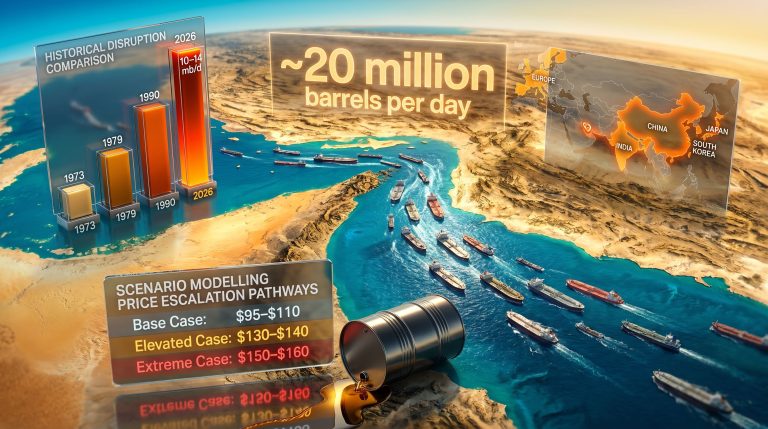
Most coverage of the Strait of Hormuz focuses exclusively on crude oil flows, and for good reason. Approximately 20% of global oil trade passes through this narrow waterway between Iran and Oman. However, the conflict's impact on commodity markets extends considerably further than petroleum.
Seaborne freight disruptions in the Persian Gulf corridor have cascading effects on dry bulk shipping, war-risk insurance premiums, and vessel routing decisions across a wide range of commodities. When shipping companies are forced to reroute vessels, add conflict-zone surcharges, or delay port calls across the Arabian Sea, the landed cost of every tonne of iron ore, alumina, or metallurgical coal arriving in Asian and European ports rises accordingly. Furthermore, iron ore trade disruptions of this kind compound existing supply-side pressures in ways that are not always immediately visible in headline price data.
For iron ore specifically, the disruption has manifested in two distinct ways:
- Direct cost pressure: Higher fuel prices and elevated freight rates have increased per-unit operating costs for miners shipping from Brazil and Australia.
- Indirect price support: Tighter effective supply reaching key markets has pushed spot and forward contract prices materially higher, more than offsetting the cost increases for major producers.
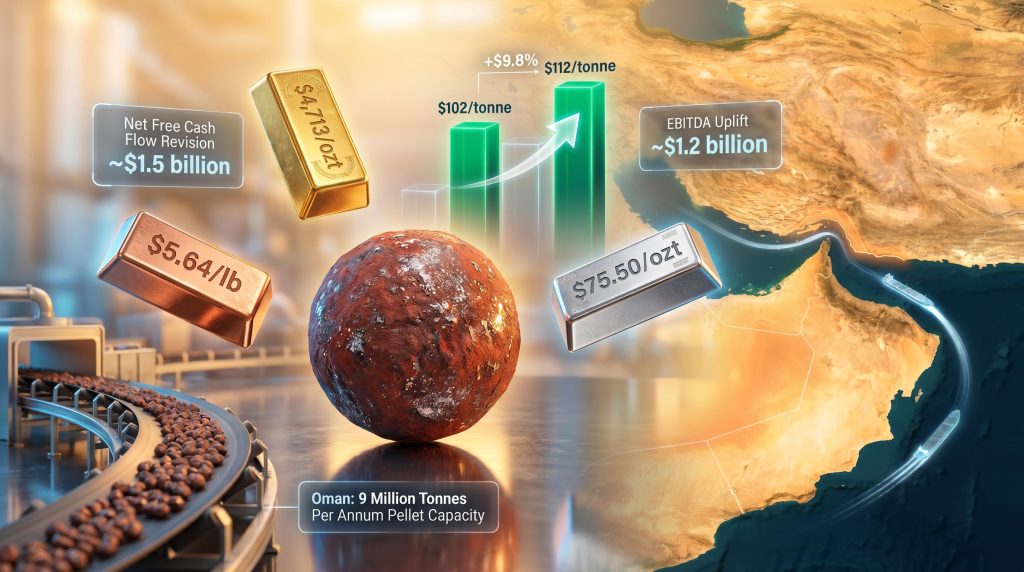
Vale, the Brazilian iron ore giant, has experienced both effects simultaneously. The company revised its 2026 average iron ore price assumption from $102 per tonne to $112 per tonne, a nearly $10 per tonne uplift that flows directly through to earnings at significant scale.
How a $10 Price Move Translates to Billions at Scale
For investors unfamiliar with iron ore economics, a $10 per tonne increase can sound modest. In practice, at Vale's production volumes, the financial leverage is substantial. The company produces roughly 320 to 340 million tonnes of iron ore annually, meaning even a partial-year price improvement of this magnitude generates hundreds of millions of dollars in additional EBITDA. According to analysis from Brazil Stock Guide, this kind of price-driven uplift has historically translated into outsized free cash flow generation for large-scale producers.
The full financial picture for Vale's 2026 upward revision breaks down as follows:
| Component | Financial Impact |
|---|---|
| EBITDA uplift from price and volume gains | ~$1.2 billion |
| Hedging and foreign exchange gains | ~$425 million |
| Higher sustaining capital expenditure (cost offset) | ~$(100) million |
| Net free cash flow revision | ~$1.5 billion |
Vale's Q1 2026 iron ore sales were reportedly the strongest first-quarter result the company had recorded in eight years, a data point that contextualises just how constructive the current operating environment has become despite the conflict-related headwinds.
Global Demand vs. Regional Disruption: An Important Distinction
One of the most analytically important concepts in understanding Vale metals demand during the Middle East war is the difference between regional demand disruption and global demand destruction. These are fundamentally different phenomena with very different implications for iron ore prices and producer earnings.
Regional disruption refers to localised curtailments in specific markets. The Iran conflict has caused genuine operational challenges for steelmakers in the Gulf Cooperation Council. Iran's own direct-reduced iron production has been curtailed by conflict-related infrastructure damage and logistics constraints. Bahrain's steel sector has experienced secondary disruptions as regional instability affects supply chains and energy inputs.
Global demand destruction, by contrast, would require a significant decline in steel consumption across the world's major producing economies. This has not occurred. The critical distinction lies in the technology these markets use. In addition, the iron ore demand outlook remains broadly constructive across the largest consuming economies despite regional volatility.
DRI vs. Blast Furnace Steelmaking: Why the Middle East's Disruption Has Limited Global Impact
This is a detail that rarely receives adequate attention in mainstream commodity coverage. Steelmakers in the Middle East predominantly use direct-reduced iron technology, which relies on natural gas to reduce iron ore into a metallic product without a traditional blast furnace. DRI-based steelmaking is structurally different from the blast furnace and basic oxygen furnace processes that dominate in China, Japan, South Korea, and Europe.
When conflict disrupts DRI production in the Gulf, the knock-on effect on global seaborne iron ore demand is structurally limited. These facilities typically consume iron ore pellets or high-grade lump ore, not the lower-grade fines that constitute the bulk of global seaborne trade. Pellets command a significant price premium precisely because of their suitability for DRI and blast furnace applications requiring low slag volume and high metallurgical efficiency.
This nuance explains why disruptions to Vale's Oman pellet complex matter disproportionately to the company's margin profile even if they have limited impact on total iron ore demand volumes globally.
The Oman Pellet Complex: Vale's Most Direct Conflict Exposure
Vale's Oman facility carries an annual production capacity of 9 million tonnes of iron ore pellets, representing approximately 29% of the company's total pellet output. This is not a peripheral asset. It sits at the core of Vale's strategy to serve Asian and Middle Eastern steel markets with higher-value processed products rather than raw fines.
The pellet premium is a critical concept here. Iron ore pellets trade at a meaningful premium to standard iron ore fines, typically ranging from $20 to $50 per tonne depending on quality specifications and market conditions. This premium reflects the energy and processing costs already embedded in the product, as well as the superior blast furnace and DRI efficiency pellets provide to steelmakers.
With the Oman complex offline and its restart pushed to Q3 2026 at the earliest, Vale faces a structural gap in its highest-margin product segment. The restart has been explicitly tied to conflict de-escalation and the normalisation of regional logistics, meaning the timeline remains entirely outside the company's operational control.
The extended shutdown of a facility representing nearly a third of total pellet capacity creates measurable margin pressure even in an environment where iron ore fines prices are rising. Pellet premiums and fines prices do not always move in lockstep, and the absence of premium product can compress blended realisation even as headline benchmark prices improve.
Vale's broader Middle East footprint, encompassing partnership arrangements and processing hubs across Saudi Arabia, the UAE, and Oman, reflects a long-term strategy of co-locating iron ore processing capacity near DRI-capable steelmakers. The conflict has paused execution of this strategy without fundamentally altering its commercial logic. Consequently, Vale's megahub expansion plans in the region remain a key component of its long-term positioning.
Commodity Price Signals Across the Metals Complex
The conflict's influence extends well beyond iron ore. Current market pricing across major metals reflects a complex interplay of geopolitical risk premiums, safe-haven flows, and genuine supply concerns.
| Commodity | Price | Movement |
|---|---|---|
| Copper | $5.64 / lb | +2.72% |
| Gold Futures | $4,713 / ozt | +3.84% |
| Silver Futures | $75.50 / ozt | +7.47% |
| Platinum | $1,973.85 / ozt | +4.22% |
| Palladium | $1,496.50 / ozt | +5.39% |
| Brent Crude | $104.40 / bbl | -4.21% |
The precious metals complex tells a particularly interesting story. Gold futures trading above $4,713 per ounce and silver futures approaching $75.50 per ounce reflect substantial safe-haven capital flows driven by geopolitical uncertainty. These moves are consistent with historical patterns during sustained regional conflicts involving major energy-producing nations.
Copper's move to $5.64 per pound is more structurally significant from an industrial demand perspective. Copper does not benefit from safe-haven flows to the same degree as gold. Its price appreciation during the conflict period reflects genuine supply tightness and continued confidence in long-term demand from electrification, grid infrastructure, and electric vehicle manufacturing. The energy transition thesis is proving structurally resilient to short-term geopolitical noise.
Capital Discipline Over Acquisition: Vale's Strategic Posture
Vale's CEO Gustavo Pimenta has been unambiguous about the company's strategic priorities during the conflict period. Rather than deploying the conflict-driven free cash flow windfall into acquisitions, Vale is directing capital toward optimising and extracting maximum value from its existing asset base.
This posture reflects sound financial logic. When commodity prices are elevated, acquisition targets become expensive in parallel. The risk-adjusted return on buying assets at peak-cycle valuations has historically been poor. Major mining companies that acquired aggressively during previous commodity price peaks, including during the so-called supercycle of the mid-2000s, subsequently faced significant write-downs as prices normalised.
In practice, Vale's asset-optimisation focus translates to several operational priorities:
- Improving throughput efficiency at existing Brazilian iron ore operations.
- Managing product mix to maximise pellet premium capture when Oman restarts.
- Controlling per-unit cost escalation from fuel and freight increases.
- Returning capital to shareholders through dividends and buybacks while cash generation remains elevated.
The disciplined approach also reflects an acknowledgment that the current price environment is partly conflict-driven and therefore potentially temporary. Locking in long-term capital commitments based on a $112 per tonne iron ore assumption carries meaningful risk if the conflict resolves and prices revert toward pre-conflict levels.
The next major ASX story will hit our subscribers first
How This Conflict Compares to Previous Commodity Shocks
Placing the current environment in historical context helps calibrate the likely duration and intensity of conflict-driven price effects.
| Event | Primary Commodity Impact | Disruption Duration | Demand Destruction? |
|---|---|---|---|
| Russia-Ukraine War (2022) | Energy, wheat, fertilizers | 12 to 18 months elevated | Partial, regional |
| Suez Canal Blockage (2021) | Freight rates, consumer goods | 6 weeks acute | Minimal |
| Gulf War I (1990 to 1991) | Oil | 6 to 9 months | Limited metals impact |
| Iran Conflict (2026) | Iron ore, freight, fuel | Ongoing | Regional, not global |
The 2026 Iran conflict most closely resembles a supply logistics shock rather than a demand destruction event. The critical escalation risk for iron ore markets is not further disruption to Gulf steelmakers, but rather any development that affects the ability of Chinese, Japanese, or South Korean steel mills to receive seaborne iron ore shipments. These three nations collectively consume the vast majority of globally traded iron ore, and their supply chains predominantly run through Indian Ocean and South China Sea routes rather than the Persian Gulf corridor.
What to Watch: Key Indicators for the Second Half of 2026
For investors and analysts tracking Vale metals demand and the broader Middle East war impact on commodity markets, several leading indicators merit close attention:
- Monthly Chinese crude steel production data: The single most reliable signal for seaborne iron ore demand. Any sustained decline would materially alter the demand-side equation. The ongoing challenges within China steel and iron ore markets remain a critical variable in this assessment.
- Port inventory levels at major Chinese steel mills: Rising inventories suggest restocking has overshot near-term demand, potentially signalling softness ahead.
- Capesize freight rates via the Baltic Dry Index: A real-time proxy for seaborne iron ore shipping demand and cost pressures.
- Vale's Oman restart announcement: The clearest operational signal that regional logistics have normalised sufficiently for production to resume.
- Iron ore price realisation vs. the $112 per tonne full-year assumption: Tracking whether spot conditions support or undermine the revised forecast. Analysts monitoring iron ore price pressures have noted the precarious balance between conflict-driven support and underlying surplus conditions.
- Hedging book disclosures: How Vale manages its price exposure as the conflict evolves will significantly affect actual cash flow outcomes relative to the revised guidance.
For investors, the central question is not whether current demand conditions are favourable, because the evidence strongly suggests they are. The more important variable is whether conflict-driven supply disruption can sustain the price premium long enough to justify the operational costs and strategic constraints it has also created, particularly the Oman shutdown.
The Longer-Term Structural Story
Beyond the immediate conflict dynamics, the 2026 episode is accelerating a broader reassessment of supply chain geography across the mining and metals industry. Major producers are increasingly evaluating their exposure to conflict-prone maritime corridors and considering whether the long-term cost of geographic diversification in processing and logistics is worth the risk mitigation it provides.
For Vale specifically, the Oman experience illustrates both the strategic appeal and the vulnerability of the Middle East mega-hub model. Proximity to growth markets and logistical efficiency are genuine competitive advantages in normal operating conditions. However, concentrated exposure in a region subject to geopolitical volatility creates a category of operational risk that no amount of hedging can fully offset.
The energy transition continues to provide a constructive long-term demand backdrop for iron ore, copper, nickel, and other industrial metals that Vale produces. Furthermore, decarbonisation of steel production itself, through hydrogen iron ore reduction processes, actually increases demand for the high-grade iron ore pellets that Vale specialises in producing. This structural tailwind operates on a multi-decade horizon that is largely independent of any single geopolitical cycle.
This article contains forward-looking analysis based on publicly available information and company disclosures. Commodity price forecasts, financial projections, and timeline estimates are inherently uncertain and subject to material revision. Nothing in this article constitutes financial or investment advice.
Want to Stay Ahead of the Next Major Commodity Discovery?
While geopolitical events like the Iran conflict reshape iron ore pricing and freight dynamics, the real opportunity for investors often lies in identifying significant mineral discoveries the moment they're announced — Discovery Alert's proprietary Discovery IQ model delivers real-time ASX alerts, turning complex commodity data into actionable insights for both short-term traders and long-term investors. Explore historic discoveries and their exceptional market returns to understand the potential, and begin your 14-day free trial today to position yourself ahead of the broader market.