June 8, 2026
The Strategic Framework Behind American Hemispheric Policy
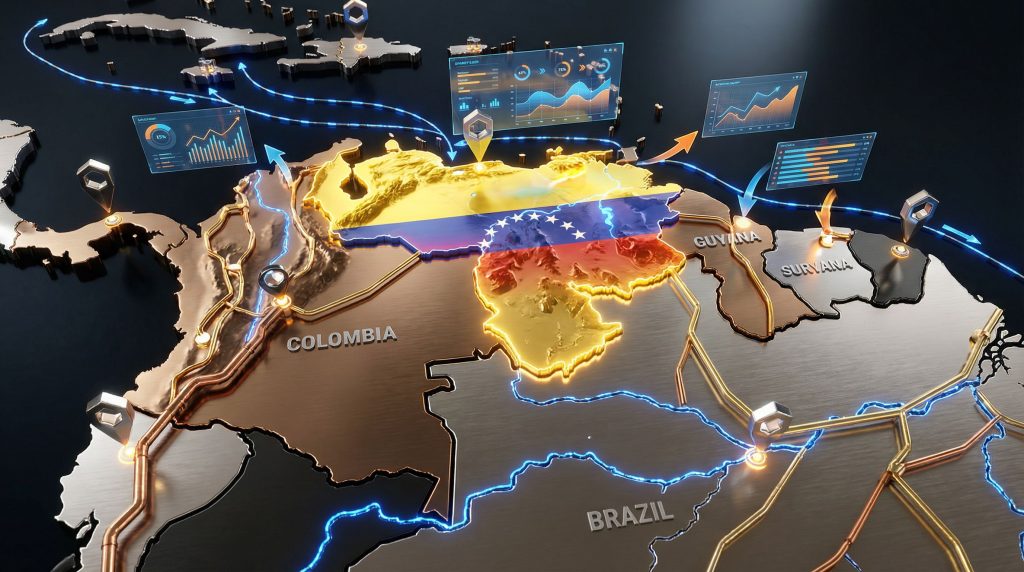
Regional energy security dynamics have fundamentally shifted across the Western Hemisphere, creating new paradigms for understanding territorial sovereignty and resource control. The evolution from traditional diplomatic channels to direct strategic positioning reflects broader changes in how major powers approach energy access and regional stability, particularly regarding U.S. intervention in Venezuela.
Contemporary hemispheric policy frameworks trace their origins to 1823 when President James Monroe established principles that continue to influence U.S. regional engagement today. Historical applications of this doctrine included interventions in Guatemala (1954), Cuba (1962), Dominican Republic (1965), Grenada (1983), and Panama (1989).
Venezuelan Energy Chokepoint Analysis
Venezuela controls approximately 297-300 billion barrels of proven crude oil reserves, representing roughly 17.5% of global proven reserves as of 2024. These deposits, primarily located in the Orinoco Belt, consist of extra-heavy crude with an API gravity of 8-11 degrees. The strategic significance extends beyond volume to encompass refining compatibility with U.S. Gulf Coast facilities.
Venezuelan crude historically supplied approximately 60% of U.S. heavy crude imports during peak periods before 2003. Current production levels have declined dramatically from a peak of 3.2 million barrels per day in 1998 to approximately 750,000-800,000 barrels per day in 2025, primarily due to infrastructure degradation.
Moreover, the oil price rally has created additional economic pressures affecting regional energy calculations. Furthermore, analysts warn about potential global recession outlook that could impact intervention timing decisions.
Comparative Historical Interventions:
| Operation | Year | Personnel | Duration | Primary Justification |
|---|---|---|---|---|
| Just Cause (Panama) | 1989 | 27,000 | 3 weeks combat | Canal security |
| Uphold Democracy (Haiti) | 1994 | 15,000 | 6 months initial | Humanitarian crisis |
| Hypothetical Venezuela | 2026 | Variable | TBD | Energy security |
Regional Alliance Architecture Vulnerabilities
The Organization of American States Charter contains inherent tensions between Article 21's non-intervention principles and Articles 27-42's collective security mechanisms. This legal framework creates ambiguity regarding humanitarian intervention doctrine versus sovereignty protection.
Chinese economic relationships through loan arrangements with Venezuelan state oil company PDVSA (Petróleos de Venezuela S.A.) represent competing influence networks. Additionally, the broader US-China trade war impact continues to influence regional energy partnerships.
Regional military capacity assessments reveal significant conventional imbalances. Venezuelan military modernisation from 2005-2015 included Russian S-300 air defence systems, Mil Mi-35 helicopters, and fast attack craft, though regional conventional military capability remains heavily favoured toward U.S. military capacity.
When big ASX news breaks, our subscribers know first
What Economic Forces Drive Contemporary Intervention Strategy?
Modern energy independence calculations fundamentally alter traditional intervention cost-benefit analyses. U.S. crude oil production maintains levels of approximately 13.0-13.5 million barrels per day while consumption averages 9.5-10.0 million barrels per day, creating occasional net exporter status.
Strategic Petroleum Reserve Considerations
Current SPR inventory stands at approximately 380-390 million barrels with total cavern capacity of 713.5 million barrels at four Gulf Coast storage locations. Federal policy objectives target maintaining SPR at 500+ million barrels for 90-day supply security.
Replenishment costs at current crude prices of approximately $60 per barrel would require $3 billion for 50 million barrels of additional inventory. However, oil price movements continue to affect these calculations significantly.
Venezuelan Crude Quality Specifications:
- Orinoco Belt crude contains high sulfur content (2-4%)
- Requires specialised hydrotreating capacity
- Carbon intensity significantly higher than conventional crude
- Processing margins dependent on price differentials
Refining Capacity Optimisation Framework
Approximately 40-45% of U.S. Gulf Coast refinery capacity was designed specifically for heavy crude processing. Louisiana's refining complex maintains over 3.5 million barrels per day capacity, representing the largest global concentration of heavy crude processing facilities.
Venezuelan extra-heavy crude requires heated pipeline infrastructure or emulsification with 25-30% light crude dilution ratios for pipeline flow. Current Venezuelan port infrastructure degradation necessitates an estimated $2-5 billion minimum rehabilitation investment.
Historical Context: 1973 Arab Oil Embargo Impact
The six-month OPEC embargo (October 1973-March 1974) demonstrated supply disruption consequences:
- Oil prices increased from $3 to $12 per barrel (300% increase)
- U.S. petrol prices doubled
- Unemployment and inflation increased significantly
- Strategic Petroleum Reserve establishment (1975) as direct response
Environmental and Carbon Intensity Considerations
Venezuelan extra-heavy crude production generates 100-150 kg CO2 per barrel compared to Guyana conventional crude at 30-50 kg CO2 per barrel. These differentials influence corporate sustainability commitments and federal energy policy alignment considerations.
Alternative crude sources currently supplying U.S. refineries include domestic shale production from Bakken, Eagle Ford, and Permian basins, Canadian oil sands, OPEC+ suppliers (Saudi Arabia, Iraq, UAE), and non-OPEC suppliers (Brazil, Guyana, Colombia).
How Do Regional Actors Respond to Shifting Power Structures?
Brazil's strategic positioning involves complex calculations regarding BRICS membership obligations versus hemispheric energy cooperation opportunities. Brazil joined BRICS in 2009, whilst Venezuela's membership application remains pending as of January 2026.
Current Brazil-Venezuela bilateral trade remains minimal at less than $500 million annually, compared to historical peak levels of approximately $4 billion annually in 2008. Furthermore, US economy tariffs continue to affect regional trade dynamics.
Petrobras Operations and Outstanding Interests
Petrobras ended upstream operations in Venezuela in 2018, maintaining approximately $1.8-2.0 billion in outstanding receivables from historical operations. Current relationships remain limited to residual interests and debt discussions, creating potential post-intervention opportunities for renewed engagement.
Venezuelan Migration Crisis Management
International organisations document 6.5 million registered Venezuelan migrants and refugees by end of 2023, with 1.5-1.7 million active refugee caseloads as of 2024. Primary destinations include Colombia (2.4+ million), Peru (1.3+ million), Chile, and Ecuador.
Colombia hosts the world's largest refugee population relative to national GDP, representing approximately 2.5% of Colombia's population. Colombian government expenditure on Venezuelan migrant integration costs an estimated $1.5-2.0 billion annually.
However, economic contributions from Venezuelan migrants generate $2-4 billion annually in remittances and informal economy participation.
Regional Economic Integration Scenarios:
| Country | Current Relationship | Post-Intervention Opportunity | Risk Factors |
|---|---|---|---|
| Brazil | Limited trade, BRICS member | Petrobras joint ventures | Chinese commitments |
| Colombia | Border management costs | Reconstruction contracts | Migration pressures |
| Mexico | USMCA obligations | Energy sector integration | Non-intervention principles |
Mexico's Diplomatic Balancing Framework
Historical precedent from Mexico's response to the 1989 Panama invasion demonstrates consistent non-intervention principles. However, USMCA obligations create energy sector integration opportunities through North American framework coordination.
Mexico's potential diplomatic mediation role in regional stability mechanisms reflects traditional regional leadership aspirations. Cross-border drug trafficking networks and enhanced U.S.-Colombia military cooperation create additional security coordination requirements.
What Are the Long-Term Strategic Implications for Hemispheric Governance?
Institutional framework evolution challenges traditional Organization of American States effectiveness in crisis management. The rise of CELAC (Community of Latin American and Caribbean States, established 2011) as a counterweight to U.S.-dominated regional organisations creates alternative diplomatic channels.
Economic Integration Development Possibilities
Trans-Caribbean pipeline infrastructure development could optimise regional energy distribution networks. LNG export terminal coordination between U.S. Gulf Coast facilities and rehabilitated Venezuelan infrastructure presents strategic integration opportunities.
Regional refining capacity optimisation strategies involve coordinating heavy crude processing across multiple facilities to maximise operational efficiency and product distribution networks throughout the hemisphere.
Strategic Risk Assessment: China's Belt and Road investments exceeding $60 billion in Latin America create competing influence networks that complicate unilateral intervention strategies and require multilateral coordination approaches.
Infrastructure Development Investment Requirements
Venezuelan oil sector rehabilitation necessitates an estimated $200+ billion investment for full capacity restoration. Port facility modernisation for increased crude export capacity requires substantial capital commitments.
Moreover, telecommunications and digital infrastructure reconstruction adds additional complexity to post-intervention planning. According to the Council on Foreign Relations, Venezuelan instability poses ongoing regional security challenges.
International Energy Company Re-Entry Strategies:
- ExxonMobil: Historical claims versus new concession opportunities
- Chevron: Existing Venezuelan operations and expansion potential
- European companies: Post-sanctions re-entry strategic planning
Risk-adjusted return calculations must account for infrastructure rehabilitation timelines typically estimated at 5-10 years for full capacity restoration, creating uncertainty about supply reliability and investment recovery periods.
Alternative Scenarios and Diplomatic Frameworks
Negotiated transition models from other authoritarian transitions provide instructive frameworks. The Chilean transition (1988-1990) utilised constitutional referendum pathways, whilst South Africa's model (1990-1994) employed truth and reconciliation mechanisms.
Eastern European Velvet Revolution examples offer additional templates for Latin American applications. The NPR analysis suggests historical intervention patterns continue to influence contemporary U.S. intervention in Venezuela strategies.
Economic Pressure Alternative Analysis
Graduated sanctions effectiveness compared to engagement strategies reveals mixed historical results. Targeted financial sanctions demonstrated limited success in achieving regime change objectives.
However, humanitarian corridor establishment without comprehensive regime change showed greater success in addressing humanitarian crises. Regional diplomatic isolation versus continental integration approaches present fundamentally different strategic pathways.
Domestic Political Sustainability Factors
Congressional authorisation dynamics under War Powers Resolution compliance requirements create constitutional constraints on extended operations. Historical patterns show bipartisan support for Latin American interventions typically develops during second presidential terms.
Nevertheless, public opinion polling reveals mixed support for military engagement versus energy security priorities.
Electoral Cycle Implications
The 2028 presidential campaign timeline creates political pressure for demonstrable results within specific timeframes. Opposition party positioning on hemispheric policy and Latino voter demographic responses to Venezuelan intervention add electoral calculations to strategic planning requirements.
Historical analysis suggests 18-24 month optimal withdrawal timelines to prevent insurgency development whilst establishing stable transitional governance structures. This timeline aligns with electoral cycle considerations and resource allocation planning.
The next major ASX story will hit our subscribers first
Regional Security Architecture Evolution
Military base network expansion possibilities include Colombian facilities enhancement for Venezuelan operations support, Caribbean island nation cooperation agreements, and Panama Canal security coordination protocols.
Intelligence Framework Development
Five Eyes expansion to include regional partners creates enhanced intelligence sharing capabilities. Counter-narcotics cooperation enhancement mechanisms and migration monitoring systems provide additional security architecture components.
How does Venezuelan intervention differ from previous Latin American operations?
Unlike Cold War-era interventions focused on ideological containment, contemporary operations prioritise energy security and migration crisis management within existing hemispheric trade frameworks.
What role do international law considerations play in intervention justification?
The Responsibility to Protect (R2P) doctrine provides humanitarian crisis response justification whilst facing potential International Court of Justice challenges similar to Nicaragua v. United States (1986).
How sustainable is direct military presence in Venezuelan territory?
Historical analysis suggests 18-24 month optimal withdrawal timelines to avoid insurgency development whilst establishing stable transitional governance structures.
Venezuelan intervention represents a fundamental shift from economic pressure tactics to direct military engagement in securing hemispheric energy interests. Success depends on rapid institutional reconstruction, regional partner cooperation, and managed withdrawal timelines that prevent long-term occupation dynamics.
Consequently, the operation's broader implications extend beyond Venezuela to reshape Latin American sovereignty expectations and regional integration possibilities under enhanced security architecture. Strategic petroleum reserve replenishment using Venezuelan crude provides immediate economic benefits whilst long-term success requires sustained political commitment.
Furthermore, U.S. intervention in Venezuela establishes precedent for energy-focused military operations that differ significantly from traditional ideological interventions. Therefore, multilateral coordination becomes essential for achieving sustainable outcomes that address both energy security and regional stability objectives.
Disclaimer: This analysis presents hypothetical scenarios for strategic planning purposes and should not be interpreted as advocating for any specific policy position. Actual policy decisions involve complex considerations beyond those addressed in this framework.
Interested in Finding the Next Strategic Energy Investment?
Discovery Alert's proprietary Discovery IQ model delivers real-time alerts on significant energy and commodity discoveries across the ASX, empowering investors to identify actionable opportunities ahead of broader market movements. Begin your 30-day free trial today to secure your market-leading advantage and stay ahead of the strategic shifts reshaping global energy markets.