June 12, 2026
The Race to Anchor Western Hemisphere Minerals Inside US Corporate Structures
The geography of global mineral supply chains has been quietly redrawing itself for years. Long before specific companies announced new corporate vehicles or spin-out transactions, the structural logic was already in place: critical minerals flowing through geopolitically adversarial processing networks represent a strategic liability that Western economies have only recently begun to confront with urgency. The question facing capital markets in 2026 is no longer whether the US will act to redirect mineral supply chains, but which corporate structures and asset portfolios will be positioned to benefit when that redirection accelerates.
It is within this broader context that Gold Reserve launches American Heralds in the US, establishing a new mining entity specifically designed to capture Western Hemisphere mineral assets inside a domestically anchored, US-listed framework. The move is not simply a corporate restructuring exercise. It reflects a calculated response to one of the more consequential shifts in resource geopolitics of the past decade.
When big ASX news breaks, our subscribers know first
What American Heralds Mining Corporation Actually Represents
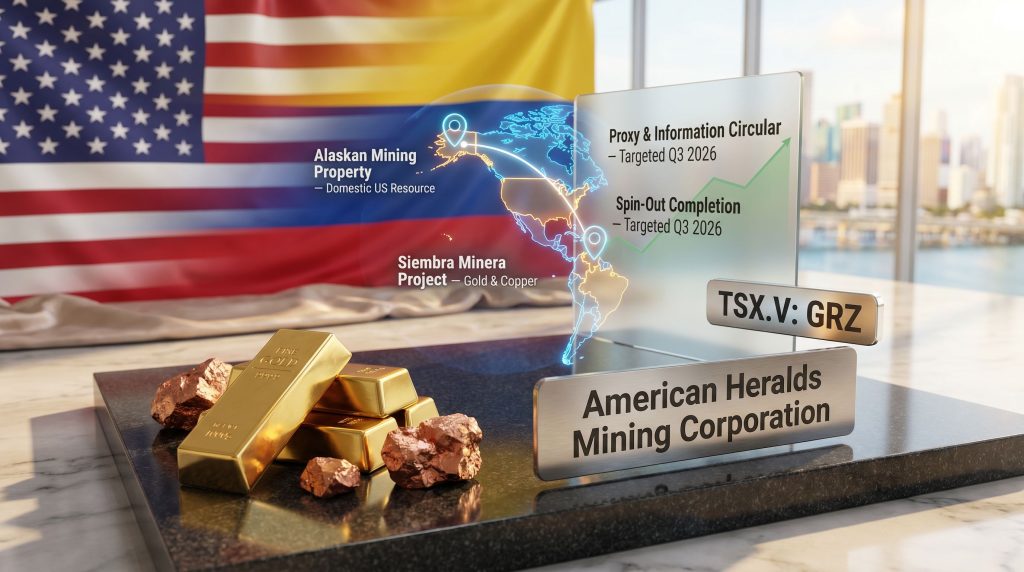
American Heralds Mining Corporation is a newly incorporated US-domiciled mining company created through a proposed spin-out of assets from Gold Reserve Ltd. (TSX.V: GRZ), a majority US-owned company currently listed on the TSX Venture Exchange. The new entity is designed to hold and develop mining interests across the Western Hemisphere, with two primary asset categories forming its initial portfolio: Venezuelan mining interests including the Siembra Minera project, and an Alaskan mining property situated within the continental United States.
The company will be headquartered in Miami, Florida, and is intended to pursue a US initial public offering following the completion of the spin-out process. Under the proposed distribution mechanism, existing Gold Reserve shareholders are expected to receive shares in American Heralds directly, subject to the requisite board, advisor, and shareholder approvals being obtained.
The corporate mandate for American Heralds centres on advancing mineral resource development that directly supports US national security and supply chain resilience, positioning it as a vehicle explicitly aligned with current US industrial and resource governance priorities.
Understanding the Asset Portfolio at the Core of the Spin-Out
The two assets transferring into American Heralds carry meaningfully different strategic profiles, and understanding the distinction between them matters for investors assessing the combined platform.
| Asset | Location | Primary Commodities | Strategic Dimension |
|---|---|---|---|
| Siembra Minera Project | Venezuela | Gold, Copper | Large-scale frontier development; prior development history |
| Alaskan Mining Property | United States (Alaska) | Not yet publicly specified | Domestic US production potential |
The Siembra Minera project represents the larger and more complex of the two, carrying prior development history within a jurisdiction that has, until recently, been effectively off-limits to US-aligned operators. The Alaskan property provides a domestic counterweight, grounding the portfolio in a stable, established regulatory environment and reinforcing the national security framing of the broader platform.
This dual-asset structure is not accidental. It mirrors a pattern increasingly visible across the critical minerals sector, where companies are combining frontier-access plays with domestic production assets to present a more complete supply chain narrative to institutional investors and capital markets audiences.
The Spin-Out Mechanics and What Shareholders Need to Know
The proposed spin-out is currently under evaluation by Gold Reserve's advisors and board of directors. It is important to emphasise that shareholder approval has not yet been obtained, and the transaction has not been formally approved. The timeline as communicated by the company targets the third quarter of 2026 for the distribution of the proxy and information circular, with spin-out completion also targeted within the same period.
The milestone sequence investors should monitor includes:
- Board and advisor review of the proposed spin-out structure (currently underway as of May 2026)
- Regulatory and legal preparation of proxy and information circular materials
- Shareholder vote on the spin-out and associated name change
- Formal completion of the spin-out and asset transfer to American Heralds
- Gold Reserve's transition to Hamilton American Holdings as an investment holding company
- Pursuit of a US IPO and formal stock exchange listing for American Heralds
Each of these milestones carries its own execution risk, and investors should treat the Q3 2026 target as directional rather than confirmed. The absence of shareholder approval at this stage means the transaction remains conditional, and material changes to the proposed structure remain possible.
Why Miami Makes Operational Sense as a Headquarters Location
The choice of Miami as American Heralds' operational base reflects several converging practical considerations that extend beyond simple geographic convenience.
Miami has, over the past two decades, evolved into one of the most significant Latin American business hubs in the United States. The city's professional services ecosystem, encompassing legal, financial, advisory, and compliance infrastructure, has been substantially shaped by the volume of hemispheric corporate activity flowing through it. For a company managing Venezuela-linked operations within a US regulatory framework, reducing institutional friction is a genuine operational priority.
The proximity to Venezuelan management teams is a direct operational benefit. Managing a complex mining development across a geopolitically sensitive jurisdiction requires close coordination between Miami-based corporate leadership and in-country technical and operational teams. Physical proximity, shared time zones, and established commercial connections all contribute to reduced management overhead.
Beyond the operational logic, Miami's positioning relative to federal regulatory infrastructure governing foreign investment and critical minerals oversight provides direct access to the compliance environment that a US-listed mining company operating in Venezuela will need to navigate carefully. This includes considerations around US Treasury oversight frameworks for foreign investment activities, which remain consequential regardless of the current diplomatic environment.
The Venezuela Question: Geopolitical Shift or Temporary Opening?
Perhaps the most significant variable in the American Heralds investment thesis is the sustainability of the current US-Venezuela diplomatic environment. Gold Reserve's Vice Chair Paul Rivett characterised the company's ability to re-enter Venezuela as a direct product of improved bilateral relations between the Trump administration and Venezuelan leadership, describing current conditions as favourable for US-aligned mining operators.
This framing deserves careful analysis. Venezuela holds some of the Western Hemisphere's most significant concentrations of underdeveloped mineral wealth, encompassing gold, copper, and a range of other materials with strategic relevance to US manufacturing and defence supply chains. The combination of geological endowment and prior inaccessibility has meant that these resources have sat largely untouched by Western capital for an extended period.
Prior US sanctions regimes created a structural barrier that effectively prevented US-aligned companies from participating in Venezuelan resource development. The suggestion that this barrier is now sufficiently relaxed to permit the kind of large-scale mining platform that American Heralds envisions represents a significant geopolitical claim — one that investors should examine with independent due diligence rather than accepting at face value. Furthermore, the broader shifts in mining geopolitics underscore just how rapidly these environments can evolve.
The geopolitical variable in Venezuelan resource access is arguably the single most consequential uncertainty in the American Heralds investment thesis. Diplomatic environments can shift rapidly, and any investor assessing this platform must treat the current opening as a scenario rather than a structural certainty.
Several considerations are relevant here:
- Diplomatic relationships can deteriorate as quickly as they improve, particularly in jurisdictions with complex internal political dynamics
- Sanctions relief, even when extended informally through policy posture rather than formal revocation, can be reversed or reinterpreted
- Operational complexity in frontier jurisdictions typically introduces timeline extensions and cost escalations that affect project economics
- The regulatory framework governing US companies operating in Venezuela remains more complex than standard international mining jurisdictions
None of these considerations necessarily invalidates the American Heralds thesis. They do suggest that investors should price the Venezuelan component of the portfolio with appropriate risk weighting, rather than treating diplomatic optimism as equivalent to operational certainty.
How This Fits Into the Broader US Critical Minerals Strategy
The United States has, over successive administrations, identified critical mineral supply chain security as a top-tier economic and national security priority. The core concern is well-documented: China currently dominates processing capacity across a wide range of strategically important minerals, creating structural vulnerability for US manufacturers across defence, technology, and clean energy sectors.
The critical minerals demand surge has intensified the policy response, which has included a strategic emphasis on what practitioners call "friendshoring" — the deliberate redirection of mineral procurement toward geopolitically aligned nations and operators. The practical challenge with friendshoring is that suitable deposits in reliably allied jurisdictions are not always available in the required volumes, grades, or commodity types.
This is where the Western Hemisphere's frontier potential becomes strategically interesting. South America, in particular, hosts extensive mineral endowment across gold, copper, lithium, and other materials that US supply chain planners regard as critical. The structural challenge has been geopolitical accessibility rather than geological availability.
American Heralds, as a corporate concept, reflects an attempt to bridge that gap through a US-domiciled, US-listed vehicle that positions frontier hemisphere assets inside a regulatory framework compatible with US capital markets and national security requirements. The critical minerals executive order and the associated US mineral production order have, furthermore, created a policy backdrop that actively incentivises exactly this kind of corporate structuring.
| Strategic Lever | What It Means | American Heralds Relevance |
|---|---|---|
| Friendshoring | Sourcing from politically aligned jurisdictions | Venezuela under current diplomatic alignment; subject to ongoing assessment |
| Domestic production | Expanding extraction on US soil | Alaskan property provides domestic dimension |
| US-listed corporate vehicles | Capital markets access for resource development | Planned US IPO central to the platform strategy |
| National security framing | Positioning minerals as defence-critical assets | Explicit in American Heralds' stated corporate mandate |
The distinction worth drawing clearly is between the existence of a supportive policy environment at a macro level and any specific confirmed support for individual projects. American Heralds is positioning itself to benefit from favourable policy conditions, but investors should not interpret this as confirmation that the project has received formal designations, funding, accelerated permitting, or other specific government commitments. The Defense Production Act mechanisms, for instance, remain an important tool in this landscape but do not automatically confer project-level benefits.
The next major ASX story will hit our subscribers first
Gold Reserve's Transformation Into Hamilton American Holdings
Once the spin-out is completed, Gold Reserve intends to rename itself Hamilton American Holdings and transition into an investment holding company. This restructuring is designed to create a clean separation between two distinct corporate functions that have until now existed within a single entity.
The first function — active mining development and operations — transfers entirely to American Heralds. The second function, the recovery of Gold Reserve's Arbitral Award through legal proceedings currently active in both Delaware and Portugal, remains with the renamed holding company.
This structural separation has genuine logic. Arbitral award recovery is a fundamentally different business activity from mineral exploration and development. Maintaining both within a single listed entity creates investor confusion, complicates capital allocation analysis, and potentially depresses valuation for both activities by forcing markets to apply a conglomerate discount.
Hamilton American Holdings, as a focused investment holding entity with a minority stake in American Heralds and an active arbitration recovery process, presents a cleaner analytical profile. For existing Gold Reserve shareholders, the spin-out effectively provides exposure to both the upside of the American Heralds platform and the optionality embedded in the Arbitral Award proceedings, without those two value streams being conflated in a single share price.
It bears emphasising that the renaming is subject to advisor, board, and shareholder approval, meaning neither the Hamilton American Holdings identity nor the spin-out structure is yet confirmed.
What the American Heralds IPO Path Looks Like
The planned US IPO for American Heralds is framed as the logical endpoint of the spin-out process, providing the new entity with direct access to US capital markets and the institutional investor base that follows critical minerals and supply chain resilience themes.
A US-listed mining vehicle carrying both a domestic Alaskan asset and a frontier Venezuelan development, anchored by a national security narrative and an experienced operational team, represents a relatively distinctive offering in the current capital markets environment. The combination of domestic production optionality and frontier scale exposure is designed to attract both conservative infrastructure-oriented capital and higher-risk-appetite growth investors.
The IPO is not yet confirmed and remains contingent on successful completion of the spin-out and all associated approvals. Investors should treat the IPO timeline as aspirational at this stage, with Q3 2026 representing the earliest plausible starting point for the process rather than a confirmed listing date.
Key Investor Considerations and Risk Factors
For Gold Reserve shareholders and prospective American Heralds investors, the following factors represent the most material variables in the investment thesis:
- Shareholder approval risk: The entire spin-out structure requires shareholder approval that has not yet been obtained. The transaction could be modified or rejected.
- Venezuelan geopolitical exposure: The sustainability of the current US-Venezuela diplomatic environment is the single largest uncertainty in the platform. Investors should monitor bilateral relations closely.
- Regulatory complexity: Operating in Venezuela within a US regulatory framework introduces compliance considerations that are more demanding than standard international mining operations.
- IPO market conditions: The success of the planned American Heralds US IPO will depend on capital market conditions prevailing at the time of listing, which cannot be predicted with confidence from the current vantage point.
- Asset-level detail: Public disclosure on specific resource estimates, grades, infrastructure status, and development timelines for both Siembra Minera and the Alaskan property remains limited. Investors should seek additional technical disclosure before forming detailed valuation views.
- Timeline execution: Q3 2026 targets are directional. Complex cross-border corporate restructurings of this nature frequently encounter delays in regulatory review, legal documentation, or shareholder process management.
This article is intended for informational purposes only and does not constitute financial or investment advice. The spin-out of American Heralds Mining Corporation and the renaming of Gold Reserve to Hamilton American Holdings are subject to regulatory, board, and shareholder approvals that have not yet been obtained. Forward-looking statements involve inherent uncertainty, and investors should conduct independent due diligence before making investment decisions.
Want to Stay Ahead of Significant ASX Mineral Discoveries in Real Time?
Discovery Alert's proprietary Discovery IQ model instantly translates complex ASX mineral announcements across more than 30 commodities into clear, actionable insights — giving subscribers a market-leading edge the moment a major discovery is confirmed. Explore historic examples of exceptional discovery returns and begin your 14-day free trial today to position yourself ahead of the broader market.