
June 12, 2026
The Geography of Capital: Understanding Why Coal Still Commands Billions
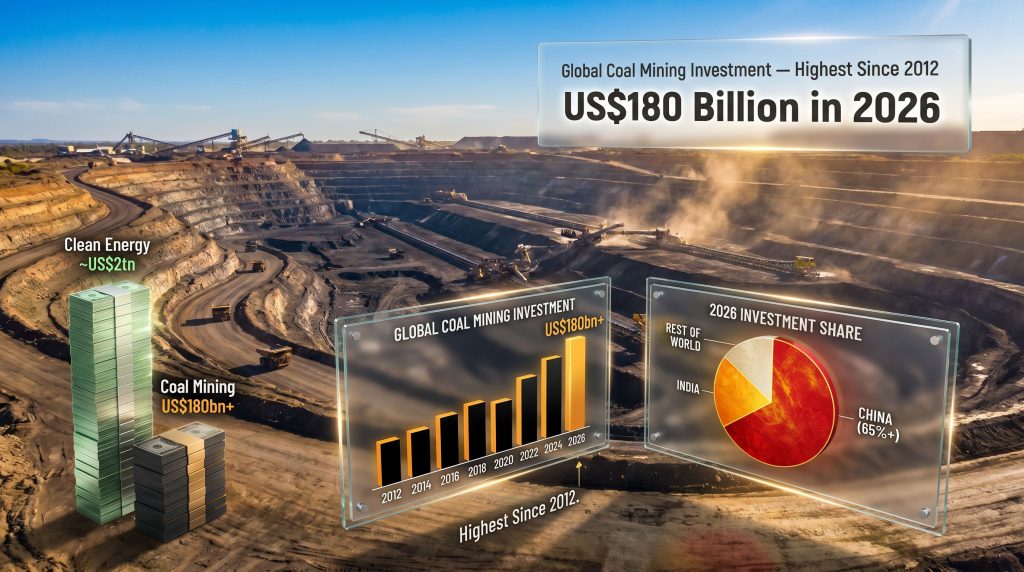
Few dynamics in modern energy economics generate as much analytical confusion as the persistence of large-scale fossil fuel investment during a period of accelerating clean energy deployment. The conventional narrative positions coal as a sunset industry bleeding capital, with investors rushing toward solar, wind, and battery storage. Yet the International Energy Agency's World Energy Investment report tells a more complicated story for 2026: global coal mining investment peak projections suggest annual totals will exceed US$180 billion, the highest recorded since 2012.
Before dismissing this as evidence of a coal renaissance, or accepting it uncritically as proof that decarbonisation is failing, the more productive analytical approach is to ask where this capital is going, why it is being deployed there, and what proportion of it is genuinely expanding the industry's extraction footprint versus simply sustaining operations that already exist.
The answers reveal an industry undergoing profound geographical concentration rather than uniform resurgence.
When big ASX news breaks, our subscribers know first
Decoding the US$180 Billion: What the IEA Data Actually Reveals
The headline figure demands immediate decomposition. A US$180 billion global total sounds expansive until the regional breakdown is applied.
| Region / Market | 2026 Investment Estimate | Key Activity |
|---|---|---|
| China (steam coal) | US$100bn+ | Greenfield expansion, commercial auctions |
| India (rail/port infrastructure) | US$7bn (up from US$5bn) | Transport infrastructure for extraction |
| Russia (coal supply chain) | ~US$6bn | Railway and seaport capacity for Asian exports |
| Australia (coking coal) | ~US$4.5bn | Two new processing plants + smaller projects |
| North America pipeline | 15 projects / 34Mt capacity | Regulatory streamlining, modest investment |
| Total global coal mining | US$180bn+ | Highest since 2012, +4% from 2025 |
| Total fossil fuel investment | ~US$1.2tn | Alongside ~US$2tn in clean energy |
China accounts for more than 65% of all global coal mining investment in 2026. Steam coal spending within China alone exceeds US$100 billion for the year, a figure that has doubled from levels recorded a decade earlier. When a single country commands such a disproportionate share of a global aggregate, the aggregate itself becomes a potentially misleading headline.
The IEA data makes clear that outside China and India, investment in both steam and coking coal mining has declined for the second consecutive year. This is not a globally resurging industry. It is a geographically concentrated capital story that aggregates into a large number. Furthermore, coal supply challenges in various regions are compounding this uneven distribution of capital across markets.
The 2026 global coal mining investment peak is better understood as China's domestic energy policy translated into capital expenditure, aggregated with India's infrastructure buildout, than as evidence of broad-based sector recovery.
The 4% Growth Rate in Context
The year-on-year increase from 2025 is approximately 4%. This modest growth rate, when viewed against a backdrop of sustained Chinese investment expansion over the past decade, suggests the current investment cycle reflects accumulated momentum rather than a sudden acceleration. China Coal Energy, the country's largest listed coal producer, has been scaling extraction consistently as domestic electricity demand continues to grow, with new capacity added through both commercial auctions and greenfield developments.
The growth trajectory within China's domestic coal sector has been sustained for roughly ten years, meaning the 2026 figure represents a continuation of an established trend rather than a new departure.
Is This a Global Coal Mining Investment Peak, or a China Story?
This is the central analytical question that the IEA data raises. And the honest answer is: it is primarily a China story, with India as an important secondary contributor.
China's Capital Dominance
China's outsized role reshapes the entire narrative around the global coal mining investment peak. Consider what the data implies:
- Steam coal production spending exceeding US$100 billion in a single calendar year within one country's borders
- A sustained ten-year domestic investment growth trajectory that has doubled the annual spending rate from its decade-earlier baseline
- New extraction capacity added through commercial auction frameworks and greenfield project approvals
- China Coal Energy among the operators scaling extraction to match domestic energy demand requirements
China steel demand also plays a significant role in sustaining the case for continued coal investment, as coking coal remains integral to steelmaking at scale. China's electricity consumption growth remains structurally tied to coal baseload generation in the near term. Coal-fired capacity provides the dispatchable power that renewable intermittency cannot yet fully replace at the scale and reliability Chinese grid operators require. This energy security logic, rather than any preference for coal over alternatives, drives the capital commitment.
India's Infrastructure-First Investment Model
India's contribution to the global coal mining investment peak follows a different pattern. Where China is directly expanding extraction capacity, India's most significant measurable investment increase is in transport infrastructure.
Rail spending to move coal from inland extraction sites to coastal ports has increased from US$5 billion to US$7 billion, a 40% rise that carries important signalling value. Infrastructure-first investment patterns in mining contexts typically represent multi-year operational planning commitments. Rail and port capacity is not built speculatively; it is built to serve projected production volumes.
India coal market reforms have additionally opened previously restricted extraction zones to competitive private participation, accelerating project timelines and drawing fresh capital into segments once dominated by state enterprises. Coal India, the world's largest coal mining company by production volume, alongside several new operators who have won commercial mine auctions in recent years, is adding tens of millions of tonnes of new extraction capacity annually.
India is also expanding coal gasification capabilities, developing facilities to convert coal into chemical feedstock products. This downstream diversification signals an intent to maintain coal's industrial role even as combustion-based applications face greater scrutiny. The infrastructure investment trajectory suggests Indian mining operators are planning for sustained or increased production volumes across a multi-year horizon.
The Rest of the World: Contraction, Not Expansion
Outside the two dominant Asian economies, the picture is one of steady investment decline. Steam and coking coal investment has fallen for two consecutive years across most of the world's other major coal regions. Without China's contribution, the global aggregate would tell a story of contraction, not record-breaking investment.
This divergence has profound implications for how policymakers, investors, and industry analysts interpret the global coal mining investment peak narrative.
Regional Investment Breakdown: Where Capital Is Flowing and Why
Russia: Pivoting Infrastructure Toward Asian Markets
Russia is directing approximately US$6 billion toward coal supply chain operations in 2026. This investment is heavily weighted toward railway expansion and seaport capacity development targeted at East Asian export corridors. The strategic rationale reflects the geopolitical realignment that accelerated after 2022, as European coal import demand collapsed and Asian buyers became Russia's primary market.
Russia's coal investment is therefore less a function of domestic demand growth and more a function of export infrastructure repositioning. The coal itself is already in the ground; the investment challenge is moving it efficiently to buyers.
Australia: Coking Coal as the Premium Allocation
Australia's approximately US$4.5 billion in coal investment is concentrated in metallurgical coal operations. Two new processing facilities have been announced alongside a pipeline of smaller projects. This allocation reflects coking coal's differentiated market position: steelmaking requires high-quality metallurgical coal for which there are no current large-scale commercial substitutes, providing relative demand insulation from the thermal coal headwinds affecting steam coal markets.
Coking coal commands significant price premiums over thermal grades, and Australia holds some of the world's highest-quality metallurgical coal deposits. According to the Minerals Council of Australia, coal remains one of Australia's most significant export commodities, underpinning the continued investment rationale for premium metallurgical grades. The investment case here is commodity-specific rather than a general coal market bet.
North America: Pipeline Growth Without Volume Leadership
The United States and Canada have experienced regulatory streamlining for coal mining approvals, contributing to a regional project pipeline that has grown to 15 active developments representing a combined 34 million tonnes of annual capacity. However, the absolute investment volumes remain modest relative to Asian counterparts, and the regulatory easing reflects domestic policy orientation rather than any external designation or support.
Asia-Pacific Excluding China and India: Refurbishment Over New Build
Import-dependent Asian markets outside the two major producers are primarily upgrading processing equipment and extending mine operational lifespans rather than building new capacity. This refurbishment cycle indicates demand continuity without implying material capacity growth commitments. Operators are keeping existing infrastructure functional while avoiding the capital exposure of greenfield developments in an uncertain long-term demand environment.
Four Drivers Behind the Investment Surge
1. Asian Energy Security as a Sovereign Priority
China and India both possess substantial domestic coal reserves that provide energy security advantages unavailable from imported oil and gas. Coal extracted domestically eliminates supply chain exposure to geopolitical disruptions, shipping route vulnerabilities, and commodity price volatility driven by offshore markets.
For both governments, investment in domestic coal mining infrastructure represents an energy sovereignty calculation as much as a purely economic one. This sovereign dimension helps explain why investment continues even as clean energy costs fall, because energy security policy often prioritises supply reliability over marginal cost optimisation.
2. Middle East Instability as a Demand Accelerant
The IEA specifically identifies Middle East supply disruptions affecting oil and gas flows to Asian markets as a factor prompting greater coal reliance. When hydrocarbon supply chains face instability, coal's position as a regionally accessible, domestically mineable alternative gains strategic attractiveness.
This dynamic creates a feedback loop: supply disruptions in one energy category accelerate investment in a competing category. Asian energy buyers increasing coal infrastructure investment partly reflects a portfolio diversification response to oil and gas supply risk.
3. Transport Infrastructure as a Leading Indicator
Rail and port investment commitments carry particular analytical weight because they reflect multi-year operational planning horizons. No mining operator invests in railway capacity without confidence in the coal volumes that capacity will need to transport.
India's 40% increase in coal transport spending therefore functions as an implicit medium-term production volume forecast embedded in capital allocation decisions. Infrastructure-first investment patterns across mining history consistently precede production capacity additions, making this spending increase one of the more significant forward signals in the current data.
4. Commercial Mine Auction Frameworks Unlocking Private Capital
India's commercial mine auction programme has opened previously restricted extraction zones to competitive private sector participation. The auction framework has attracted both domestic and international operators, accelerating project development timelines and drawing private capital into segments previously dominated by state enterprises.
China has employed similar mechanisms to direct capital toward new capacity additions through structured commercial development frameworks. These auction-based approaches represent a structural change in how coal development is financed in major Asian markets, potentially sustaining higher investment levels than would occur under purely market-driven capital allocation.
The Climate Tension: Investment Reality Versus Decarbonisation Requirements
The 2026 coal investment data creates an uncomfortable juxtaposition with international climate commitments.
Clean energy investment now attracts approximately US$2 trillion annually, roughly eleven times the current level of global coal mining investment. Yet the absolute size of coal investment, and critically its direction of travel in Asia, suggests decarbonisation is proceeding unevenly across geography and development stage.
The broader question of energy transition in mining remains complex, as operators must balance immediate energy security obligations with longer-term decarbonisation commitments. Furthermore, the global steel outlook continues to create structural demand for metallurgical coal that cannot be easily unwound in the near term.
New Capacity Additions Tell a Different Story
While headline investment figures have reached a 14-year high, Global Energy Monitor data indicates that new coal mine capacity additions globally fell to 105 million tonnes per annum in 2024, a 46% decline from 2023 and the lowest new-capacity figure recorded in a decade. This apparent contradiction between rising investment and falling new capacity additions reinforces the maintenance capital versus expansion capital distinction.
Existing global production capacity is already sufficient to support the record output levels recorded in 2024. The implication is significant: high investment spending is maintaining and optimising a production base that was largely built in previous cycles, not constructing an equally large new one.
Maintenance Capital Versus Expansion Capital: Why the Distinction Matters
Investment figures aggregate all capital expenditure regardless of purpose. A dollar spent replacing ageing longwall mining equipment at an existing Chinese coal operation contributes to the investment total identically to a dollar spent sinking a new mine shaft. But these two expenditures have fundamentally different implications for future production capacity.
Analysis of Australian coal investment patterns, where investment has remained relatively subdued since 2012, indicates that the sector has focused on sustaining rather than significantly growing production volumes. High aggregate investment figures in this context can mask a structural shift from growth capital to sustaining capital that produces more modest actual capacity changes than the dollar figures might suggest.
This distinction is particularly relevant for interpreting the 2026 global coal mining investment peak: a meaningful portion of the US$180 billion figure likely reflects operators paying to maintain existing operations rather than building genuinely new extraction capacity.
The next major ASX story will hit our subscribers first
Implications for Mining's Supply Chain and Technology Sector
Equipment and Services Demand Concentrated in Asia
For companies supplying mining equipment and technology, the geographical concentration of coal investment creates a specific demand geography. Chinese and Indian operators expanding and maintaining coal infrastructure represent the primary active market for:
- Dragline and continuous miner equipment for large-scale open-cut and underground operations
- Longwall mining systems for high-productivity underground coal extraction
- Digital mine management platforms and automation systems being deployed in new Chinese capacity additions
- Coal preparation and processing equipment including crushing, screening, and washing systems
The sustained investment cycle in China and India means procurement pipelines for these equipment categories remain active, while equivalent demand from Western markets continues to contract.
Transport and Logistics Infrastructure: The Indirect Multiplier
India's rail and port infrastructure expansion creates secondary demand across a broad supply chain. Coal handling equipment, conveyor systems, stockyard machinery, and bulk loading terminals all represent procurement opportunities flowing from the transport investment increase.
Russia's seaport expansions similarly generate demand for specialised bulk commodity handling systems oriented toward the East Asian trade corridor. These infrastructure investments create sustained equipment demand that extends well beyond the mine gate.
Coal Gasification as a Technology Investment Signal
India's expansion of coal gasification capabilities represents a strategically significant technology investment worth monitoring. Gasification converts coal into synthetic gas or chemical feedstocks rather than burning it for heat and power, providing a pathway for coal's industrial use that is structurally different from combustion-based applications.
For technology suppliers in the gasification space, India's investment signals a potentially large and growing market. The IEA's analysis of coal investments and emissions abatement further contextualises how operators are hedging against future combustion restrictions by developing alternative coal utilisation pathways that may face different regulatory treatment.
Frequently Asked Questions
What is driving the global coal mining investment peak in 2026?
The primary driver is sustained capital deployment by Chinese operators, which accounts for over 65% of global coal mining investment. Secondary drivers include India's transport infrastructure expansion, geopolitical energy supply disruptions affecting Asian oil and gas access, and commercial mine auction frameworks that have mobilised private sector capital.
Does the US$180 billion figure indicate coal production will increase significantly?
Not necessarily. A significant portion of current investment reflects maintenance and operational sustaining capital rather than net new capacity construction. Global Energy Monitor data shows new coal mine capacity additions fell 46% in 2024 to a decade low, suggesting investment is maintaining the existing production base more than expanding it materially.
Why is coking coal investment different from thermal coal investment?
Metallurgical coal is used in steelmaking and currently has no large-scale commercial substitute in that application. This provides demand insulation from the energy transition pressures affecting thermal coal. Australia's investment focus on coking coal reflects this commodity-specific value proposition rather than a general coal market conviction.
How does coal investment compare to clean energy investment globally?
Total fossil fuel investment is projected at approximately US$1.2 trillion in 2026, while clean energy investment reaches approximately US$2 trillion. This represents a roughly 1.7:1 ratio favouring clean energy, but coal's investment trajectory is not declining at the pace required to align with international climate frameworks.
What does India's transport infrastructure investment signal for future production?
Rail and port capacity investments typically reflect multi-year production planning commitments. India's 40% increase in coal transport spending, from US$5 billion to US$7 billion, functions as a forward indicator that mining operators are planning for sustained or growing extraction volumes rather than managing a declining asset base.
What the Data Confirms and What It Obscures
The 2026 global coal mining investment peak figure is simultaneously a genuine statistical milestone and a potentially misleading headline. Understanding it requires holding two realities in parallel.
What the data confirms:
- A genuine 14-year high in total coal mining investment spending, with the IEA providing the authoritative source for the US$180 billion+ figure
- China's decade-long investment expansion has doubled steam coal spending from levels recorded ten years ago
- India's infrastructure commitment signals a multi-year operational planning horizon, not a short-cycle response
- Regional divergence is stark and quantifiable: Asian markets expand whilst most of the rest of the world contracts or stagnates
What the data obscures:
- New capacity additions are at a decade low despite record investment spending, indicating the industry is maintaining rather than dramatically expanding its production footprint
- The global label on investment figures is statistically accurate but conceptually misleading without acknowledging China's 65%+ concentration
- Maintenance, refurbishment, and operational sustaining capital inflate headline figures without translating proportionally into new production capacity
- The investment surge is partly a sovereign energy security response rather than a purely commercial assessment of coal's long-term economics
The 2026 coal mining investment figure is best understood not as evidence of a global coal renaissance, but as a reflection of two economies making sovereign energy security decisions that prioritise domestic resource control. For mining equipment, technology, and infrastructure businesses, the opportunity is real but geographically concentrated, and strategies premised on broad-based global coal expansion are likely to disappoint.
This article draws on publicly available data from the International Energy Agency's World Energy Investment report series and regional investment information reported by Mining Digital. Figures attributed to specific markets represent IEA estimates and projections. This article is informational in nature and does not constitute financial or investment advice. Forward-looking statements regarding investment trajectories, production capacity, and market conditions involve inherent uncertainty and should not be relied upon as predictions of actual outcomes.
Want To Stay Ahead of Significant ASX Mineral Discoveries Before the Broader Market?
Discovery Alert's proprietary Discovery IQ model delivers real-time alerts on significant ASX mineral discoveries, turning complex mineral data into actionable insights for both short-term traders and long-term investors — explore the historic returns major discoveries have generated and begin your 14-day free trial today to position yourself ahead of the market.