June 12, 2026
The Dual-Edged Economics of Gold Jewelry Retail
Few industries illustrate the paradox of commodity dependence better than gold jewelry retail. A rising gold price can simultaneously expand margins on one product category while suppressing consumer demand in another, creating a financial tug-of-war that plays out across balance sheets every time spot prices shift meaningfully. For investors and analysts tracking Chow Tai Fook shares rise on higher gold prices, understanding this dynamic is fundamental to interpreting what initially appears to be a straightforward correlation between gold prices and jewelry company valuations.
The reality is far more layered. When Chow Tai Fook posted a record-breaking fiscal year result in June 2026 and its shares surged 15% in a single session, the market was reacting not merely to favourable commodity conditions, but to evidence that the company had successfully restructured its revenue architecture to benefit from gold price movements while simultaneously building defences against the demand destruction that elevated gold prices traditionally cause.
When big ASX news breaks, our subscribers know first
What the FY2026 Numbers Actually Reveal
Breaking Down the Record Financial Performance
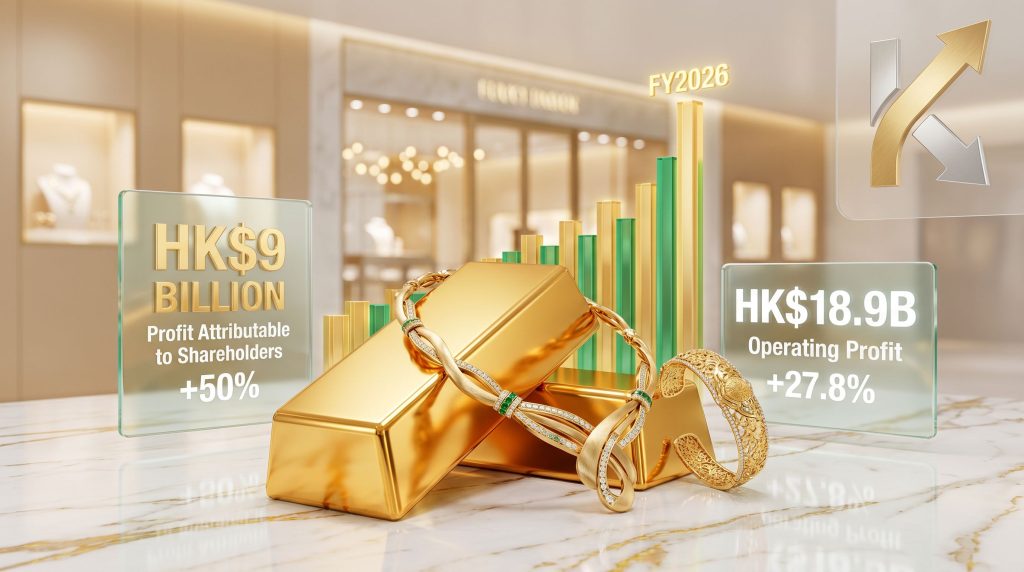
The headline figures from Chow Tai Fook's fiscal year ending March 2026 tell a story of exceptional operational momentum that extended well beyond commodity tailwinds. Profit attributable to shareholders reached HK$9 billion (approximately USD $1.14 billion), representing a 50% year-over-year increase that established a new company record.
Operating profit reached HK$18.9 billion, reflecting 27.8% year-over-year growth. The fact that shareholder profit grew at nearly double the rate of operating profit signals meaningful improvements in the company's cost structure, tax efficiency, and non-operating income streams, suggesting genuine business model maturation rather than simply riding a commodity wave.
| Financial Metric | FY2026 Result | Year-on-Year Change |
|---|---|---|
| Profit Attributable to Shareholders | HK$9 billion (~USD $1.14B) | +50% |
| Operating Profit | HK$18.9 billion | +27.8% |
| Same-Store Sales Growth (April to May 2026) | Above analyst consensus | Weight-based gold recovery driven |
| Share Price Movement (June 12, 2026) | +15.38% intraday | Post-results surge |
Why the 15% Share Surge Reflects Structural Confidence
Single-day moves of 15% or more in large-cap stocks are unusual enough to warrant careful analysis. When the broader market context is considered, Chow Tai Fook's surge was amplified by forward-looking guidance that outpaced what analysts had modelled. According to a Citi note published on Thursday June 12, 2026, the company's FY2027 guidance exceeded consensus expectations on both revenue and margin metrics, with projected net profit margin expansion underpinned by planned luxury store openings and an accelerated rollout of proprietary signature jewellery collections.
This combination of backward-looking results and forward-looking guidance beats is a particularly powerful catalyst for institutional repositioning. Consequently, investors who had been underweight the stock based on concerns about gold price volatility were forced to reassess whether their framework for evaluating Chow Tai Fook shares was still valid.
Same-store sales growth in April and May 2026 came in stronger than expected, supported by recovering demand in weight-based gold jewellery as gold prices pulled back from their highs. This sequential improvement served as a concrete leading indicator of demand elasticity, demonstrating how quickly consumers re-engage with gold purchases when prices moderate.
Is Higher Gold Always Good News for Gold Jewelry Companies?
The Historical Evidence Complicates the Simple Narrative
The instinctive assumption that rising gold prices uniformly benefit gold jewellery companies collapses quickly under historical scrutiny. Chow Tai Fook's own financial history provides the most compelling counterevidence. In fiscal year 2025, elevated gold prices contributed to a revenue contraction of approximately 17.5% year-on-year to HK$89,656 million, demonstrating that commodity price increases can create significant top-line headwinds when consumer price sensitivity is high.
This apparent contradiction resolves when the mechanism is properly understood. Furthermore, the gold price record highs witnessed in recent years have made this dynamic more pronounced across the sector:
- Gross margin expansion: Higher gold prices increase the monetary value of each gram sold on weight-based products, lifting gross profit per transaction even as volumes decline
- Volume suppression: Elevated gold prices deter price-sensitive consumers from completing purchases, particularly in mainland China where gold jewellery is historically viewed as both adornment and wealth storage
- Net revenue compression: If volume declines outpace margin expansion, total revenue falls despite higher per-unit profitability
- Demand deferral vs. demand destruction: Many consumers who pause purchases during price spikes return once prices moderate, creating the demand recovery pattern visible in Chow Tai Fook's April to May 2026 same-store sales data
The Gross Margin Mechanism Explained
Understanding how gold price movements flow through to gross margins requires clarity about how weight-based jewellery products are priced and accounted for. The retail price of a weight-based gold item is calculated as the current spot price multiplied by the item's gold content, plus a craftsmanship premium that typically represents 10–25% of the metal value. When spot prices rise, the absolute gross profit per transaction increases even though the margin percentage remains relatively stable.
This creates an interesting asymmetry: higher gold prices simultaneously increase gross profit per unit while reducing the number of units sold. The net effect on total gross profit is therefore a function of demand elasticity, which varies significantly by:
- Customer income segment targeted by the retailer
- The proportion of weight-based versus fixed-price products in the sales mix
- Geographic market characteristics and consumer attitudes toward gold as an investment
- Competitive pricing environment and promotional activity
The relationship between gold prices and jewellery retailer profitability is demonstrably non-linear. Short-term demand suppression from elevated prices can coexist with gross margin expansion if the product mix simultaneously shifts toward higher-margin, design-led categories. Retailers that have engineered this product mix shift are fundamentally better positioned than those relying predominantly on commodity-linked revenue.
The K-Shaped Recovery Dynamic Reshaping Chinese Jewelry Demand
What K-Shaped Recovery Means for Premium Retail
China's economic recovery following the pandemic period and subsequent property market stress has not followed the symmetrical V or U-shaped trajectories that economic textbooks typically describe. Instead, a divergent pattern has emerged where higher-income households have seen asset values recover and discretionary spending power increase, while middle and lower-income cohorts continue facing financial pressure from property market losses, employment uncertainty, and elevated living costs.
For a retailer like Chow Tai Fook, this K-shaped dynamic creates two simultaneous realities:
- Resilient premium demand: Affluent consumers in Tier-1 and Tier-2 cities continue purchasing aspirational and luxury-positioned jewellery collections, largely insulated from gold price fluctuations because their purchase motivation is status, gifting, and aesthetic appreciation rather than commodity value
- Suppressed mass-market demand: Price-sensitive consumers who represent a significant portion of China's gold jewellery market defer or reduce purchases when spot prices are elevated, creating the volume headwinds that weighed on FY2025 revenue
Chow Tai Fook's CFO Karen Yih explicitly referenced this dynamic in her post-results commentary, noting that strong demand was observed in higher-tier Chinese cities and international markets. The company's high-margin, fixed-price jewellery demonstrated demand resilience even during periods of gold price volatility. The strategic implication is significant: by deliberately growing its premium and design-led product exposure, Chow Tai Fook is effectively repositioning its customer base toward the upper arm of China's K-shaped recovery.
Store Strategy as a Demand Segmentation Tool
The planned expansion of luxury and self-operated store formats highlighted in Citi's FY2027 analysis is not merely a real estate strategy. It functions as a deliberate demand segmentation mechanism, designed to attract and retain higher-income consumers who are less sensitive to gold price movements and more motivated by brand experience, store environment, and product exclusivity.
Self-operated stores, as opposed to franchised locations, provide greater control over the customer experience, product mix presentation, and staff training. For design-led and signature jewellery collections where the value proposition extends beyond metal content, this control over the retail environment is a meaningful competitive differentiator. Indeed, Chow Tai Fook's strategic pivot toward younger buyers and higher-margin formats reinforces precisely this approach.
Gold Price Volatility in 2025 to 2026: The Forces Behind the Cycle
Why Gold Surged and Then Corrected
The gold price cycle that defined Chow Tai Fook's fiscal year environment involved two distinct phases with materially different implications for different segments of the business. The initial surge through late 2025 into early 2026 was driven by a confluence of macro and geopolitical forces that have historically triggered safe-haven buying at scale.
Key factors behind the rally included:
- Safe-haven demand intensification amid macroeconomic uncertainty and geopolitical instability across multiple regions, consistent with broader safe-haven gold demand trends observed globally
- Continued central bank gold accumulation by emerging market economies seeking to diversify foreign reserves, with central bank gold demand playing a particularly influential role throughout this period
- Inflation hedging behaviour among institutional investors concerned about persistent price pressures in major economies
- Currency debasement concerns in markets experiencing elevated fiscal deficits and monetary expansion
Following the escalation of the Iran conflict, gold prices experienced a correction of approximately 20% from peak levels, a development with paradoxical implications for jewellery retailers. The pullback in metal prices reduced the per-unit economics of weight-based products but simultaneously re-engaged price-sensitive consumers who had been sitting on the sidelines during the rally phase. The strong same-store sales performance reported for April and May 2026 directly reflects this consumer re-engagement following price moderation.
Fixed-Price Versus Weight-Based Gold: The Strategic Framework
Understanding the Two Product Economics
The structural distinction between fixed-price design jewellery and weight-based gold products represents perhaps the most important variable for investors evaluating gold jewellery retailers. These are not simply different product types within the same business. They represent fundamentally different economic models operating simultaneously under one brand umbrella.
| Product Category | Pricing Model | Margin Profile | Gold Price Sensitivity |
|---|---|---|---|
| Weight-Based Gold Jewelry | Spot-linked, dynamic | Lower, commodity-driven | High: demand declines as gold rises |
| Fixed-Price Design Jewelry | Brand-determined, stable | Higher, design-driven | Low: demand largely resilient |
| Signature and Luxury Collections | Premium retail pricing | Highest margin tier | Very low: aspiration-driven purchasing |
The design-led segment's pricing resilience stems from a fundamentally different consumer psychology. Buyers of signature and fixed-price collections are purchasing craftsmanship, brand identity, and aesthetic value. The metal content is a material rather than the primary value driver. This purchasing motivation is largely decoupled from commodity market movements, creating the demand stability that Chow Tai Fook's CFO described as characteristic of their higher-margin product lines.
Why This Distinction Matters for Margin Expansion Targets
Citi's projection of net profit margin expansion in FY2027 rests substantially on the continued portfolio shift toward higher-margin product categories. As signature collections and luxury-format stores grow as a proportion of total revenue, the company's blended gross margin improves without requiring any change in gold prices. This structural margin expansion is more durable than commodity-driven profit growth because it is not subject to reversal when gold price cycles turn.
The operational investment required to drive this shift involves several interdependent elements:
- Product design and development capability to create collections that command premium pricing
- Marketing investment to build brand equity that supports fixed-price positioning
- Retail environment investment through luxury store formats that reinforce product positioning
- Staff training to communicate design value propositions to traditionally commodity-focused consumers
- Supply chain development for precision craftsmanship that justifies premium price points
The next major ASX story will hit our subscribers first
What FY2027 Guidance Signals for the Broader Sector
Reading the Forward Indicators
Chow Tai Fook's FY2027 guidance exceeding consensus expectations on both revenue and margin metrics is significant beyond the company itself. It suggests that sophisticated investors and analysts are beginning to reframe their evaluation criteria for major gold jewellery retailers, moving away from simple gold-price correlation models toward frameworks that account for product mix sophistication, luxury positioning, and demand segmentation strategy.
The same-store sales recovery in April and May 2026 functions as a particularly informative leading indicator. Furthermore, understanding the broader gold market outlook provides useful context for interpreting how these same-store figures translate into longer-term revenue trajectory modelling. Rapid recovery in weight-based product sales following the post-Iran-conflict gold price correction demonstrates high latent demand that had been temporarily suppressed rather than permanently destroyed.
However, the gold price impact on stocks across the broader sector reminds investors that this demand deferral versus demand destruction distinction is critical for modelling future revenue, not just for jewellery retailers but across gold-linked equities more broadly.
Analysts tracking the broader Asia-Pacific luxury goods sector increasingly note that demand recovery in weight-based gold categories during periods of gold price moderation can generate significant revenue tailwinds for retailers with substantial mainland Chinese consumer exposure, particularly when that recovery coincides with continued growth in higher-margin design-led categories.
Frequently Asked Questions
Why Did Chow Tai Fook Shares Rise 15% in One Day?
The single-session surge of 15.38% followed the release of full-year financial results confirming a 50% increase in profit attributable to shareholders to HK$9 billion, combined with FY2027 guidance that exceeded analyst consensus on both revenue and margin metrics. The simultaneous delivery of backward-looking results beats and forward-looking guidance upgrades triggered significant institutional repositioning.
Does a Higher Gold Price Always Benefit Gold Jewelry Retailers?
Not consistently. While elevated gold prices expand gross margins on weight-based product categories, they also suppress consumer demand for those same products, particularly among price-sensitive customer segments. The net effect on total profitability depends heavily on the retailer's product mix, customer demographics, and the specific magnitude and duration of the price movement.
What Is Weight-Based Gold Jewelry and How Is It Priced?
Weight-based gold jewellery is priced according to the prevailing spot price of gold multiplied by the item's gold content, plus a craftsmanship premium. Because the retail price fluctuates with commodity markets, consumers are effectively making a gold price bet when they purchase. This makes them highly sensitive to current price levels and creates the demand volatility pattern visible in Chow Tai Fook's historical revenue data. For further context, Chow Tai Fook's own market insights outline how these pricing dynamics are communicated directly to consumers.
How Does the K-Shaped Recovery Affect Jewelry Demand in China?
The K-shaped recovery creates divergent demand patterns where affluent consumers in higher-tier cities continue spending on aspirational jewellery regardless of gold price levels, while price-sensitive consumers defer purchases during gold price spikes. Retailers that have built product portfolios and store networks targeting the upper income segment are structurally advantaged in this environment.
What Is Chow Tai Fook's Strategy for Protecting Margins During Gold Price Volatility?
The company is actively expanding its portfolio of fixed-price, design-led jewellery with strong brand equity that insulates pricing from commodity movements. The planned increase in luxury store formats and signature collection offerings serves to grow the proportion of revenue derived from high-margin, design-driven products, reducing overall sensitivity to gold price cycles.
Key Takeaways for Investors Tracking Chow Tai Fook Shares
The relationship between Chow Tai Fook shares rise on higher gold prices and the underlying business fundamentals is demonstrably more complex than a simple directional correlation. Several structural factors are reshaping how investors should evaluate the company:
- Record shareholder profit of HK$9 billion represents a 50% year-over-year increase, driven by both favourable gold price dynamics and deliberate product mix improvement
- Operating profit of HK$18.9 billion reflects 27.8% growth, indicating operational leverage extending beyond pure commodity effects
- Historical evidence confirms that gold price increases have previously caused significant revenue declines, underscoring the non-linear nature of the relationship
- China's K-shaped recovery is reshaping the consumer landscape toward premium, design-led products, creating structural advantage for retailers with luxury positioning and fixed-price collections
- FY2027 guidance above consensus expectations suggests the current earnings trajectory has genuine structural support rather than being purely cyclical in nature
- The approximately 20% gold price correction following the Iran conflict triggered the demand recovery captured in the strong April to May same-store sales data, demonstrating the rapid demand elasticity that characterises the weight-based segment
This article is intended for informational purposes only and does not constitute financial advice. Past financial performance and analyst projections referenced herein are not guarantees of future results. Investors should conduct their own due diligence and consult qualified financial advisors before making investment decisions.
Want to Stay Ahead of the Next Major ASX Mineral Discovery?
While macroeconomic forces continue reshaping commodity markets and investor sentiment, Discovery Alert's proprietary Discovery IQ model delivers real-time alerts on significant ASX mineral discoveries — instantly converting complex data across 30+ commodities into clear, actionable insights for both traders and long-term investors. Explore historic discoveries and their market returns, then begin your 14-day free trial to position yourself ahead of the broader market.