July 17, 2026

The Race to the Ocean Floor: Why America Is Betting on Pacific Seabed Minerals
The global scramble for battery and defence minerals has entered a new frontier, one measured not in hectares of open-cut pits but in ocean depth and sediment age. For decades, land-based mining operations have shouldered the burden of supplying the raw materials that power modern economies. Cobalt from the Democratic Republic of Congo, nickel from Indonesia and the Philippines, copper from the Atacama Desert — each of these supply chains carries its own web of geopolitical exposure, community conflict, and price volatility. As critical minerals demand accelerates alongside the energy transition and the expansion of advanced defence systems, resource strategists are casting their eyes downward, to the abyssal plains of the world's ocean floors, where mineral wealth has been accumulating, undisturbed, for millions of years.
The proposed American Samoa seabed mining lease represents the most tangible step yet in the United States' ambition to rewrite its mineral supply chain from the ocean up.
When big ASX news breaks, our subscribers know first
What Makes the American Samoa Lease Proposal Significant
The sheer scale of the proposed lease is difficult to understate. The U.S. Department of the Interior's Marine Minerals Administration (MMA) has put forward a plan to auction exploration rights over two contiguous seabed blocks in federal waters off the eastern coast of Tau, one of American Samoa's seven islands, within the U.S. Exclusive Economic Zone (EEZ). Together, these blocks cover more than 31 million acres of Pacific Ocean floor.
| Lease Parameter | Block A | Block B | Combined Total |
|---|---|---|---|
| Area (acres) | 16.3 million | 15.1 million | >31 million |
| Location | Eastern coast of Tau, American Samoa EEZ | Eastern coast of Tau, American Samoa EEZ | Outer Continental Shelf |
| Lease Duration | 20 years | 20 years | Preliminary exploration only |
| Minimum Bid | $3 million | $3 million | $6 million combined floor |
| Royalty Rate (Yrs 1–5) | 2% of mineral value | 2% of mineral value | — |
| Royalty Rate (Yr 6+) | 5% of mineral value | 5% of mineral value | — |
Critical Distinction: These leases authorise preliminary exploration only. Any commercial seabed extraction would require a separately submitted and independently approved Mining Plan from the Bureau of Ocean Energy Management (BOEM), meaning a successful auction bid marks the beginning, not the end, of a long regulatory process.
The process was triggered in April 2025 when Impossible Metals, a U.S.-based deep-sea mining company, submitted an unsolicited application to BOEM. Following the completion of BOEM's Area Identification stage in 2025, the MMA formally delineated the potential lease zone and is now targeting a competitive auction on November 19, 2026, to be conducted at BOEM's Camarillo, California offices. The auction will be closed to the public but livestreamed on the MMA's official website, with a minimum bid of $3 million per block.
Understanding Polymetallic Nodules: The Mineral Formation at the Heart of the Debate
To understand why the American Samoa seabed mining lease has attracted both intense commercial interest and fierce environmental opposition, it is necessary to understand the geology involved.
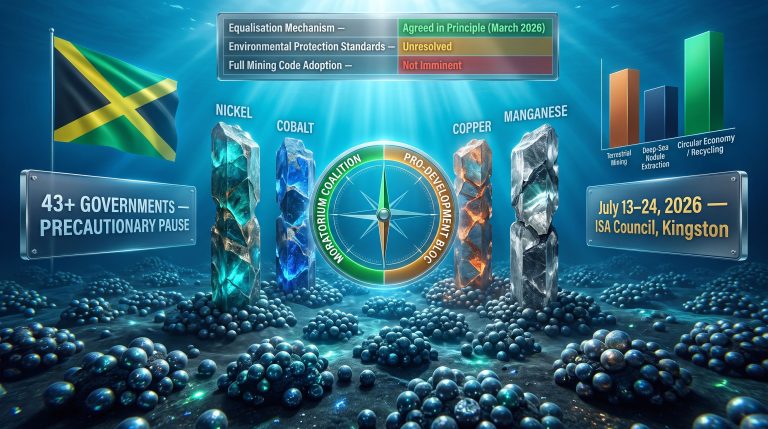
Polymetallic nodules are roughly potato-shaped mineral concretions that form on the deep ocean floor over extraordinarily long timescales, often growing at rates of just a few millimetres per million years. They precipitate from mineral-rich seawater in abyssal zones typically exceeding 4,000 metres in depth, concentrating layers of manganese, nickel, cobalt, and copper around a small nucleus, which may be a shark tooth, a fragment of shell, or a piece of older nodule material.
What makes these formations strategically compelling is their mineral density relative to many land-based ore deposits.
| Mineral | Typical Land-Based Ore Grade | Polymetallic Nodule Concentration | Strategic Application |
|---|---|---|---|
| Nickel | 0.5–1.5% | 1.0–1.4% | EV battery cathodes |
| Cobalt | 0.05–0.2% | 0.1–0.2% | Battery chemistry, aerospace |
| Copper | 0.4–0.8% | 0.8–1.2% | Electronics, defence wiring |
| Manganese | Variable | 25–30% | Steel alloys, battery anodes |
One aspect rarely discussed in mainstream coverage is the co-product economics of nodule mining. Unlike a land-based copper mine where cobalt might be a minor byproduct, a single nodule collection operation simultaneously recovers four commercially significant minerals. This multi-mineral yield per tonne of material processed fundamentally changes the unit economics compared to single-commodity terrestrial operations, and it is a key reason the financial models underpinning deep-sea mining have attracted serious venture capital in recent years.
Critically, the waters surrounding American Samoa are considered among the more promising Pacific nodule fields outside the better-documented Clarion-Clipperton Zone, a stretch of equatorial Pacific seabed spanning approximately 4.5 million square kilometres that has been the focus of international seabed mining interest for decades.
The Policy Architecture Behind the Push
The American Samoa seabed mining lease proposal does not exist in isolation. It sits within a deliberate federal strategy to reduce U.S. dependence on foreign-controlled mineral supply chains, particularly those dominated by Chinese processing and refining capacity. China currently controls a dominant share of global cobalt refining, manganese processing, and rare earth separation — a structural reality that U.S. defence and industrial planners have identified as a critical vulnerability.
Under the Trump administration, the critical minerals push has directed federal agencies to accelerate domestic critical minerals development across multiple fronts. Deep-sea mineral leasing represents one pillar of this broader effort. The acting MMA Director, Matt Giacona, has publicly described the proposed American Samoa lease as a meaningful step toward establishing a more resilient domestic supply chain for critical minerals.
Beyond American Samoa, the MMA has signalled plans for further lease sales in the Commonwealth of the Northern Mariana Islands (also targeted for 2026) and Alaska (2027), a three-territory programme collectively covering approximately 875,000 km² of seabed that would represent the most ambitious offshore mineral leasing initiative in U.S. history.
How This Compares to the Global Seabed Mining Landscape
The United States is not the only nation advancing seabed mineral ambitions. However, its approach differs in important ways from the multilateral framework governing international waters.
| Country / Entity | Seabed Mining Status | Key Zone | Primary Minerals Targeted |
|---|---|---|---|
| United States | Active leasing proposed (2026) | American Samoa EEZ, CNMI, Alaska | Nickel, cobalt, copper, manganese |
| Norway | Exploration licenses issued | Norwegian Continental Shelf | Manganese, cobalt-rich crusts |
| China | ISA exploration contracts held | Clarion-Clipperton Zone (Pacific) | Polymetallic nodules |
| Japan | Pilot extraction trials conducted | Exclusive Economic Zone | Cobalt-rich crusts, manganese |
| Pacific Island Nations | Moratorium advocacy | Regional EEZs | Opposition to commercial extraction |
In international waters, the International Seabed Authority (ISA) — the UN-affiliated body governing mineral rights beyond national jurisdiction — has issued exploration contracts to multiple state and private entities but has yet to finalise commercial mining regulations. This regulatory delay has frustrated operators and created an opening for nations with large EEZs, including the United States, to advance seabed leasing within their own jurisdictional boundaries where ISA rules do not apply.
This distinction matters enormously for investors and industry observers. U.S. EEZ seabed leasing operates under domestic law administered by BOEM and the MMA, not international treaty frameworks, meaning the regulatory pathway, while still complex, avoids the multilateral gridlock that has stalled ISA-zone commercial development for years.
The Opposition: Environmental, Cultural, and Jurisdictional Dimensions
The deep-sea mining controversy surrounding the American Samoa seabed mining lease has drawn substantive opposition from multiple directions, each raising distinct concerns that go beyond simple environmental objection.
The Territorial Government's Position
American Samoa's Governor, Pulaali'i Nikolao Pula, is a documented opponent of deep-sea mining. Under the regulatory process, the governor has 60 days from the publication of the proposed lease notice to submit a formal response. The MMA must then issue a final notice of the lease sale in October 2026 before the November auction can proceed.
A territorial Executive Order (0006-2024) previously established a moratorium on seabed mining within American Samoa's territorial waters. However, this moratorium extends only to approximately 3 nautical miles from shore, which is the limit of territorial jurisdiction. The proposed lease blocks are situated in federal Outer Continental Shelf waters well beyond this boundary, meaning the governor can register formal opposition but lacks the legal authority to unilaterally block the federal lease process.
Environmental and Scientific Objections
Marine conservation organisation Oceana has characterised the proposed lease as a disregard for environmental science and community sentiment. Furthermore, their core arguments — shared by a growing body of marine biologists — centre on several concerns:
- Ecosystem irreversibility: Abyssal communities are among the slowest-recovering ecosystems on Earth. Sediment disturbance from nodule collection can generate plumes that travel hundreds of kilometres, smothering filter feeders and disrupting chemosynthetic food webs
- Scientific knowledge gaps: A significant proportion of deep-sea species in the American Samoa region remain formally unclassified by science, making meaningful environmental impact assessment extremely difficult
- Legal permanence risk: Environmental legal experts have noted that deep-sea mining leases, once granted, are extremely difficult to rescind, creating long-term regulatory exposure regardless of future administration changes
- Cultural and Indigenous rights: Pacific Island leaders argue that federal leasing decisions made in Washington effectively override the sovereign interests and cultural relationships that Indigenous Pacific communities maintain with the ocean
Environmental review under the National Environmental Policy Act (NEPA) has been formally initiated for the American Samoa lease area, a mandatory procedural requirement that must be satisfied before any extraction activities could be authorised.
The next major ASX story will hit our subscribers first
The Regulatory Pathway From Auction to Active Mining
One of the most commonly misunderstood aspects of this proposal is the distance between a successful lease bid and actual seabed production. The deep-sea mining regulations governing this process involve at least ten distinct stages:
- Unsolicited Application Filed (April 2025, completed by Impossible Metals)
- Area Identification Completed by BOEM (2025, completed)
- NEPA Environmental Review Initiated (mandatory federal environmental assessment)
- Proposed Lease Notice Published by the MMA
- Governor's 60-Day Response Period commences
- Final Lease Sale Notice Issued (targeted October 2026)
- Competitive Closed Auction Conducted (proposed November 19, 2026)
- Exploration Lease Granted to winning bidder (20-year preliminary authorisation)
- Mining Plan Submitted by leaseholder to BOEM for independent review
- BOEM Mining Plan Approval (only upon approval can commercial extraction commence)
This structure means that even the most expeditious regulatory scenario places commercial nodule extraction years beyond the 2026 auction date. For investors evaluating exposure to deep-sea mineral plays, understanding this timeline is fundamental to assessing realistic production horizons and associated capital requirements.
Economic Arguments: The Supply Chain Security Case and Its Critics
The economic rationale for the American Samoa seabed mining lease rests on several interlocking arguments that proponents advance with increasing urgency.
The Case For
- Supply chain diversification: Domestic EEZ nodule extraction reduces reliance on politically sensitive supply sources, particularly cobalt from the DRC and nickel from Indonesia, both of which have experienced significant policy and operational instability in recent years
- Co-product economics: The simultaneous recovery of four critical minerals from a single extraction operation offers a fundamentally different cost structure compared to most land-based single-commodity mines
- Reduced terrestrial impact: Supporters argue that seabed nodule harvesting, by delivering large volumes of multiple minerals from a single remote operation, could reduce the cumulative footprint of land-based mining globally
- Federal revenue generation: The royalty structure — at 2% for years 1 through 5 and 5% thereafter — combined with minimum auction bids of $6 million across both blocks, creates a direct revenue stream to the federal treasury that scales with production volumes
The Case Against
Critics maintain that the economic case for deep-sea mining is built on assumptions that remain scientifically and operationally untested at commercial scale. No polymetallic nodule operation anywhere in the world has yet achieved sustained commercial production, meaning cost and yield projections carry substantial uncertainty.
- Sediment plume modelling from historical test operations in the Pacific suggests environmental impacts may extend far beyond the immediate extraction footprint
- The energy intensity of deep-sea nodule collection and processing, including the requirement to lift material from depths exceeding 4,000 metres, remains a significant engineering and cost challenge
- Commodity price volatility for nickel and cobalt — both of which have experienced severe price corrections in recent years — creates uncertainty around the economic viability of operations that carry high upfront capital costs
Frequently Asked Questions
What minerals are found in the seabed off American Samoa?
The ocean floor in this region contains polymetallic nodules with commercially significant concentrations of nickel, cobalt, copper, and manganese, each of which plays a critical role in electric vehicle battery production, defence electronics, and industrial manufacturing.
Who is administering the lease auction?
The Marine Minerals Administration (MMA), operating under the U.S. Department of the Interior in coordination with BOEM, is administering the proposed auction.
Can the territorial government block the lease?
The Governor's moratorium applies only within approximately 3 nautical miles of shore. Federal Outer Continental Shelf waters fall outside this jurisdiction, meaning formal objection is possible but unilateral blocking is not.
When is the auction scheduled?
The competitive closed auction is proposed for November 19, 2026, with a final sale notice required from the MMA by October 2026.
Does winning the lease mean mining can begin?
No. The lease authorises preliminary exploration only. A separately submitted and independently approved Mining Plan from BOEM is required before any commercial extraction can commence.
What This Moment Signals for U.S. Ocean Mineral Strategy
The proposed American Samoa seabed mining lease is best understood not as a single transaction, but as a policy inflection point. It represents the formal beginning of a systematic U.S. programme to treat its EEZ seabed as a strategic mineral reserve — one that has existed beneath federal jurisdiction for decades but has never been seriously tested as a domestic supply chain asset.
Whether this programme advances to commercial production will depend on variables that extend well beyond the November 2026 auction. Environmental reviews must be completed, legal challenges from conservation organisations and potentially from the territorial government are plausible, commodity markets must support the economics of frontier extraction technology, and the engineering challenges of sustained deep-water nodule collection at scale have yet to be demonstrated by any operator globally.
What is already clear is that the competitive dynamics of global critical mineral supply have shifted decisively enough that the United States is now willing to move from policy discussion to formal lease proposals over some of the most ecologically sensitive ocean territory under its jurisdiction. Consequently, how the tension between mineral security imperatives and environmental responsibility is resolved in American Samoa will likely shape the trajectory of deep-sea mining regulation across the Pacific for decades to come.
This article is intended for informational purposes only and does not constitute financial, investment, or legal advice. Projections regarding lease timelines, production horizons, and economic outcomes involve significant uncertainty and should not be relied upon for investment decisions.
Want to Track the Next Major Mineral Discovery Before the Broader Market Does?
Discovery Alert's proprietary Discovery IQ model delivers real-time alerts on significant ASX mineral discoveries — instantly transforming complex mineral data into actionable opportunities across critical commodities including nickel, cobalt, and copper. Explore historic discoveries and their market returns, then begin your 14-day free trial at Discovery Alert to position yourself ahead of the market.