
July 17, 2026
The Regulatory Fault Lines Shaping the Future of Ocean Floor Extraction
Beneath kilometres of ocean water, across vast abyssal plains, trillions of potato-sized mineral formations have accumulated over millions of years. These polymetallic nodules, rich in nickel, cobalt, copper, and manganese, have become one of the most contested resources on the planet, not because of where they sit, but because of who governs them and what extracting them would actually mean. The answer to those questions is currently being fought out, line by line, inside a negotiating chamber in Kingston, Jamaica.
Understanding the stakes of the ISA deep sea mining negotiations in Jamaica requires stepping back from the immediate policy drama and examining the structural forces that have brought governments, conservationists, and commercial operators into direct conflict.
When big ASX news breaks, our subscribers know first
What the ISA Actually Governs and Why It Matters
The International Seabed Authority, headquartered in Kingston, was established under the United Nations Convention on the Law of the Sea to serve as the sole multilateral body with jurisdiction over mineral extraction in international seabed areas. These areas, collectively referred to as "the Area," lie beyond any national jurisdiction and are legally defined as the common heritage of mankind.
This is not merely rhetorical framing. The common heritage designation carries real legal weight: it means that no single state or commercial actor can claim ownership over these resources, and that any extraction must, in principle, generate equitable benefits for all of humanity, not simply for the sponsoring nations or the companies holding contractor licences.
The Mining Code that the ISA has been negotiating for over a decade is the instrument designed to translate that principle into practical regulation. It is intended to govern:
- How commercial extraction licences are evaluated and granted
- What environmental protection standards contractors must meet
- How revenues and royalties are distributed among member states
- What liability thresholds apply if environmental damage occurs
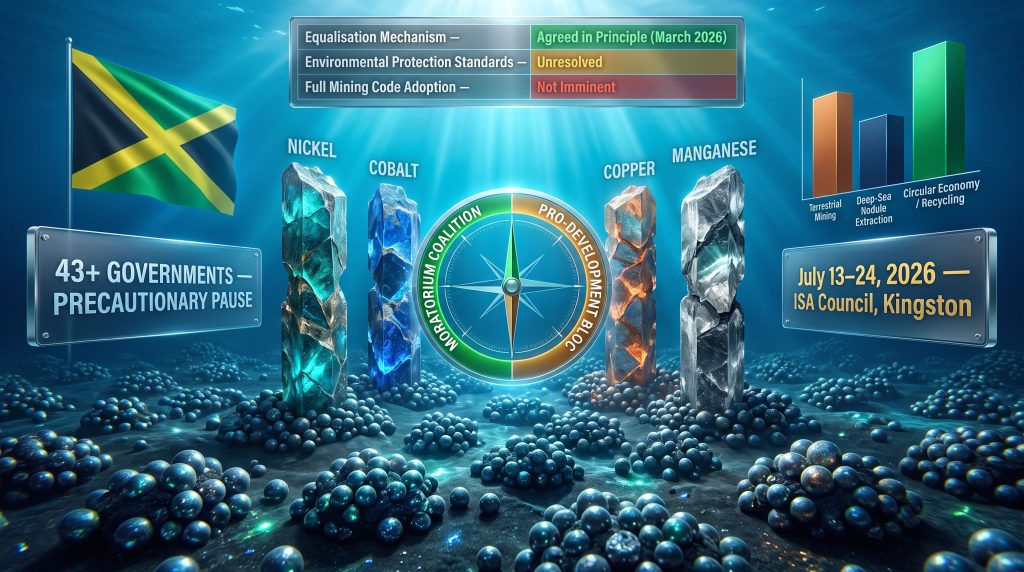
As of the current 31st Session, none of these frameworks have been finalised. The July 2026 Council session, running from the 13th to the 24th, represents the most concentrated decision-making window the ISA has faced, followed immediately by the Assembly session from the 24th to the 28th of July, where a formal debate on a precautionary pause is scheduled to take place.
What Has and Has Not Been Resolved
Progress from the first part of the 31st Session, held in March 2026, was incremental but meaningful in two specific areas. Governments agreed in principle on an Equalisation Mechanism designed to distribute revenues among member states, and on a Compliance Committee framework to monitor contractor obligations.
Beyond those two items, the negotiating landscape remains unsettled. The table below illustrates where key provisions stand as of July 2026:
| Regulatory Provision | Status |
|---|---|
| Equalisation Mechanism | Agreed in principle (March 2026) |
| Compliance Committee Framework | Agreed in principle (March 2026) |
| Environmental Protection Standards | Unresolved |
| Profit-Sharing Architecture | Partially negotiated |
| Licence Application Process | No consensus mechanism |
| Full Mining Code Adoption | Not anticipated in near term |
Adding legal urgency to this picture is the so-called Nauru Rule. Nauru, a small Pacific island nation, invoked a provision under UNCLOS requiring the ISA to consider licence applications within two years of such a request. That two-year window expired on July 9, 2026. The ISA is now technically obligated to consider applications upon request, but a critical distinction must be made: the obligation to consider is not the same as an obligation to approve. This nuance carries profound legal and political implications that remain actively contested among member states.
The Moratorium Coalition and the Pro-Development Bloc
The ISA's member states have fractured into recognisable, though not entirely predictable, coalitions. As of mid-2026, at least 43 governments have formally aligned with calls for a moratorium or precautionary pause on deep-sea mining activity. This group includes Chile, Palau, Vanuatu, and Brazil, among others.
The moratorium position is not a call for a permanent ban. It is a conditional pause, structured around three prerequisites that advocates argue must be satisfied before extraction can responsibly proceed:
- Sufficient peer-reviewed scientific understanding of how deep-sea ecosystems function and how they would respond to commercial-scale disturbance
- A credible demonstration that extraction could occur without causing irreversible harm to the marine environment
- Verified evidence that any future mining activity would generate broadly equitable outcomes for humanity as a whole, not primarily for extractive commercial interests
As of July 2026, none of these conditions have been satisfied to the moratorium coalition's standard.
On the opposing side, states including China, Italy, Saudi Arabia, and Ghana have taken positions broadly favouring continued regulatory development and commercial progress running in parallel. Their central argument is that halting negotiations in favour of a moratorium would freeze institutional momentum and leave the critical minerals demand supply chain unnecessarily constrained. This bloc has also resisted engagement with developing a broader General Policy on marine environmental protection at this stage of negotiations.
The fault lines in Kingston do not simply divide wealthy industrialised nations from developing economies. They reflect fundamentally different interpretations of what the common heritage principle actually demands: equitable benefit-sharing, precautionary environmental governance, or accelerated resource access. All three positions claim legitimacy under the same treaty framework.
The Environmental Unknowns That Make This Debate Unusually Complex
One of the most frequently misunderstood aspects of the deep-sea mining controversy is the assumption that it presents a risk profile comparable to terrestrial extraction. Conservationists and scientists argue that comparison is misleading for several structural reasons.
First, the ocean operates without borders. Sediment plumes, acoustic disturbance, and other extraction byproducts do not respect the boundaries of designated mining zones. Impacts generated within a contractor's licensed area can propagate across vast distances, affecting ecosystems and biodiversity well outside any single jurisdiction.
Second, the functional ecology of abyssal ecosystems remains genuinely poorly understood. These environments, at depths exceeding four kilometres, host unique biodiversity that has evolved over geological timescales. Scientific consultation has consistently found that current knowledge is insufficient to model impacts with any reliable precision.
Third, the deep ocean functions as a measurable carbon sink. Any disruption to sediment layers and biological communities on the ocean floor carries potential consequences for long-term carbon sequestration, introducing a climate dimension that goes well beyond direct biodiversity loss.
Small-scale test operations have already produced results outside predicted parameters. Notably, at least one documented incident involved an unpredicted discharge plume released from a mining vessel during trial operations conducted at limited intensity. The significance of this is not simply the incident itself, but what it reveals about the gap between controlled small-scale trials and what might occur at full commercial-scale deployment. No modelling currently exists for commercial-scale impact scenarios.
The Metals Company and the Challenge to Multilateral Authority
No single issue has injected more urgency into the current Kingston session than the conduct of The Metals Company, a Canadian firm holding contractor licences through two ISA-registered subsidiary entities. The company has simultaneously pursued a domestic permitting route through United States regulatory channels for deep-sea mining operations in the Pacific.
Critics, including the Deep Sea Conservation Coalition, argue this dual-track strategy constitutes a breach of international law and represents a direct credibility test for the ISA as a functioning regulatory institution. The core legal argument is straightforward: if a contractor holding ISA licences can pursue unilateral extraction pathways outside the multilateral framework without facing consequences, the authority's enforcement legitimacy is fundamentally compromised.
The question of whether The Metals Company's subsidiary contracts should be terminated is a live and unresolved issue within the current session. Advocates for termination argue that pursuing unlawful mining pathways outside ISA jurisdiction is incompatible with the obligations attached to holding contractor status under the ISA framework.
A deeper structural question also emerges: has the ISA's decade-long regulatory delay created the conditions for this kind of regulatory arbitrage? The honest answer is nuanced. A prolonged absence of finalised rules does create rational incentives for commercially motivated actors to explore alternative routes. However, the pursuit of a unilateral domestic permitting strategy appears to reflect a pre-existing strategic posture rather than a reactive response to ISA delays. Member states carry obligations under international law to erect barriers against unlawful unilateral mining, and the enforcement of those obligations remains a central open question in Kingston.
The next major ASX story will hit our subscribers first
Critical Minerals Demand: Does the Commercial Case Actually Hold Up?
The argument most frequently deployed in favour of advancing deep-sea mining is the critical minerals narrative: that polymetallic nodules importance could reduce dangerous dependence on geopolitically concentrated terrestrial supply chains for nickel, cobalt, and copper essential to battery technology and the clean energy transition.
The commercial logic deserves scrutiny. A growing body of research suggests that deep-sea nodule extraction, even if fully developed at commercial scale, may not be sufficient to meaningfully close projected critical mineral supply deficits. The business case, in other words, remains unproven.
An alternative pathway is gaining increasing traction both in academic literature and within ISA member state delegations. The circular economy argument holds that:
- Vast quantities of already-extracted metals remain embedded in existing products, infrastructure, and end-of-life equipment
- Recycling and urban mining systems remain significantly underdeveloped relative to their theoretical capacity
- Scaling circular mineral recovery could substantially reduce primary demand before seabed extraction becomes commercially or environmentally necessary
The table below offers a comparative overview of primary supply pathways:
| Supply Pathway | Maturity Level | Environmental Risk | Geopolitical Risk |
|---|---|---|---|
| Terrestrial Mining (existing) | High | Moderate to High | High (supply concentration) |
| Deep-Sea Nodule Extraction | Pre-commercial | Unknown to High | Low |
| Circular Economy / Recycling | Developing | Low | Low |
| Urban Mining | Early-stage | Low | Low |
Defining the Threshold for Responsible Extraction
A recurring question in the public debate around deep-sea mining is whether the moratorium position represents a pragmatic pause or a prohibition dressed in conditional language. Policy advocates within the moratorium coalition are explicit: the position is genuinely conditional, not permanent by design.
What Would Satisfy the Moratorium Conditions?
The criteria require:
- Large-scale, peer-reviewed environmental impact data derived from operations comparable in scope to what commercial extraction would involve, not extrapolated from small pilot studies
- Independent verification that extraction can proceed without causing measurable, irreversible biodiversity loss in affected ecosystems
- Governance structures demonstrably capable of ensuring equitable benefit distribution across all ISA member states, not solely to sponsoring states and licence-holding contractors
An important institutional question sits beneath all of these: what body would have the authority to certify that conditions have been met? No such mechanism currently exists within the ISA framework, and its design would itself require significant multilateral consensus.
The moratorium versus permanent ban distinction matters strategically. A precautionary moratorium preserves optionality. It signals that the international community is not categorically opposed to extraction but is demanding that evidential and governance standards be met first. A permanent prohibition would carry a fundamentally different legal and diplomatic weight and would be far harder to achieve through the current ISA framework.
Procedural Outlook: What Happens in Kingston and Beyond
Governments are currently engaged in a line-by-line review of the draft Mining Code text, a process that makes the scale of remaining work visible in granular terms. Major unresolved thematic clusters include environmental protection provisions, liability standards, and equity and benefit-sharing frameworks. Furthermore, the deep-sea mining regulations themselves cannot be considered in isolation, as a range of broader governance structures would need to be established before the code could responsibly be adopted, adding further layers of complexity to any timeline estimate.
Full code adoption is not anticipated in the near term. A third ISA session in 2026 has been proposed to continue work if July talks do not resolve outstanding provisions.
Key upcoming decision points are structured as follows:
- July 13 to 24, 2026: ISA Council Session, line-by-line Mining Code text negotiations
- July 24 to 28, 2026: ISA Assembly, formal debate on precautionary pause and moratorium proposals
- Potential Q3/Q4 2026: Third ISA session if July talks remain inconclusive
- Ongoing: Legal and diplomatic proceedings related to The Metals Company's US domestic permitting strategy
The Assembly session beginning July 24 may ultimately prove more consequential than the Council negotiations that precede it. While the Council works through technical regulatory language, the Assembly holds broader institutional authority over the ISA's strategic direction. A formal Assembly resolution expressing support for a precautionary pause would carry significant political weight, even in the absence of binding enforcement mechanisms.
Consequently, as Inside Climate News reports, negotiations continue to resume amid considerable industry pushback, underscoring just how contested the path forward remains for all stakeholders involved.
Frequently Asked Questions: ISA Deep-Sea Mining Negotiations in Jamaica
What is the ISA and why does it negotiate in Jamaica?
The International Seabed Authority is headquartered in Kingston, Jamaica, and functions as the multilateral body responsible for regulating mineral extraction from international seabed areas. Regular Council and Assembly sessions are held at its Kingston headquarters.
What minerals are central to the deep-sea mining debate?
The primary targets are polymetallic nodules containing nickel, cobalt, copper, and manganese. These are classified as critical minerals essential to battery technology, electric vehicles, and the broader clean energy transition.
What is the Nauru Rule and why does it matter in 2026?
Nauru invoked a UNCLOS provision requiring the ISA to consider licence applications within two years. That deadline passed on July 9, 2026, creating legal pressure on the ISA to process applications, though the obligation to consider does not equate to an obligation to approve.
How many governments support a moratorium?
At least 43 governments have formally aligned with moratorium or precautionary pause positions as of mid-2026, with the ISA Assembly scheduled to debate this question during its late July session.
Why is The Metals Company's US permitting route considered controversial?
The Metals Company pursued a domestic US regulatory pathway for deep-sea mining while its subsidiary entities continue to hold ISA contractor licences. Critics argue this constitutes a breach of international law and undermines the ISA's authority as the legitimate multilateral regulator of international seabed resources.
Could deep-sea nodule extraction replace terrestrial critical mineral supply chains?
The evidence is contested. While industry proponents argue nodules could diversify supply, emerging research suggests extraction at commercial scale may not be sufficient to close projected demand gaps. However, as explored by earth.org, the broader outcomes of these negotiations remain deeply unsettled, and accelerating circular economy and recycling infrastructure may represent a lower-risk alternative with comparable supply potential.
This article reflects publicly available information and policy positions as of July 2026. It does not constitute financial, legal, or investment advice. Readers should independently verify regulatory developments through official ISA session documentation and member state submissions, which are publicly accessible through the ISA's institutional website.
Want to Track the Critical Minerals Driving the Deep-Sea Mining Debate?
While the ISA works through the regulatory complexities of seabed extraction, significant critical mineral discoveries are already being made on the ASX — and Discovery Alert's proprietary Discovery IQ model delivers real-time alerts the moment they're announced, turning complex mineral data into actionable opportunities. Explore how historic discoveries have generated substantial returns on Discovery Alert's dedicated discoveries page, and begin your 14-day free trial today to position yourself ahead of the market.