July 17, 2026
Africa's Resource Reckoning: Can Solid Minerals Replace Petrodollars?
Across sub-Saharan Africa, a quiet but consequential debate has been unfolding for years: what happens when the oil runs out, or worse, when it simply stops being worth extracting? For most hydrocarbon-dependent economies in the region, this question has remained theoretical. For Cameroon, it is becoming urgent. With domestic crude output on a measurable downward trajectory and global commodity markets rewarding battery metals, structural steel inputs, and rare earth elements with growing intensity, the country now finds itself at a genuine fiscal crossroads.
The projection that Cameroon mining revenue to overtake oil is not a distant ambition mapped out in a long-range planning document. It is a near-term government target, publicly stated and backed by a specific portfolio of projects already entering production or commissioning phases. Understanding what is driving this shift, what could derail it, and what it means for Central Africa's economic architecture requires moving well beyond the headline number.
When big ASX news breaks, our subscribers know first
The Structural Problem With Cameroon's Oil Dependency
Oil's role in Cameroon's economy has always been somewhat paradoxical. The sector has historically generated roughly 18.4% of fiscal revenue, according to World Bank data, yet it represents only around 2.2% of gross domestic product. That disconnect between revenue dependence and economic weight is the defining vulnerability of Cameroon's fiscal architecture.
The broader extractive sector, encompassing oil, gas, and mining combined, contributed approximately:
- 4.9% of GDP in 2024
- 11.9% of total government revenue in 2024
- 31.3% of all exports in 2024
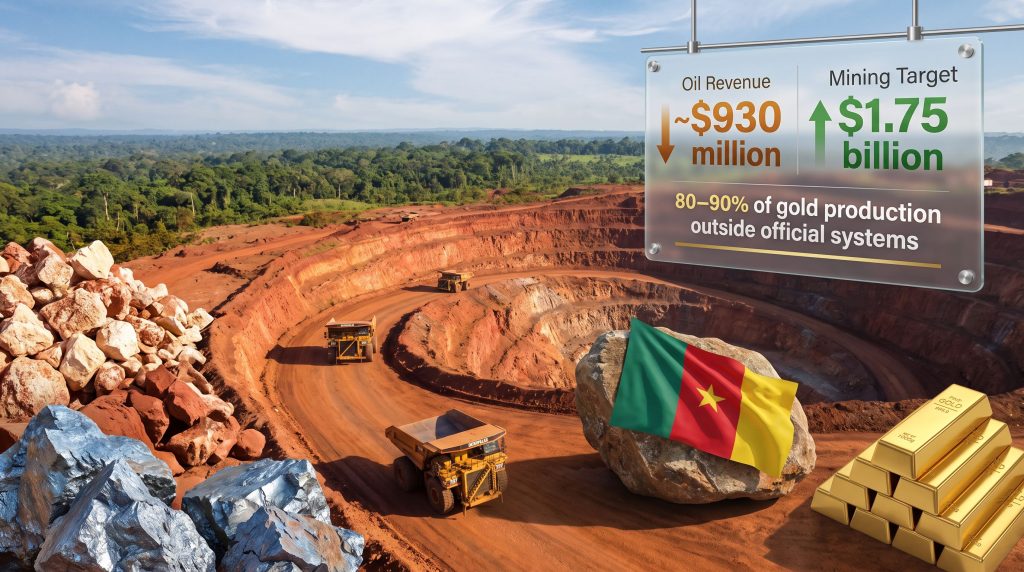
These figures, cited by the US International Trade Administration, reveal just how exposed Cameroon's public finances remain to a sector that is simultaneously contracting. Oil output is projected to decline by 12.2% year-on-year in 2026, with suppressed production levels expected to persist through at least 2028. The anticipated oil revenue for 2026 stands at approximately $930 million (CFA 563.1 billion), a figure that reflects both volume decline and the structural limits of ageing field infrastructure.
What makes this particularly consequential is that Cameroon's oil fields are mature. There is no large undeveloped frontier discovery waiting to reverse the production curve. The depletion trajectory is structural, not cyclical. Furthermore, the resource export challenges faced by other commodity-dependent nations offer a sobering reminder of how quickly fiscal positions can deteriorate when extraction rates fall.
Why $1.75 Billion from Mining Is Both Ambitious and Achievable
The government's annual mining revenue target of $1.75 billion (1 trillion CFA francs) would represent nearly double the projected 2026 oil revenue. Given that solid minerals currently contribute only around 1% of GDP, the scale of transformation required is substantial. Yet the pathway is more concrete than similar aspirations in other frontier mining jurisdictions.
According to Reuters, three simultaneous mechanisms are intended to drive the revenue crossover:
- Large-scale project commissioning across bauxite, iron ore, and gold, converting known deposits into active revenue-generating operations
- Gold sector formalisation, recovering fiscal receipts from a segment of the industry that had been operating almost entirely outside official collection systems
- Critical minerals development, targeting rare earth elements as a longer-term revenue multiplier aimed at eventually doubling annual mining income
Each mechanism operates on a different timeline and carries distinct execution risks. Together, they form a layered revenue strategy that is more diversified than a simple reliance on a single commodity boom. In addition, the rising critical minerals demand globally provides a favourable external backdrop for Cameroon's ambitions.
| Revenue Source | Near-Term Target | Longer-Term Potential |
|---|---|---|
| Bauxite (Minim-Martap) | First exports Q4 2026 | Full production at 5Mt/year |
| Iron Ore (multiple projects) | Advancing through 2026 | Three additional projects in pipeline |
| Gold (formalised sector) | ~$692M recovery targeted | Sustained royalty and tax base |
| Critical Minerals | Exploration stage | Up to $3.5B annual contribution |
The Five Projects Anchoring Cameroon's Mining Revenue Push
Mines Minister Fuh Calistus Gentry confirmed that five major operations have either commenced production or entered the commissioning phase. Each plays a distinct role in the overall revenue architecture:
- Minim-Martap Bauxite Project — Cameroon's flagship aluminium feedstock development and the highest-profile investment in the current portfolio
- Bipindi Grand-Zambi Iron Ore Project — targeting coastal-accessible iron ore reserves in the southern region
- Kribi-Lobé Iron Ore Development — strategically linked to Cameroon's deep-water port infrastructure at Kribi, reducing export logistics complexity
- Bidzar Marble Project — an industrial minerals contributor providing diversification within the non-metallic minerals space
- Colomine Gold Mine — the primary formal gold production asset in the current portfolio
Beyond these five, the minister indicated that iron ore projects at Mbalam, Nkout, and Ngovayang are expected to advance through 2026, alongside the Mborguene and Bibemi gold developments. This pipeline extends the revenue runway considerably beyond the initial five-project cluster.
Minim-Martap: The Bauxite Project That Defines Cameroon's Mining Ambitions
Of all the projects in Cameroon's portfolio, Minim-Martap attracts the most international attention and carries the greatest individual revenue significance. A mining agreement exceeding $2 billion in value was executed in 2024, covering an initial 20-year operating horizon targeting 99.1 million tonnes of proven high-grade bauxite reserves.
The capital structure for the project is phased and instructive. Reaching 2 million tonnes per annum (Mtpa) of production capacity requires approximately $158 million in capital investment, while scaling to 5 Mtpa demands a proportionally larger commitment. Full expansion to 10 Mtpa would require up to $446 million in total capital deployed.
Trial mining is scheduled to begin in Q3 2026, with the first shipment targeted for Q4 2026. This timeline matters enormously for the government's fiscal projections. A mine in trial production generates different fiscal receipts than one at steady-state commercial operations, meaning the revenue contribution in year one will be materially lower than the steady-state figure. Understanding bauxite production and importance within the global aluminium supply chain helps contextualise why this project commands such attention from international investors.
From an investor perspective, the gap between project announcement and full commercial revenue realisation is consistently underestimated in frontier mining markets. Projects frequently encounter infrastructure bottlenecks, permitting delays, or ramp-up challenges that compress early fiscal contributions significantly below projected levels.
The Gold Sector: A Fiscal Leak Being Forcibly Closed
Perhaps the most immediately actionable component of Cameroon's revenue strategy involves not a new mine, but the recovery of income that should already have been flowing into government coffers. The scale of what authorities describe as systematic evasion is striking.
Government figures indicate that between 80% and 90% of gold produced by semi-mechanised operators had been bypassing official collection channels entirely before recent enforcement actions began. This suggests that Cameroon's true gold production has been substantially higher than figures appearing in official export records for an extended period.
The enforcement response has been rapid and far-reaching:
- More than 200 illegal operators have been formally identified
- 137 companies have been referred to court proceedings
- All semi-mechanised mining permits have been suspended pending compliance reviews
- Joint enforcement operations are scheduled to commence on 1 August 2026
The financial recovery targets are substantial:
| Assessment Period | Projected Recovery Amount |
|---|---|
| 2025 Production Reassessment | ~$166.5 million (CFA 95 billion) |
| 2026 Production Reassessment | ~$525.6 million (CFA 300 billion) |
| Combined Recovery Target | ~$692 million (CFA 395 billion) |
The Hidden Complexity of Gold Formalisation in West and Central Africa
What is less commonly understood is the structural reason why artisanal and semi-mechanised gold sectors in Central Africa so frequently operate outside formal systems. Gold, unlike bauxite or iron ore, is highly portable, easily traded across borders, and has a well-established informal purchasing network that predates modern regulatory frameworks by generations.
This is not simply a law enforcement problem. It is partly a function of how artisanal gold supply chains are structured globally. Licensed buying offices, transit traders, and refinery networks that accept undocumented gold have created parallel markets deeply embedded in local economies. Disrupting these networks generates immediate fiscal gains but also creates displacement effects that governments must manage carefully.
The Cameroonian government faces a genuine tension: aggressive enforcement maximises short-term revenue recovery but risks pushing operators further underground or across borders if legitimate pathways back into the formal sector are not clearly defined. The social dimension of this crackdown, affecting thousands of workers in artisanal and semi-mechanised communities, will determine whether formalisation creates a durable revenue base or simply produces a one-time enforcement dividend.
Cameroon Within the CEMAC Framework: Why This Shift Matters Regionally
Cameroon's economic weight within the Central African Economic and Monetary Community (CEMAC) makes this transition significant far beyond its borders. The country accounts for more than 40% of CEMAC's total economic output, according to World Bank estimates, within a six-nation bloc that includes Chad, Gabon, Equatorial Guinea, the Central African Republic, and the Republic of Congo.
Several of these neighbours are themselves hydrocarbon-dependent and facing similar structural pressures from declining production. A successful mining diversification in Cameroon would create a demonstration effect with significant regional implications. The dynamics bear some resemblance to pressures seen in the China steel and iron ore market, where structural shifts are reshaping global commodity flows and creating new opportunities for emerging suppliers.
The Kribi deep-water port, already linked to two of Cameroon's iron ore projects, has broader significance as a potential regional export hub for landlocked neighbours. Infrastructure investments anchored by Cameroon's mining expansion could generate regional economic spillovers that amplify the domestic fiscal impact considerably.
The next major ASX story will hit our subscribers first
The Value-Addition Question: Export Raw Ore or Build Processing Capacity?
One of the most consequential strategic decisions Cameroon faces is whether to primarily export raw mineral ore or invest in downstream processing that captures more value domestically. This question is not unique to Cameroon; it is the defining policy debate for mineral-rich African nations in the current cycle.
Guinea provides the most instructive regional precedent. Its government has exerted increasing pressure on international investors to construct domestic alumina refinery capacity rather than continuing to export raw bauxite. The approach has generated significant friction with international mining companies but has also attracted genuine commitment from investors who see long-term value in integrated supply chain positions.
For Cameroon, the calculus involves several layers:
- Bauxite refining into alumina requires substantial energy inputs, and Cameroon's power supply constraints make this immediately challenging at scale
- Iron ore value-addition through pelletising or direct reduction would require investment well beyond current project commitments
- Gold processing to dore or refined bars is more achievable in the near term and could be mandated through licensing conditions
The downstream processing question will shape how much of the projected $1.75 billion in mining revenue actually stays within Cameroon's domestic economy versus flowing offshore.
Critical Minerals and the $3.5 Billion Long-Term Ceiling
Beyond the current project portfolio, the Cameroonian government has identified rare earth elements and other critical minerals as the pathway to eventually doubling mining's annual revenue contribution to approximately $3.5 billion (2 trillion CFA francs). This longer-term ambition is grounded in genuine geological potential but faces a considerably longer development runway. Consequently, Cameroon's positioning within global rare earth supply chains will be a critical factor in whether this ceiling is ultimately achievable.
Critical minerals relevant to Cameroon's geological profile include materials used in:
- Permanent magnets for wind turbines and electric vehicle motors
- Battery cathode materials for lithium-ion energy storage
- Defence electronics and aerospace components
- Advanced semiconductor manufacturing
The strategic significance of these materials has intensified considerably as Western governments and manufacturers seek to reduce supply chain concentration in China. This geopolitical dynamic creates a favourable backdrop for new entrants with credible geological endowments, though the pathway from deposit identification to commercial rare earth production is typically measured in decades rather than years.
"The rare earth sector requires a degree of technical sophistication in processing that far exceeds conventional metal mining. Unlike iron ore or bauxite, rare earth concentrates must undergo complex separation processes to produce individual elements, and building domestic processing capacity represents a multi-billion dollar industrial commitment."
Key Risks That Could Prevent the Revenue Crossover
The government's $1.75 billion target represents a carefully constructed projection, but each assumption embedded within it carries independent execution risk. As analysts at Cameroon Online have noted, this historic pivot carries both extraordinary promise and genuine structural uncertainty.
Infrastructure constraints remain the most persistent bottleneck. Cameroon's mineral deposits are frequently located in remote interior regions where road and rail connections to coastal export terminals are either inadequate or non-existent. The Minim-Martap bauxite project's first-shipment timeline for Q4 2026 is contingent on transport infrastructure performing as planned.
Power supply reliability affects both mine operations and any processing ambitions. Electricity constraints have been cited repeatedly as an operational challenge across Cameroon's industrial base.
Gold enforcement collection risk is distinct from the enforcement operations themselves. Identifying and prosecuting non-compliant operators does not automatically translate into cash recovered. The government's ability to actually collect the approximately $692 million in assessed liabilities depends on the financial capacity of cited companies and the speed of court proceedings.
Commodity price volatility affects all three primary mineral categories simultaneously. A sustained softening in iron ore prices, bauxite demand, or gold would compress royalty and export tax receipts below projected levels regardless of production volumes achieved.
Regulatory consistency is a long-standing concern for international investors evaluating frontier mining jurisdictions. The gold sector crackdown, while fiscally rational, introduces short-term unpredictability into the investment environment that could affect capital allocation decisions for new projects.
Key Takeaways: What Investors and Policymakers Should Watch
- $1.75 billion annual mining revenue target represents approximately double the projected 2026 oil revenue of ~$930 million
- Five projects are actively in production or commissioning, with three additional iron ore developments and two gold projects advancing through 2026
- 80–90% of semi-mechanised gold production had been bypassing official collection systems, creating a substantial but uncertain recovery opportunity
- ~$692 million in gold-related tax and customs recoveries are targeted across 2025–2026 assessment periods, with actual collection dependent on enforcement capacity
- The Minim-Martap bauxite project, anchored by 99.1 million tonnes of proven reserves and a $2 billion+ mining agreement, is the single most significant individual investment in the portfolio
- Critical minerals development represents the pathway to a longer-term $3.5 billion annual revenue ceiling, though the development timeline extends well beyond the current project portfolio
- Infrastructure, power supply, and regulatory consistency remain the three structural constraints most capable of delaying the Cameroon mining revenue to overtake oil target
Disclaimer: This article is intended for informational purposes only and does not constitute financial or investment advice. Government revenue projections represent targets rather than guaranteed outcomes. Actual mining revenue realisation will depend on multiple operational, regulatory, and market variables. Readers should conduct independent research before making investment decisions related to any sector or jurisdiction discussed.
Ready to Capitalise on the Next Major Mineral Discovery Before the Market Does?
Cameroon's ambitious shift toward solid minerals revenue reflects a broader global trend of emerging resource opportunities that sophisticated investors cannot afford to miss — Discovery Alert's proprietary Discovery IQ model instantly identifies significant ASX mineral discoveries the moment they are announced, transforming complex data across 30+ commodities into clear, actionable insights. Explore historic discoveries and their exceptional returns, then begin your 14-day free trial at Discovery Alert to position yourself ahead of the market.