July 17, 2026
The Hidden Architecture of Supply Chain Fragility: Why Critical Minerals Have Become the New Oil
When historians look back at the early decades of the twenty-first century, they may well identify critical mineral security and export restrictions as the defining geopolitical fault line of the era. Not because these materials are scarce in absolute terms, but because of how extraordinarily concentrated their processing and refining have become within a single dominant geography. The current moment bears a striking resemblance to the oil shocks of the 1970s, when the world discovered, painfully, that dependence on a narrow set of suppliers for a foundational input carries systemic economic risk.
The difference today is that the materials in question underpin not just energy, but the entire architecture of modern manufacturing, defence, and clean technology. Understanding this risk requires moving past the familiar narrative of "who mines what" and examining a more consequential question: who refines, processes, and converts raw ore into the intermediate and finished materials that manufacturers actually need.
When big ASX news breaks, our subscribers know first
The Real Vulnerability: Refining Concentration vs. Mining Diversity
A common misconception in public discourse around critical mineral security and export restrictions is that diversifying mining output is equivalent to diversifying supply chains. It is not. Mining is the lowest-value stage of the supply chain. The strategic chokepoints sit further downstream, in the refineries, chemical processing plants, and manufacturing facilities that transform ore into battery-grade materials, permanent magnets, and semiconductor inputs.
This distinction matters enormously when assessing actual exposure. Consider the following supply concentration data across key minerals:
| Mineral | Dominant Supplier | Refining Share (2025 est.) | Export Restriction Exposure |
|---|---|---|---|
| Rare Earth Elements | China | ~85% | ~46% of global trade |
| Graphite | China | ~70%+ | ~47% of exports |
| Cobalt | China (refining) | High | Up to 67% of trade (2021-2023) |
| Nickel | Indonesia (mining) | 75%+ of supply growth | Moderate |
| Manganese | Single dominant supplier | Near-total growth share | Elevated |
| Germanium and Magnesium | China | ~90%+ | Subject to export bans |
The pattern is consistent across categories: a single nation controls the majority of processing capacity for most energy transition minerals. Furthermore, even where mining activity is more geographically distributed, refining remains concentrated to a degree that renders upstream diversity largely irrelevant during a supply disruption. The critical minerals demand surge anticipated through 2025 and beyond only intensifies this structural vulnerability.
The Upstream-Downstream Mismatch: A Structural Blind Spot
Analysis of project pipelines outside the dominant supplier reveals a particularly concerning structural imbalance. Investment in diversification is heavily weighted toward mining, while refining and downstream manufacturing capacity expansion lags far behind.
In rare earth supply chains, planned refining capacity outside the dominant supplier reaches only approximately two-thirds of projected mine output by 2035. Planned magnet manufacturing capacity amounts to just one-third. This upstream-downstream mismatch is arguably the defining structural vulnerability of current diversification efforts worldwide.
This means that even if every announced mining project outside China proceeds on schedule, the world will still lack the processing infrastructure to convert that ore into usable materials. Digging more holes in the ground, without the corresponding investment in downstream capacity, does not constitute a resilient supply chain.
Export Restrictions: From Trade Policy Tool to Geopolitical Weapon
The proliferation of export controls on critical raw materials has been one of the most consequential and underreported shifts in global economic policy over the past five years. What began as occasional resource nationalism has evolved into a sophisticated toolkit for geopolitical leverage. The energy security in critical minerals debate has, consequently, moved from academic circles into the boardrooms of major manufacturers worldwide.
The scale of this shift is significant:
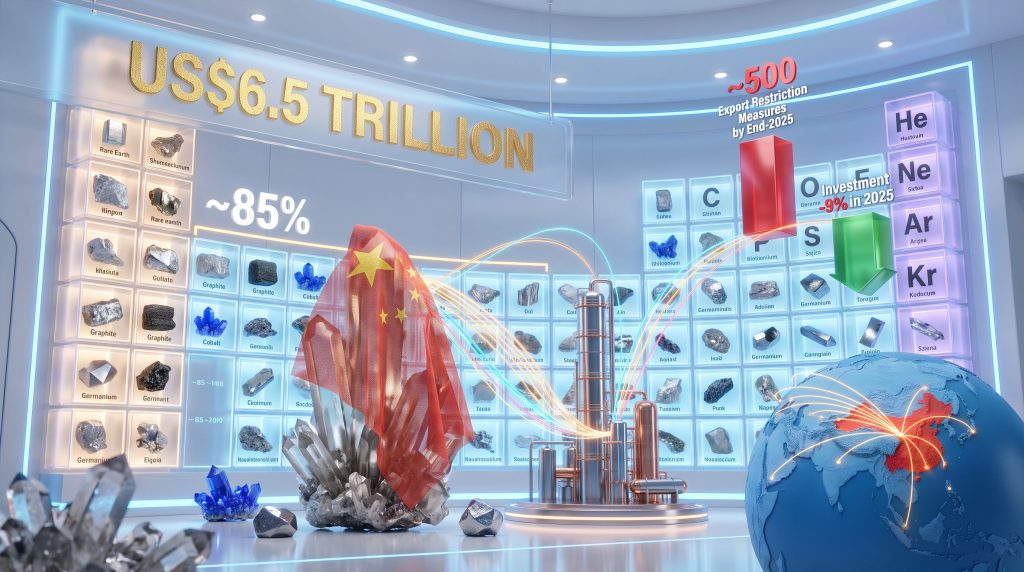
- Cumulative export restriction measures on critical raw materials reached nearly 500 by end-2025, more than double the approximately 200 recorded in 2020
- Over 40 countries have introduced new critical mineral export restrictions since 2020
- Approximately 16% of critical raw material trade monitored by the OECD now faces at least one active restriction
- 86% of post-2020 export controls target processed and intermediate materials, not raw ores, reflecting a deliberate strategy to retain downstream manufacturing advantage
That final statistic deserves emphasis. The deliberate targeting of intermediate and refined materials signals that export controls are not simply about controlling the ground beneath a nation's feet. They are about controlling the knowledge, infrastructure, and industrial capacity required to make something useful from what comes out of the ground. According to OECD analysis, these rising restrictions are increasingly destabilising global supply chains in ways that were not anticipated even five years ago.
China's Export Control Escalation: A Chronological Framework
China's rare earth export restrictions have followed an escalating and increasingly sophisticated pattern, timed to coincide with wider geopolitical tensions:
| Mineral or Material | Policy Action | Date | Strategic Context |
|---|---|---|---|
| Gallium, Germanium, Antimony | Export ban to the US | December 2024 | Response to US semiconductor restrictions |
| Rare Earths (7 elements: samarium, gadolinium, terbium, dysprosium, lutetium, scandium, yttrium) | Export licensing required | April 2025 | Response to US tariff escalation |
| Tungsten, Indium, Bismuth, Tellurium, Molybdenum | Export licensing required | February 2025 | Targeting defence, clean energy, and battery sectors |
| Rare Earths (5 additional: holmium, erbium, thulium, europium, ytterbium) | Export licensing required | November 2025 | Expanding control to medium and heavy REEs |
| Synthetic Graphite | Expanded export controls | November 2025 | Critical battery anode material |
| Foreign-made products containing 0.1% or more Chinese REEs | Licensing requirement | October 2025 | Modelled on US Foreign Direct Product Rule |
The November 2025 suspension of controls on five mineral categories following diplomatic engagement should not be interpreted as a retreat. It illustrates precisely the opposite: that export restrictions function as negotiable geopolitical leverage, capable of being deployed, withdrawn, and redeployed according to strategic calculus. Businesses and governments that model supply chain risk on the assumption that a temporary suspension signals permanent policy reversal are likely to be caught off guard.
Quantifying the Economic Exposure: What Is Actually at Stake
Abstract discussions of supply concentration become far more concrete when translated into economic terms. The IEA's 2026 Global Critical Minerals Outlook provides a headline figure that commands attention: an estimated US$6.5 trillion in annual downstream production outside China could be placed at risk if China's October 2025 rare earth export control expansion is fully enacted following its one-year delay.
That figure spans automotive, defence, electronics, and clean energy manufacturing sectors globally. It is not a hypothetical worst-case scenario constructed for effect; it reflects the actual downstream value of manufacturing processes that depend on rare earth inputs.
Real-world disruptions have already occurred. Rare earth export controls introduced in April 2025 forced certain automakers to reduce production output or temporarily suspend operations. The rare earth processing challenges exposed by these disruptions have further highlighted the near-total absence of viable alternative processing infrastructure outside China in battery-grade graphite, in particular.
The Cost Absorption Argument: Why the Security Premium Is Economically Manageable
One of the more counterintuitive findings from IEA analysis concerns the economics of supply chain diversification. Critical minerals typically represent a very small fraction of final product prices, which means the additional cost of sourcing from diversified, higher-cost suppliers is far more absorbable than the political resistance to diversification might suggest.
| Product | Critical Mineral Share of Component Cost | Critical Mineral Share of Final Product Price |
|---|---|---|
| Electric Vehicle Battery Cell | ~25% of cell cost | ~3% of total EV price |
| Permanent Magnet (rare earths) | ~40% of magnet cost | Less than 1% of vehicle value |
This reframes the entire cost-benefit calculus. The additional expenditure associated with diversified sourcing should be understood as a mineral security premium: a form of structural insurance against supply disruption in an era of elevated geopolitical risk. At less than 3% of final product value in key sectors, this premium is economically absorbable for most manufacturers.
Investment Contraction: A Warning Signal the Market Is Sending
Despite the urgency of the supply challenge, critical mineral sector investment declined 9% in 2025, ending several consecutive years of growth. Price volatility and geopolitical uncertainty are the primary deterrents to new capital deployment. Ironically, as investment fell, commodity prices for critical minerals rebounded in 2025 and into early 2026 as supply conditions tightened, a dynamic that may eventually attract renewed capital flows if sustained.
Public finance has partially compensated for private sector hesitation. Public finance commitments to critical mineral supply chain development more than quadrupled between 2023 and 2025, reaching US$65 billion in total. Progress in copper and lithium project pipelines has advanced sufficiently to narrow projected demand-supply gaps over the next decade.
However, this public finance is disproportionately directed toward mining-stage projects, reinforcing the structural imbalance already identified. Refining and downstream capacity continue to receive a fraction of the capital being deployed at the extraction stage. Efforts to address this imbalance are also complicated by challenges around European critical raw materials supply, where refining infrastructure remains significantly underdeveloped relative to projected demand.
Strategic Minor Minerals: The Overlooked Dimension of Supply Security
Among the most underappreciated findings in recent analysis is the vulnerability concentrated in what are termed strategic minor minerals: materials for which global markets are small by volume, but where supply disruption would carry an outsized economic impact relative to market size.
These minerals rarely feature in mainstream supply chain discussions precisely because their markets are small and their names are unfamiliar outside specialist circles. Yet they underpin critical functions across defence electronics, aerospace components, and advanced manufacturing systems. The policy opportunity here is significant: IEA analysis indicates that despite extremely high supply concentration in these categories today, meaningful progress on supply security is achievable at a relatively contained cost, provided coordinated international policy frameworks and sustained financial support are in place.
The next major ASX story will hit our subscribers first
What Genuine Supply Chain Resilience Actually Requires
Resilience in critical mineral supply chains is not a single intervention; it is a layered structural challenge requiring coordinated action across multiple dimensions. Four foundational requirements stand out:
- Geographic diversification across all supply chain stages, not just at the mining level, extending through refining, processing, and downstream manufacturing
- Technology and equipment access, addressing the reality that outside China, only a handful of suppliers provide key battery-grade graphite and rare earth processing equipment, typically at significantly higher costs and with extended lead times
- Workforce development, building the specialised technical expertise required for advanced mineral processing, a constraint that capital investment alone cannot resolve
- Emergency preparedness frameworks, establishing strategic stockpiles and coordinated response protocols before a supply crisis occurs rather than in reaction to one
Rare Earths as a Proof of Concept: What Progress Looks Like
The rare earth sector provides the clearest evidence that diversification is achievable with sufficient policy commitment. China's share of rare earth refining declined from over 90% in 2023 to approximately 85% in 2025, driven by new US-based refining projects and expanded production capacity in Malaysia. If all currently planned projects proceed on schedule, that share is projected to fall to approximately 70% by 2035.
This is meaningful progress, though it also illustrates the time horizons involved. Structural diversification in mineral supply chains is measured in decades, not quarters. Governments and businesses that have not already begun the process are operating with a significant lag. The IEA has noted that these new export controls are transforming what were once theoretical concentration risks into immediate operational realities for manufacturers worldwide.
Frequently Asked Questions: Critical Mineral Security and Export Restrictions
What are critical mineral export restrictions and why are they increasing?
Export restrictions are government-imposed controls on the sale or shipment of specific materials to foreign buyers. They are increasing because mineral-rich nations have recognised that processing and refining capacity represents enormous strategic leverage in an era when clean energy technology, defence systems, and advanced electronics all depend on the same narrow set of inputs.
Which minerals face the highest supply concentration risk in 2025 and 2026?
Rare earth elements, graphite, germanium, magnesium, and cobalt face the most acute concentration risk, with a single supplier controlling between 70% and 90% or more of global refining capacity in each category.
What is the difference between mining diversification and refining diversification?
Mining diversification refers to expanding the number of countries extracting raw ore. Refining diversification refers to expanding the number of countries with the processing infrastructure to convert that ore into usable materials. The latter is far more strategically significant and far more difficult to achieve.
Can the global economy absorb the cost of critical mineral supply chain diversification?
Based on IEA analysis, yes. Because critical minerals represent a very small share of final product prices in most key sectors, the additional cost of diversified sourcing is economically manageable. The challenge is political and structural, not purely economic.
How do export controls on processed materials differ from controls on raw ores?
Controls on processed materials are more strategically potent because they prevent competitor nations from building independent manufacturing capacity. Controlling ore exports limits a buyer's access to raw material; controlling processed material exports limits their ability to manufacture finished products at all. This distinction sits at the heart of critical mineral security and export restrictions policy debates globally.
The Path Forward: Sequencing Policy Action Effectively
Short-term priorities should focus on emergency preparedness: strategic stockpile development, supply disruption response protocols, and mapping of single-source dependencies across critical manufacturing sectors.
Medium-term priorities must address the downstream capacity gap directly, using public finance instruments to incentivise investment in refining and processing infrastructure outside currently dominant geographies.
Long-term structural priorities centre on technology sovereignty and workforce development. The equipment bottlenecks and skills gaps that constrain non-Chinese processing capacity cannot be resolved through capital alone; they require sustained investment in industrial knowledge and technical training pipelines.
International coordination amplifies the effectiveness of all these interventions. Unilateral national policies can make progress at the margins, but the scale of the structural challenge in critical mineral security and export restrictions is such that coordinated multilateral frameworks consistently deliver better outcomes than fragmented individual efforts.
Readers seeking primary-source data and analysis on global critical mineral supply chains are encouraged to explore the IEA's Global Critical Minerals Outlook series, published annually, alongside related reporting from Global Mining Review. These resources provide the foundational quantitative and policy context underpinning the dynamics discussed in this article.
Want to Know When Critical Mineral Discoveries Hit the ASX?
Discovery Alert's proprietary Discovery IQ model scans ASX announcements in real time, delivering instant alerts on significant mineral discoveries across rare earths, graphite, cobalt, and the full spectrum of critical minerals reshaping global supply chains — turning complex data into actionable investment insights. Explore historic examples of major mineral discoveries and their market returns, then begin your 14-day free trial at Discovery Alert to position yourself ahead of the market.