
July 17, 2026
The Architecture of a Supply Crisis: Why Two Chokepoints Are Rewriting Energy Risk
Most energy market risk models are built around a single point of failure. Analysts assign probability weights to disruption scenarios, model rerouting capacity, and conclude that the global oil system is resilient enough to absorb localised shocks. That framework has served reasonably well for decades. However, it was designed for a world where, if one maritime corridor became compromised, another remained available as a functional alternative.
That assumption is now being tested in real time, with red sea shutdown risk oil prices becoming a central concern for energy markets worldwide.
When big ASX news breaks, our subscribers know first
Understanding What the Red Sea Actually Moves
The Bab el-Mandeb Strait sits at the southern tip of the Arabian Peninsula, separating Yemen from Djibouti and Eritrea. It is narrow, shallow in parts, and geographically unavoidable for any vessel attempting to move cargo between the Indian Ocean and the Mediterranean via the Suez Canal.
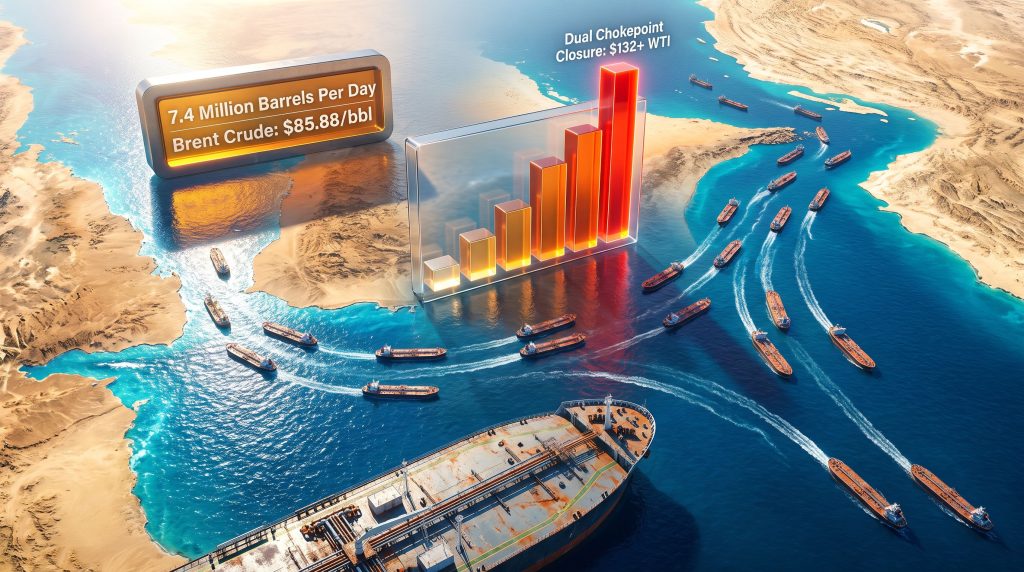
In June 2026, Kpler vessel-tracking data recorded approximately 7.4 million barrels of crude and refined petroleum transiting the strait every single day. That figure represents roughly 7% of the world's total daily oil supply moving through a waterway that, at its narrowest point, is less than 30 kilometres wide.
For context, consider what that volume actually means in practice:
- European refiners depend heavily on Red Sea-routed crude from the Persian Gulf and East Africa
- Asian exporters use it as a westbound corridor for refined products
- The canal connection makes it the most economically efficient route between production centres and consuming markets in Europe and South Asia
Under normal operating conditions, the Red Sea is a critical but manageable component of the global logistics network. What has changed in 2026 is that the Strait of Hormuz, the primary exit route for Persian Gulf crude, is no longer functioning normally.
Kpler tracking data confirmed that just seven ships transited Hormuz on a single day in mid-July 2026, compared to 13 vessels the previous day. Of those seven transits, four were inbound vessels, meaning only three tankers exited the Gulf carrying cargo. That is a dramatic reduction in throughput for a corridor that, under normal conditions, handles approximately 20% of global oil supply.
How Hormuz Compression Made the Red Sea Indispensable
The partial closure of the Strait of Hormuz did not eliminate Gulf crude exports. It rerouted them. Saudi Arabia, with existing pipeline infrastructure connecting its eastern fields to the Red Sea port of Yanbu on its western coast, redirected approximately 70% of its crude exports through this overland-to-sea pathway.
This shift transformed the Red Sea from a secondary corridor into the primary functional escape route for Gulf oil production. The geopolitical oil supply risks are straightforward to understand: if Hormuz is constrained and the Red Sea is closed simultaneously, the Gulf's ability to export crude to global markets is effectively neutralised.
This is the core of what analysts are now describing as a dual-chokepoint risk, and it is a scenario with no direct modern historical parallel.
The compounding logic of dual-chokepoint risk is not additive. It is multiplicative. Blocking a backup route when the primary route is already constrained does not create twice the disruption. It creates a near-total supply cutoff.
The Geopolitical Trigger Mechanism
The current risk escalation traces directly to the collapse of a month-long interim truce between the United States and Iran. Following that breakdown, Iran reportedly instructed Yemen's Houthi militant network to position itself for activation of Red Sea interdiction operations, with the specific trigger being any US military strike targeting Iranian power infrastructure.
This is a conditional escalation structure, not an open-ended threat. It establishes a clear threshold event and a pre-planned response, which is analytically significant because it means the trigger is specific, observable, and potentially rapid in its consequences.
The Houthi Capability Question
The Houthi movement has demonstrated, through prior maritime interdiction campaigns, a meaningful operational capacity to disrupt commercial shipping in the Red Sea corridor. The strategic logic of targeting Bab el-Mandeb as an instrument of asymmetric pressure against US foreign policy objectives is well-established. Furthermore, Red Sea shipping disruptions have already shown their capacity to drive meaningful price responses in global energy markets.
What makes the current moment different from earlier Houthi disruption episodes is the context in which it would occur. Previously, Hormuz remained open, rerouting was viable, and the supply shock was manageable. That context no longer applies.
Freight operators have already begun routing vessels around southern Africa to avoid the Red Sea corridor, and war-risk insurance premiums for Red Sea-transiting vessels have escalated significantly, functioning as a real-time market signal of perceived closure probability.
An analyst at Guotai Haitong Futures assessed a military strike targeting the passage as a credible near-term risk, noting specifically that such an action would generate US consumer inflation and create domestic political headwinds, which itself serves as a strategic incentive for adversaries seeking to apply pressure on US policymakers.
Price Scenario Modelling: What Closure Would Actually Cost
Brent crude was trading near $85.88 per barrel in mid-July 2026, reflecting a 21% rally since early July. The oil price rally observed in recent months is not purely a reaction to existing disruption — it is pricing in the probability of future disruption, a fundamentally different and more volatile market dynamic.
The table below summarises the key price scenarios currently being modelled by analysts and energy research firms:
| Scenario | Brent Price Range | Core Assumptions |
|---|---|---|
| Threat Premium Only (current baseline) | $85 to $95/bbl | Uncertainty pricing with no physical volume disruption |
| Partial Red Sea Disruption | +$3 to $4/bbl above baseline | Rerouting absorbs most volume; freight costs rise materially |
| Full Bab el-Mandeb Blockade | $130 to $150/bbl | Red Sea closed while Hormuz remains constrained |
| Dual Chokepoint Closure | $132+/bbl (WTI) | Near-total Gulf export cutoff; severe supply shock |
Sources: Kpler vessel-tracking data, Rystad Energy modelling, analyst consensus estimates. Price projections are forward-looking estimates and should not be construed as investment advice.
Rystad Energy's modelling of a combined Hormuz-Red Sea closure scenario projects Brent above $150 per barrel, a figure that would represent one of the most severe supply shocks in modern energy market history.
How the Shock Actually Transmits Through the System
Understanding why prices would spike at those levels requires tracing the transmission mechanism step by step:
- Volume displacement: 7.4 million barrels per day removed from efficient routing, requiring alternative pathways that add cost and time
- Insurance premium escalation: War-risk surcharges make some routes economically unviable for operators, effectively removing vessels from the active fleet
- Freight cost inflation: Rerouting around the Cape of Good Hope adds approximately 10 to 14 days of additional transit time per voyage, reducing effective tanker supply
- Refinery feedstock stress: European and Asian refiners face delayed crude deliveries, forcing inventory drawdowns and spot market competition
- Consumer price transmission: Elevated crude costs flow through to retail fuel and petrochemical pricing within approximately 4 to 6 weeks
The strategic petroleum reserve (SPR) release mechanism exists as a partial buffer, but it is time-limited and finite. A prolonged closure would exhaust SPR capacity before diplomatic resolution becomes achievable, making coordinated International Energy Agency member releases the most credible collective response tool available.
Why Historical Analogies Only Go So Far
Energy market participants instinctively reach for historical comparisons when assessing disruption scenarios. The table below maps key precedents against the current situation:
| Event | Chokepoints Affected | Peak Price Spike | Disruption Duration |
|---|---|---|---|
| 1973 Arab Oil Embargo | Suez Canal (partial) | Approximately +70% | Around 6 months |
| 1979 Iranian Revolution | Hormuz (partial) | Approximately +150% | Around 18 months |
| 1990 Gulf War | Hormuz (threatened) | Approximately +100% | Around 7 months |
| 2026 US-Iran Escalation | Hormuz + Red Sea (simultaneous) | Modelled at +75% to +100%+ | Ongoing |
The critical structural difference in 2026 is the simultaneity of the dual-chokepoint threat. Each of the historical episodes involved a single primary corridor under stress, with alternatives available. The current scenario involves the primary corridor (Hormuz) already operating at severely reduced capacity whilst the backup corridor (Red Sea) faces credible interdiction risk.
Goldman Sachs had previously argued that Red Sea disruptions were manageable because rerouting options existed. That thesis was conditionally valid when Hormuz remained fully operational. However, under dual-chokepoint conditions, the rerouting argument is structurally invalidated because there is no third viable routing option for Gulf crude at current volumes. In addition, the trade war impact on oil has already introduced further pricing volatility into an already fragile market environment.
The 2026 scenario does not fit cleanly into any prior disruption template. The closest analogues involved either one chokepoint or the other being threatened, never both simultaneously under conditions where one was already compromised.
The next major ASX story will hit our subscribers first
Downstream Consequences Beyond the Crude Price
Inflationary Transmission
Energy costs are embedded throughout the modern economy. A sustained crude price spike at the levels being modelled would transmit into:
- Transportation costs across road, sea, and air freight
- Agricultural input costs, particularly for fertilisers and mechanised farming
- Manufacturing energy costs, particularly for energy-intensive industries
- Heating and electricity costs for residential and commercial consumers
The political economy dimension is particularly relevant. A US administration managing both an active Iran confrontation and a domestic inflation spike faces competing pressures that could constrain military decision-making or accelerate diplomatic outreach.
Shipping and Insurance Market Stress
War-risk insurance premiums function as a real-time barometer of perceived threat severity. Elevated premiums do not merely reflect current conditions — they reshape operator behaviour by making some routes economically irrational to transit, effectively contracting the functional fleet size without any vessel being physically destroyed.
Container shipping rate contagion is a secondary effect worth monitoring. Historically, oil tanker disruptions spill over into broader freight markets as vessels and port capacity get reallocated, creating congestion and rate increases beyond the energy sector alone. Consequently, the risks to Red Sea oil exports extend well beyond crude pricing to affect the entire global trade ecosystem.
Asian and European Import Vulnerability
China, India, Japan, and South Korea collectively represent the largest volume consumers of Persian Gulf crude. A dual-chokepoint closure would affect these nations disproportionately given their geographic dependence on Gulf supply routed through either Hormuz or the Red Sea.
European energy security, already restructured following the withdrawal from Russian supply dependency, faces a second vector of vulnerability. The shift toward Middle Eastern supply as a replacement for Russian flows has inadvertently increased exposure to the exact geopolitical dynamic now materialising.
Key Indicators for Monitoring Escalation Risk
For energy market participants, the following leading indicators provide the most actionable real-time signals:
- Bab el-Mandeb and Hormuz vessel transit counts via Kpler and Vortexa tracking platforms
- War-risk insurance premium movements for Red Sea-transiting vessels, as a forward-looking closure probability signal
- Brent crude forward curve structure, specifically the depth of backwardation as a proxy for immediate supply stress
- US-Iran diplomatic activity, including any ceasefire negotiations or back-channel communication signals
- Houthi operational statements, which have historically preceded tactical escalations by 24 to 72 hours
Furthermore, from an investor positioning perspective, the current environment favours attention to:
- Energy sector equities with diversified routing and storage infrastructure
- Commodity futures as a hedging instrument under elevated geopolitical risk
- Refining margin dynamics, where downstream processors face compression risk when crude spikes outpace refined product price adjustments
- Shipping and logistics equities exposed to alternative routing demand, including Cape of Good Hope route operators
Rethinking the Single-Chokepoint Risk Model
The broader strategic lesson embedded in the current situation is that energy security frameworks calibrated on single-chokepoint risk are no longer adequate. The assumption that one corridor can substitute for another when threatened has been a foundational element of IEA and national energy security planning for decades. That assumption now requires revision.
Geopolitical escalation involving state-directed non-state actors introduces non-linear disruption risk that does not behave like a standard supply shortage. The speed of potential closure, the difficulty of military counter-response in a constrained theatre, and the absence of a third major routing alternative combine to create a tail-risk profile that is meaningfully different from anything modelled in prior disruption frameworks.
Moreover, the US-China oil price risks add another layer of complexity, as geopolitical rivalries between major powers could further constrain coordinated responses to a red sea shutdown risk oil prices scenario. OPEC market influence will also play a pivotal role in determining whether alternative supply sources can meaningfully offset any reduction in Gulf throughput.
For import-dependent economies, structural investment in supply diversification, strategic reserve deepening, and alternative energy infrastructure is increasingly a matter of energy security arithmetic rather than optional policy ambition. The red sea shutdown risk oil prices dynamic has, consequently, elevated dual-chokepoint preparedness from a theoretical concern to an urgent strategic priority.
The current environment represents a structural stress test of global energy logistics architecture. Participants modelling only linear price impacts may significantly underestimate their actual tail-risk exposure in a dual-chokepoint closure scenario.
Disclaimer: This article contains forward-looking price projections and analyst estimates that are inherently speculative and subject to rapid change based on geopolitical developments. Nothing in this article constitutes financial or investment advice. Readers should consult qualified financial professionals before making investment decisions. All price scenarios referenced are modelled estimates from publicly available research and should be interpreted within their stated assumptions.
For further reading on global energy chokepoint dynamics and maritime oil flow vulnerabilities, the U.S. Energy Information Administration (EIA) and the International Energy Agency (IEA) publish ongoing research and supply disruption scenario analysis available through their respective public platforms.
Want to Stay Ahead of the Next Major Commodity Discovery Driven by Geopolitical Disruption?
When energy market volatility reshapes commodity valuations, the opportunities emerging from mineral discoveries on the ASX can move just as fast — Discovery Alert's proprietary Discovery IQ model delivers real-time alerts the moment significant discoveries are announced, ensuring subscribers can act before the broader market catches on. Explore historic examples of extraordinary discovery returns and start your 14-day free trial today to position yourself at the forefront of the next major find.