May 15, 2026
The Shrinking Universe of Primary Silver Producers and Why It Matters Now
Across decades of commodity cycles, one structural reality has consistently shaped silver investment outcomes: supply cannot be switched on like a tap. Unlike oil or even copper, where marginal production can respond to elevated prices within a matter of months, silver's supply chain is deeply embedded in the economics of other metals. The global mining industry has not engineered a solution to this inelasticity, and the convergence of new industrial demand drivers with a tightening producer pool is creating conditions that reward concentrated ownership of high-quality primary assets.
Against this backdrop, the Americas Gold and Silver Galena mine turnaround represents one of the more compelling operational value-creation stories in the North American silver sector. The investment thesis does not rest on exploration optionality or speculative price forecasting. Instead, it is grounded in a demonstrable infrastructure upgrade cycle, a modernising mining method transition, and a resource base that has existed for over a century waiting for the right capital and operational framework to unlock it.
When big ASX news breaks, our subscribers know first
What Is Driving Structural Silver Demand Beyond Traditional Investment Flows?
Solar Energy and the Scale of Global Panel Manufacturing
The most quantifiable pillar of new silver demand is photovoltaic manufacturing. Silver paste is used in solar cell busbars and contacts, and while the industry has worked to reduce silver content per cell, the volume growth in total panel production has consistently outpaced any efficiency gains from thrifting. Nations across Europe, the Middle East, and Asia have accelerated their solar buildout programmes, partly in response to energy security concerns arising from geopolitical disruption to oil supply routes.
China's importation of significant silver volumes to support its panel manufacturing operations is now a material factor in the global silver balance. This dynamic reinforces the view that demand-side growth is structural rather than cyclical, and that further efficiency improvements in individual cells are unlikely to offset total consumption growth. Furthermore, silver supply deficits continue to widen as industrial applications multiply faster than mining output can respond.
AI Infrastructure, Data Centers, and an Unquantified Demand Driver
A less-discussed source of potential silver demand is the global buildout of artificial intelligence infrastructure. Data centres require enormous quantities of circuit boards, each of which contains silver in solder joints, contacts, and conductive pathways. While the industry has not yet produced widely accepted estimates for total silver consumption from this category, the sheer pace of data centre construction globally suggests this could become a meaningful demand component within the next three to five years.
It is worth noting that this demand driver remains speculative in terms of specific volume estimates. The concept is directionally sound given silver's irreplaceable role in electronic manufacturing, but investors should treat AI-related silver demand as an emerging thesis requiring further quantification rather than a confirmed figure in current supply-demand models.
Solid-State Battery Technology and the Toyota Factor
Toyota has announced plans to commercialise solid-state battery technology for its electric vehicles. Industry analysis suggests these batteries could require up to approximately 1 kilogram of silver per unit, a significant increase over the silver content in conventional lithium-ion batteries. Solid-state batteries offer approximately double the energy density of lithium-ion equivalents and eliminate the fire risk associated with liquid electrolytes, though current production costs remain elevated relative to existing technology.
If economies of scale are achieved and Toyota's rollout proceeds as planned, this single application could add a meaningful increment to global silver demand on an annualised basis. In addition, silver's industrial role across multiple sectors means that demand pressure is unlikely to ease regardless of developments in any single application.
Solid-state battery commercialisation represents a step-change in per-unit silver consumption. Unlike solar efficiency thrifting, which reduces silver per watt over time, battery adoption could increase per-unit silver requirements significantly as the automotive sector transitions away from lithium-ion chemistry.
Six Consecutive Years of Structural Deficit
The Silver Institute's annual supply and demand assessments have documented a structural deficit in the silver market for an extended period, with estimates suggesting the market has consumed between 150 and 200 million ounces more than it has produced annually for six consecutive years. This persistent imbalance has not triggered a proportionate supply response, which is the defining characteristic of a structurally constrained metal.
How Does Silver Supply Inelasticity Amplify the Case for Primary Producers?
The Byproduct Problem
Approximately 70% of global silver production is extracted as a byproduct of other mining operations, predominantly copper, zinc, and lead mines. This means that silver supply cannot respond independently to silver price signals. When silver prices rise, copper mines do not accelerate their operations to produce more silver. Their production decisions are governed by copper economics, capital programmes, and long-term mine plans that have nothing to do with the silver price.
This structural reality creates a persistent floor beneath silver supply growth and makes primary silver producers disproportionately important in any scenario where silver demand continues to expand. Consequently, silver supply constraints are increasingly influencing how institutional capital is being deployed across the sector.
Copper Mine Output and the Sulfuric Acid Constraint
Copper hydrometallurgical operations, which account for a significant proportion of global copper production, rely heavily on sulfuric acid for the leaching process. Sulfuric acid is partly derived from oil refining and industrial chemical processes, supply chains that are exposed to geopolitical disruption through key maritime chokepoints. Disruption to these supply chains can constrain copper mine throughput independent of the copper price.
Since copper mines are the largest single source of byproduct silver, any constraint on copper output has a proportionate impact on silver supply. Furthermore, silver as a critical mineral designation in the United States underscores the strategic vulnerability that byproduct dependency creates for domestic supply security.
The Investable Primary Silver Producer Universe
The pool of investable, publicly traded primary silver producers is extraordinarily small. Industry participants estimate the number at between 11 and 13 globally, and the majority of those companies derive less than 50% of their revenue or resource base from silver. This means true primary silver exposure through listed equities is rarer than most investors realise.
| Metric | Detail |
|---|---|
| Estimated investable primary silver producers globally | 11 to 13 |
| Proportion with less than 50% silver revenue exposure | Majority |
| Estimated annual structural supply deficit | 150 to 200 million ounces |
| Consecutive years of structural deficit | 6 years |
| Silver's U.S. critical minerals designation | Confirmed |
The addition of silver to the U.S. critical minerals list formalises what market participants have understood for some time: domestically produced silver has strategic value that extends beyond its commodity price. This designation creates a framework within which government interest in domestic supply security is officially recognised.
What Were the Core Operational Bottlenecks at Galena Before the Turnaround Began?
A World-Class Ore Body With Legacy Infrastructure
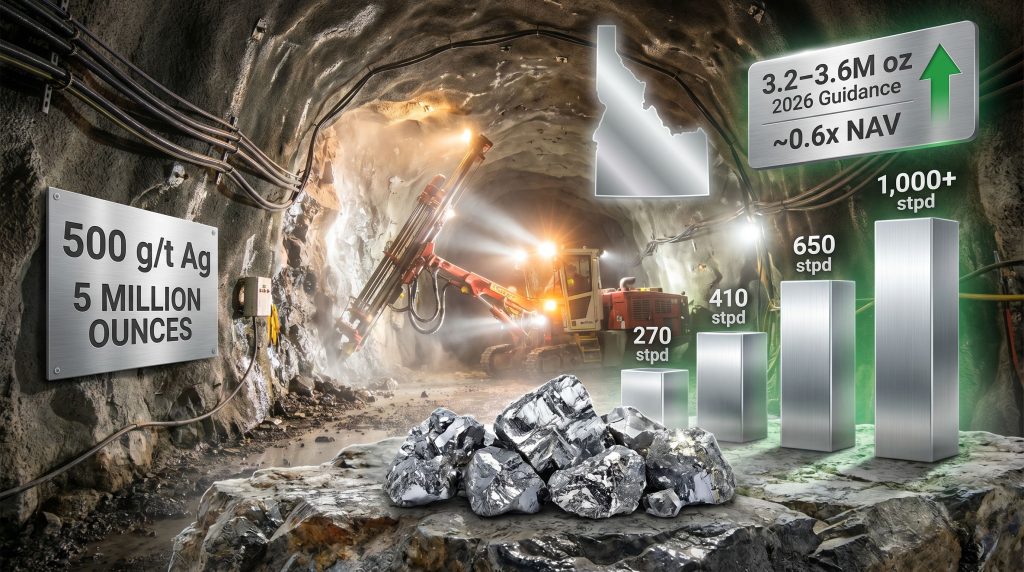
The Galena Complex sits within Idaho's Silver Valley, a district with more than 130 years of continuous mining history. The mine hosts a resource base exceeding 200 million ounces of silver at approximately 500 grams per tonne, which positions it as the second-highest-grade silver mine in the world by reported resource grade. The fundamental quality of the ore body was never in question.
What constrained value creation was decades of underinvestment driven by prolonged periods of depressed silver prices. Multiple commodity downturns between 2011 and 2020 left the mine's infrastructure well behind the standard of what modern mechanised operations can achieve. This underinvestment was a rational economic response to low metal prices, but it created a significant gap between the mine's potential throughput and its actual production performance.
The Number Three Shaft: The Primary Hoisting Bottleneck
The single most consequential constraint on Galena's throughput was the capacity of the Number 3 Shaft, the mine's primary hoisting infrastructure. At the time of Americas Gold and Silver's operational takeover, the shaft was capable of hoisting approximately 40 short tons per hour. This physical ceiling on ore movement meant that regardless of how much ore was available at the mining face, the amount reaching the surface, and ultimately the mill, was capped far below optimal levels.
The solution required a full modernisation of the hoisting system, including a replacement hoist motor, new braking systems, and upgraded communication and control infrastructure. Phase 2 of this upgrade targets a hoisting capacity of approximately 105 short tons per hour, with completion scheduled for the second quarter of 2026.
Conventional Mining Methods Constraining Productivity
The second major bottleneck was the mining method itself. The operation had relied on underhand cut-and-fill, a conventional approach that is inherently slower and more labour-intensive than modern mechanised alternatives. While this method is appropriate for certain geotechnical conditions, it was limiting cycle times, reducing the number of stopes that could be actively mined simultaneously, and constraining throughput growth independently of the hoisting constraint.
How Is Americas Gold and Silver Executing the Galena Turnaround? A Phase-by-Phase Breakdown
Phase 1: Solving the Hoisting Problem First
The operational philosophy applied by the management team follows a clear prioritisation logic: resolve the binding constraints before adding capacity elsewhere. The Number 3 Shaft upgrade addressed the primary bottleneck directly. With the new hoist motor, braking system, and communications infrastructure in place, the mine gained the ability to move materially more ore from the underground working faces to the surface processing plant.
This was not a glamorous investment, but it was the foundational step that unlocked every subsequent improvement in the mine plan. The Galena Complex capital projects update provides further detail on the infrastructure programme currently underway.
Phase 2: Transitioning to Long-Hole Stoping
Long-hole stoping is a mechanised underground mining method that allows large volumes of ore to be drilled, blasted, and extracted from a single stope design. Compared to underhand cut-and-fill, the method delivers dramatically faster cycle times, lower operating costs per tonne, and significantly higher productivity per unit of labour deployed.
The transition at Galena required:
- Procurement and deployment of remote-operated drilling equipment underground
- Crew training on the new equipment and method sequences
- Development of a panel inventory sufficient to sustain continuous long-hole operations
- Integration with the existing mine plan and resource model
To date, 10 panels have been extracted using long-hole stoping, with the operation reporting productivity improvements exceeding 300% relative to prior conventional methods. Cycle times have improved by approximately 12 times compared to the underhand cut-and-fill approach. The target is for 70% of all mining activity to be conducted via long-hole stoping by the end of 2027.
Productivity improvements of 300% from a mining method transition are not theoretical projections. They reflect actual panel-by-panel performance data from stopes that have already been extracted using the new method. This is observable, confirmable operational progress rather than forward guidance.
Phase 3: The Paste Backfill Plant as the Rate-Limiting Factor
The paste backfill plant is perhaps the most technically significant infrastructure investment in the turnaround programme. Underground mining at depth creates voids when ore is removed. For long-hole stoping to proceed rapidly across multiple panels simultaneously, those voids need to be filled quickly with a stabilising material that allows adjacent stopes to be safely mined without delay.
Paste backfill achieves this by mixing a cement-based material on surface and pumping it into underground voids. Once the paste sets, adjacent stopes can be advanced. Equipment fabrication for the paste backfill plant is underway, with deliveries commencing in June 2026 and commissioning targeted for the fourth quarter of 2026. The system is designed to accelerate the backfill cycle by approximately 250% compared to current methods, which will directly translate into higher stope cycling rates and increased throughput.
Phase 4: Mill Modernisation and Capacity Expansion
While the primary throughput constraint sits underground rather than at the processing plant, the surface mill infrastructure is also being upgraded to ensure it does not become the next binding constraint as underground output increases:
- Crusher upgrades have been completed
- New flotation cells have been ordered and are being installed
- A third mill restart is targeting an increase in milling capacity from 750 short tons per day to 1,200 short tons per day by end 2026
- Fibre optic connectivity is being deployed across the underground network to enable real-time equipment monitoring
- Semi-autonomous operation of key underground systems is planned as part of the digital modernisation programme
What Do the Throughput Numbers Actually Reveal About Galena's Trajectory?
The throughput progression at Galena is the single most important data series for investors to monitor. It captures the cumulative impact of every operational improvement in a single number and translates directly into silver ounces produced and revenue generated.
| Production Stage | Throughput (Short Tons Per Day) | Target Period |
|---|---|---|
| Baseline at acquisition | approximately 270 stpd | Prior period |
| Current operational rate | approximately 410 stpd | 2025 |
| Year-end 2025 target | approximately 650 stpd | Q4 2025 |
| Medium-term ramp target | 1,000+ stpd | 2026 to 2027 |
| Milling capacity post-expansion | 1,200 stpd | End 2026 |
The step from 270 to 410 short tons per day has already been achieved, representing a 52% improvement from the acquisition baseline. Moving to 650 tons per day by year-end represents a further 59% increase from the current run rate. The path to 1,000+ tons per day is the medium-term objective that, if achieved, would transform the mine's cost structure through operating leverage as fixed costs are spread across a larger production base.
Each ton that is moved through the mine carries with it the same high-grade silver content. More tons simply means more silver ounces, at progressively lower cost per ounce as fixed overheads are diluted.
The next major ASX story will hit our subscribers first
How Does Exploration Reinforce the Turnaround Thesis at Galena?
Americas' Largest-Ever Exploration Programme
The turnaround thesis does not rely on discovering new mineralisation. The existing resource base is already exceptional at over 200 million ounces. However, in-mine exploration is being conducted at an unprecedented scale, with 64,000 metres of drilling planned across 2026 in what represents the company's largest-ever exploration programme at the property.
A fourth major high-grade vein discovery was reported in April 2026, extending the known mineralised system further and providing additional feed options for the long-term mine plan. This kind of in-mine resource growth supports the mine plan trajectory well beyond the initial 5 million ounce annual production target, providing geological optionality that underpins the longer-term growth narrative.
What Is the 2026 Production Guidance and How Does It Compare to Peers?
Consolidated Silver Guidance and Growth Rate
Americas Gold and Silver has set consolidated silver production guidance of 3.2 to 3.6 million ounces for 2026, representing approximately 30% growth over 2025 output. The Galena Complex contributed approximately 1.5 million ounces in 2025, providing the baseline from which this growth trajectory is being measured.
The management team has framed quarterly execution as the primary credibility mechanism, drawing on a prior operational track record at another mine where 19 of 20 consecutive quarterly targets were delivered. The single missed quarter was attributable to COVID-related workforce disruption that prevented staff from accessing the site, a circumstance outside management's control. The company's full-year 2025 results and 2026 guidance confirm this production growth trajectory in detail.
Consistent quarterly delivery is the mechanism through which a turnaround narrative becomes a re-rating event. Investors watching the Americas Gold and Silver Galena mine turnaround should track throughput per quarter, active long-hole stoping panel counts, and paste backfill commissioning milestones as the primary leading indicators of multiple expansion potential.
The longer-term objective is to reach 5 million silver ounces per year, and the management team has indicated ambition to grow beyond that level once the primary infrastructure programme is complete. Street consensus estimates do not currently incorporate production scenarios beyond the 5 million ounce target, meaning the current valuation does not reflect the full potential of the asset if the growth programme succeeds.
How Does the Antimony and Copper Byproduct Strategy Reduce Operating Costs?
Galena's Polymetallic Profile as a Cost Advantage
The Galena ore body produces silver, copper, and antimony in the same mining sequence. When ore is brought to surface and processed, all three metals are present in the concentrate. The company has positioned this polymetallic profile not as an operational complexity but as a revenue diversification and cost reduction mechanism.
For every incremental tonne of high-grade silver ore mined, copper and antimony come with it at no additional mining cost. The question is not whether to mine them, but how to maximise the revenue they generate and ensure that processing captures their full value. Indeed, antimony shortage risks at a national level further elevate the strategic importance of bringing domestic antimony processing capacity online.
The 51/49 Joint Venture With U.S. Antimony
Americas Gold and Silver has structured a 51/49 joint venture with U.S. Antimony to construct an on-site antimony processing facility at Galena. The facility will extract antimony from the mine's existing silver-copper concentrate and convert it into a marketable antimony flake metal product, generating a higher realised price than is currently achieved by selling the untreated concentrate.
Key parameters of this initiative include:
- Site selection and preliminary site preparation are already underway
- Equipment commissioning is targeted for approximately Q2 2027, roughly 18 months from announcement
- The venture will not require Americas to divert operational focus from silver mining
- U.S. Antimony will operate the processing facility under the joint venture structure
- Galena has been identified as the largest antimony mine in the United States by volume
Americas has also submitted a white paper to the U.S. government outlining the strategic significance of domestic antimony production, a move that positions the company within the broader critical minerals policy framework without implying any confirmed government funding or project designation.
Byproduct Credit Impact on All-In Sustaining Costs
As antimony and copper credits begin flowing through the cost structure, they will progressively compress all-in sustaining costs per silver ounce. This margin improvement does not require any increase in silver production. It derives purely from maximising the revenue from material that is already being mined. The combined effect of higher throughput, lower per-tonne operating costs from mining method improvements, and increasing byproduct credits creates a three-layer margin expansion story.
Why Does Galena's U.S. Jurisdiction Matter to Institutional and Retail Investors?
Idaho's Silver Valley: 130 Years of Established Mining History
The Silver Valley district in Idaho is one of the most historically significant silver mining regions in the world. Operations including Hecla Mining's Lucky Friday mine, Bunker Hill, the Sunshine Mine, and Galena itself have collectively produced hundreds of millions of silver ounces from this district over more than a century. The geological knowledge base, existing infrastructure, established workforce, and permitting precedents accumulated over this period represent a significant advantage relative to greenfield silver jurisdictions in less established regions.
Americas has consolidated a meaningful position within the district, with the Crescent silver mine acquisition for $65 million providing direct mill feed synergies to the Galena processing infrastructure. Crescent sits adjacent to an operation representing approximately $20 billion in enterprise value, providing geological context for the district's ongoing significance.
Jurisdiction Risk and Institutional Investment Mandates
The United States is viewed by a significant portion of global institutional capital as a tier-one mining jurisdiction. This matters practically because some institutional mandates explicitly prohibit or limit exposure to operations in certain Latin American or other higher-risk jurisdictions. For these funds, U.S.-based silver production is the only way to access primary silver exposure within their investment guidelines.
Americas has identified this dynamic as a material driver of institutional interest, particularly from European institutions including Swiss, Austrian, German, and UK-based fund managers. Some of the largest asset managers in the world have taken positions in the company, and the management team has articulated an explicit goal of becoming the third primary port of call for U.S. retail and institutional silver investors after the two established large-cap peers that dominate current market share in the space.
How Is Americas Gold and Silver Attracting a New Class of Institutional Investors?
From Illiquid Micro-Cap to Institutional-Grade Liquidity
One of the most striking data points in the Americas Gold and Silver story is the transformation of daily traded volume. At the time the current management team took operational control, daily traded volume was in the range of $400,000 to $500,000. That figure has since grown to $70 to $75 million per day, representing an increase of more than 150 times in market liquidity.
This kind of liquidity transformation is not simply a function of a rising silver price. It reflects a fundamental change in who owns the stock and how they are sizing positions. Institutional participation at this scale requires that daily volume be sufficient to build and unwind positions without material market impact, a threshold the company has now clearly crossed.
Generalist Fund Rotation Into Silver
The investor profile evolution at Americas Gold and Silver mirrors a broader trend: generalist fund managers who have historically allocated exclusively to gold are beginning to step down the risk spectrum within precious metals. Rather than moving further down the gold cap structure into developers and explorers, many are rotating into silver producers as a way to access additional leverage in a precious metals bull market cycle while maintaining exposure to the industrial demand narrative.
This rotation is structurally different from prior precious metals cycles. Previous silver rallies were primarily driven by retail speculation and dedicated precious metals fund flows. However, the current cycle involves sophisticated institutional capital making deliberate allocations to primary silver producers based on industrial demand theses, supply constraint analysis, and jurisdiction quality assessments.
What Valuation Gap Exists and How Could Execution Close It?
Peer Acquisition Precedents
The two most significant silver M&A transactions in recent years, the acquisitions of Gatos Silver and SilverCrest Metals, were both completed at approximately 2.0 times net asset value. These transactions provide a benchmark for what acquirers are willing to pay for high-quality primary silver assets when the market is functioning efficiently.
| Comparable Transaction | Acquisition Multiple |
|---|---|
| Gatos Silver | approximately 2.0x NAV |
| SilverCrest Metals | approximately 2.0x NAV |
| Americas Gold and Silver (current) | approximately 0.6x NAV (street estimates) |
Americas Gold and Silver is currently trading at approximately 0.6 times NAV using publicly available street consensus estimates. This estimate excludes the additional production scenarios and growth projects that sit above the 5 million ounce annual production target that the company is working toward. The potential re-rating from 0.6x to a level comparable to acquisition precedents represents a material return opportunity if execution continues to meet or exceed guidance.
The mechanism for closing this valuation gap is straightforward in concept, though demanding in execution: deliver on quarterly guidance, hit the infrastructure milestones on schedule, and demonstrate that the throughput trajectory being described in investor presentations is actually appearing in operational data.
What Is the Balance Sheet Position Supporting the Galena Buildout?
Financial capacity to execute the capital programme is a necessary condition for the turnaround thesis to succeed. Americas Gold and Silver currently holds $122 million in cash on the balance sheet, with $50 million drawn from a $100 million credit facility, leaving $50 million of undrawn credit available.
At current silver prices, the operating assets are generating cash flow that is being deployed into the growth capital programme. This self-funding dynamic reduces dilution risk and allows management to accelerate project execution without returning to capital markets at inopportune times. The Crescent acquisition at $65 million demonstrated a disciplined approach to capital deployment, acquiring a directly synergistic asset at a price that preserves balance sheet flexibility.
What Are the Key Execution Milestones Investors Should Monitor Through 2027?
The Americas Gold and Silver Galena mine turnaround is fundamentally an execution story. The following milestones represent the verifiable checkpoints against which management credibility should be assessed:
- Q2 2026: Number 3 Shaft Phase 2 hoisting capacity upgrade completion, targeting approximately 105 short tons per hour
- Q4 2025: Exit run rate of approximately 650 short tons per day achieved at Galena
- Q4 2026: Paste backfill plant commissioning, targeting approximately 250% improvement in backfill cycle times
- End 2026: Mill capacity expansion to 1,200 short tons per day completed
- Q2 2027: U.S. Antimony joint venture processing facility commissioned and operational
- End 2027: 70% of all mining activity converted to long-hole stoping across the operation
Each milestone has a specific technical dependency on the preceding one. The paste backfill plant enables faster stoping cycles, which drives throughput toward 1,000+ tons per day, which requires the expanded mill capacity to process the additional ore. The sequence is logical and the timeline is internally consistent.
Frequently Asked Questions: Americas Gold and Silver Galena Mine Turnaround
What is the Galena Complex and where is it located?
The Galena Complex is a high-grade primary silver mine located in the Silver Valley region of Idaho, United States. It hosts a resource base exceeding 200 million ounces of silver at approximately 500 grams per tonne, making it the second-highest-grade silver mine in the world by reported resource grade.
What production growth is Americas targeting at Galena?
The company is guiding for consolidated silver production of 3.2 to 3.6 million ounces in 2026, representing approximately 30% growth over 2025. The medium-term target is to reach 5 million ounces per year as infrastructure upgrades are completed, with ambitions to grow beyond that level thereafter.
What is long-hole stoping and why does it matter for the turnaround?
Long-hole stoping is a mechanised underground mining method that extracts large volumes of ore more efficiently than conventional cut-and-fill techniques. It requires remote-operated drilling equipment and a backfill system to stabilise mined voids. Americas has reported productivity improvements exceeding 300% and cycle time improvements of approximately 12 times compared to prior conventional methods since beginning the transition.
What is the paste backfill plant and when will it be operational?
The paste backfill plant mixes a cement-based material on surface and pumps it into underground voids created by stope extraction. Once set, the backfill stabilises the rock mass and allows adjacent stopes to advance without delay. The plant is expected to be commissioned in Q4 2026 and is designed to accelerate backfill cycle times by approximately 250%, directly increasing the rate at which stopes can be sequentially cycled through the production system.
What is the U.S. Antimony joint venture?
Americas has entered a 51/49 joint venture with U.S. Antimony to construct an on-site processing facility at Galena that will extract antimony from the mine's silver-copper concentrate and convert it into a marketable flake metal product. The facility is targeted for commissioning in Q2 2027 and is expected to generate higher realised revenue from antimony than is currently achieved through concentrate sales.
Why does Galena's Idaho location matter to certain institutional investors?
The United States is considered a tier-one mining jurisdiction, and some institutional mandates restrict investment to operations in specific jurisdictions. For these investors, Galena represents one of the only ways to access primary silver exposure within their investment guidelines. Silver's addition to the U.S. critical minerals list has further elevated the strategic significance of domestic primary silver production within the broader investment community.
From Legacy Asset to Modern Silver Platform: The Galena Execution Roadmap
The Americas Gold and Silver Galena mine turnaround is built on three interlocking value creation layers. The first is operational: systematically removing the physical constraints that have prevented a world-class ore body from reaching its throughput potential. The second is byproduct monetisation: capturing the full economic value of copper and antimony that has historically been undermonetised within the existing production stream. The third is jurisdictional: positioning a high-quality U.S.-based primary silver producer within a market where domestic supply of critical minerals is increasingly valued by both institutional investors and policy frameworks.
The year 2026 is pivotal. The paste backfill plant commissioning, the shaft upgrade completion, and the mill expansion are all scheduled to deliver within the calendar year. If these milestones are achieved on schedule, the throughput trajectory toward 1,000+ tons per day becomes a near-term operational reality rather than a medium-term aspiration.
The valuation gap between current trading multiples and acquisition precedents in the sector is significant. Closing that gap does not require a silver price rally, though such a rally would amplify the returns. It requires the management team to replicate the same execution discipline that previously delivered 19 of 20 consecutive quarterly targets, applied to a larger and more complex asset with more capital available to deploy.
This article contains forward-looking statements, projections, and analysis related to Americas Gold and Silver and the silver mining sector. These include production guidance figures, infrastructure milestone timelines, throughput targets, and valuation comparisons. Actual results may differ materially from projections due to operational risks, commodity price volatility, capital availability, geological uncertainty, and other factors. Nothing in this article constitutes financial advice. Readers should conduct their own due diligence and consult a qualified financial adviser before making any investment decisions.
Want to Catch the Next Major Silver Discovery Before the Market Moves?
Discovery Alert's proprietary Discovery IQ model scans ASX announcements in real time, instantly alerting subscribers to significant mineral discoveries — including primary silver producers — so they can act on actionable opportunities ahead of the broader market. Explore how historic discoveries have generated substantial returns on Discovery Alert's dedicated discoveries page, and begin your 14-day free trial today to position yourself at the forefront of the next major find.