June 4, 2026
The Forces Behind Coal's Enduring Grip on Global Energy
Few commodities have generated as much debate, contradiction, and ongoing capital commitment as coal. Across boardrooms and commodity trading floors, the conversation rarely centres on whether coal will disappear, but rather on how quickly its role will evolve, and which companies are best positioned to navigate that transition. For investors, energy economists, and industrial strategists alike, understanding the largest coal mining companies operating today requires more than tracking production tonnage. It demands a framework that accounts for vertical integration, reserve quality, geopolitical function, and the diverging futures of thermal versus metallurgical coal.
The persistent gap between energy policy ambitions and actual consumption data tells a revealing story. According to the International Energy Agency, global coal demand has remained near record highs in recent years, with China and India together accounting for the overwhelming majority of worldwide coal consumption. This structural reality has continued to underpin enormous capital allocation toward extraction infrastructure, even as Western capital markets apply mounting ESG pressure to coal-exposed assets.
Understanding why these divergences exist, and which companies benefit most from them, is the starting point for any serious analysis of the sector.
When big ASX news breaks, our subscribers know first
Why Ranking the Largest Coal Mining Companies Is More Complicated Than It Looks
Revenue, Production, and Market Capitalisation Tell Three Different Stories
There is no single universally agreed metric for ranking the largest coal mining companies. Depending on whether you measure by annual production volume, total revenue, or stock market capitalisation, the rankings shift considerably. This is not a trivial distinction. Each metric reflects a different investment thesis and a different understanding of where value actually resides within the supply chain.
Revenue figures, for example, reflect current earnings power and pricing conditions. Market capitalisation reflects forward-looking investor expectations about reserve longevity, geopolitical security, and structural demand. Production volume, meanwhile, captures physical scale but says little about profitability or strategic positioning.
The table below illustrates how starkly rankings can diverge depending on the lens applied:
Revenue-Based Rankings (2021 Figures)
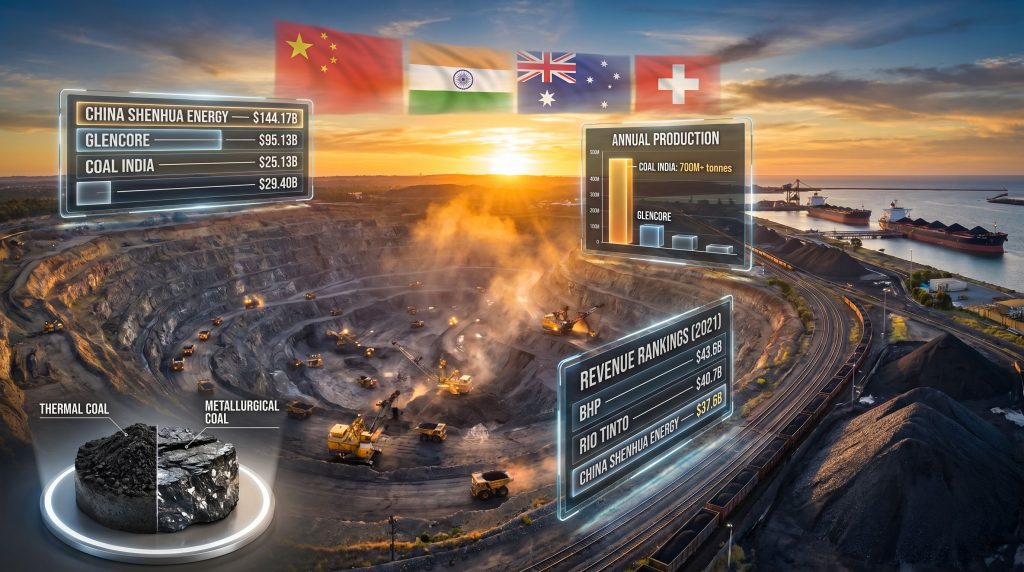
| Rank | Company | Revenue (2021) | Country |
|---|---|---|---|
| 1 | BHP | $43.6B | Australia |
| 2 | Rio Tinto | $40.7B | Australia/UK |
| 3 | China Shenhua Energy | $37.6B | China |
| 4 | Anglo American plc | $27.7B | UK |
| 5 | Coal India | $14.5B | India |
Market Capitalisation Leaders (2026 Figures)
| Rank | Company | Market Cap (2026) | Country |
|---|---|---|---|
| 1 | China Shenhua Energy | $144.17B | China |
| 2 | Glencore | $95.13B | Switzerland |
| 3 | Yankuang Energy | $30.01B | China |
| 4 | Coal India | $29.40B | India |
"The divergence between revenue rankings and market capitalisation rankings reflects something deeper than accounting differences. Investors are pricing in long-term reserve control, state-backed stability, and integrated supply chain ownership rather than simply rewarding current earnings."
This distinction matters significantly for capital allocation. A company with modest current revenue but immense geological reserves and government backing may carry far greater long-term valuation weight than a higher-earning competitor with depleting reserves and constrained access to capital markets. For a broader view of how these companies compare globally, the largest coal mining companies by market cap provides a useful reference point across jurisdictions.
The Three Analytical Lenses Every Serious Investor Should Apply
Before ranking individual companies, it is worth establishing the three primary lenses through which each firm should be evaluated:
- Output Scale – Raw production capacity in millions of tonnes annually, reflecting physical dominance of supply
- Market Valuation – Investor-assigned worth, reflecting reserve quality, state backing, and integrated logistics
- Vertical Integration – The degree to which a company controls mining, transport, processing, and end-use delivery within a single operational structure
These three dimensions explain why the six companies profiled below occupy their positions, and why simple production-volume comparisons fail to capture the full picture.
Why Coal Remains Strategically Relevant in 2025 Despite Decarbonisation Pressures
The narrative of coal's imminent obsolescence has persisted for over a decade, yet the physical reality of global energy systems continues to complicate that story. Several structural factors explain coal's persistent relevance:
- Grid baseload dependency: Renewable intermittency in major developing economies has not yet been resolved by battery storage infrastructure at the required scale
- Industrial heat requirements: Many heavy industrial processes require temperatures that current renewable technologies cannot economically deliver
- Steel production: Blast furnace steelmaking, which accounts for roughly 70% of global steel output, relies on metallurgical coal in ways that hydrogen-based alternatives have not yet commercially replicated
- Energy access economics: In rapidly urbanising economies, coal-fired electricity remains among the most cost-effective routes to rapid electrification at scale
Furthermore, coal supply challenges in 2025 have reinforced the strategic importance of established producers, as infrastructure constraints and geopolitical shifts continue to reshape global trade flows.
"Metallurgical coal and thermal coal face fundamentally different demand trajectories. Thermal coal is directly targeted by electricity decarbonisation policies, while metallurgical coal remains genuinely difficult to substitute in blast furnace steelmaking. This distinction is critical for any long-term capital allocation analysis in the sector."
The Six Largest Coal Mining Companies Shaping Global Supply Chains
How Scale, Geography, and Business Model Define Market Power
The following six companies represent the most consequential forces in global coal production and trade. Their influence extends beyond extraction, shaping shipping routes, electricity prices, steel production economics, and national energy security frameworks across multiple continents.
Number 6 – Peabody Energy: America's Largest Private-Sector Coal Producer
A Dual-Market Strategy Spanning Domestic Supply and Asia-Pacific Exports
Peabody Energy occupies a unique position among the largest coal mining companies globally, operating as the most significant privately held coal producer in the United States while simultaneously maintaining major Australian export operations that feed Asian steelmaking demand. In addition, the recent Peabody coal acquisition of Anglo American's coal assets has further expanded its operational footprint and strategic reach.
The company's U.S. operations achieved production of approximately 95,789 thousand short tons in 2024, representing around 18.7% of total domestic U.S. coal output, according to company reporting. Annual revenues ranged between $4.89 billion and $4.95 billion across the 2022 to 2023 period, reflecting both price volatility and the company's dual exposure to thermal and metallurgical markets.
Australian Operations as the Strategic Revenue Engine
What makes Peabody's business model particularly compelling from a long-term investor perspective is its Australian footprint. Queensland-based operations give Peabody access to premium hard coking coal seams, enabling participation in the high-value metallurgical coal market linked directly to Asian blast furnace steelmaking. Demand from India's rapidly expanding steel sector has reinforced the export opportunity for quality Australian coking coal, providing Peabody with revenue diversification that pure domestic U.S. producers cannot match.
The Bankruptcy Cycle: A Cautionary and Recovery Story
Peabody's 2016 Chapter 11 bankruptcy filing remains one of the most closely studied financial events in modern mining history. It occurred within a broader wave of financial distress that affected close to half of all U.S. coal companies over the preceding decade, driven by regulatory tightening, natural gas price competition, and accelerating institutional divestment mandates.
"The U.S. coal sector's bankruptcy cycle carries important lessons for commodity investors. Structural cost pressures, rather than temporary price weakness, were the primary driver of financial distress, making recovery dependent on fundamental business model restructuring rather than simply waiting for price recovery."
Peabody's subsequent recovery, aided by tightened global coal supply and elevated Asian demand, is considered one of the sector's more notable financial turnarounds. However, the company's experience also illustrates the heightened risk premium that deregulated coal markets carry compared to state-backed producers operating in protected domestic environments.
Number 5 – BHP: Redefining Coal Identity Through a Metallurgical Focus
Why BHP's Queensland Assets Represent a Different Kind of Coal Investment
BHP is most commonly associated with iron ore and copper, yet its Queensland metallurgical coal operations represent a materially distinct investment category within the coal sector. The critical distinction lies in end-use application. While thermal coal faces direct regulatory targeting as an electricity generation fuel, metallurgical coal is embedded in the steelmaking process itself, creating a different and more defensible demand profile.
BHP's Queensland operations supply premium hard coking coal to Asian blast furnace steelmakers, a product category that commands significantly higher prices than thermal coal on international spot and contract markets. The price premium reflects genuine scarcity, as high-quality coking coal deposits capable of producing low-ash, low-sulphur metallurgical product are geologically concentrated in relatively few regions globally, with Queensland representing one of the world's premier producing zones.
Infrastructure Advantage as a Structural Competitive Moat
Access to established port and rail infrastructure amplifies BHP's competitive position in ways that are difficult for new entrants to replicate. Australia's east coast export infrastructure, developed over decades, provides BHP with logistical efficiency that directly supports cost competitiveness in Asian markets. This infrastructure advantage functions as a structural moat, compressing the cost-per-tonne delivered to customer that new supply sources would struggle to match without comparable capital investment.
Key characteristics of BHP's metallurgical coal positioning include:
- Hard coking coal commands substantially higher benchmark prices than thermal coal in international markets
- Queensland assets supply premium-grade product to Asian blast furnace steelmakers with long-term offtake relationships
- Hydrogen-based steelmaking alternatives remain commercially unscalable at the volumes required to displace conventional blast furnace production
- BHP has progressively reduced thermal coal exposure while consolidating its metallurgical coal portfolio
Emissions Commitments Alongside Continued Coal Investment
BHP's ongoing investment in emissions reduction programmes alongside continued metallurgical coal production reflects a calculated strategic position rather than an internal contradiction. The company's argument is that premium coking coal will remain an essential input to global steel production for the foreseeable future, while environmental management investment mitigates both regulatory risk and reputational pressure from institutional investors.
The next major ASX story will hit our subscribers first
Number 4 – Glencore: The Commodity Trader That Made Coal Its Cash Engine
How the Integrated Trading Model Separates Glencore From Pure-Play Miners
Glencore's position among the largest coal mining companies globally cannot be understood without accounting for its commodity trading arm. Unlike conventional mining companies that extract and sell at prevailing spot or contract prices, Glencore's integrated marketing operation allows it to actively manage pricing exposure, arbitrage regional demand imbalances, and optimise delivery logistics across multiple markets simultaneously.
This trading capability transforms coal from a simple extraction business into a global logistics and arbitrage operation with meaningfully different risk and return characteristics.
Geographic Portfolio Diversification
| Region | Coal Type | Primary Export Markets |
|---|---|---|
| Australia | Thermal and Metallurgical | Japan, South Korea, India |
| South Africa | Thermal | Europe, Asia |
| Colombia | Thermal | Atlantic Basin, Europe |
This geographic spread across three producing regions and multiple export corridors gives Glencore a supply flexibility that concentrated producers cannot replicate. When Asian spot prices spike relative to Atlantic Basin benchmarks, Glencore's Colombian and South African operations can redirect thermal coal flows to capture the differential, while Australian production serves established long-term Asian customers.
The ESG Paradox: Institutional Pressure Versus Record Profitability
Few dynamics in contemporary commodity markets illustrate the tension between ESG capital mandates and underlying fundamental economics as clearly as Glencore's coal division performance in recent years. Supply shortages and surging Asian demand drove Glencore's coal operations to produce cash flows that materially exceeded expectations and underwrote significant shareholder returns.
Glencore's public position is that responsibly managing and eventually winding down existing coal assets, rather than divesting them to less regulated operators, represents a more credible environmental outcome. This argument has attracted both pragmatic institutional support and sustained criticism from environmental advocacy organisations. The demerger debate, whether Glencore should separate its coal business into a standalone entity, continues to surface periodically as the company navigates competing shareholder expectations.
Number 3 – Adani Enterprises: Vertical Integration as a Competitive Moat
From Controversy to Operational Scale: The Carmichael Mine Reality
Adani Enterprises has constructed one of the most comprehensively integrated coal supply chains in the private sector, combining mining operations, port infrastructure, rail logistics, and power generation capacity within a single conglomerate structure. The Carmichael coal mine in Queensland, Australia, attracted sustained global attention from environmental campaigners and institutional investors during its development phase. Despite prolonged controversy, the project achieved operational status and now forms a significant component of Adani's international coal sourcing capability.
India's Electricity Demand as the Structural Driver
The strategic logic underlying Adani's coal expansion is anchored in India's electricity demand growth, which remains among the most powerful structural forces in global energy markets. Consequently, Indian steel prices and industrial energy demand are closely linked to the pace at which companies like Adani can scale domestic and imported coal supply:
- Coal continues to supply the substantial majority of India's electricity generation capacity, with the Central Electricity Authority tracking coal's dominance in the generation mix
- Rapid urbanisation and industrial growth are compressing the timeline for new baseload power additions, creating sustained demand for reliable fuel supply
- Adani's combination of domestic mining, international sourcing, and port infrastructure positions it as a critical enabler of India's electricity security
Adani's dual-track strategy, expanding coal infrastructure while simultaneously investing aggressively in renewable energy capacity, reflects an attempt to remain relevant across multiple phases of India's energy transition rather than concentrating exposure on any single technology pathway.
Number 2 – Coal India Limited: The State-Owned Giant That Outproduces All Private Competitors
Production Scale That Dwarfs Private-Sector Peers
Coal India Limited's production figures exist in a different category from virtually every private sector competitor. With annual output exceeding 700 million tonnes, the company's scale reflects both the enormous domestic demand it serves and the structural dependency of India's electricity system on coal-fired generation.
Key operational facts:
- Annual production: Exceeds 700 million tonnes, making it comfortably the world's largest single coal-producing entity
- Electricity dependency: Coal generates more than 70% of India's electricity, anchoring Coal India at the centre of national energy security
- Operational footprint: Hundreds of active mines concentrated in Jharkhand, Odisha, and Chhattisgarh
India's Long-Duration Energy Transition Creates Structural Demand Continuity
India's energy transition is widely expected by industry analysts to follow a multi-decade gradual trajectory rather than an accelerated phase-out comparable to European decarbonisation timelines. The combination of population scale, rapid industrialisation, and ongoing rural electrification programmes creates sustained baseload electricity demand that renewable capacity additions alone cannot yet satisfy at the required reliability level.
"This structural timeline reinforces Coal India's position as one of the most consequential coal producers globally, with influence likely to extend well into the 2040s regardless of the pace of renewable energy deployment."
Technology Modernisation and Strategic Diversification
Coal India has invested materially in modernisation initiatives, including digital mine monitoring systems, automated equipment deployment, and environmental rehabilitation programmes. The company has also announced diversification strategies targeting renewable energy and critical minerals, though coal production remains the dominant revenue driver. Rail infrastructure investment and logistics bottleneck reduction represent additional competitive priorities, as delivery efficiency directly determines the company's ability to meet contracted supply obligations across India's power sector.
Number 1 – China Energy Investment Corporation: The World's Most Powerful Integrated Coal Conglomerate
Scale That Cannot Be Compared to Private-Sector Mining Companies
China Energy Investment Corporation occupies a position in global coal markets that has no private-sector equivalent. Formed through the consolidation of major state-owned enterprises, the company combines mining assets, railway networks, coastal shipping infrastructure, and power generation capacity under a single integrated structure operating at national scale. Understanding this company's strategic weight requires broader context around the China steel market and the enormous volumes of coal that underpin both electricity generation and industrial production across the country.
Reserve Concentration and Regional Production
| Region | Strategic Significance |
|---|---|
| Inner Mongolia | Home to some of China's largest open-pit coal reserves with low strip ratios |
| Shaanxi Province | High-quality thermal coal with established rail export corridors to eastern grid |
Advanced automation systems and high-capacity open-pit operations have enabled China Energy to maintain production growth while simultaneously improving operational efficiency metrics. The company's mining regions benefit from geological characteristics, particularly low overburden ratios in key Inner Mongolian basins, that support competitive cost-per-tonne production economics even at the enormous scale at which the company operates.
China's Coal Context: Consumption That Exceeds All Other Nations Combined
China's coal consumption dynamics are extraordinary by any global comparative standard. The country consumes more coal than all other nations combined, deploying it across electricity generation, industrial heating, chemical production, and metallurgical applications. While Beijing's renewable energy investment programme has been substantial and genuine, coal remains essential to grid stability and industrial resilience in ways that current alternative energy infrastructure has not yet overcome.
"China Energy Investment Corporation functions not merely as a mining company but as a national energy security instrument, one that can be directed to increase or moderate output in response to macroeconomic conditions, grid stability requirements, or broader strategic signals. This state function gives it capabilities and a risk profile that are fundamentally different from any listed private-sector coal company."
Comparing the Largest Coal Mining Companies Across Key Operational Dimensions
| Company | Primary Coal Type | Business Model | Key Export Markets | Strategic Direction |
|---|---|---|---|---|
| China Energy Investment Corp | Thermal | Vertically Integrated (State) | Domestic | Grid Stability and Industrial Supply |
| Coal India Limited | Thermal | State-Owned Producer | Domestic | Energy Security and Modernisation |
| Adani Enterprises | Thermal | Vertically Integrated (Private) | India and Export | Infrastructure Expansion |
| Glencore | Thermal and Metallurgical | Diversified Trader-Miner | Global | Managed Transition |
| BHP | Metallurgical | Diversified Major | Asia-Pacific | Premium Asset Focus |
| Peabody Energy | Thermal and Metallurgical | Pure-Play Coal | U.S. and Asia | Recovery and Efficiency |
The Biggest Challenges Facing the World's Largest Coal Companies
Despite the structural demand drivers supporting current production levels, the largest coal mining companies face a distinct set of challenges that will shape competitive positioning over the coming decade:
- ESG Capital Constraints: Institutional divestment mandates are progressively restricting the universe of capital available to coal-exposed companies, raising financing costs and compressing valuation multiples relative to comparable industrial businesses
- Bankruptcy Risk in Deregulated Markets: The U.S. coal sector's extensive bankruptcy history demonstrates that private-sector coal companies operating in competitive, deregulated markets face structural financial vulnerabilities that state-backed producers do not
- Natural Gas and Renewable Cost Compression: Falling levelised costs of electricity from renewables, combined with cheap natural gas in certain markets, is eroding thermal coal's cost competitiveness in electricity generation across multiple regions
- Infrastructure Bottlenecks: Port capacity, rail access, and shipping constraints continue to limit export volume growth even when geological reserves and mining capacity would otherwise support expansion
- Regulatory Uncertainty: Multiple jurisdictions are implementing or considering carbon pricing mechanisms, mining permit restrictions, and coal phase-out timelines that create planning uncertainty for capital-intensive long-life mining operations
However, monitoring metallurgical coal prices remains essential for investors assessing which producers are best positioned to manage these headwinds, particularly as pricing signals diverge between thermal and coking coal benchmarks.
Is Coal Mining Still a Viable Long-Term Investment Sector?
The Case for Continued Relevance
Asian demand continuity, steel production requirements, and energy access economics across developing economies provide genuine structural support for coal demand at volumes that cannot be quickly displaced by alternative energy systems. The multi-decade energy transition timeline expected across India and Southeast Asia in particular creates a prolonged demand runway for well-positioned producers.
The Case for Structural Decline
Policy-driven coal phase-out timelines in Europe and parts of North America, combined with accelerating renewable cost deflation and growing institutional capital restrictions, create tangible stranded asset risk for thermal coal operations with extended mine lives requiring ongoing capital reinvestment. Current coal market data further illustrates how benchmark prices have been increasingly volatile in response to these competing forces.
Why the Thermal Versus Metallurgical Distinction Is the Most Critical Investment Variable
For investors evaluating exposure to the largest coal mining companies, the thermal versus metallurgical distinction is arguably more important than company-level comparisons. Thermal coal's demand trajectory is directly targeted by electricity decarbonisation policies across multiple major markets. Metallurgical coal, by contrast, remains genuinely difficult to substitute within blast furnace steelmaking, a process responsible for approximately 70% of global steel output, at the commercial scale and cost economics required by integrated steelmakers.
This distinction explains why companies with metallurgical coal exposure, notably BHP and portions of Glencore and Peabody's Australian portfolios, are often assessed differently by sophisticated commodity investors than predominantly thermal coal producers.
This article contains forward-looking statements and analytical projections based on publicly available information. Commodity markets are inherently volatile, and actual outcomes may differ materially from projections discussed above. Nothing in this article constitutes financial advice. Readers should conduct independent research and seek professional guidance before making any investment decisions related to coal sector equities or commodity exposure.
Further coverage of global mining sector developments, commodity market dynamics, and operational updates across the minerals industry is available at Mining and Minerals Today, which publishes ongoing analysis across the mining and minerals sector.
Want to Track the Next Major ASX Mineral Discovery Before the Broader Market Does?
While the world's largest coal companies dominate global supply chains, some of the most compelling resource investment opportunities emerge from significant new mineral discoveries on the ASX — and Discovery Alert's proprietary Discovery IQ model delivers real-time alerts the moment those discoveries are announced, turning complex geological data into actionable insights for investors at every experience level. Explore historic examples of discovery-driven returns and begin a 14-day free trial to position yourself ahead of the market.