
May 15, 2026
The Quiet Metal Powering the Modern World: Why Western Tin Supply Is Reaching a Tipping Point
Few metals occupy as inconspicuous a position in the public imagination as tin. It lacks the narrative glamour of lithium or the geopolitical theatre surrounding rare earth elements. Yet tin sits at the foundation of virtually every electronic device manufactured today. Every circuit board, every semiconductor package, every solar panel connection point relies on tin-based solder to function. Without it, the electronics supply chain stops.
This largely invisible role has made tin's geographic concentration problem all the more dangerous for Western industrial economies. The overwhelming majority of global tin production is centred in Southeast Asia and China, with Indonesia, Myanmar, and China collectively accounting for the vast bulk of world supply. For manufacturers in the United Kingdom, European Union, and United States, this represents a single-point-of-failure risk that is difficult to insure against through stockpiling alone.
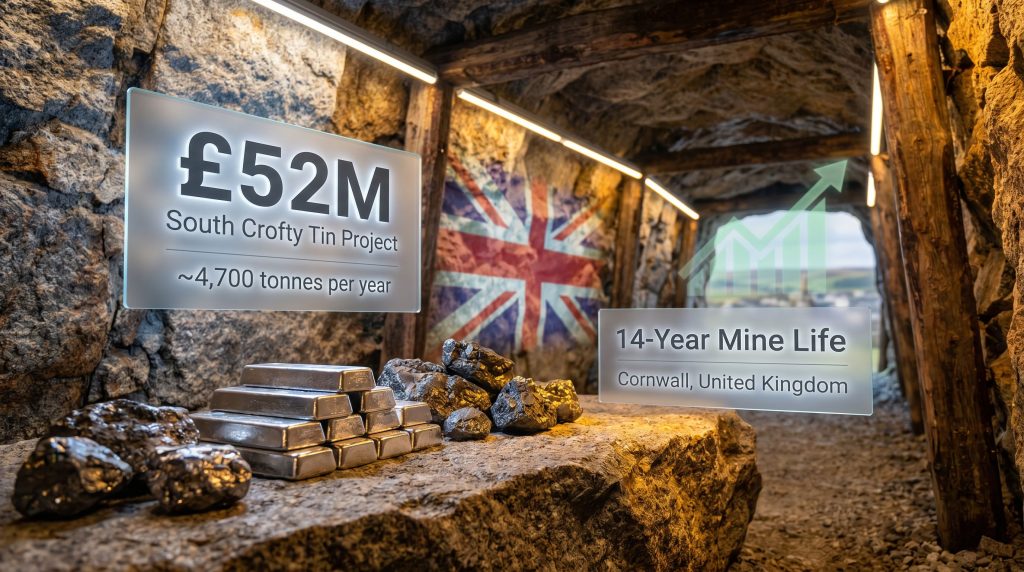
It is against this backdrop that Cornish Metals secures £52m investment for South Crofty tin project marks a genuinely significant development, not merely for the company involved, but for the broader structural challenge of rebuilding Western critical minerals supply chains from the ground up.
When big ASX news breaks, our subscribers know first
Tin's Understated Role in the Global Industrial Economy
Understanding why South Crofty matters requires understanding what makes tin strategically irreplaceable. Its primary application, accounting for roughly half of global consumption, is solder. Solder is the material that physically and electrically connects components on printed circuit boards. As consumer electronics, industrial automation, and defence systems have grown more sophisticated, the quantity of solder per unit of output has increased alongside circuit board complexity.
What is less commonly appreciated is tin's growing exposure to the energy transition. Photovoltaic solar panels use tin-based solder to connect individual cells within each panel and to connect panels within arrays. As global solar installation capacity has expanded dramatically, so has the demand this creates for tin. The International Tin Association has noted that solar manufacturing represents one of the fastest-growing demand segments for the metal, a trend that was negligible a decade ago and is now material.
Furthermore, tin also plays a role in emerging battery chemistries. Research into tin-based anode materials as an alternative to graphite in lithium-ion batteries has accelerated, though commercial-scale deployment of this application remains developmental rather than established. If tin anodes achieve commercial viability, the demand implications would be substantial and would compound an already tightening supply picture. The critical minerals demand outlook, consequently, only strengthens the case for Western supply diversification.
The fundamental challenge for Western tin consumers is not simply that production is geographically concentrated. It is that very few advanced-stage Western development projects exist that could realistically produce meaningful volumes within the next decade.
This is the supply gap that positions South Crofty as strategically relevant beyond its scale.
What South Crofty Actually Is and Why Its History Matters
South Crofty is not a newly discovered deposit. It is one of the most studied and historically documented mining operations in the world. Cornwall's tin mining history spans more than two thousand years, and South Crofty itself operated continuously for centuries before its closure in 1998. At the time of closure, the decision was driven primarily by the collapse of tin prices following the failure of the International Tin Council buffer stock mechanism in 1985, an event that sent tin prices into a prolonged depression from which the economics of high-cost Western mines could not recover.
Critically, the mine did not close because it ran out of tin. The resource remained in the ground, preserved by geology, while above-ground economic conditions made extraction unviable. This distinction matters enormously for project rehabilitation. Cornish Metals, which acquired South Crofty in 2016, inherited an asset with a documented geological history rather than a speculative exploration target.
The multi-year de-risking process undertaken since acquisition has focused on several interconnected technical challenges:
- Water management: Underground mines in Cornwall require substantial pumping and treatment infrastructure to manage groundwater ingress. Pilot water treatment systems have been developed and tested at South Crofty to demonstrate that dewatering the mine to operational depths is technically achievable.
- Shaft condition and refurbishment: The existing shaft infrastructure has undergone systematic assessment to determine rehabilitation requirements, enabling engineering cost estimates to be developed with greater confidence.
- Resource modelling: Modern geophysical techniques and updated drilling programmes have been applied to refine the resource estimate, improving the confidence classification of tonnes and grade.
- Regulatory and environmental permitting: Obtaining and maintaining the necessary permits for underground mining in a populated, historically significant region requires sustained engagement with regulatory authorities.
Project Fundamentals at a Glance
| Metric | Detail |
|---|---|
| Projected Average Annual Production | ~4,700 tonnes tin |
| Mine Life (Updated PEA) | 14 years |
| Mine Type | Underground, high-grade |
| Location | Cornwall, United Kingdom |
| Listing | AIM, London Stock Exchange |
| Development Stage | Pre-FID, advanced de-risking |
| Critical Mineral Status | UK, EU, US policy frameworks |
A 14-year mine life producing approximately 4,700 tonnes annually would make South Crofty one of the larger Western tin operations in recent history. For context, the entire United Kingdom currently produces no primary tin. Any production from South Crofty would represent a step-change in Western supply diversity, particularly given the critical mineral benefits that domestic production offers to downstream industries.
Decoding the £52M Credit Facility and Its Role in the Capital Stack
The £52 million in secured credit facilities announced in May 2026 cannot be understood in isolation. It forms one layer of a multi-instrument financing structure that also includes a $210 million Nordic bond placement announced on 7 May 2026. These two instruments serve fundamentally different functions within the project's capital architecture.
The Nordic bond market, which has developed a sophisticated institutional appetite for resource and infrastructure projects, provides the primary large-scale debt financing for project development. Nordic bonds are typically structured with defined terms, covenants, and repayment schedules that require a degree of project certainty. The credit facilities, by contrast, provide operational flexibility: drawdown-on-demand access to capital that can be deployed as project activities require it, without the administrative burden of re-engaging bond markets for each tranche.
Capital Structure Breakdown
| Funding Instrument | Amount | Primary Function |
|---|---|---|
| Secured Credit Facilities | ~£52 million total | Operational flexibility, pre-FID development |
| Escrow Allocation (from credit facilities) | Up to ~£16 million | Bond issuance condition precedent |
| Remaining Credit Facility | ~£36 million | Underground development, shaft refurbishment, surface works, corporate |
| Nordic Bond Placement (separate) | $210 million | Primary project financing vehicle |
The escrow mechanism is a technical but important detail. The £16 million allocated to the escrow account is a condition precedent to the bond issuance, meaning the bonds cannot be formally issued until this escrow is funded. The credit facility essentially bridges this requirement, allowing the bond structure to proceed while preserving cash for operational purposes.
What is structurally notable is the drawdown optionality built into the credit facility. Rather than obligating the company to deploy the full £52 million, the facility provides access to capital as needed. This matters at the pre-FID stage because capital efficiency — the ability to advance de-risking without over-committing capital to a project not yet sanctioned for full construction — is a key determinant of whether a development project reaches FID or stalls through financial overextension. According to a recent report by the International Tin Association, the combined financing package positions South Crofty's FID as expected this summer.
When a financing structure preserves optionality rather than creating obligation, it signals that the lenders are comfortable extending capital confidence without requiring immediate full deployment, a meaningful indicator of institutional conviction at this stage of development.
The Shareholder-Lender Dynamic: A Structure Worth Understanding
Perhaps the most analytically interesting feature of this financing announcement is who is providing the capital. The National Wealth Fund and Vision Blue Resources are both simultaneously major shareholders and the primary lenders behind the £52 million facility.
The National Wealth Fund holds approximately 28.45% of Cornish Metals' issued share capital. Vision Blue Resources holds approximately 29.08%. Together, these two entities control over 57% of the company's equity while also serving as its primary debt financiers.
This creates a capital structure with unusual alignment properties. In conventional project finance, debt holders and equity holders occupy adversarial positions: debt holders prioritise capital preservation and repayment certainty, while equity holders prioritise upside capture and may accept higher risk. When the same parties hold both positions simultaneously, these tensions are internalised rather than negotiated across a table.
The practical implication is that the due diligence process that preceded this credit facility was almost certainly conducted with equity-like depth of analysis. Institutions that already hold over a quarter of the company each do not extend secured credit facilities without rigorous re-examination of project viability, permitting status, technical assumptions, and market conditions. The fact that both extended further capital to the same project, on top of existing equity exposure, represents a considered recommitment to the South Crofty thesis.
Key Stakeholder Positions
| Stakeholder | Equity Holding | Role in Credit Facility | Strategic Mandate |
|---|---|---|---|
| National Wealth Fund | ~28.45% | Co-lender | UK domestic industrial and resource capacity |
| Vision Blue Resources | ~29.08% | Co-lender | Critical minerals supply chain resilience |
| Combined | ~57.53% | Primary lenders | Aligned equity and debt interests |
Vision Blue Resources operates as a specialist critical minerals investment vehicle with a thesis centred on supply chain resilience for materials that Western economies cannot afford to import exclusively from geopolitically exposed sources. Its continued participation signals private sector conviction in tin's demand fundamentals that is independent of policy-driven mandates.
The Road to Final Investment Decision
The explicit purpose of the £52 million credit facility, as articulated by CEO Don Turvey, is to provide financial runway through to the project's final investment decision. Understanding what an FID actually involves helps contextualise what this capital is being asked to accomplish.
A final investment decision is the formal commitment by a company's board and financing parties to proceed with full-scale project construction. It is preceded by several requirements that collectively reduce execution risk to a level acceptable to lenders and investors. Completing a definitive feasibility study represents one of the most critical prerequisites, as it upgrades capital cost accuracy to within 10–15% of actual costs.
- Bankable feasibility study completion: The preliminary economic assessment must be upgraded to a bankable or definitive feasibility study with capital cost accuracy typically within 10–15% of actual costs.
- Offtake agreements: Forward sales contracts with creditworthy buyers provide revenue certainty that underpins debt serviceability models.
- Full financing package commitment: All capital required for construction must be committed before an FID is declared, typically combining equity, project finance debt, and potentially export credit agency support.
- Permitting clearances: All material regulatory approvals must be secured or have a defined pathway to being secured.
The reference to ongoing engagement with strategic offtakers and institutional investors is particularly significant. Offtake agreements from electronics manufacturers, solar panel producers, or semiconductor supply chain participants would serve a dual purpose: establishing contracted revenue, and signalling to lenders that end-market demand for South Crofty's output is confirmed rather than assumed.
The US Export-Import Bank Dimension
The outline of project financing discussions references a non-binding letter of interest from the US Export-Import Bank. While non-binding instruments carry no commitment weight, their significance lies in what they indicate about US strategic interest in the project's output. Export credit agencies do not issue letters of interest for projects that lack relevance to their mandate.
For the US Ex-Im Bank to engage with a UK tin project signals that American supply chain security considerations extend to tin concentrate as a material of strategic relevance. This is consistent with the broader pattern of US critical mineral strategy under successive administrations seeking to diversify away from Chinese-dominated mineral supply chains.
The next major ASX story will hit our subscribers first
Evaluating South Crofty as a Long-Term Investment Proposition
Assessing South Crofty's investment merits requires honest engagement with both the supportive case and the risks that remain unresolved at the pre-FID stage.
The Bull Case
- A 14-year mine life in a tier-one jurisdiction with established mining law provides long-duration, predictable production exposure to tin prices.
- No greenfield exploration risk: the resource is documented and has been subject to modern re-evaluation.
- Shareholder-lender alignment reduces the probability of financing disruption at critical junctures.
- First-mover advantage in Western tin production gives South Crofty potential pricing leverage with offtake counterparties who place strategic value on supply origin.
- The combination of equity, bond market capital, and potential export credit agency involvement represents a maturing, diversified financing structure.
The Risk Factors
- Capital cost certainty: PEA-level estimates carry accuracy ranges of 25–35%, meaning actual construction costs could differ materially from current projections.
- Tin price sensitivity: Underground mines carry relatively high fixed costs, making project economics sensitive to tin price movements below the assumed base case.
- Permitting complexity: Operating in a populated, heritage-significant region introduces regulatory variables that open-pit mines in remote jurisdictions do not face.
- Execution risk in shaft refurbishment: Historic underground infrastructure presents uncertainties that modern greenfield mines do not encounter.
- FID timing: No public FID date has been confirmed, and delays in completing the feasibility upgrade or securing offtake agreements could extend the pre-production timeline.
Comparative Positioning
| Dimension | South Crofty | Typical Western Tin Junior |
|---|---|---|
| Jurisdiction | Tier 1 (UK) | Variable |
| Resource Basis | Historically documented, modern update | Often early-stage exploration |
| Financing Structure | Equity + Bonds + Credit Facilities | Typically equity-heavy |
| Institutional Backing | National Wealth Fund + Vision Blue | Limited institutional involvement |
| Development Timeline | Advanced pre-FID | Often pre-PEA |
| Supply Chain Relevance | Direct Western supply gap narrative | Often abstract |
What the South Crofty Financing Tells Us About UK Critical Mineral Strategy
The evolution of South Crofty's financing from a single equity acquisition in 2016 to a multi-instrument capital structure exceeding $260 million in committed and structured capital by mid-2026 reflects something larger than one company's progress. It represents the practical, project-level implementation of policy commitments that Western governments have been articulating for several years.
Critical mineral strategy documents are relatively easy to produce. Translating them into actual capital deployment, permit approvals, community engagement, and eventually ore production is substantially harder. South Crofty's trajectory demonstrates that the pathway from policy rhetoric to operating mine is long, capital-intensive, and technically demanding — but it is navigable.
The National Wealth Fund's role as both equity holder and lender illustrates a model in which public capital acts as a catalyst rather than a substitute for private investment. By anchoring the equity and lending alongside Vision Blue, the National Wealth Fund has created conditions in which bond markets and potentially export credit agencies are willing to participate. This layered approach — where public capital reduces the first-loss risk that deters purely commercial investors — may be the template that other dormant UK mineral assets require if they are to follow a similar revival trajectory. As reported by mining.com, the $210 million financing marks one of the most significant commitments to UK tin production in recent history.
The combination of a historic resource base, modern technical de-risking, a structured multi-instrument financing package, and the strategic imperative to rebuild Western tin supply has positioned South Crofty as one of the more credible development narratives in the current critical minerals landscape.
Whether this narrative ultimately translates into production depends on the decisions and milestones that lie between the current pre-FID position and the declaration of a final investment decision. The financing announced in May 2026 does not guarantee that outcome, but it materially improves the probability that Cornish Metals secures £52m investment for South Crofty tin project will reach the starting line and, in doing so, help reshape the Western tin supply picture for decades to come.
Disclaimer: This article is intended for informational purposes only and does not constitute financial or investment advice. Statements regarding production targets, mine life, financing terms, and project timelines are based on publicly available information and company announcements as of the date of publication. Forward-looking statements involve inherent uncertainty. Readers should conduct independent research and consult qualified financial advisers before making investment decisions.
Want to Identify the Next Major Critical Minerals Discovery Before the Market Does?
Discovery Alert's proprietary Discovery IQ model delivers real-time alerts on significant ASX mineral discoveries — instantly translating complex data across more than 30 commodities into actionable insights for both short-term traders and long-term investors. Explore historic discoveries and the returns they generated, then begin your 14-day free trial to position yourself ahead of the broader market.