May 15, 2026
Inside the Production Engine: How Two Very Different Mines Delivered Americas Gold & Silver Record Q1 2026 Silver Output
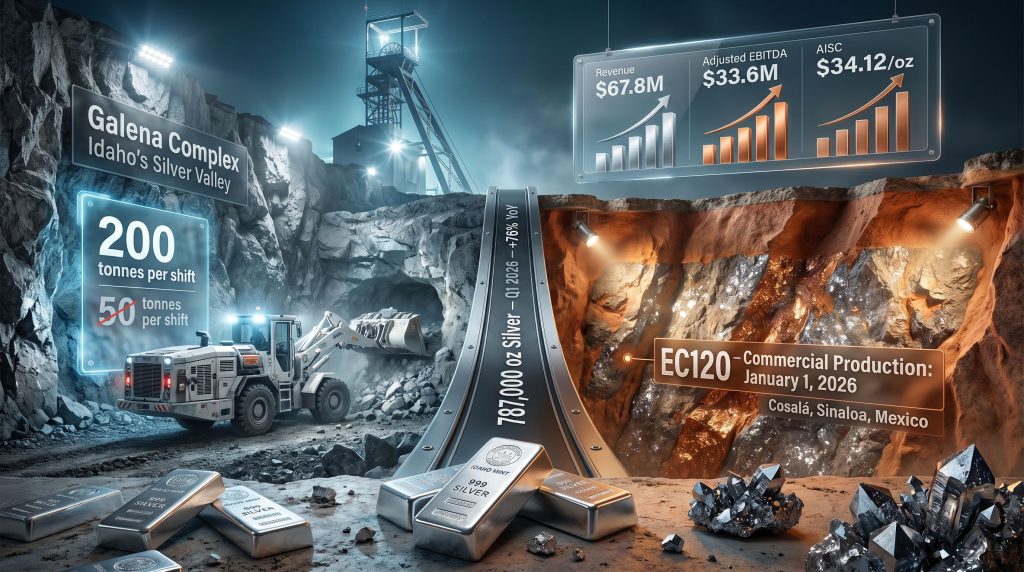
Underground mining operates on a fundamental paradox: the deeper and more complex the orebody, the more dependent production outcomes become on engineering precision rather than geological fortune. For investors tracking silver producers, this distinction matters enormously. A company that achieves output growth through genuine operational transformation carries a fundamentally different risk profile than one relying on favourable grades alone. Americas Gold & Silver record Q1 silver production at Galena and Cosalá illustrates exactly this distinction, with 787,000 consolidated silver ounces produced in Q1 2026 representing a 76% year-over-year increase built on two structurally different operational mechanisms executing in parallel.
Understanding what actually drove that number, and whether it is repeatable, requires looking well beyond the headline figure.
When big ASX news breaks, our subscribers know first
What the Q1 2026 Numbers Actually Tell Us
The headline production figure of 787,000 ounces compared to approximately 446,000 ounces in Q1 2025 is striking, but the composition of that growth is more instructive than the total. Consolidated silver equivalent production reached approximately 909,000 ounces for the quarter once lead, copper, and antimony by-products were incorporated on a silver-equivalent basis.
What makes this quarter particularly notable from an operational analysis perspective is that silver sales of 830,000 ounces actually exceeded production volume. That dynamic indicates the company drew down prior inventory to fulfil sales commitments, a detail that often goes unremarked in headline coverage but signals active inventory management and strong commercial execution.
The by-product breakdown for the quarter was as follows:
- 1.9 million pounds of lead
- 1.0 million pounds of copper
- 137,000 pounds of antimony
Critically, the production surge was not the product of a single favourable variable. It emerged from two operationally distinct sites executing through entirely different technical mechanisms simultaneously.
The Two-Engine Architecture: Galena and Cosalá Compared
The Galena Complex in Idaho and the Cosalá Operations in Sinaloa, Mexico, share a corporate parent but almost nothing in terms of their geological character, metallurgical profile, or the specific levers being pulled to improve output. Comparing their Q1 2026 performance side by side clarifies how the consolidated growth number was constructed.
| Metric | Galena Complex Q1 2026 | Cosalá Operations Q1 2026 |
|---|---|---|
| Silver Production | ~425,000 oz | ~362,000 oz |
| YoY Change | +35% | +174% |
| Primary Growth Driver | Higher throughput tonnage | Higher grade via EC120 transition |
| Key By-Products | Lead, copper, antimony | Copper |
| Cash Cost per Silver Oz | $22.12 | $24.85 |
Galena Complex, Idaho: Volume-Led Growth Through Engineering Upgrades
Galena's 35% year-over-year increase to approximately 425,000 ounces was achieved through a volume-led strategy rather than grade improvement. The mine processed higher throughput tonnage at marginally lower silver grades, meaning the growth came from moving more material more efficiently rather than from accessing richer ore.
The practical enablers of this approach were two interlocking operational changes: the transition to long-hole stoping methodology and the deployment of remote mucking systems. Both are discussed in detail in the following section.
Galena also achieved a notable commercial milestone during Q1 2026 with the first-time monetisation of copper and antimony by-products under a new commercial arrangement with Teck Resources. Previously, these metals were produced but not fully captured as revenue-generating by-products. Their addition to the by-product credit pool directly improved cost economics at the site.
Cosalá Operations, Mexico: Grade-Led Transformation via EC120
Cosalá's 174% increase to approximately 362,000 ounces represents a more fundamental operational shift. The Cosalá site transitioned from the San Rafael zinc-lead-silver orebody to the EC120 silver-copper deposit, with commercial production at EC120 formally declared effective January 1, 2026.
The mineralogical difference between these two orebodies is the core of the story. EC120 delivers superior silver grades and metallurgical recoveries compared to San Rafael. In practical terms, more silver is recovered from each tonne of ore processed at EC120 than was achievable under the previous mining regime. This grade and recovery improvement is what generated a 174% output increase even as overall processed tonnages were lower than in prior periods.
The structural trade-off from this transition is that zinc and lead by-product volumes declined materially as San Rafael mining ceased. This had a direct upward effect on Cosalá's reported cash costs per silver ounce, a point addressed in the cost analysis section below.
Long-Hole Stoping and Remote Mucking: The Mechanics Behind Galena's Productivity Gains
For investors unfamiliar with underground mining engineering, the terminology used to describe Galena's improvements can obscure what is actually a significant productivity story. Both long-hole stoping and remote mucking represent departures from labour-intensive conventional methods and carry measurable implications for cost structure, output capacity, and workforce safety.
Understanding Long-Hole Stoping
Traditional underground silver mining in narrower, higher-grade veins typically uses cut-and-fill methods, specifically underhand or overhand configurations. In these approaches, miners work in relatively small increments, advancing through the ore zone slice by slice. While precise and well-suited to complex vein geometries, cut-and-fill is inherently volume-limited and labour-intensive.
Long-hole stoping takes a fundamentally different approach. Rather than advancing incrementally, it involves drilling a series of parallel boreholes across a defined ore panel and blasting large volumes of material simultaneously. The result is bulk extraction of ore rather than incremental removal, dramatically increasing the volume of ore available for mucking and transport per unit of time.
At the Galena 49-360 stope, ten long-hole panels have been mined to date, with the eighth panel extracted during Q1 2026 specifically. A key operational benchmark is that all panels mined so far have achieved planned mining widths, which means dilution — the unintended inclusion of waste rock with ore — has remained within acceptable parameters. Dilution control is critical in long-hole stoping because excessive dilution reduces the effective grade of the ore stream reaching the mill, undermining the efficiency gains of the method.
Three additional long-hole stopes are currently in development and scheduled for extraction during Q2 and Q3 2026.
Does Remote Mucking Deliver a Fourfold Productivity Gain?
Remote mucking refers to the use of remotely operated equipment to load and transport broken ore from stoping zones to ore passes or haulage systems, removing the need for operators to be physically present in active blast zones.
The productivity improvement at Galena from this technology change is quantified directly in company disclosures. Interpreting drill results and evaluating equipment upgrades like remote mucking in tandem gives investors a clearer picture of genuine operational momentum:
- Remote mucking throughput: approximately 200 tonnes per shift
- Traditional manual mucking throughput: approximately 50 tonnes per shift
- Effective productivity improvement: 4x per operating shift
This is not a marginal efficiency gain. Moving four times the material volume per shift with the same or fewer personnel fundamentally changes the economics of underground haulage. Fixed labour costs are spread across substantially more ore tonnes, and the operational bottleneck at the mucking stage is largely eliminated.
Remote mucking also removes personnel from the most hazardous zones within an active stope during and immediately after blasting cycles, directly reducing exposure risk for underground workers. This connection between productivity technology and safety outcomes is often underappreciated in financial analysis of mining operations.
Cost Performance: Diverging Trajectories with Different Root Causes
Consolidated attributable cash costs for Q1 2026 came in at $23.57 per silver ounce, with all-in sustaining costs (AISC) of $34.12 per silver ounce, placing the company within its stated full-year guidance range of $30 to $35 per ounce. However, the site-level cost trajectories moved in opposite directions, and understanding why matters for assessing the quality of the results.
Galena: Cost Improvement Driven by Scale and By-Product Credits
| Galena Cash Cost Metric | Q1 2025 | Q1 2026 | Change |
|---|---|---|---|
| Cash Cost per Oz | $28.19 | $22.12 | -$6.07 (-21.5%) |
The reduction at Galena reflects two concurrent forces. Higher silver sales volume distributes the fixed cost base across more ounces, mechanically reducing the per-ounce cost figure. Simultaneously, the first-time monetisation of copper and antimony by-products under the Teck agreement added new by-product credits, which are applied against operating costs in the cash cost calculation. The combination produced a meaningful and genuine cost improvement.
Cosalá: A Transitional Cost Increase, Not an Efficiency Problem
| Cosalá Cash Cost Metric | Q1 2025 | Q1 2026 | Change |
|---|---|---|---|
| Cash Cost per Oz | $17.17 | $24.85 | +$7.68 (+44.7%) |
The increase at Cosalá requires careful contextual interpretation. Under the San Rafael regime, zinc and lead production generated substantial by-product credits that significantly reduced the reported cash cost per silver ounce. When San Rafael mining ceased, those credits disappeared from the cost calculation entirely.
This cost increase is a direct accounting consequence of the orebody switch, not evidence of operational deterioration. As EC120's copper production matures and copper by-product credits build through the remainder of 2026, the Cosalá cost profile is expected to normalise progressively.
Financial Turnaround: From Deep Losses to Profitable Momentum
The financial transformation from Q1 2025 to Q1 2026 is the clearest expression of operational leverage that silver production scale can generate. Furthermore, when throughput rises sharply against a largely fixed cost base, the margin expansion can be dramatic. The Americas Gold & Silver record Q1 silver production at Galena and Cosalá is reflected clearly in the Q1 2026 financial results:
| Financial Metric | Q1 2026 | Q1 2025 | Change |
|---|---|---|---|
| Revenue | $67.8M | $23.5M | +187% |
| Net Income/(Loss) | $10.0M ($0.03/share) | ($19.7M) ($0.08/share) | ~+$29.7M swing |
| Adjusted Earnings/(Loss) | $19.9M ($0.06/share) | ($11.5M) ($0.05/share) | +$31.4M |
| Adjusted EBITDA | $33.6M ($0.10/share) | ($5.5M) ($0.02/share) | +$39.1M |
| Cash and Equivalents | $122.4M | N/A | As at March 31, 2026 |
| Working Capital | $66.8M | N/A | As at March 31, 2026 |
The adjusted EBITDA swing from negative $5.5 million to positive $33.6 million in a single year is a direct numerical expression of production leverage. Revenue grew 187% while the cost base did not grow proportionally, producing the EBITDA expansion visible in the table above.
One nuance worth noting is that reported net income was partially offset by higher unrealised derivative liabilities, a consequence of rising forward curves for gold and silver increasing the present value of the company's metals contract obligations. This is a non-cash accounting effect rather than a cash cost, and its impact is eliminated in the adjusted earnings figures.
Disclaimer: Past financial performance is not indicative of future results. All financial data cited in this article derives from company disclosures. Investors should conduct independent due diligence and consult a qualified financial adviser before making investment decisions.
The next major ASX story will hit our subscribers first
Building a Critical Minerals Platform: Antimony and the Crescent Acquisition
Silver production figures have dominated the Q1 2026 narrative, but the strategic architecture being assembled around the Galena Complex extends well beyond silver. In addition, two developments in particular deserve attention from investors with longer time horizons.
Galena as the United States' Largest Antimony Producer
Galena Complex is identified as the largest antimony mine in the United States, and Q1 2026 marked the first quarter in which antimony production at the site was commercially monetised, producing 137,000 pounds under the Teck Resources agreement.
In February 2026, Americas formed a 51/49 joint venture with United States Antimony Corporation to construct an antimony processing facility within Idaho's Silver Valley. The strategic intent is to create a fully integrated domestic supply chain from mine extraction through to finished antimony product within the United States. Antimony is classified as an antimony critical mineral, and the United States currently lacks meaningful domestic processing infrastructure for the metal. The joint venture targets that gap directly.
For investors, the antimony dimension adds a strategic optionality layer to what is primarily a silver investment thesis. The antimony shortage risks for defence and industry add further urgency to domestic supply chain development, and investors should monitor progress accordingly.
The Crescent Silver Mine: World-Class Grade Optionality
The December 2025 acquisition of the Crescent Silver Mine, located approximately nine miles from the Galena Complex, added an asset carrying the designation of the world's third-highest-grade silver resource to the portfolio. This silver asset acquisition model, where proximity to existing infrastructure drives capital efficiency, is a recurring theme in successful silver district development. The geographic proximity to Galena creates meaningful operational and infrastructure synergy potential.
Full-year 2026 capital allocation includes $30 to $40 million directed toward Crescent Mine development, representing a significant portion of the company's total capital expenditure guidance of $90 to $120 million. Bringing a world-class grade asset into production from an existing operational base in the same district is a capital-efficient development pathway relative to greenfield construction.
Mineral Resource Growth: A Signal Worth Understanding
Accompanying the Q1 2026 production release, the company reported that Measured and Indicated Mineral Resources at Galena increased 19% year-over-year, while Measured and Indicated grades improved by 21% year-over-year. Two new near-mine silver discoveries were also announced, alongside a new high-grade discovery at El Alacrán near the Cosalá operations in Mexico.
The combination of rising resource tonnage and improving average grade within a single reporting period is technically significant. In most active mining operations, resource grade tends to decline over time as higher-grade material is preferentially extracted. When both tonnage and grade grow simultaneously, it indicates that newly delineated mineralisation is of superior quality to the existing resource base average — a genuinely positive geological signal rather than a simple numerical increase.
Safety as an Operational Indicator
Both the Galena Complex and Cosalá Operations achieved one full year without a Lost Time Accident, with Galena reaching this milestone on March 11, 2026, and Cosalá achieving the same on April 14, 2026. In underground mining environments, LTA-free performance sustained over 12 or more months reflects the quality of management systems, workforce training programmes, and operational discipline at a site level.
There is also a productivity correlation that is often overlooked in investment analysis: operations with lower incident rates typically achieve higher equipment utilisation rates and lower unplanned downtime. The absence of accidents reduces operational disruption, and the training standards that prevent accidents tend to produce more technically proficient and efficient underground crews.
Full-Year 2026 Guidance: The Delivery Framework
| Guidance Category | 2026 Target |
|---|---|
| Silver Production | 3.2 to 3.6 million oz |
| AISC per Silver Oz Sold | $30 to $35 |
| Total Capital Expenditure | $90M to $120M |
| Crescent Mine Capital Allocation | $30M to $40M |
| Exploration Capital | $15M to $20M |
| Total Drill Programme | 64,000 metres |
The 64,000-metre drill programme, described as the largest in company history, spans both infill and exploration targets across Galena, Crescent, Cosalá, and El Alacrán. Consequently, for the full-year production guidance of 3.2 to 3.6 million ounces to be achieved, several operational milestones need to execute on schedule. Furthermore, the record silver production benchmarks set by peers in the sector demonstrate what sustained execution can deliver at scale. The Americas Gold & Silver record Q1 silver production at Galena and Cosalá provides a strong foundation, but the following milestones remain critical:
- Three additional long-hole stopes at Galena must enter production in Q2 and Q3 2026 as planned
- Shaft upgrades and underground fleet modernisation at Galena must advance on schedule
- EC120 at Cosalá must sustain higher silver grades and recoveries across the remaining three quarters
- Crescent Mine development must progress within the allocated $30 to $40 million capital envelope
- The antimony processing facility construction must advance in line with joint venture plans
- The drill programme must generate resource conversion results supporting future production confidence
Forward-looking statements regarding production guidance, capital expenditure, and operational milestones involve known and unknown risks. Actual results may differ materially from guidance figures. This article does not constitute financial advice.
Frequently Asked Questions
Why did consolidated silver production increase by 76% in Q1 2026?
The increase was generated by two parallel mechanisms. At Galena, higher processed tonnages driven by long-hole stoping and remote mucking technology delivered a 35% output increase. At Cosalá, the transition from the San Rafael zinc-lead-silver orebody to the higher-grade EC120 silver-copper deposit, with commercial production declared effective January 1, 2026, delivered a 174% increase. Both improvements executed simultaneously.
What is the EC120 deposit and why does it matter?
EC120 is a silver-copper orebody within the Cosalá Operations in Sinaloa, Mexico. Its mineralogy delivers higher silver grades and superior recovery rates compared to the San Rafael deposit it replaced. The transition to EC120 was the primary driver of Cosalá's outsized production increase in Q1 2026.
How does remote mucking change the economics of underground silver mining?
Remote mucking replaces manual underground material handling with remotely operated equipment. At Galena, this transition lifted throughput from approximately 50 tonnes per shift under conventional methods to approximately 200 tonnes per shift, a fourfold improvement. Fixed labour and overhead costs are spread across a much larger ore volume, directly reducing per-ounce costs.
Why did cash costs rise at Cosalá if production increased so significantly?
The cost increase at Cosalá from $17.17 per ounce in Q1 2025 to $24.85 per ounce in Q1 2026 resulted directly from the cessation of San Rafael mining, which eliminated zinc and lead by-product credits. These credits previously offset a substantial portion of operating costs. As EC120 copper production builds and generates its own by-product credits, this transitional cost pressure is expected to ease.
What are the key milestones investors should monitor for the remainder of 2026?
- Progress on three additional long-hole stopes at Galena entering production in Q2 and Q3
- Crescent Mine development advancing within budget
- EC120 grade and recovery performance sustaining through H2 2026
- Results from the 64,000-metre drilling programme, as detailed in the official announcement
- Construction progress on the Idaho antimony processing facility with United States Antimony Corporation
Disclaimer: Past financial performance is not indicative of future results. All financial data cited in this article derives from company disclosures. Investors should conduct independent due diligence and consult a qualified financial adviser before making investment decisions.
Want to Catch the Next Major Silver or Critical Minerals Discovery Before the Market Does?
Discovery Alert's proprietary Discovery IQ model scans ASX announcements in real time, instantly identifying significant mineral discoveries across silver, antimony, copper, and more than 30 other commodities — turning complex data into clear, actionable opportunities for investors at every level. Explore how historic discoveries have generated extraordinary returns and begin your 14-day free trial at Discovery Alert to position yourself ahead of the market.