June 18, 2026
The Monetary Reckoning: Why Silver May Be the Most Mispriced Asset on Earth
Throughout modern financial history, the assets that have generated the most extraordinary long-term returns share one defining characteristic: they were deeply unfashionable at precisely the moment they were most attractively priced. Value does not announce itself. It accumulates quietly beneath the surface of market noise, waiting for the structural conditions that render its absence impossible to ignore.
Silver sits in exactly that position today. Many analysts argue that silver is the most undervalued asset in the world, trading at a fraction of its inflation-adjusted historical highs. The convergence of monetary dysfunction, accelerating industrial consumption, and extreme relative undervaluation against gold creates a multi-layered investment thesis that few assets can replicate.
This article explores that thesis in depth, examining the macro forces, historical precedents, valuation frameworks, and risk factors that define silver's position in the current financial landscape. This is not financial advice. All forward-looking analysis represents opinion and should not be construed as a guarantee of future performance.
When big ASX news breaks, our subscribers know first
What Makes Silver Uniquely Positioned Among All Asset Classes?
Most assets derive their value from a single source: income generation, scarcity, or utility. Silver is one of the very few assets on the planet that draws simultaneously from all three wells, functioning as a monetary store of value, an industrially consumed raw material, and a finite geological resource. This tripartite identity is not merely interesting from an academic standpoint. It creates a structural demand floor that no other precious metal can replicate.
Gold is the monetary benchmark. Copper is the industrial bellwether. Bitcoin is the digital scarcity narrative. Silver occupies all three conceptual spaces at once, and yet it is priced as though it belongs to none of them. Understanding silver's dual nature as both a precious and industrial metal is essential to grasping why that mispricing exists.
The Fiat System Under Pressure: What Trust Erosion Means for Hard Assets
Fiat currency systems do not fail because of arithmetic. They fail because of psychology. The precise moment when a critical mass of participants begins to doubt the integrity of the monetary system is the inflection point that separates manageable debt problems from existential currency crises. That threshold is not defined by a specific debt-to-GDP number. It is defined by the erosion of trust in the institutions that issue and manage the currency.
The United States currently carries a national debt exceeding $35 trillion, representing more than 120% of GDP. To contextualise the scale of this expansion: in 1980, total U.S. national debt stood at approximately $1 trillion. The nominal increase of 35 times in four decades has not been accompanied by proportional economic output growth, meaning the debt has compounded faster than the productive capacity of the economy it was designed to fund.
When real interest rates turn negative, meaning inflation-adjusted returns on sovereign bonds fall below zero, the opportunity cost of holding non-yielding assets like silver effectively disappears. Historically, this environment has been among the most powerful catalysts for precious metals appreciation.
The conventional inflation measure, CPI, understates the true erosion of purchasing power when assessed against money supply growth. Over the past decade, broad money supply in the United States has grown at an annualised rate of approximately 8 to 10%. With nominal interest rates sitting near 4%, investors in sovereign bonds are earning a deeply negative real yield when measured against actual monetary expansion rather than headline consumer prices. Furthermore, the inflation hedge dynamics of hard assets become increasingly relevant under these conditions.
A sovereign bond that cannot be realistically repaid in real terms does not carry zero risk. It carries zero return with embedded inflation risk, making the traditional concept of risk-free sovereign debt a structural illusion under current monetary conditions.
When real yields are structurally negative, hard assets with finite supply become mathematically more attractive than paper instruments. Silver, as a finite, physically tangible store of value, occupies the sweet spot of that dynamic.
The Gold-to-Silver Ratio: The Most Important Metric Most Investors Overlook
The gold-to-silver ratio (GSR) measures how many ounces of silver are required to purchase a single ounce of gold. It is among the oldest and most reliable relative valuation tools in commodity markets, with meaningful historical data extending across multiple centuries. In-depth gold-silver ratio analysis reveals just how historically stretched current valuations have become.
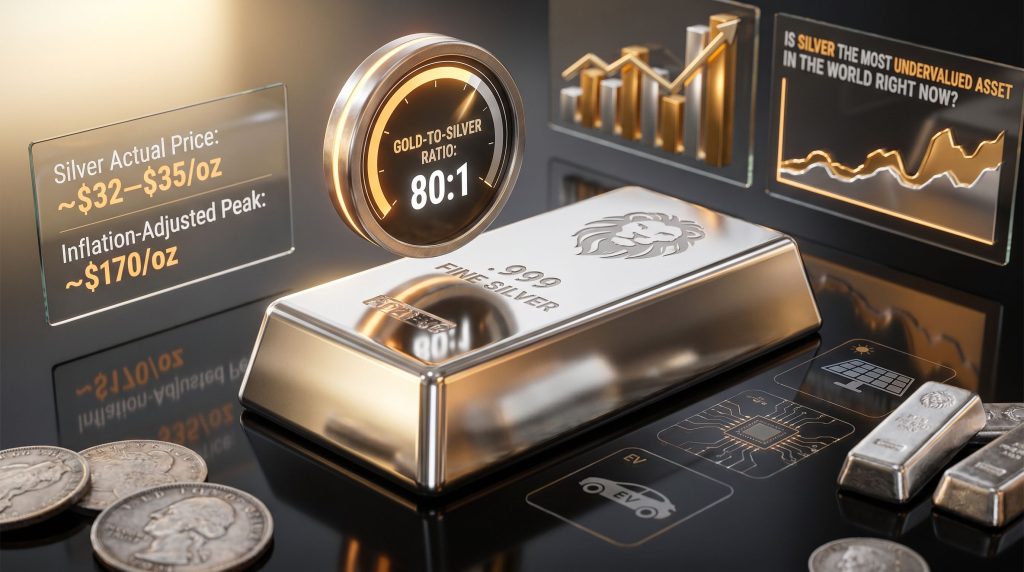
As of mid-2025, the GSR sits above 80:1, meaning silver is historically cheap relative to gold by nearly every long-run benchmark.
| GSR Level | Historical Context | Implication for Silver |
|---|---|---|
| 15:1 | Classical monetary gold/silver standard | Silver at full monetary parity with gold |
| 50-60:1 | Long-run modern average | Silver trading near fair value |
| 80:1+ | Current level (2025-2026) | Silver historically cheap relative to gold |
| 100:1+ | COVID-19 peak (March 2020) | Extreme undervaluation that preceded a major silver rally |
The ratio's current elevation is particularly instructive when examined against geological reality. Earth's crust yields approximately 7 to 8 ounces of silver for every 1 ounce of gold mined. Yet the market prices silver at more than 80 ounces per 1 ounce of gold. The divergence between what the ground produces and what markets price is a structural signal that experienced commodity analysts rarely dismiss.
The 1939 Precedent: What Extreme GSR Readings Have Historically Indicated
One of the most instructive historical moments for understanding extreme GSR readings occurred in 1939. As geopolitical tensions escalated across Europe, central banks aggressively accumulated gold as a reserve asset, a rational institutional response to sovereign risk. Because central banks historically do not purchase silver, that flight-to-gold dynamic pushed the GSR to its highest recorded modern level.
Once the geopolitical reality became undeniable and broader market participants began responding, silver demand surged as retail and institutional investors sought monetary protection. The ratio subsequently collapsed, and silver dramatically outperformed gold over the following period. The pattern is instructive: extreme GSR readings have historically preceded sharp silver outperformance, particularly once the monetary flight instinct broadens beyond institutional gold buyers to include silver demand from individual investors.
Silver's Inflation-Adjusted Price: The Numbers Tell a Stark Story
The most compelling element of the silver undervaluation argument is the comparison between current spot prices and inflation-adjusted historical peaks.
| Metric | 1980 Value | 2025-2026 Inflation-Adjusted Equivalent |
|---|---|---|
| Silver spot price | ~$50/oz | ~$170/oz in real terms |
| Gold spot price | ~$850/oz | ~$2,500-$3,000/oz (gold has met or exceeded this) |
| U.S. national debt | ~$1 trillion | ~$35 trillion+ (35x nominal expansion) |
| Silver actual price (2025) | N/A | ~$32-$35/oz |
The asymmetry here is striking. Gold has broadly closed, and in many recent periods exceeded, its inflation-adjusted 1980 peak. Silver, despite a meaningful rally through 2024 and into 2025, trades at roughly one-fifth of its real-terms historical high. This is not a marginal gap. It represents a structural lag that underpins the core of the silver undervaluation case.
Whether or not one accepts the most aggressive price projections circulating in precious metals commentary, the gap between silver's current price and its inflation-adjusted historical peak represents one of the most pronounced valuation disconnects in any asset class tracked by institutional analysts today.
Industrial Demand: The Permanent Supply Drain That Changes the Equation
Gold's investment thesis rests almost entirely on its monetary and store-of-value properties. Silver's thesis is fundamentally more complex because approximately two-thirds of annual silver supply is consumed industrially in applications where recovery is either economically impractical or technically impossible.
This creates a structural supply dynamic that no other monetary metal faces: silver is progressively consumed. Unlike gold, where the vast majority of historically mined supply remains in some accessible above-ground form, silver is continuously removed from the investable pool through irreversible industrial use. Consequently, the growing silver supply deficits represent a long-term structural tightening with no near-term resolution.
The three primary growth vectors reshaping silver's demand profile through 2030 are:
- Solar photovoltaic manufacturing, where silver paste is a critical component in panel production, with demand projections continuing to rise as global solar installation capacity expands
- Electric vehicle manufacturing, where silver is used in battery management systems, electrical contacts, and circuit boards across every major EV platform
- AI hardware and advanced electronics, where silver's unmatched electrical conductivity makes it irreplaceable in high-performance computing infrastructure
Each of these demand vectors is growing independently, and their cumulative pressure on available silver supply represents a structural tightening that has no near-term technological solution. You cannot mine more silver on demand. You cannot substitute away from silver's conductivity properties without accepting meaningful performance degradation.
This industrial consumption reality interacts with silver's monetary premium in an unusual way: even if investor sentiment toward precious metals were to weaken, the industrial demand floor provides a structural price support that pure monetary metals like gold do not possess.
The next major ASX story will hit our subscribers first
When Markets Stop Thinking: The Passive Investing Problem and Its Implications for Real Assets
One of the most underappreciated dynamics distorting current asset prices is the near-complete replacement of fundamental analysis by passive and quantitative investing flows. The implications for rational price discovery across all asset classes are profound.
Consider a simple thought experiment. If an experienced financial analyst were placed in a room with a non-specialist and offered a choice between two assets: a company generating $1 billion in annual profit trading at a $400 billion market capitalisation, or a company generating $25 billion in profit trading at a $120 billion market capitalisation, any rational human actor would select the latter without hesitation. The return on invested capital comparison is not remotely close.
Yet current market pricing reflects the opposite outcome. Markets are, in aggregate, allocating vastly more capital to the lower-return asset. The only mechanism capable of producing this outcome systematically and persistently is one in which price-insensitive, rules-based capital flows rather than analytical human judgment are the dominant pricing mechanism.
When passive and quantitative investment flows replace fundamental analysis as the primary driver of asset prices, the market ceases to function as a price discovery mechanism. It becomes, instead, a policy transmission tool, reflecting central bank liquidity conditions more accurately than underlying business value.
This breakdown in price discovery creates a historically rare opportunity in assets that passive flows largely ignore. Physical silver and silver mining equities, which sit outside the major passive index ecosystems, remain priced closer to fundamental reality than the index-driven assets that passive capital reflexively purchases regardless of valuation.
How Silver Compares to Other Asset Classes in the Current Environment
The question of whether silver represents the most compelling opportunity requires comparison against the full universe of available alternatives. Furthermore, understanding central bank influence on gold versus silver pricing helps explain the persistent institutional demand differential between the two metals.
| Factor | Gold | Silver | Bitcoin | Bonds |
|---|---|---|---|---|
| Central bank buying | Active and accelerating | Minimal institutional buying | None | Benchmark asset |
| Industrial demand | Limited | Significant and growing | None | None |
| Inflation-adjusted price gap vs. 1980 high | Largely closed | Significant gap remains | N/A | Deeply negative real yield |
| Volatility profile | Moderate | Higher (amplified upside/downside) | Very high | Low nominal, high real |
| Liquidity | Very high | High | High | Very high |
| Store of value history | Multi-millennia | Multi-millennia | ~15 years | Institutional construct |
Triffin's Dilemma and the Reserve Currency Endgame
Any complete analysis of silver's macro backdrop must address the structural tension at the heart of the U.S. dollar system. Triffin's Dilemma describes the inherent conflict faced by the issuer of a global reserve currency: to supply the world with adequate liquidity, the reserve currency nation must run persistent trade deficits. However, those persistent deficits ultimately undermine confidence in the currency itself, creating a self-reinforcing credibility erosion that no policy tool can permanently resolve.
This structural tension has been building within the U.S. dollar system for decades. No government voluntarily returns its currency to a gold or silver standard while that currency retains sufficient credibility to fund deficit spending. The historical pattern, observed across multiple currency systems, is that the return to hard monetary anchors follows, rather than precedes, the loss of faith in the fiat alternative.
Silver Mining Equities: Leveraged Exposure to the Thesis
For investors seeking amplified exposure to silver price appreciation, mining equities offer a structurally compelling proposition that physical silver cannot replicate. When silver prices rise, the economics of silver production improve dramatically, because operating costs are largely fixed while revenue scales directly with the commodity price.
A practical illustration: a silver producer generating 10 to 12 million ounces of silver annually, even as a byproduct of base metal operations, at a silver price of $100 per ounce, would generate approximately $1 to $1.2 billion in silver-related revenue. If that company's total market capitalisation sits near $1.5 to $1.7 billion, the silver revenue stream alone nearly covers the entire enterprise value at that price assumption, implying the market is attributing near-zero value to all other operations, management capability, resource base, and future production optionality.
That kind of valuation dislocation does not persist indefinitely. It resolves either through silver price appreciation, or through broader market recognition of the asset's fundamental value, or both simultaneously.
Due Diligence Checklist for Silver Mining Companies
- Annual silver production volume, distinguishing primary silver producers from byproduct producers
- All-in sustaining cost (AISC) per ounce, which determines profitability at various silver price scenarios
- Revenue breakdown between silver and base metals, which affects sensitivity to silver price movements
- Market capitalisation relative to silver revenue at both spot and projected price scenarios
- Balance sheet strength and debt levels, which determine financial resilience during commodity price downturns
- Jurisdiction risk and the regulatory environment of operating countries
Risks to the Silver Bull Case: An Honest Assessment
Intellectual integrity demands that any bull case for silver be evaluated against its most credible counterarguments. The following table presents the core risk factors and the bull-case responses to each.
| Risk Factor | Bear Case Argument | Bull Case Response |
|---|---|---|
| Recession | Industrial demand collapses, widening the GSR | Monetary demand historically offsets industrial weakness during recessions |
| Dollar strength | Hard assets face headwinds during USD rallies | Dollar strength at current debt levels is structurally unsustainable long-term |
| Paper market suppression | Futures positioning can delay physical price discovery | Physical market tightness has historically overwhelmed paper pricing eventually |
| Silver's volatility | Price swings deter institutional allocation | Higher volatility creates amplified upside when the trend direction is correct |
| Better alternatives | Copper and rare earths offer purer industrial exposure | Silver uniquely combines monetary and industrial demand in a single asset |
Silver's volatility relative to gold is perhaps the most practically important risk factor for investors to internalise. The same characteristics that produce outsized gains during bullish cycles produce equally outsized drawdowns during risk-off periods. Position sizing and time horizon alignment are critical considerations. For instance, the case that silver is the most mispriced asset of the decade has been made by several independent analysts who point to precisely these structural imbalances.
Practical Positioning: How Investors Are Approaching Silver Exposure
The question of how to access silver exposure involves trade-offs across liquidity, leverage, counterparty risk, and operational complexity.
| Investor Segment | Current Positioning | Trend Direction |
|---|---|---|
| Central banks | Accumulating gold; minimal silver presence | Neutral on silver specifically |
| Retail investors | Growing physical silver demand | Bullish and accelerating |
| Hedge funds | Tactical positioning, not structural conviction | Opportunistic |
| Major analyst firms | Acknowledging undervaluation vs. inflation-adjusted highs | Cautiously constructive |
| Social media and retail communities | High conviction with speculative targets | Strongly bullish, $50-$100/oz targets cited |
For investors considering entry, dollar-cost averaging into volatile assets like silver mitigates the risk of mistiming cyclical peaks and troughs. Given silver's historical price behaviour, attempting to time a single entry point with a concentrated position has historically produced inferior risk-adjusted outcomes compared to systematic accumulation over time.
Portfolio allocation frameworks generally suggest that precious metals exposure, including silver, functions most effectively as a hedge against monetary debasement rather than a primary return-generating position. Sizing that allocation appropriately, typically in the context of a broader portfolio that also includes income-generating real assets, balances the asymmetric upside potential against silver's volatility characteristics. In addition, the book on silver as an undervalued asset remains a useful foundational resource for investors seeking a deeper understanding of the structural arguments underpinning this thesis.
Frequently Asked Questions: Silver as an Investment in 2025-2026
What is the current gold-to-silver ratio and is it historically high?
As of mid-2025, the GSR sits above 80:1, significantly above its long-run modern average of approximately 50 to 60:1, and well above the classical monetary-era ratio of 15:1. By historical standards, this represents elevated silver undervaluation relative to gold.
Why has silver underperformed gold over the past decade?
Central banks are active gold buyers but do not accumulate silver as a reserve asset. This institutional demand differential structurally supports gold pricing while leaving silver dependent on retail, industrial, and speculative demand to drive appreciation.
Is silver a good hedge against inflation?
Silver has historically functioned as an inflation hedge, though with considerably more volatility than gold. Its effectiveness as an inflation hedge is strongest during periods of sustained monetary debasement rather than short-term CPI fluctuations.
What price would silver need to reach to close its inflation-adjusted gap?
On a straight inflation-adjusted basis from the 1980 peak, silver would need to reach approximately $170 per ounce to match its historical real-terms high. Gold has already broadly achieved this recoupment; silver has not.
How does industrial demand affect the investment case?
Industrial consumption removes approximately two-thirds of annual silver supply from investable circulation on a largely permanent basis. This structural drain tightens available above-ground supply over time, creating upward price pressure independent of investment sentiment.
What are the biggest risks of investing in silver right now?
Recession-driven industrial demand collapse, short-term dollar strength, paper market positioning that delays physical price discovery, and silver's inherent price volatility are the most significant near-term risk factors.
Should investors buy physical silver, ETFs, or mining stocks?
Each vehicle serves different objectives. Physical silver eliminates counterparty risk but lacks income and leverage to price. ETFs offer liquidity and price exposure with lower storage burden. Mining equities provide leveraged exposure to price appreciation but introduce operational, geological, and management risk. A combination approach is common among experienced precious metals investors.
The Convergence That Makes This Moment Different
Individual investment theses are rarely compelling when they rest on a single variable. Silver's case in 2025 and 2026 is not built on one argument. It emerges from the simultaneous convergence of multiple independent forces: an extreme gold-to-silver ratio sitting well above long-run averages, structurally negative real yields when measured against money supply growth rather than headline CPI, accelerating industrial consumption across solar, EV, and AI hardware sectors, progressive depletion of above-ground investable silver supply, and a global reserve currency system operating under structural stress that decades of economic literature identifies as ultimately unsustainable.
The timing argument matters as much as the valuation argument. Undervalued assets can remain undervalued for extended periods. The catalysts that compress that gap, whether currency stress, physical supply tightness, or a broader shift in investor sentiment away from passive equity concentration toward real asset allocation, are not precisely predictable. What historical precedent does suggest is that when they arrive, the repricing of structurally undervalued assets tends to be rapid and significant.
The argument that silver is the most undervalued asset in the world is not a fringe view held exclusively by precious metals enthusiasts. It is a thesis supported by geological data, monetary history, relative valuation frameworks, and industrial demand projections that collectively paint a picture of an asset priced well below what its fundamental characteristics would justify. Whether the most aggressive price targets prove accurate is unknowable. That the current price materially understates silver's multi-dimensional value is a proposition that the weight of available evidence finds difficult to dismiss.
This article is intended for informational and educational purposes only. It does not constitute financial advice, investment recommendations, or a solicitation to buy or sell any security or commodity. All investments carry risk, including the potential loss of principal. Past performance is not indicative of future results. Readers should consult a qualified financial adviser before making any investment decisions.
Want to Know the Moment a Major ASX Mineral Discovery Hits the Market?
Discovery Alert's proprietary Discovery IQ model delivers real-time alerts on significant ASX mineral discoveries — instantly turning complex data across more than 30 commodities into a single, actionable gold-equivalent metric — so subscribers can identify opportunities well ahead of the broader market. Explore Discovery Alert's dedicated discoveries page to understand how historic mineral discoveries have generated extraordinary returns, and begin your 14-day free trial today to position yourself at the forefront of the next major find.