May 19, 2026
The global energy landscape experiences unprecedented transformation as natural gas transitions from regionalised commodity pricing toward internationally integrated spot markets. America's LNG boom represents a critical driver of this shift, fundamentally altering pricing mechanisms across entire energy value chains through massive infrastructure investments connecting previously isolated supply basins to worldwide demand centres.
Traditional energy market structures developed around geographic constraints, regulatory frameworks, and localised supply-demand relationships. Natural gas exemplified this pattern, with pricing determined primarily by domestic production capabilities, regional pipeline networks, and local consumption patterns. However, technological advancement in liquefaction processes now enables rapid global arbitrage opportunities.
Understanding America's LNG Infrastructure Revolution
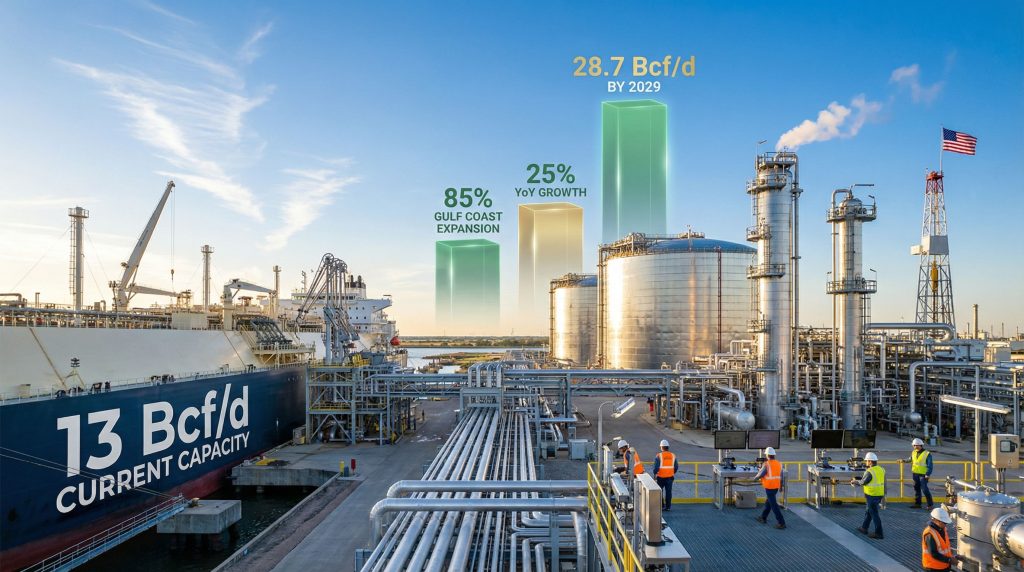
The United States has constructed the world's most extensive liquefied natural gas export infrastructure within a remarkably compressed timeframe. Current operational capacity reaches approximately 12 billion cubic feet per day (Bcf/d), representing a dramatic expansion from essentially zero export capability in 2015.
Current Infrastructure Scale:
- Major export terminals concentrated along Gulf Coast regions
- Multiple liquefaction trains operating at facilities including Sabine Pass and Corpus Christi
- Pipeline networks connecting Permian Basin and Appalachian production to export terminals
- Specialised LNG carrier fleet serving international routes
This infrastructure buildout required unprecedented capital investment, with individual liquefaction projects costing $15-25 billion for multi-train facilities. The technical complexity involves cooling natural gas to minus 162 degrees Celsius, reducing volume by 600 times for efficient ocean transport.
Planned Expansion Projects:
Development pipelines include numerous additional export terminals across Texas and Louisiana coastlines. Final investment decisions are pending for projects that could potentially double current capacity within five years. However, these expansion timelines depend on complex permitting processes, environmental reviews, and long-term contract commitments.
Industry data indicates that achieving projected capacity targets requires sustained construction activity, specialised equipment procurement, and skilled workforce development across multiple simultaneous projects. Furthermore, weekly natural gas trends demonstrate the volatile nature of market conditions affecting these developments.
When big ASX news breaks, our subscribers know first
Market Integration Mechanisms Driving Price Convergence
Natural gas pricing historically operated within isolated regional frameworks where local supply and demand fundamentals determined commodity values. Pipeline capacity constraints, seasonal demand variations, and regulatory oversight created price differentials that persisted for extended periods.
LNG export capability fundamentally alters these dynamics by enabling international buyers to compete directly for American natural gas supplies. European and Asian purchasers can now bid against domestic consumers, creating arbitrage opportunities that drive price convergence toward global benchmarks.
Regional Pricing Structure Evolution:
| Historical Framework | Emerging Global Structure |
|---|---|
| Henry Hub domestic benchmark | International spot market competition |
| Regional pipeline constraints | Global shipping arbitrage |
| Seasonal demand patterns | Worldwide weather correlations |
| State regulatory oversight | International commodity trading |
This transition creates direct transmission mechanisms where geopolitical events affect domestic American energy costs. Weather patterns affecting Asian heating demand or European industrial activity can influence prices at wellheads in Texas and Pennsylvania.
The 2018 Department of Energy analysis highlighted these dynamics, noting that increased LNG exports would necessarily raise domestic natural gas prices. This economic principle reflects basic supply and demand relationships where export demand competes with domestic consumption for available supplies.
In addition, commodity market volatility has become increasingly interconnected with global trading patterns. This volatility is further complicated by global market impacts from international trade tensions.
Consumer Cost Implications Across Market Segments
American households face multifaceted exposure to rising natural gas costs through direct heating expenses and electricity generation fuel costs. Residential consumers typically experience these impacts through utility bill mechanisms designed to pass commodity price changes directly to end users.
Direct Residential Heating Impact
Natural gas serves as the primary heating fuel for approximately 47% of American households, with concentration in northern and midwest regions. A sustained 20% increase in commodity gas prices translates to roughly 6-10% higher heating bills, depending on local utility rate structures.
Regional variations reflect pipeline access, local production availability, and state regulatory frameworks. States with abundant shale gas production may experience more gradual price increases compared to regions dependent on long-distance pipeline transportation.
Industrial Competitiveness Concerns
Energy-intensive manufacturing sectors face significant margin pressure from rising natural gas costs. Chemical production, petroleum refining, and primary metals manufacturing represent major industrial gas consumers vulnerable to international pricing pressures.
These industries historically benefited from North American natural gas price advantages compared to international competitors. Convergence toward global pricing levels erodes this competitive positioning, potentially affecting investment decisions and plant utilisation rates.
Electricity Generation Cost Transmission
Natural gas fuels approximately 38% of American electricity generation, making power sector fuel costs particularly sensitive to commodity price movements. Fuel adjustment clauses enable utilities to pass gas price increases directly through to ratepayers without extended regulatory review processes.
Deregulated electricity markets face especially direct exposure, as wholesale power prices track natural gas costs in real-time. Texas, Pennsylvania, and other restructured markets experience immediate price transmission from gas commodity fluctuations to consumer electricity bills.
Power Generation Expansion Amplifying Demand Pressures
America's ongoing electrification initiatives coincide with substantial natural gas power plant construction, creating compounding demand pressures on gas supplies. This occurs just as export markets increase international competition for these same resources.
Approximately 40 gigawatts of new gas-fired generating capacity is planned through 2030, representing demand for an additional 20 Bcf/d of natural gas supply. This expansion occurs as data centre growth, electric vehicle adoption, and industrial electrification drive overall electricity consumption higher.
Power Sector Demand Dynamics:
- New combined-cycle gas turbines requiring consistent fuel supply
- Peaking units for renewable energy backup applications
- Replacement of retiring coal plants with gas-fired alternatives
- Grid reliability requirements during renewable energy intermittency
The timing creates a perfect storm scenario where domestic gas demand growth coincides with export market competition. This potentially amplifies price pressures beyond what either trend would generate independently.
However, renewable energy transformations are creating competitive alternatives. Power plant operators face fuel cost volatility that directly impacts electricity market economics, unlike renewable energy sources with fixed operating costs.
Regional Winners and Losers in Market Restructuring
America's LNG boom creates distinct geographic and sectoral advantages and disadvantages as energy market integration proceeds. Understanding these distributional effects helps identify potential political and economic tensions.
Economic Beneficiaries:
- Natural gas producers: Higher commodity prices increase wellhead revenues and drilling economics
- Pipeline infrastructure operators: Increased throughput and capacity utilisation
- LNG terminal owners: Export facility utilisation and processing fees
- Renewable energy developers: Improved cost competitiveness versus volatile gas pricing
- Nuclear power operators: Enhanced capacity factor economics
Cost Burden Concentrations:
- Residential heating consumers: Direct natural gas bill increases
- Industrial gas users: Manufacturing input cost inflation
- Electricity ratepayers: Power generation fuel cost pass-through
- Deregulated market participants: Real-time price volatility exposure
Regional variations reflect local energy infrastructure, regulatory frameworks, and economic structures. Gulf Coast regions with extensive petrochemical industries may experience mixed effects, benefiting from higher gas prices but facing increased production costs.
Northern states with significant heating demand face disproportionate household cost impacts. This particularly affects lower-income populations spending higher percentages of income on energy expenses.
Infrastructure Bottlenecks Constraining Export Growth
Despite ambitious expansion plans, several infrastructure limitations could restrict LNG export growth and moderate domestic price impacts. These constraints involve pipeline capacity, permitting processes, and technical construction challenges.
Pipeline Transportation Constraints
Moving gas from production basins to Gulf Coast export terminals requires extensive pipeline network expansion. The Permian Basin alone requires multiple new pipeline projects to evacuate growing associated gas production from oil drilling activity.
Appalachian shale gas faces similar transportation challenges, with limited pipeline capacity to move supplies from Pennsylvania and West Virginia to Louisiana and Texas export facilities.
Permitting and Environmental Review Delays
Interstate natural gas pipeline projects require Federal Energy Regulatory Commission approval, often involving multi-year review processes. Local opposition, environmental assessments, and permitting complexity can extend project timelines significantly beyond initial schedules.
State-level permitting for LNG export terminals also involves extensive environmental review, safety assessments, and local approval processes. These may delay project completion dates considerably.
Construction and Labor Constraints
Simultaneous development of multiple large-scale LNG projects strains specialised construction capabilities and skilled labour availability. Complex liquefaction equipment requires experienced installation teams with limited availability across the industry.
Weather-related construction delays, equipment delivery schedules, and commissioning complexity can extend project completion timelines. These factors often push commercial operation dates beyond planned schedules, as noted by America's LNG boom analysis from industry experts.
The next major ASX story will hit our subscribers first
Global Competition Dynamics Affecting Export Strategy
American LNG faces intensifying international competition as other nations develop export capabilities and existing suppliers expand capacity. This competitive landscape influences long-term market positioning and pricing power.
Major Competing Suppliers:
- Qatar: North Field expansion projects adding substantial new capacity
- Australia: Operational optimisation and potential brownfield expansion
- Russia: Arctic LNG developments despite sanctions complexity
- Emerging suppliers: African and South American project development
Market share competition involves cost competitiveness, shipping distance advantages, contract flexibility, and geopolitical considerations. American exports benefit from proximity to European markets and contractual terms offering greater flexibility compared to traditional oil-indexed pricing structures.
Contract Structure Evolution
LNG markets increasingly favour shorter-term contracts and spot market transactions, reducing the traditional 20-year contract structures that historically financed project development. This shift affects project economics and financing structures for new American export facilities.
Buyers prefer contract terms allowing destination flexibility and pricing formulas tied to regional gas benchmarks rather than oil prices. American exporters generally offer more flexible terms compared to traditional suppliers.
Currency fluctuations also affect competitive positioning, as LNG transactions typically occur in U.S. dollars. Competing suppliers face different currency exposures affecting their cost structures.
The surging gas prices have created additional pressure on domestic markets, however, energy export challenges remain significant factors in long-term planning.
Policy Intervention Options for Domestic Price Moderation
Government authorities possess several regulatory tools to moderate domestic natural gas price impacts from export growth. Each approach involves complex trade-offs between economic efficiency and domestic affordability concerns.
Export Restriction Mechanisms
Federal authorities could implement export licensing restrictions during periods of extreme domestic price increases or supply shortages. Such interventions would require balancing international trade commitments against domestic consumer protection.
Historical precedent exists for energy export controls during crisis periods. However, modern trade agreements and diplomatic relationships complicate implementation of restrictive measures.
Strategic Reserve Development
Creating natural gas storage facilities similar to the Strategic Petroleum Reserve could provide supply buffers during price spike periods. Nevertheless, natural gas storage involves more complex technical requirements and higher ongoing operational costs compared to petroleum storage.
Underground storage development requires specific geological conditions and substantial capital investment for injection and withdrawal infrastructure.
Utility Rate Regulation Reform
State public utility commissions could modify fuel adjustment clause structures to limit the pass-through of extreme price increases to residential consumers. Such changes might involve caps, smoothing mechanisms, or subsidised rates for low-income households.
These regulatory modifications would require utilities to absorb commodity price volatility. This could potentially affect credit ratings and financing costs for utility companies.
Industrial Energy Subsidy Programmes
Targeted support for energy-intensive manufacturing industries could help maintain domestic competitiveness during periods of high gas prices. Such programmes might involve direct subsidies, tax credits, or guaranteed pricing arrangements.
Implementation complexity involves determining eligible industries, subsidy levels, and funding mechanisms without creating market distortions or trade policy conflicts.
Renewable Energy Acceleration Through Gas Price Volatility
Rising and volatile natural gas prices create powerful economic incentives for renewable energy deployment. This may accelerate clean energy transitions beyond policy-driven targets, representing an unintended consequence of LNG export expansion.
Renewable Energy Competitive Advantages
Solar and wind power offer fixed-cost electricity generation that becomes increasingly attractive compared to volatile fossil fuel alternatives. Long-term power purchase agreements provide price certainty unavailable from gas-fired generation.
Battery storage systems reduce renewable energy intermittency concerns while providing additional grid services that enhance overall system value. Declining storage costs improve the economic competitiveness of renewable plus storage combinations.
Investment Flow Implications
Higher expected electricity prices improve renewable energy project economics, potentially attracting increased private investment without additional policy support. Utility-scale solar and wind developments benefit from improved revenue projections.
Corporate renewable energy procurement accelerates as businesses seek long-term price stability through direct power purchase agreements. Companies facing volatile electricity costs increasingly view renewable energy contracts as risk management tools.
Grid Modernisation Requirements
Renewable energy expansion necessitates transmission system upgrades and smart grid technologies to manage distributed generation resources. These infrastructure investments create additional employment and economic development opportunities.
Regional transmission organisations must adapt market structures to accommodate increasing renewable energy penetration while maintaining grid reliability and economic efficiency.
Long-term Market Structure Evolution Scenarios
America's energy market structure faces several potential development pathways depending on infrastructure constraints, policy interventions, and global market dynamics. Understanding these scenarios helps anticipate future economic and political developments.
Scenario 1: Continued Export Expansion
Successful completion of planned LNG projects creates substantial export capacity, driving domestic gas prices toward international parity levels. Consumer cost increases generate political pressure for policy interventions or accelerated renewable energy adoption.
This pathway maximises export revenue generation while imposing highest costs on domestic consumers and energy-intensive industries.
Scenario 2: Infrastructure-Constrained Growth
Pipeline bottlenecks and permitting delays limit export capacity expansion below planned levels, moderating domestic price impacts while reducing potential export revenues. Regional price differentials persist between production basins and export terminals.
Limited export growth maintains some domestic price advantages while reducing international competitive pressures on American manufacturers.
Scenario 3: Global Market Oversupply
Competing international suppliers successfully develop substantial new LNG capacity, creating global oversupply conditions that compress export margins and moderate domestic price impacts.
Market oversupply could lead to project cancellations, facility consolidation, and reduced investment in American export infrastructure.
Each scenario involves different distributional consequences for energy producers, consumers, and related industries, with corresponding political and economic implications for regional development patterns.
Conclusion: Navigating Energy Market Transformation
America's LNG boom fundamentally restructures domestic energy markets by connecting previously isolated natural gas supplies to global commodity pricing mechanisms. This integration creates substantial wealth for energy producers while imposing costs on residential consumers and industrial users.
The coincidence of export expansion with power sector electrification amplifies these effects, potentially accelerating renewable energy adoption as gas price volatility makes fixed-cost alternatives increasingly attractive. Policy makers face complex choices between export revenue opportunities and domestic energy affordability concerns.
Success in managing this transition requires careful attention to distributional consequences, infrastructure development priorities, and international competitive positioning. The outcome will significantly influence America's energy landscape for decades to come.
Disclaimer: This analysis involves forward-looking scenarios and market projections that involve inherent uncertainty. Energy market developments depend on numerous factors including regulatory changes, technological advancement, and geopolitical events that may differ from current expectations. Readers should conduct independent research before making investment or policy decisions based on this information.
Ready to Capitalise on Energy Market Volatility?
Discovery Alert's proprietary Discovery IQ model delivers real-time alerts on significant ASX mineral discoveries, including energy and commodity sectors experiencing rapid market transformation. Understand why historic discoveries can generate substantial returns by exploring Discovery Alert's dedicated discoveries page, showcasing exceptional market outcomes from major mineral finds.