August 24, 2026
Why Commodity Markets Fear Geographic Concentration More Than Price Volatility
There is a principle embedded deep within commodity risk analysis that traders and supply chain strategists understand intuitively but that rarely surfaces in mainstream coverage: geographic concentration of production is often more dangerous than price volatility itself. When a single waterway, a cluster of export terminals, or a handful of producing nations controls the flow of an essential industrial input, the entire global supply chain becomes hostage to events that no buyer can predict, hedge fully, or replace quickly.
Ammonia sits at the intersection of this vulnerability more acutely than almost any other traded commodity. It underpins roughly half of all nitrogen-based fertilizer production worldwide, feeds industrial chemical processes from explosives manufacturing to refrigeration, and is increasingly positioned as a hydrogen energy carrier for the low-carbon economy. The ammonia market outlook and Middle East conflict dynamics unfolding through early 2026 are not simply a commodity price story. They represent a structural stress test of how deeply a single geopolitical flashpoint can reorder global food security calculations.
When big ASX news breaks, our subscribers know first
The Structural Architecture of Global Ammonia Trade
Why Ammonia Is Not Like Other Traded Commodities
Ammonia's physical properties create trading constraints that most commodities do not face. It must be stored and transported under pressure or at extremely low temperatures (approximately -33°C at atmospheric pressure), which limits the number of vessels, terminals, and storage facilities capable of handling it. This means that unlike crude oil, where any tanker with basic modifications can carry cargo, ammonia requires a specialised, capital-intensive supply chain that cannot be scaled up rapidly in response to sudden disruptions.
The global seaborne ammonia trade handled approximately 10.9 million tonnes per year as of 2025, according to Argus Media's ammonia market outlook coverage. This is a relatively small volume compared to bulk commodities like coal or iron ore, but its downstream significance is disproportionate because ammonia is the feedstock for fertilisers that sustain food production for billions of people.
The Middle East's Structural Role in Global Ammonia Supply
The Middle East's dominance in ammonia production is not accidental. The region sits atop enormous natural gas reserves, and because natural gas (specifically methane as a hydrogen source) accounts for the majority of production cost in conventional Haber-Bosch ammonia synthesis, proximity to cheap feedstock gas creates a structural cost advantage that producers in Europe, Asia, and North America cannot replicate at scale.
Key producing nations in the region include:
- Saudi Arabia (SABIC and affiliated producers with large-scale export infrastructure)
- Qatar (major nitrogen complex operators with significant global export contracts)
- Iran (substantial domestic capacity, though sanctioned exports create market distortions)
- UAE (Fertil and related facilities at Ruwais)
- Bahrain (GPIC, one of the Gulf's longer-established ammonia exporters)
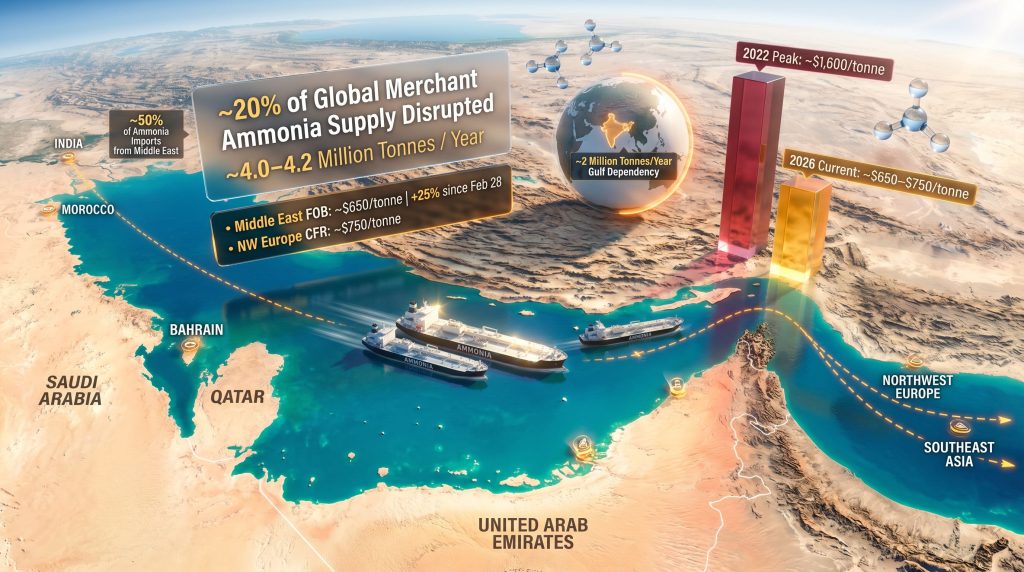
Collectively, the Gulf region accounts for an estimated 4.0 to 4.2 million tonnes of annual ammonia export capacity that routes through, or is dependent on, the Strait of Hormuz shipping corridor, according to data referenced in Argus Media's Q2 2026 ammonia market video update.
The Strait of Hormuz: A Chokepoint With No Parallel for Ammonia
The Strait of Hormuz is approximately 33 kilometres wide at its narrowest navigable point. It is the only maritime exit from the Persian Gulf, meaning that Saudi, Qatari, UAE, and Bahraini ammonia exports have no viable alternative routing. This is a fundamentally different risk profile from, for example, the Suez Canal, which can be bypassed by routing around the Cape of Good Hope at significantly higher cost but without physical impossibility.
Furthermore, the global supply chain risks created by this single chokepoint are compounded by the fact that Hormuz offers no bypass route whatsoever. For comparison, the Malacca Strait connecting the Indian Ocean to the South China Sea carries a far larger volume of global trade but serves a different geography with multiple potential bypass routes. For the ammonia market outlook and Middle East conflict scenario, this makes the Hormuz vulnerability qualitatively different from almost any other supply disruption scenario.
The 2026 Supply Shock: Scale, Sequence, and Market Impact
How the Disruption Unfolded
Beginning in late February 2026, escalating conflict in the Middle East resulted in the effective closure of the Strait of Hormuz to commercial ammonia shipping. Port infrastructure in the region sustained damage from missile strikes, with Salalah port in Oman among the facilities affected by the broader conflict's reach into regional logistics networks. Reports indicate that three loaded ammonia vessels became trapped without safe passage, while at least six additional vessels were diverted from their original routes, creating immediate spot market dislocations.
The disruption's scale can be quantified as follows:
| Metric | Estimated Impact |
|---|---|
| Annual ammonia supply removed | ~4.0 to 4.2 million tonnes |
| Monthly volume disrupted | ~315,000 tonnes |
| Share of global merchant ammonia supply removed | ~20% |
| Share of seaborne ammonia trade affected | ~15% of 10.9 million tpy |
| Urea seaborne trade additionally at risk | ~21% of global volumes |
The simultaneous exposure of urea trade is significant because urea is the primary derivative product of ammonia in agricultural use. A disruption that removes both ammonia and a fifth of global seaborne urea at the same time creates compounding nitrogen supply pressure across multiple crop cycles.
Compounding Supply Vulnerabilities Already Present
What makes the 2026 disruption particularly severe is that it entered a market already weakened by prior supply losses. Trinidad and Tobago, traditionally a significant Atlantic basin supplier of ammonia, had experienced production cuts of approximately 40% in the period preceding the Gulf crisis, driven by gas feedstock shortages from aging domestic fields. Simultaneously, Russian ammonia exports remained constrained by sanctions implemented following the 2022 invasion of Ukraine, meaning that the Gulf disruption represented the third major source removal from the global market within a four-year period.
The cumulative effect of Trinidad production cuts, sustained Russian export restrictions, and now Gulf supply removal creates a tightness profile in the ammonia market that is arguably more structurally entrenched than the 2022 crisis, even if headline prices have not yet reached equivalent peaks.
Comparing 2026 to the 2022 Russia-Ukraine Ammonia Crisis
The 2022 crisis remains the industry's benchmark worst-case price event. When Russia's Togliatti-Odessa pipeline was shut down and Russian seaborne ammonia exports were disrupted following the invasion of Ukraine, prices surged to approximately $1,600 per tonne — a level that caused genuine demand destruction across multiple markets and contributed to food price inflation globally.
| Dimension | 2022 Russia-Ukraine Crisis | 2026 Middle East Disruption |
|---|---|---|
| Primary supply removed | Russian exports (Togliatti pipeline) | Gulf/Hormuz exports (~4.0-4.2Mt/year) |
| Peak price recorded | ~$1,600/tonne | TBD; ~$650-$750/tonne (rising, mid-March) |
| Market preparedness | Low; markets largely unprepared | Moderate; US capacity expanded post-2022 |
| Urea impact | Severe | Significant (~21% seaborne trade at risk) |
| Food security risk | High globally | High for India, Africa, Asia-Pacific |
| Prior supply context | Single event in otherwise stable market | Third major supply loss since 2022 |
The presence of expanded US Gulf Coast ammonia production capacity, developed partly in response to the 2022 crisis investment cycle, provides meaningful but incomplete cushioning for 2026 buyers. US capacity moderates the price trajectory but cannot replace 4-plus million tonnes of annual Gulf output. Indeed, trade and geopolitical shocks of this magnitude consistently expose the fragility of supply chains built around a small number of dominant export corridors.
Regional Price Responses and the Geography of Pain
How Prices Have Moved Across Trading Regions
Price responses to the Hormuz closure have varied significantly by geography, reflecting differential freight costs, vessel availability, and regional buyer dependencies.
| Region | Price Level (Mid-March 2026) | Change Since Late February |
|---|---|---|
| Northwest Europe spot (CFR) | ~$750/tonne | +~$50/tonne from early March |
| Middle East FOB | ~$650/tonne | +~25% / +$170/tonne since Feb 28 |
| Southeast Asia FOB | ~$470/tonne | +$30 week-on-week |
| Southeast Asia indicative range | $480-$490/tonne+ | Upward pressure from multiple buyer inquiries |
The Middle East FOB price movement is particularly instructive. A 25% price increase in under two weeks reflects genuine supply anxiety among sellers trying to reprice remaining export capacity, not merely speculative positioning. The fact that sellers in Southeast Asia began withdrawing offers amid uncertainty about their own forward pricing signals that the market's psychological shift from adequacy to scarcity was rapid and broad-based.
The EU's CBAM: An Additional Cost Layer for European Buyers
European buyers face an additional cost dimension that their Asian counterparts do not: the EU Carbon Border Adjustment Mechanism (CBAM), which imposes incremental cost burdens on imported nitrogen-based products based on the carbon intensity of their production. As European buyers compete for non-Gulf ammonia from US Gulf Coast or North African origins, CBAM compliance costs narrow the margin of arbitrage advantage and compress the economic flexibility that might otherwise allow faster market rebalancing.
This is a lesser-understood dimension of the 2026 ammonia supply crisis. The policy was designed to level the competitive playing field for European producers, but in a supply disruption scenario, it functions as an additional friction cost at precisely the moment when buyers need maximum procurement flexibility. This dynamic is broadly consistent with broader low-carbon commodity transition pressures that are simultaneously reshaping cost structures across multiple industries.
Which Buyers Face the Greatest Exposure?
India: Agricultural Season Risk Is the Critical Variable
India's exposure to the Gulf ammonia disruption extends beyond simple import volume dependency. The country imports approximately 2 million tonnes per year of ammonia from Middle Eastern producers, making it one of the single largest buyers of Gulf-origin ammonia globally. However, the timing dimension compounds the risk enormously.
India's kharif agricultural season, the summer planting cycle that covers crops including rice, cotton, and pulses, begins ramping up in June. Fertiliser application for this season represents a concentrated, time-inelastic demand event. If the Gulf supply disruption extends into Q2 2026, inventory buffers accumulated before the crisis deplete and alternative procurement is not yet secured, Indian farmers face genuine input shortage risk during their most critical agricultural window.
India also imports 6 to 8% of its urea from Gulf producers, meaning the downstream impact on finished fertiliser availability compounds the raw ammonia supply problem. Additionally, Gulf LNG supply disruptions could constrain India's energy-intensive domestic ammonia manufacturing sector, potentially reducing locally-produced supply at precisely the wrong moment. The energy transition demand pressures already reshaping global commodity markets add a further layer of complexity to India's long-term procurement strategy.
The Broader Exposure Map Across Asia, Africa, and Europe
| Country or Region | Exposure Profile |
|---|---|
| Morocco | ~50% of ammonia imports sourced from the Middle East |
| South Korea | Significant Gulf-origin dependency for industrial and agricultural use |
| Turkey | Shifted procurement toward North Africa and US Louisiana; some vessels affected by sanctions complications |
| South Africa | Reliant on Middle East supply with limited alternative sourcing infrastructure |
| China | Inquiry activity increasing; exploring westbound arbitrage opportunities |
| Indonesia | Gulf-origin import dependency; evaluating alternative suppliers |
| Pakistan | Compounded LNG and ammonia supply disruption risk |
Morocco and South Africa represent structurally more vulnerable positions than their relatively smaller import volumes might suggest. Both countries have limited domestic production capacity, constrained access to alternative supply corridors, and face freight cost disadvantages when competing with better-positioned Asian buyers for US or Southeast Asian cargoes. According to ICIS analysis, global ammonia prices are expected to remain elevated through the second half of 2026, with a potential easing not anticipated until early 2027.
Where Replacement Supply Is Coming From
The United States as the Market's Swing Supplier
Post-2022 investment in US ammonia production capacity, concentrated primarily around Gulf Coast facilities in Louisiana and Texas, has positioned American producers as the market's primary swing supplier in the current crisis. US export terminals can serve European, Turkish, and North African buyers through Atlantic basin routing without Hormuz dependency, making this capacity particularly valuable during the current disruption.
The critical limitation is volume. US capacity can moderate price spikes and serve specific buyer relationships, but it cannot single-handedly replace 4-plus million tonnes of annual Gulf output. Its role is one of partial displacement, not full substitution.
Southeast Asian Producers: Caught Between Competing Demands
Southeast Asian ammonia producers, particularly in Malaysia and Indonesia, are receiving simultaneous inquiry volumes from both Indian buyers seeking Gulf replacement supply and Western buyers seeking Atlantic basin alternatives. This dual demand pressure, combined with sellers withdrawing offers amid forward pricing uncertainty, is creating a buyer-unfriendly environment where procurement teams face both higher prices and reduced offer availability.
The theoretical arbitrage window of routing Southeast Asian cargoes westward to Europe is constrained by three structural factors:
- Insufficient availability of ammonia-capable pressure vessels for extended voyages
- Extended voyage times that add substantial freight cost premiums
- Competing regional demand from Asian buyers who hold geographical and logistical priority
North Africa as a Limited European Buffer
North African producers in Algeria and Egypt are providing partial supply cover for Northwest European buyers, with spot prices assessed at approximately $750 per tonne CFR into northwest Europe as of mid-March 2026. However, North African production capacity is not scalable to fill the complete Gulf supply gap, and these producers face their own feedstock and infrastructure constraints that limit rapid production increases.
The next major ASX story will hit our subscribers first
The Q2 2026 Risk Window and Longer-Term Scenarios
Why the Next Three Months Are Critical
The initial phase of the Gulf disruption was partially absorbed by inventory buffers held across buyer supply chains. However, as those stocks draw down through Q2 2026, the market moves from a position of managed tightness to one of genuine scarcity. Northern Hemisphere spring fertiliser application season, which represents peak agricultural ammonia demand, coincides precisely with this inventory depletion window.
This timing dynamic is what market analysts are watching most closely. A disruption resolved by late Q2 might still produce significant price peaks without triggering structural food security consequences. A disruption extending into Q3, however, would fundamentally alter the 2026 agricultural input supply landscape.
Three Recovery Scenarios for the Ammonia Market
Scenario 1: Short disruption, resolved by Q3 2026. Markets rebalance within six to nine months as Gulf supply gradually resumes. Prices retreat from peaks as inventory rebuilds. Some demand destruction occurs at elevated price levels, but no lasting structural damage to fertiliser trade flows.
Scenario 2: Extended disruption, 12 or more months. Sustained price elevation, accelerated investment in alternative supply routes, and potential food security stress in high-dependency import nations including India, Morocco, and sub-Saharan Africa. Downstream fertiliser affordability impacts ripple into crop production economics globally.
Scenario 3: Structural market transformation. Prolonged conflict and repeated supply shocks accelerate investment in decentralised, renewable-powered ammonia production using green hydrogen. Countries with the highest import dependency have the strongest strategic incentives to commit capital to domestic green ammonia capacity, potentially triggering a generational shift in how the commodity is produced and distributed.
The Green Ammonia Acceleration Thesis
Perhaps the most significant long-term implication of the 2026 disruption is its potential role as a policy and investment catalyst for green ammonia. The conventional Haber-Bosch process, which synthesises ammonia from natural gas-derived hydrogen and atmospheric nitrogen, is inherently geography-dependent because it requires access to cheap fossil fuel feedstocks. Renewable-powered electrolysis, producing green hydrogen from solar or wind electricity, theoretically allows ammonia production almost anywhere with adequate renewable energy resources.
Countries like India, South Korea, Morocco, and South Africa all have both significant renewable energy potential and demonstrated strategic incentives to reduce Gulf ammonia dependency. The 2022 crisis planted the seeds of this investment thesis; the 2026 crisis is consequently accelerating the germination timeline. The geopolitical commodity risk environment more broadly suggests that supply security concerns will continue to drive structural investment decisions well beyond the current disruption.
Successive supply shocks are doing what decades of climate policy advocacy could not fully achieve: creating an undeniable economic and security case for decentralised green ammonia production independent of fossil fuel geography.
This is not merely speculative. The pattern closely mirrors how Europe's 2022 gas crisis accelerated renewable energy deployment across the continent at a pace that had previously seemed decades away. Capital follows genuine supply security fear far faster than it follows policy targets.
Key Takeaways for Market Participants
The ammonia market outlook and Middle East conflict intersection represents one of the most significant commodity supply disruptions since the 2022 Russia-Ukraine crisis, with several dimensions that arguably make it structurally more complex:
- Approximately 20% of global merchant ammonia supply has been removed by the Hormuz closure, equivalent to roughly 315,000 tonnes per month
- The disruption compounded existing supply losses from Trinidad production cuts and Russian export restrictions
- Price increases of $30 to $170 per tonne across regions reflect genuine physical tightness, not speculative premium alone
- India faces the highest near-term risk given agricultural season timing and 2 million tonne annual import dependency
- Morocco and South Africa face structurally elevated vulnerability due to high Middle East import dependency and limited alternative supply access
- Q2 2026 is the critical risk window as inventory buffers deplete ahead of peak Northern Hemisphere agricultural demand
- US Gulf Coast capacity and North African supply are moderating but not eliminating the price impact
- A prolonged disruption could accelerate structural investment in green ammonia production as a long-term supply security solution
This article draws on market intelligence and pricing data referenced in Argus Media's Q2 2026 ammonia market video update, available at argusmedia.com. All price figures, volume estimates, and forward scenarios involve market assessments subject to revision as geopolitical conditions evolve. This article does not constitute financial or investment advice. Readers should conduct independent analysis before making procurement or investment decisions based on commodity market outlooks.
Want to Stay Ahead of the Next Major Commodity Supply Shock?
When geopolitical disruptions reshape global commodity markets at this speed, identifying the right resource opportunities early can make a decisive difference — Discovery Alert's proprietary Discovery IQ model delivers real-time alerts on significant ASX mineral discoveries, turning complex market shifts into actionable investment insights for both short-term traders and long-term investors. Explore historic examples of how major mineral discoveries have generated exceptional returns and begin your 14-day free trial today to position yourself ahead of the next market-moving event.