
June 23, 2026
What Does Going From Analogue to Digital Actually Mean?
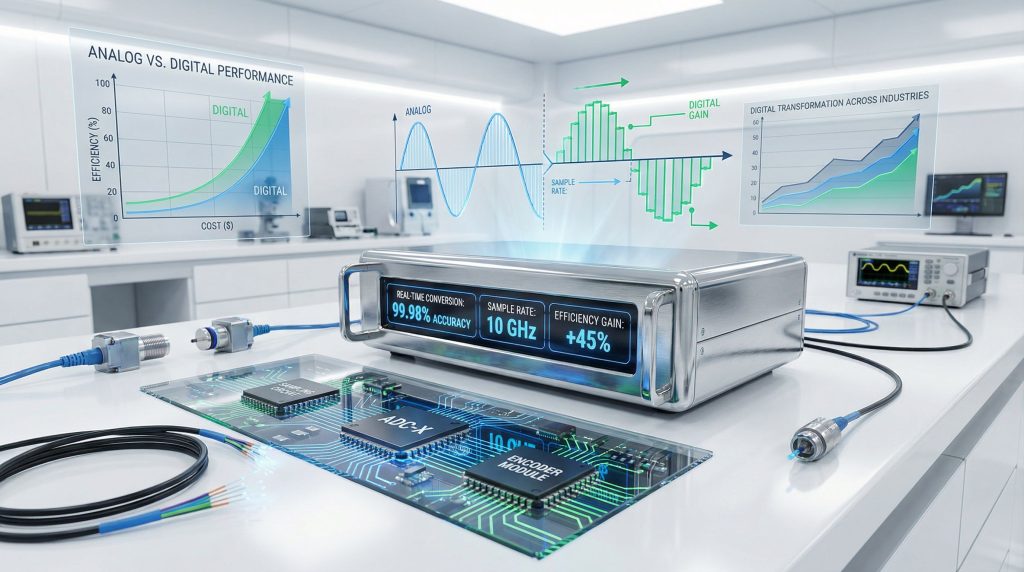
The transformation from analogue to digital systems represents one of the most significant technological shifts in modern industrial operations. This going from analogue to digital conversion requires examining the fundamental differences between continuous analogue signals and discrete digital representations, a process that's revolutionizing industries worldwide.
Signal Conversion Fundamentals
Analogue signals operate across a continuous range with theoretically infinite values, while digital signals represent information as discrete binary values using only zeros and ones. This fundamental distinction affects how information is captured, processed, and transmitted throughout industrial systems.
The Nyquist-Shannon sampling theorem establishes that sampling frequency must be at least twice the highest frequency component of the signal being converted to avoid aliasing errors. This mathematical principle governs all successful analogue-to-digital conversions, whether in analog to digital conversion for audio systems sampling at 44.1 kHz for CD quality or industrial sensors monitoring equipment at much higher frequencies.
Core Components of Digital Transformation
The conversion process involves four critical stages that work together to preserve signal integrity:
- Anti-aliasing filters remove unwanted frequency components before sampling
- Sample-and-hold circuits capture instantaneous analogue values at precise intervals
- Quantizers map continuous values to discrete digital levels
- Encoders convert quantized values into binary code for digital processing
Resolution specifications directly impact measurement precision. An 8-bit system provides 256 possible values, while 16-bit resolution offers 65,536 levels of precision. Industrial temperature monitoring typically uses 12-bit resolution (4,096 levels), providing adequate precision whilst maintaining reasonable processing speeds.
When big ASX news breaks, our subscribers know first
Why Are Industries Making the Analogue-to-Digital Transition?
Industrial sectors worldwide are accelerating digital adoption due to compelling operational and economic drivers. The global industrial automation market reached $167.5 billion in 2023 and projects growth at 9.8% annually through 2030, reflecting widespread recognition of digital transformation benefits.
Operational Efficiency Drivers
Digital systems enable dramatic infrastructure consolidation through multiplexing capabilities. Traditional analogue point-to-point systems require individual wiring for each sensor – potentially hundreds of copper lines running from field instruments to control rooms. Digital multiplexed systems can transmit multiple parameters through single Ethernet lines or daisy-chained digital buses.
| System Type | Infrastructure Requirements | Cable Reduction | Cost Savings |
|---|---|---|---|
| Analogue Point-to-Point | Individual wiring per sensor | N/A | Baseline |
| Digital Multiplexed | Single communication line | 50-70% reduction | 15-20% project cost savings |
| Ethernet-Based Networks | Standard CAT6 cabling | 80%+ reduction | 25-35% infrastructure savings |
Underground mining operations implementing digital monitoring systems report 15-25% improvement in equipment uptime. Remote diagnostics capabilities reduce response time for equipment failures from days to hours, enabling preventive maintenance rather than reactive repairs.
Data Analytics and Intelligence Benefits
Digital conversion creates the foundation for predictive maintenance models that transform operational strategies. Organisations can transition from reactive maintenance (repair after failure) to predictive maintenance (repair before failure occurs), reducing unplanned downtime by 35-45% and extending equipment lifespan by 20-25%.
Real-time data collection through digital sensors enables:
- Remote monitoring from any internet-connected location
- Centralised data storage with 5-10 years of historical trending
- Integration with machine learning algorithms for anomaly detection
- Cloud connectivity for advanced analytics and reporting
Manufacturing digital transformation investments have increased by 23% annually since 2020 across OECD countries, demonstrating the strategic priority organisations place on data-driven decision making.
How Do Analog-to-Digital Converters Work?
Analog-to-Digital Converters (ADCs) perform the critical function of translating continuous analogue signals into discrete digital values. The global ADC market, valued at $18.7 billion in 2023, projects growth to $28.4 billion by 2030 as industrial digitisation accelerates.
Technical Conversion Process
The three-stage conversion sequence represents fundamental trade-offs between speed and accuracy. Faster conversion rates demand higher power consumption; greater resolution requires longer conversion times.
Stage 1: Sampling
The sample-and-hold circuit captures analogue voltage at precisely timed intervals determined by clock frequency. The sampling interval equals 1/fs (where fs represents sampling frequency). To satisfy the Nyquist criterion, sampling frequency must equal or exceed twice the signal's maximum frequency component.
Stage 2: Quantisation
Captured voltage values are mapped to the nearest discrete digital levels. The number of available levels equals 2^n (where n represents bit resolution). Quantisation step size equals (Vmax – Vmin) / 2^n, creating an inherent quantisation error of ±q/2.
Stage 3: Encoding
Quantised levels convert to binary representation using formats like straight binary, two's complement, or Gray code. Two's complement format most commonly handles both positive and negative values in industrial applications.
Example Calculation:
A 12-bit ADC with 0-10V input range provides:
- Resolution: 10V ÷ 4096 levels = 2.44 mV per least significant bit
- Measurement uncertainty: ±1.22 mV
- Suitable for industrial process control requiring moderate precision
ADC Technology Comparison
| ADC Type | Speed Range | Resolution | Power Usage | Applications | Cost Level |
|---|---|---|---|---|---|
| Flash | 1+ GHz | 6-8 bit | Highest | Oscilloscopes, radar systems | Premium |
| Pipeline | 100-500 MSPS | 12-16 bit | Medium-High | Video processing, medical imaging | High |
| SAR | 1-100 MSPS | 12-16 bit | Low-Medium | Industrial control, automotive | Moderate |
| Sigma-Delta | 100 kHz-1 MSPS | 16-24 bit | Low | Precision measurement, audio | Economy |
Flash ADCs achieve the highest speeds up to 1 GHz+ for applications like real-time oscilloscopes and radar systems, but consume significant power and offer limited resolution. Furthermore, Successive Approximation Register (SAR) ADCs provide balanced performance for most industrial control applications, combining adequate speed with high resolution and reasonable power consumption.
What Are the Key Implementation Strategies?
Successful going from analogue to digital transitions require systematic approaches that minimise operational disruption whilst maximising long-term benefits. Industry research indicates 78% of successful implementations use phased approaches rather than simultaneous "big bang" conversions.
Phased Transition Approaches
Starting with pilot projects on non-critical systems allows organisations to validate methodologies and train personnel before deploying across production-critical equipment. This approach typically extends implementation timelines by 6-12 months but reduces failure risk by 60-75%.
Phase 1: Pilot Implementation
- Select non-critical measurement points for initial conversion
- Install smart sensors with multi-parameter monitoring capabilities
- Establish baseline performance metrics and training protocols
- Validate communication infrastructure and data management systems
Phase 2: Expansion to Secondary Systems
- Implement digital conversion on support equipment and auxiliary processes
- Integrate digital data streams with existing control systems
- Develop hybrid analog-digital operational procedures
- Expand workforce training to include maintenance and troubleshooting
Phase 3: Production-Critical Deployment
- Convert primary production equipment monitoring systems
- Implement advanced analytics and predictive maintenance algorithms
- Establish full remote monitoring and diagnostic capabilities
- Complete integration with enterprise resource planning systems
Infrastructure Planning Considerations
Project success depends more on organisational change management than technology selection. Research indicates stakeholder alignment, executive sponsorship, and workforce training represent 65-70% of success factors, whilst technology selection represents only 15-20%.
Critical Success Factors:
Executive leadership commitment and resource allocation form the foundation for successful digital transformation. Without sustained management support, technical implementation efforts frequently stall during organisational resistance phases.
Network Infrastructure Requirements:
- Ethernet backbone capable of handling increased data traffic
- Cybersecurity protocols for networked industrial systems
- Backup power systems for critical digital monitoring equipment
- Environmental protection for electronic components in harsh conditions
Average manufacturing facilities require 18-36 months for comprehensive digital conversion, with 60-70% of projects experiencing timeline delays beyond initial projections. Primary delay causes include legacy system integration complexity (35%), workforce training gaps (28%), and scope creep (22%).
Which Industries Benefit Most From Digital Conversion?
Certain industrial sectors experience particularly significant advantages from analogue-to-digital transitions due to their operational characteristics and performance requirements.
Manufacturing and Industrial Automation
Manufacturing operations benefit from digital conversion through enhanced process control and monitoring capabilities. Digital systems enable real-time quality assurance and traceability throughout production workflows.
Process Control Applications:
- Temperature, pressure, and flow monitoring with 0.1% accuracy
- Multi-loop control systems managing dozens of process variables simultaneously
- Statistical process control with automatic alarm generation
- Integration with Manufacturing Execution Systems (MES) for production optimisation
Energy efficiency improvements of 15-20% commonly result from precise digital control of heating, cooling, and motor speed systems. Digital monitoring enables identification of energy waste patterns invisible in analogue systems.
Mining and Resource Extraction
Mining operations face unique challenges that make digital conversion particularly valuable. Equipment operates in harsh environments with high reliability requirements and significant downtime costs.
Large mining operators implementing IoT-enabled digital vibration sensors on rotating equipment report early detection of bearing degradation 2-4 weeks before catastrophic failure. This advance warning enables planned maintenance during scheduled downtime windows rather than emergency repairs causing 2-5 day production shutdowns.
Moreover, mining evolution trends demonstrate how these mining transformation strategies are becoming essential for competitive operations.
Safety System Integration:
- Gas detection sensors with wireless communication to evacuation systems
- Personnel tracking and emergency response coordination
- Equipment interlock systems preventing dangerous operating conditions
- Real-time structural monitoring of underground excavations
Broadcasting and Media Production
The broadcasting industry completed one of the most comprehensive analogue-to-digital transitions in history. The digital television transition from analogue TV transmission to digital broadcasting, completed in most developed nations by 2012-2015, demonstrated the transformative potential of digital conversion.
Digital broadcasting achieved 4-6x spectrum efficiency improvements, allowing multiple digital channels in the same bandwidth previously occupied by single analogue channels. This transition freed valuable radio spectrum for mobile communications and public safety applications.
Content Production Benefits:
- Non-linear editing systems replacing mechanical tape editing
- Multi-platform distribution from single digital masters
- Automated content management and archival systems
- Real-time collaboration between geographically distributed production teams
What Challenges Should Organisations Expect?
Digital transformation projects encounter predictable technical and organisational obstacles that require proactive management strategies.
Technical Implementation Hurdles
Signal integrity becomes critical when converting from analogue systems that may have operated reliably despite electrical noise. Digital systems require clean power supplies, proper grounding, and electromagnetic interference shielding.
Common Technical Challenges:
- Ground loop elimination in mixed analog-digital systems
- Electromagnetic interference from variable frequency drives and wireless equipment
- Network latency affecting real-time control system performance
- Data synchronisation across multiple measurement points
Bandwidth requirements increase dramatically as measurement density rises. A facility monitoring 100 analogue points at 1 Hz generates minimal data traffic, whilst the same points sampled digitally at 1 kHz create 100x more network traffic requiring infrastructure upgrades.
Organisational Change Management
Workforce adaptation represents the most significant challenge in most digital transformation projects. Maintenance technicians accustomed to analogue troubleshooting methods must learn digital diagnostic techniques.
Skills Gap Areas:
- Network troubleshooting and cybersecurity awareness
- Software-based diagnostic tools replacing mechanical instrumentation
- Data analysis and trending interpretation
- Digital communication protocol understanding (Modbus, Ethernet/IP, OPC-UA)
Training programmes require 3-6 months for technical staff to achieve proficiency with digital systems. Organisations underestimating this timeline experience project delays and resistance to new technologies.
Cost justification becomes complex when comparing analogue systems with decades of reliable service against digital alternatives with higher upfront costs but lower long-term operating expenses. ROI calculations must account for reduced maintenance labour, improved energy efficiency, and enhanced production optimisation capabilities.
The next major ASX story will hit our subscribers first
How to Measure Success in Digital Transformation?
Establishing clear performance metrics enables organisations to validate return on investment and identify areas requiring optimisation.
Performance Metrics and KPIs
Operational Efficiency Indicators:
- Equipment uptime improvement: Target 15-25% increase within 12 months
- Mean Time To Repair (MTTR) reduction: 40-60% improvement typical
- Energy consumption per unit of production: 10-20% efficiency gains
- Maintenance labour hours: 20-30% reduction through predictive maintenance
Quality and Safety Metrics:
- Process variation reduction measured by statistical process control
- Safety incident reduction through improved monitoring and interlocks
- Product quality consistency improvements
- Environmental compliance monitoring accuracy
Digital systems enable measurement precision previously impossible with analogue instrumentation. Organisations commonly discover process variations and inefficiencies that were invisible in analogue data, leading to optimisation opportunities beyond initial project scope.
Long-term Strategic Benefits
Competitive advantage through data-driven insights emerges as organisations mature their digital capabilities. Advanced analytics reveal patterns in production data, equipment behaviour, and market demand that inform strategic decisions.
Scalability Advantages:
- Digital infrastructure adapts to production increases without proportional monitoring system costs
- Software updates enhance capabilities without hardware replacement
- Remote monitoring enables centralised management of multiple facilities
- Integration with enterprise systems provides comprehensive operational visibility
Future-proofing considerations become critical as technology evolution accelerates. Digital platforms can accommodate emerging technologies like artificial intelligence and machine learning, whilst analogue systems require complete replacement to access new capabilities.
What Does the Future Hold for Digital Conversion?
Emerging technologies continue expanding the benefits of going from analogue to digital transformation whilst addressing current implementation challenges.
Emerging Technologies and Trends
Edge computing revolutionises digital system architectures by performing data processing locally rather than transmitting all information to centralised systems. This approach reduces network bandwidth requirements whilst enabling real-time decision making in time-critical applications.
Edge Computing Benefits:
- Reduced network latency for control system applications
- Continued operation during communication network outages
- Local data preprocessing reduces bandwidth requirements
- Enhanced cybersecurity through distributed architecture
Artificial intelligence integration enables predictive capabilities beyond traditional threshold-based alarming. Machine learning algorithms identify subtle patterns in equipment behaviour, predicting failures weeks or months before conventional monitoring systems detect problems.
Industry-Specific Evolution Pathways
Different industrial sectors follow distinct digital maturity progression paths based on their operational requirements and risk tolerance.
Mining Sector Digital Evolution:
- Basic Digitisation: Converting individual measurement points to digital sensors
- System Integration: Connecting digital devices through industrial networks
- Advanced Analytics: Implementing predictive maintenance and optimisation algorithms
- Autonomous Operations: Developing unmanned equipment and remote control capabilities
In addition, AI‐driven mining insights and data‐driven mining operations represent the next frontier in mining technology. Furthermore, mineral exploration AI is revolutionising how companies discover and evaluate resources.
Regulatory frameworks increasingly require digital documentation and reporting capabilities. Environmental monitoring regulations demand data accuracy and retention periods that analog chart recorders cannot provide, accelerating mandatory digital conversion in many jurisdictions.
Investment trends indicate sustained growth in industrial digitisation spending. Organisations that defer digital transformation face increasing competitive disadvantages as early adopters realise operational efficiency gains and cost reductions.
Frequently Asked Questions About Analogue-to-Digital Conversion
Technical FAQ
What sampling rates are required for different applications?
Sampling rate requirements depend on the fastest changing component of the measured signal. Temperature processes may require only 0.1-1 Hz sampling, whilst vibration monitoring needs 10-50 kHz rates. The Nyquist theorem provides the theoretical minimum, but practical implementations use 5-10x higher rates for signal reconstruction accuracy.
How do you prevent signal degradation during conversion?
Signal preservation requires proper filtering, adequate resolution, and appropriate sampling rates. Anti-aliasing filters remove high-frequency noise before sampling. Resolution must exceed measurement precision requirements – typically 4-5 bits more than needed for the final result. Shielded cables and proper grounding prevent electromagnetic interference.
What are the power consumption differences?
Digital systems typically consume 20-40% more power than equivalent analogue instrumentation due to microprocessor operation and network communication. However, system-level efficiency often improves through better process control, potentially offsetting individual device power increases.
Implementation FAQ
How long does a typical conversion project take?
Project timelines vary significantly with scope and complexity. Simple sensor replacement projects require 3-6 months, whilst comprehensive facility-wide conversions need 18-36 months. Phased approaches extend timeline but reduce implementation risk and allow for organisational learning.
What are the most common implementation mistakes?
Inadequate network infrastructure planning causes the majority of project delays. Organisations frequently underestimate bandwidth requirements, cybersecurity needs, and environmental protection for electronic components. Insufficient training for maintenance staff leads to operational difficulties and resistance to new systems.
How do you maintain system reliability during transition?
Hybrid analog-digital operation during transition phases maintains operational continuity. Install digital systems in parallel with existing analogue equipment initially. Validate digital system performance over several operating cycles before removing analogue backup systems. Establish troubleshooting procedures and spare parts inventory before cutover.
Disclaimer: This article provides general information about analogue-to-digital conversion technologies and implementation strategies. Specific technical requirements vary by application and should be evaluated by qualified engineering professionals. Implementation timelines and cost estimates are approximate and may vary significantly based on project scope and organisational factors.
Looking to Capitalise on Mining's Digital Revolution?
Discovery Alert's proprietary Discovery IQ model delivers real-time alerts on significant ASX mineral discoveries across the technology-driven mining sector, instantly empowering subscribers to identify actionable opportunities ahead of the broader market. Begin your 14-day free trial today and understand why historic discoveries can generate substantial returns by exploring the transformative potential of digitally-enhanced mining operations.