June 13, 2026
The Structural Fault Line in India's Clean Energy Ambitions
Every electric vehicle motor, every wind turbine generator, and every precision-guided defence system shares a common dependency: rare earth permanent magnets. These components are not peripheral accessories but load-bearing elements of the hardware that powers the clean energy transition. Yet for most countries outside China, the ability to produce these magnets domestically remains either nascent or entirely absent.
India sits in a particularly exposed position. The country holds meaningful geological reserves of rare earth-bearing minerals, yet it has historically exported raw mineral concentrates rather than capturing the far greater value embedded in processing, refining, and magnet fabrication. As India's electric vehicle market accelerates and its renewable energy capacity targets grow more ambitious, this structural gap between resource ownership and processing capability becomes increasingly costly.
Andhra Pradesh rare earth projects are now emerging at the centre of India's response to this challenge, with the state positioned as a potential anchor of a nationally integrated rare earth supply chains value chain.
When big ASX news breaks, our subscribers know first
What Makes Andhra Pradesh Geologically Exceptional
Coastal Heavy Mineral Deposits and Their Strategic Significance
The geological case for Andhra Pradesh rests on the composition and scale of its coastal mineral belt. The state's shoreline hosts monazite-rich beach sand deposits, a class of mineral resource that has historically attracted limited processing investment in India despite its considerable strategic value.
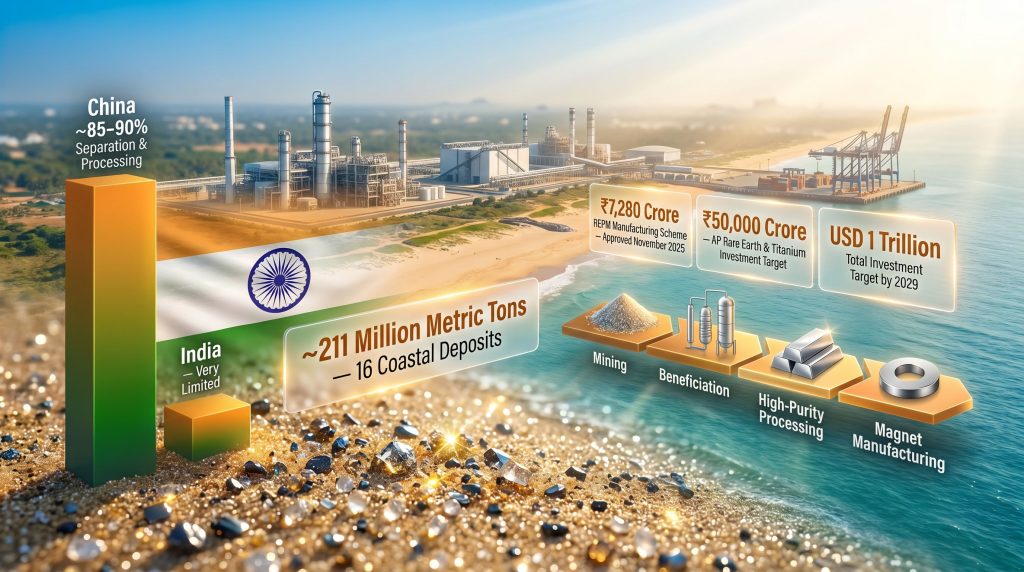
The aggregate resource base across Andhra Pradesh's coastal zone is estimated at approximately 211 million metric tons of beach sand mineral resources distributed across 16 separate coastal deposits. This scale places the state among India's most significant rare earth mineral provinces.
Monazite, the primary rare earth-bearing mineral in these sands, serves as a natural host for a suite of light rare earth elements including cerium, lanthanum, neodymium, and praseodymium. Neodymium and praseodymium are the two elements most directly critical to permanent magnet production, making monazite-bearing sands a strategically important feedstock for the magnet manufacturing value chain.
The associated heavy mineral suite in Andhra Pradesh's coastal deposits typically includes:
- Monazite (rare earth and thorium source)
- Ilmenite (titanium feedstock)
- Rutile (high-purity titanium dioxide precursor)
- Zircon (refractory and ceramic applications)
- Garnet (industrial abrasive and filtration media)
This polymetallic profile means that rare earth processing facilities in the state could be co-developed alongside titanium value chain infrastructure, furthermore diversifying the economic rationale for investment.
The Thorium Complication: A Regulatory Layer Most Investors Overlook
A factor not widely appreciated outside specialist circles is monazite's dual-use character. Because monazite concentrates contain thorium alongside rare earth elements, processing facilities handling this mineral fall under India's atomic energy regulatory framework. This creates a licensing and compliance burden that does not apply to rare earth projects sourcing from non-thorium-bearing mineral systems such as bastnäsite or ionic clay deposits.
For investors and project developers, this regulatory overlay is a material consideration. It extends permitting timelines, requires engagement with the Department of Atomic Energy, and constrains the pool of eligible processing facility operators. It also partly explains why India's monazite resources have remained underleveraged despite decades of documented geological knowledge about their scale and distribution. These rare earth processing challenges are not unique to India, however they are particularly pronounced given the thorium regulatory dimension.
Andhra Pradesh vs Other Indian Rare Earth States
India's rare earth mineral endowment is spread across several coastal states, but Andhra Pradesh's combination of resource scale, port infrastructure, and industrial investment track record differentiates it from comparable jurisdictions.
| State | Key Mineral Assets | Infrastructure Maturity | Corridor Designation |
|---|---|---|---|
| Andhra Pradesh | Large monazite-bearing coastal sands, ilmenite, rutile | High; major port access, industrial zones | Yes |
| Odisha | Heavy mineral sands, bauxite, iron ore adjacency | Moderate | Yes |
| Kerala | Monazite-rich coastal deposits (long-established) | Moderate | Yes |
| Tamil Nadu | Beach sand minerals, established mineral processing history | Moderate-High | Yes |
Andhra Pradesh's logistical advantages are particularly relevant for a processing-oriented investment thesis. Coastal location reduces inbound concentrate transport costs and simplifies export logistics for processed outputs targeting international buyers.
India's National Policy Architecture for Rare Earth Development
The Four-State Corridor Framework
Under its Union Budget 2026-27 framework, India's federal government formally identified four states as the foundation of a national rare earth corridor network: Andhra Pradesh, Odisha, Kerala, and Tamil Nadu. According to India's Press Information Bureau, the corridor model is explicitly designed to compress the development timeline for a complete domestic value chain by concentrating investment, infrastructure, research capability, and manufacturing activity within defined geographic zones.
This is a structural departure from India's previous approach to rare earth development, which tended to treat mining, processing, and manufacturing as separate policy domains. The corridor framework recognises that the economic logic of rare earth investment only fully materialises when all four value chain stages are geographically proximate and institutionally coordinated.
The REPM Manufacturing Scheme: What the Numbers Mean
In November 2025, the Indian government approved a Rare Earth Permanent Magnet (REPM) manufacturing scheme valued at INR 7,280 crore (approximately USD 766 million). This program targets the establishment of domestic sintered magnet production capacity, which represents the highest-value stage of the rare earth supply chain.
The scheme's approval signals that federal policy ambition has moved beyond geological mapping and mineral reservation into active industrial policy. For project developers, this creates a more predictable incentive environment, though the translation of scheme approval into operational capacity will depend heavily on execution quality and private capital mobilisation.
Andhra Pradesh's State-Level Policy Instruments
At the state level, Andhra Pradesh is finalising its own rare earth corridor policy, with cabinet approval anticipated in the near term. Once ratified, the policy framework is expected to unlock a formal competitive tender process for rare earth processing facilities.
Key parameters under consideration include:
- A minimum investment threshold of INR 1,000 crore (approximately USD 105 million) per qualifying project
- A decade-long state investment target of INR 50,000 crore across rare earth and titanium sectors
- Alignment with the federal REPM scheme to enable projects to access both state and central incentives
Policy Reference Framework
| Policy Instrument | Key Detail |
|---|---|
| National Corridor States | Andhra Pradesh, Odisha, Kerala, Tamil Nadu |
| REPM Scheme Value | INR 7,280 crore (~USD 766 million) |
| Scheme Approval Date | November 2025 |
| AP Minimum Project Threshold | INR 1,000 crore (~USD 105 million) |
| AP Sector Investment Target | INR 50,000 crore over 10 years |
| AP Broader Investment Target | USD 1 trillion by 2029 |
Corporate Interest: Which Conglomerates Are Watching Andhra Pradesh
The Preliminary Investment Landscape
According to sources familiar with draft government planning documents, approximately 10 companies have expressed preliminary interest in establishing rare earth processing infrastructure in Andhra Pradesh. Among those identified in the draft documentation are Reliance Industries, Vedanta, and the Adani Group, three of India's largest and most diversified industrial conglomerates.
It is important to note that corporate interest at this stage remains preliminary. No binding investment commitments have been publicly confirmed by any of the named entities, and formal participation will be subject to the state's competitive tender process following cabinet approval of the corridor policy. Andhra Pradesh's move to unlock coastal mining and reduce dependence on China has consequently attracted significant attention from these major players.
Strategic Logic for Each Major Player
Each of the named conglomerates approaches rare earth investment from a distinct strategic position:
Reliance Industries has been systematically building positions across clean energy infrastructure and advanced materials. Rare earth magnet inputs are a natural adjacency to its green hydrogen ecosystem and emerging EV supply chain ambitions, where magnet availability is a direct production constraint.
Vedanta brings existing critical minerals processing infrastructure and a base metals heritage that provides relevant technical competency for rare earth separation chemistry. The company's interest represents a value chain extension rather than an entry into entirely unfamiliar territory.
Adani Group operates at scale in both renewable energy generation and logistics infrastructure. Direct-drive wind turbines, which are increasingly preferred for offshore applications, are among the most magnet-intensive technology platforms in commercial deployment. Adani's renewable energy pipeline creates genuine downstream demand that could underpin long-term offtake economics for a processing investment.
The Four-Stage Value Chain India Is Trying to Build
Breaking Down the Rare Earth Processing Sequence
Understanding where India's capacity gap is most acute requires clarity about how the rare earth value chain actually functions. The four stages are distinct in their technical requirements, capital intensity, and value contribution:
-
Mining and mineral concentration involves the physical extraction of heavy mineral sands and the production of bulk mineral concentrates. India has demonstrated capability at this stage, particularly through state-owned entities.
-
Beneficiation and rare earth separation is the most technically demanding stage. It involves solvent extraction and ion exchange processes to isolate individual rare earth oxides from mixed mineral concentrates. This stage requires specialised chemical engineering expertise and generates significant waste streams that require careful environmental management. It is also the stage where China has built its most durable competitive advantage.
-
High-purity metal and alloy production converts separated rare earth oxides into metals and master alloys meeting the tight compositional specifications required by magnet manufacturers. Tolerances at this stage are measured in parts per million.
-
Permanent magnet manufacturing transforms rare earth alloys into sintered NdFeB (neodymium-iron-boron) or samarium-cobalt magnets. This stage involves powder metallurgy, pressing, sintering, and surface treatment processes. The resulting magnets command prices orders of magnitude above the raw mineral concentrates from which they originate.
India currently has meaningful capacity at stage one and nascent capability at stage four in isolated cases. Stages two and three represent the critical gaps that the corridor framework is designed to fill.
China's Dominance: A Quantitative Assessment of India's Exposure
The Concentration Risk in Numbers
The scale of China's control over the rare earth supply chain is sometimes understated in general discussion. A precise breakdown by value chain stage clarifies the risk profile:
| Value Chain Stage | China's Estimated Global Share | India's Current Position |
|---|---|---|
| Rare Earth Mining | ~60% | Moderate reserves, limited extraction |
| Separation and Processing | ~85-90% | Very limited domestic capacity |
| Permanent Magnet Production | ~90% | Early-stage and fragmented |
For Indian manufacturers of EV motors and wind turbine generators, this concentration means that import dependency is not just a cost issue but a supply security issue. Recent years have demonstrated, through multiple commodity and technology sectors, the commercial consequences of over-reliance on a single national supply source for critical industrial inputs. Indeed, China's rare earth strategy has been deliberately calibrated to preserve this processing dominance as a geopolitical lever.
The Substitution Problem
A technical point often overlooked in public debate is that rare earth permanent magnets are not easily substitutable in high-performance applications. Neodymium-iron-boron magnets produce the highest energy density of any permanent magnet material commercially available. In EV traction motors designed for maximum torque-to-weight efficiency, and in direct-drive wind turbine generators where mechanical simplicity is paramount, NdFeB magnets represent the engineering optimum rather than a preference.
This non-substitutability is what gives rare earth supply chain security genuine strategic weight, distinguishing it from commodity supply chain concerns where alternative sources or materials can more readily substitute. Consequently, the link between critical minerals and energy security is now considered a central dimension of national industrial policy across multiple major economies.
The next major ASX story will hit our subscribers first
Key Challenges Facing the Andhra Pradesh Corridor
Technical Complexity and Workforce Readiness
Rare earth separation chemistry is among the most technically demanding disciplines in industrial processing. The solvent extraction circuits used to isolate individual rare earth elements involve dozens of sequential stages, precise pH control, and careful management of mixed waste streams. Building this capability domestically requires not only capital but a trained workforce with specialised chemical engineering expertise that India currently produces in limited numbers relative to demand.
Environmental and Coastal Permitting
Coastal mining operations face a distinct environmental permitting environment. Andhra Pradesh's beach sand deposits sit within or adjacent to coastal regulation zones, requiring environmental impact assessments that address shoreline stability, groundwater interaction, and marine ecosystem effects. These processes are not prohibitive, but they add time and require genuine community engagement to navigate successfully.
The Offtake and Financing Gap
For rare earth processing projects of the scale contemplated under the corridor framework, project finance typically requires long-term offtake agreements with creditworthy buyers. Growing critical minerals demand across India's domestic EV and renewable sectors provides a compelling long-term rationale, however bridging the gap between available domestic demand and the volume required to underpin bankable project economics remains a structuring challenge that developers and policymakers will need to address collaboratively.
Scenario Analysis: Three Development Pathways to 2030
| Scenario | Conditions Required | Likely Outcome by 2030 |
|---|---|---|
| Accelerated Development | Swift cabinet approval; anchor conglomerate investment committed; federal incentives fully deployed | First processing facilities operational; initial NdFeB magnet capacity established |
| Moderate Progression | Policy approved with moderate delays; one or two investments secured | Beneficiation capacity under construction; processing at pilot scale |
| Delayed Execution | Regulatory complexity, financing gaps, or policy uncertainty slow rollout | Corridor designated but limited operational infrastructure commissioned |
The difference between the accelerated and moderate scenarios likely hinges on the speed of the cabinet approval process and whether anchor investors can be contracted before the tender process becomes prolonged by competing bids or financing complications.
Frequently Asked Questions: Andhra Pradesh Rare Earth Projects
What rare earth minerals are found in Andhra Pradesh's coastal deposits?
The primary rare earth-bearing mineral is monazite, which hosts light rare earth elements including cerium, lanthanum, neodymium, and praseodymium. Associated heavy minerals include ilmenite, rutile, zircon, and garnet. Monazite's thorium content is what places processing activities within India's atomic energy regulatory framework.
Why does rare earth separation require such specialised expertise?
Individual rare earth elements are chemically very similar to one another, which makes physical and chemical separation extraordinarily difficult. The dominant commercial approach, solvent extraction, exploits tiny differences in the behaviour of rare earth ions in acidic solutions containing organic extractants. Achieving high-purity separation of individual elements requires carefully engineered multi-stage circuits and precise process control that takes years to develop and optimise.
When is Andhra Pradesh expected to begin issuing processing facility tenders?
Based on available reporting, cabinet approval for the state's rare earth corridor policy is anticipated in the near term, after which formal tender issuance would follow. Specific timelines remain subject to the policy ratification process and may shift as the program develops.
What does the INR 7,280 crore REPM scheme actually fund?
The Rare Earth Permanent Magnet manufacturing scheme approved in November 2025 is designed to support the establishment of domestic sintered permanent magnet production capacity in India. It targets the highest-value manufacturing stage of the rare earth supply chain, where China currently commands approximately 90% of global output. The scheme's structure is intended to attract private capital into a sector where, without policy support, the economics of competing with established Chinese producers would be difficult to justify in the near term.
Readers seeking broader context on India's critical minerals policy environment and adjacent commodity sectors may find additional perspective at AL Circle, which covers developments across aluminium, bauxite, and related minerals industries at alcircle.com.
Want to Track the Next Major Mineral Discovery Before the Broader Market Does?
Discovery Alert's proprietary Discovery IQ model delivers real-time alerts on significant ASX mineral discoveries — instantly converting complex mineral data into actionable investment insights for both short-term traders and long-term investors. Explore Discovery Alert's dedicated discoveries page to understand how historic mineral discoveries have generated substantial market returns, and begin your 14-day free trial today to secure a market-leading advantage.