June 13, 2026
The Processing Gap: Why Refining Capacity Is America's Most Urgent Mineral Vulnerability
For decades, the conversation around mineral security focused almost exclusively on where metals could be found in the ground. Geology was the gating factor. That framing has shifted fundamentally. Today, the more consequential question is not where critical minerals exist, but where they can be refined, separated, and converted into usable industrial inputs. The ElementUSA rare earth processing facility in Louisiana represents a direct response to this structural gap.
This distinction between mining and processing represents one of the most underappreciated structural vulnerabilities in the U.S. industrial economy. A nation can control vast mineral deposits and still remain entirely dependent on foreign actors for the chemical separations, hydrometallurgical treatment, and pyrometallurgical conversion required to turn raw ore into commercially viable material.
That is precisely the position the United States finds itself in across several critical mineral categories, particularly rare earth elements. Furthermore, the energy security challenge this creates extends well beyond simple trade dependency into questions of national defence readiness.
When big ASX news breaks, our subscribers know first
Why the Processing Bottleneck Matters More Than the Mining Gap
The rare earth supply chain is often misunderstood by those outside the industry. Light rare earth elements such as lanthanum and cerium are relatively abundant and easier to process. The commercially critical challenge lies with heavy rare earth elements, a subgroup that includes dysprosium, terbium, gadolinium, and ytterbium.
These elements are essential to the high-performance permanent magnets used in electric vehicle motors, wind turbine generators, and advanced defence systems. They are also the elements for which processing infrastructure outside of a small number of overseas jurisdictions is most severely limited.
The practical consequence of this processing gap is that even as the United States moves to develop new mining projects, the refined outputs required by manufacturers cannot be produced domestically at meaningful scale. Building that infrastructure is the central challenge that the ElementUSA rare earth processing facility in Louisiana is designed to address. Consequently, critical minerals demand is outpacing the pace at which domestic processing capability is being established.
What ElementUSA Is Building in St. John the Baptist Parish
ElementUSA Inc., working in partnership with Colorado School of Mines, is developing a commercial-scale critical minerals and rare earth processing facility in Gramercy, located within St. John the Baptist Parish, Louisiana. The project targets a feedstock that most industrial operators have historically treated as a liability: bauxite residue, more commonly known as red mud.
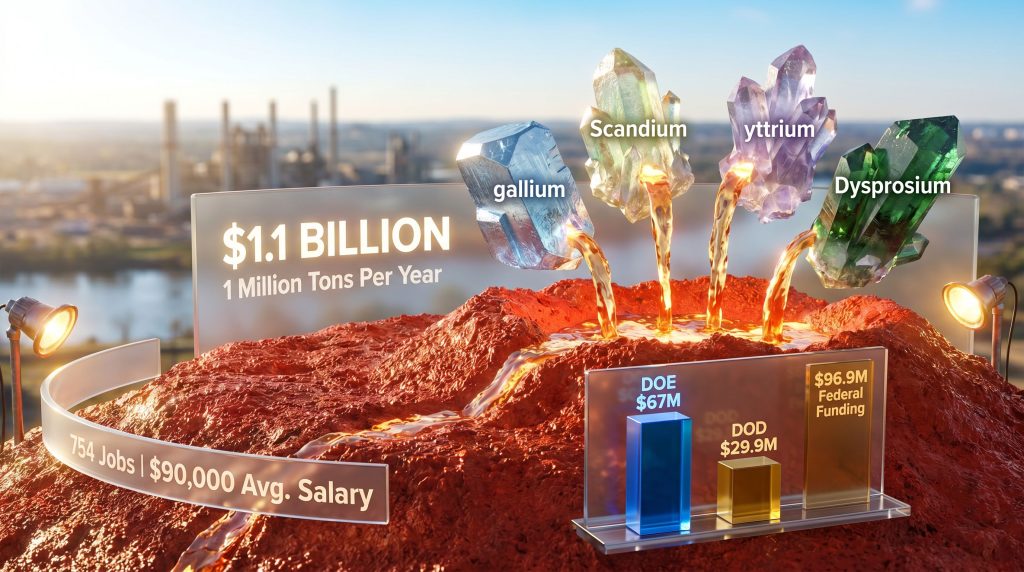
The Gramercy site holds exclusive access to approximately 34 million tons of bauxite residue stored at the former Atalco alumina refinery, one of the largest single-site concentrations of this material in North America. This legacy stockpile, accumulated over decades of bauxite and alumina refining operations along the Mississippi River, has now become the foundation of a project with a projected total capital investment of approximately $1.1 billion.
The facility has secured a combined $96.9 million in federal funding across two separate awards:
- A $67 million U.S. Department of Energy (DOE) grant to advance the design, construction, commissioning, and operation of the rare earth element processing facility.
- A $29.9 million U.S. Department of Defense (DoD) grant focused specifically on gallium and scandium recovery and commercialisation.
The dual-agency funding structure reflects how different parts of the federal government have come to view rare earth and critical mineral processing through distinct but complementary lenses. The DOE frames it as an energy and industrial supply chain problem. The DoD frames gallium and scandium recovery as a defence readiness issue, given these elements' roles in semiconductors, radar systems, and aerospace components.
Understanding Bauxite Residue: From Industrial Liability to Strategic Feedstock
Bauxite residue is generated during the Bayer process, the primary industrial method for refining aluminium oxide (alumina) from bauxite ore. For every tonne of alumina produced, roughly one to two tonnes of red mud are generated as a highly alkaline waste slurry. Globally, this process has accumulated an estimated 4 billion tons of bauxite residue, stored in containment ponds and dry stacking facilities across Europe, Australia, Jamaica, India, and the Americas.
What makes this material newly compelling is not a change in its chemistry but a change in what its chemistry is now worth. Bauxite residue contains measurable concentrations of:
- Iron oxides (typically comprising around 50% of residue mass, convertible to pig iron)
- Gallium (a federally designated critical mineral essential to semiconductors and photovoltaics)
- Scandium (used in solid oxide fuel cells and as an aluminium alloy strengthener)
- Yttrium (a rare earth element used in phosphors, ceramics, and cancer treatment compounds)
- Germanium (critical to fibre optics and infrared optics)
- Dysprosium, gadolinium, and ytterbium (heavy rare earth elements central to high-performance magnets and specialty alloys)
The Gramercy resource is particularly notable because its mixed rare earth oxide basket carries elevated heavy rare earth and yttrium concentrations relative to many mined deposits. In addition, the role of gallium in semiconductors and defence applications makes the DoD's investment in this project strategically logical.
How the Processing Technology Works: A Dual-Stream Approach
ElementUSA's proprietary Waste2Market platform combines pyrometallurgical and hydrometallurgical processing in an integrated flowsheet designed to extract maximum value from a single feedstock with zero solid waste output. This is technically ambitious and commercially significant.
What Are the Five Stages of the Process?
The five-stage process operates as follows:
- Feedstock conditioning: Bauxite residue is prepared for dual-stream treatment, adjusting chemistry and physical properties for downstream processing.
- Pyrometallurgical smelting: High-temperature treatment converts iron-bearing fractions into pig iron, leveraging the approximately 50% iron content of the residue to generate a primary revenue stream for the steel industry.
- Hydrometallurgical extraction: Aqueous chemical processing isolates rare earth elements and critical minerals from the non-iron fractions remaining after smelting.
- Mixed rare earth oxide production: The extraction circuit produces a mixed oxide basket enriched in heavy rare earth elements and yttrium, targeting advanced manufacturing and magnet supply chain customers.
- Zero solid waste closure: The integrated design is engineered to eliminate residual solid waste streams entirely, converting the full material volume into saleable products.
The dual-revenue model is structurally different from conventional rare earth processing. By generating pig iron sales alongside rare earth oxide production, ElementUSA can partially offset capital and operating costs through a commodity product with established markets, reducing the commercial risk profile of the rare earth output stream.
This is a meaningful distinction. Most rare earth processing facilities operate as single-output businesses, entirely dependent on REE pricing and offtake. A co-product model with a bulk industrial output like pig iron introduces a financial buffer that can support project economics through REE market cycles.
The Scale of the Opportunity: Demand Coverage at Full Production
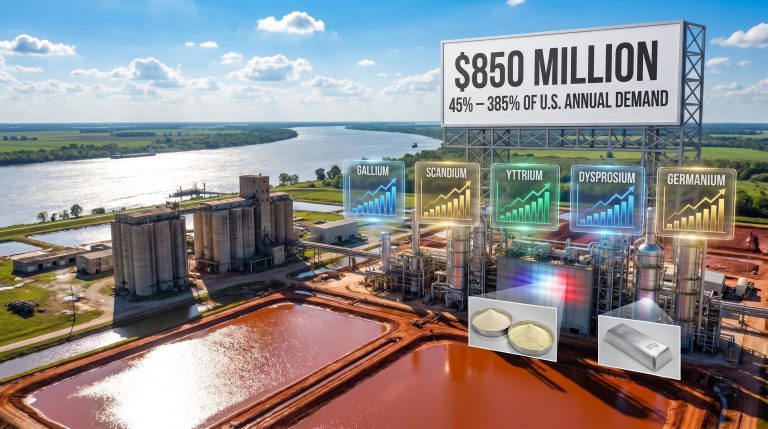
At full commercial-scale operation, processing more than 1 million tons of bauxite residue per year, the St. John the Baptist Parish facility has the potential to cover a striking proportion of U.S. domestic demand across several critical mineral categories. According to tomorrowsworldtoday.com, the new processing plant could recover up to 1,000 tons of rare earth elements annually.
| Mineral / Element | Strategic Classification | Projected U.S. Demand Coverage at Full Scale |
|---|---|---|
| Gallium | Critical Mineral | 45% to 385% of annual U.S. demand |
| Scandium | Critical Mineral | 45% to 385% of annual U.S. demand |
| Yttrium | Rare Earth Element | 45% to 385% of annual U.S. demand |
| Germanium | Critical Mineral | 45% to 385% of annual U.S. demand |
| Dysprosium | Heavy Rare Earth Element | Significant domestic contribution |
| Gadolinium | Rare Earth Element | Significant domestic contribution |
| Ytterbium | Heavy Rare Earth Element | Significant domestic contribution |
| Pig Iron | Industrial Co-Product | ~50% of residue mass by volume |
The wide range in demand coverage projections reflects uncertainty in both final production yields and the trajectory of U.S. demand growth. These figures should therefore be treated as scenario-based projections rather than guaranteed outcomes.
The next major ASX story will hit our subscribers first
Development Timeline: From Groundbreaking to Commercial Scale
The ElementUSA Louisiana facility is advancing through a structured multi-phase development schedule:
- Mid-2026: Groundbreaking for the initial scale-up phase in St. John the Baptist Parish, Louisiana.
- 2027: Simultaneous commencement of demonstration facility construction and commercial facility construction.
- Q3 2028: Initial production targeted from the demonstration facility, providing proof-of-concept at pre-commercial throughput.
- Full commercial scale: Target processing capacity exceeding 1 million tons of bauxite residue per year is reached in the subsequent build-out phase.
The Mississippi River location at Gramercy provides meaningful logistical advantages, including existing industrial infrastructure, barge access for bulk material movement, and proximity to established chemical and manufacturing supply chains along the Gulf Coast corridor.
Economic Impact: Jobs, Wages, and Regional Development
Beyond its strategic mineral dimensions, the ElementUSA rare earth processing facility in Louisiana carries substantial regional economic implications for Southeast Louisiana.
The project is expected to generate 200 direct jobs at an average annual salary of approximately $90,000, a figure roughly 28% above the local area average wage. Indirect employment effects are estimated at an additional 554 positions, bringing the total regional employment impact to 754 jobs across the broader Southeast Louisiana economy.
For St. John the Baptist Parish, a region with a historical economic identity anchored in industrial refining and petrochemical production, this wage profile and job volume represents a meaningful evolution toward advanced materials manufacturing as a new economic pillar. Furthermore, the Opportunity Louisiana project profile highlights the state government's active support for attracting this category of advanced industrial investment.
How the Louisiana Resource Compares to Conventional REE Deposits
One of the more technically interesting aspects of the ElementUSA model is how the bauxite residue feedstock differs structurally from conventional rare earth mining.
| Attribute | ElementUSA Louisiana Resource | Conventional Mined REE Deposit |
|---|---|---|
| Feedstock type | Industrial waste (bauxite residue) | Hard rock or ionic clay ore |
| New mining required | No | Yes |
| Environmental profile | Converts existing waste liability | Generates new tailings |
| Payable metals recovery | Greater than 95% across iron, REEs, and critical minerals | Variable; typically lower across multi-element streams |
| Heavy REE content | Elevated (dysprosium, gadolinium, ytterbium) | Often light REE-dominant |
| Revenue streams | Pig iron plus mixed REE oxide basket | Single primary product stream typical |
The greater than 95% payable metals recovery figure is particularly notable from a process engineering perspective. Most conventional mineral processing operations accept significantly lower overall recovery rates, with losses distributed across tailings, processing circuits, and rejected streams.
The Global Replication Question: Can the Waste2Market Model Scale Internationally?
Perhaps the most speculative but consequential dimension of the ElementUSA story is whether its processing platform can be replicated at bauxite residue sites elsewhere in the world. ElementUSA has indicated the technology is designed for deployment beyond Louisiana, and the global inventory of bauxite residue provides an enormous addressable resource base.
What Conditions Must Be Met for International Deployment?
The critical conditions that would need to be satisfied at other locations include:
- Sufficient concentration of target minerals within the local residue chemistry (which varies significantly between sites based on original bauxite ore source)
- Site infrastructure adequate for dual-stream pyrometallurgical and hydrometallurgical processing
- Proximity to industrial pig iron buyers and rare earth offtake customers
- Regulatory frameworks permitting the reclassification and commercial treatment of legacy waste stockpiles
The chemistry of bauxite residue is not uniform globally. Red mud derived from Guinean or Australian bauxite carries a different mineral fingerprint than material derived from Caribbean or Southeast Asian sources. Whether the Gramercy site's favourable heavy REE and critical mineral profile is replicated at other major stockpile locations remains an open technical question.
Frequently Asked Questions: ElementUSA Rare Earth Processing Facility in Louisiana
What Minerals Will the ElementUSA Louisiana Facility Produce?
The facility is designed to produce a mixed rare earth oxide basket rich in heavy rare earth elements and yttrium, alongside pig iron as a primary co-product. Key minerals include gallium, scandium, dysprosium, gadolinium, ytterbium, germanium, and yttrium.
Where Is the Facility Located?
The facility is located in Gramercy, St. John the Baptist Parish, Louisiana, on the site of the former Atalco alumina refinery along the Mississippi River.
What Is Bauxite Residue and Why Is It Used as a Feedstock?
Bauxite residue is a highly alkaline industrial byproduct generated during alumina refining. The Gramercy site holds approximately 34 million tons of stored material containing commercially recoverable concentrations of rare earth elements and critical minerals.
How Much Federal Funding Has the Project Received?
The project has received a combined $96.9 million in federal funding: $67 million from the DOE and $29.9 million from the DoD.
When Will the Facility Begin Production?
Initial production from the demonstration facility is targeted for Q3 2028, following groundbreaking in mid-2026 and construction commencing in 2027.
What Is the Total Investment for the Project?
The projected total capital investment is approximately $1.1 billion for the full commercial-scale facility.
How Many Jobs Will the Facility Create?
The project is projected to generate 200 direct jobs and 554 indirect jobs, for a total regional employment impact of 754 positions.
What Makes ElementUSA's Technology Different?
The integrated pyrometallurgical and hydrometallurgical flowsheet generates revenue from two distinct product streams — pig iron and rare earth oxides — from a single industrial waste feedstock, with a design target of zero solid waste output.
What the Louisiana Project Signals for U.S. Critical Mineral Strategy
The ElementUSA rare earth processing facility in Louisiana does not exist in isolation. It reflects a broader structural recognition that domestic mineral security requires investment in processing infrastructure as much as, if not more than, investment in new mining projects. The United States has historically excelled at geological exploration and resource discovery while allowing processing and refining capability to atrophy.
The heavy rare earth category represents the sharpest edge of this vulnerability. Unlike light rare earths, where some domestic processing capability exists, commercial-scale separation and refining of dysprosium, terbium, and associated heavy rare earth elements from a North American feedstock remains an extremely limited capability. However, a facility that can produce these materials from a domestic waste stream, at commercial scale, with a co-product revenue model to support project economics, addresses a gap that conventional mining investment alone cannot close.
Whether the project executes on its timeline, achieves its recovery targets, and ultimately reaches the processing throughput required to make a measurable impact on U.S. import dependency are all questions that will be answered in the years ahead. What the Louisiana project already demonstrates is that the logic of waste-to-resource conversion, long discussed in academic and policy contexts, is now being backed with nine-figure capital commitments and tested at commercial scale.
This article contains forward-looking projections regarding production capacity, demand coverage, employment outcomes, and project timelines. All such figures are based on publicly available company disclosures and should not be construed as guarantees of future performance or investment advice.
Want To Stay Ahead of the Next Major Mineral Discovery on the ASX?
Discovery Alert's proprietary Discovery IQ model delivers real-time alerts on significant ASX mineral discoveries across critical minerals, rare earths, and beyond, instantly transforming complex geological data into actionable investment insights for traders and long-term investors alike. Explore how historic mineral discoveries have generated extraordinary returns and begin your 14-day free trial today to secure a market-leading edge before the broader market catches on.