June 13, 2026
The Processing Gap That Defines America's Critical Mineral Vulnerability
For decades, the conversation around mineral security has centred on who controls the ground. Which country holds the largest deposits? Which mining jurisdiction offers the most favourable geology? These are important questions, but they miss the deeper structural problem that now defines America's strategic exposure: it is not the ground that matters most, it is what happens after extraction.
The United States possesses meaningful deposits of several critical minerals, yet it refines and processes a fraction of what its economy and defence industrial base require. The gap between mining and manufacturing — specifically the processing and separation stages that transform raw material into usable industrial inputs — is where supply chain vulnerability is most acute. Closing that gap requires not just new mines, but entirely new categories of domestic processing infrastructure.
The ElementUSA rare earth processing facility in Louisiana represents one of the most technically distinctive attempts to address this structural deficit, and it does so through a feedstock that most of the industry has spent decades treating as a liability rather than an asset. Furthermore, the broader critical minerals demand surge makes projects like this increasingly urgent for national industrial strategy.
When big ASX news breaks, our subscribers know first
Rethinking What Counts as a Mineral Resource
The Industrial Waste Thesis and Why Is It Gaining Traction?
Conventional rare earth project development follows a familiar sequence: exploration, resource definition, feasibility study, permitting, and eventually construction. The timeline from discovery to production routinely spans a decade or more, and the permitting process alone can consume years of capital with no certainty of outcome.
Projects built around industrial waste streams operate on fundamentally different logic. The resource already exists, has already been quantified, and is already concentrated in a known location. There is no greenfield exploration risk, no grade continuity uncertainty, and no requirement to disturb undisturbed land. From a development risk perspective, the starting position is materially different from conventional mining.
This is the core thesis driving growing interest in bauxite residue — commonly called red mud — as a mineral feedstock. Produced during the Bayer process that refines bauxite ore into alumina, red mud accumulates at alumina refineries in massive volumes. Globally, the estimated stockpile exceeds 4 billion tons, with new material being added continuously at active refining operations. Within that accumulated mass sits a concentrated inventory of gallium, scandium, rare earth elements, yttrium, and iron — all co-mingled in a material that the industry has historically managed as an environmental liability.
The economic inversion is significant: what was once a cost centre requiring perpetual management and environmental monitoring is now being re-evaluated as a pre-accumulated, pre-quantified mineral resource sitting at existing industrial sites with established logistics infrastructure already in place.
Why Bauxite Residue Is Particularly Mineral-Dense
Not all industrial waste streams carry equal mineral value. What distinguishes bauxite residue from many other secondary resource candidates is the combination of mineral diversity and concentration. The Bayer process is highly selective for alumina, meaning that gallium, scandium, rare earth elements, and iron are effectively concentrated into the residue fraction rather than captured in the alumina product stream.
This creates a residue that, in some deposits, contains higher concentrations of certain critical minerals than many conventional ore bodies being actively considered for primary mining. The Louisiana bauxite residue that ElementUSA is targeting has been characterised as having more than 95% payable metals across iron, rare earth elements, and critical minerals — a figure that distinguishes it from both conventionally mined deposits and other industrial waste categories under development globally.
Project Architecture: What ElementUSA Is Actually Building in Louisiana
Site Selection and the Gramercy Advantage
The ElementUSA rare earth processing facility in Louisiana is anchored to a site in St. John the Baptist Parish, in the Gramercy area along the Mississippi River corridor. The location is not incidental. This stretch of the Mississippi has historically hosted alumina refining operations, and the bauxite residue accumulated from those historical activities now represents the project's primary feedstock base.
ElementUSA holds exclusive access to more than 34 million tons of bauxite residue at the site. At the project's full commercial processing rate of approximately 1 million tons per year, that resource base represents roughly 34 years of operational feedstock without requiring any new material to be sourced. The Mississippi River corridor also provides practical logistical advantages: deep-water access for inbound material and outbound product distribution, existing industrial utilities, and proximity to Gulf Coast manufacturing and chemical processing clusters.
The Two-Phase Development Structure
The project is structured across two sequential development phases, each with distinct technical and financial objectives:
| Phase | Description | Key Milestone |
|---|---|---|
| Phase 1 | Demonstration-scale facility for process validation and scale-up | Construction commenced mid-2026 |
| Phase 2 | Full commercial facility at ~1 million tons per year throughput | Construction commencing 2027 |
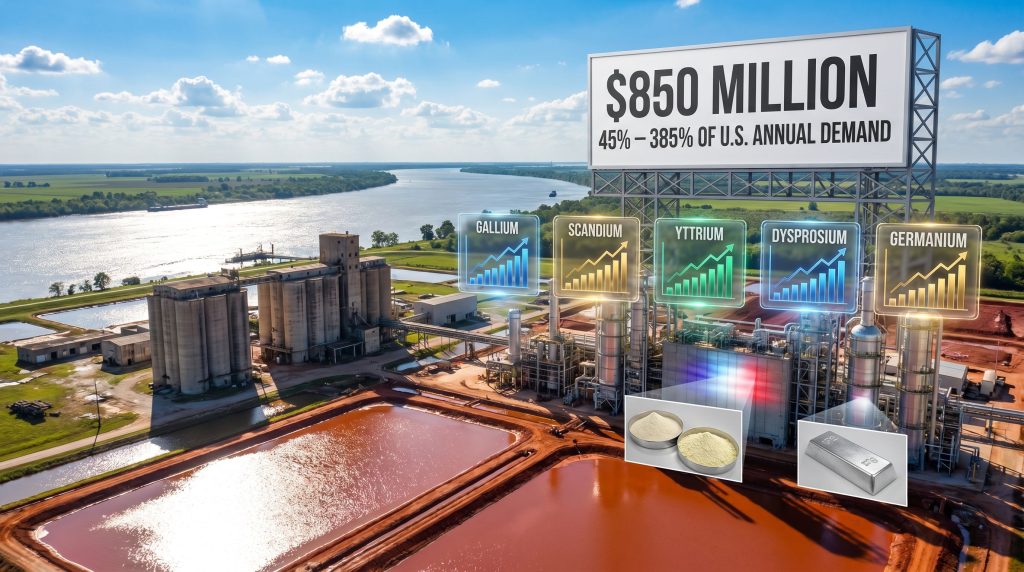
Phase 1 is funded in part by the $67 million Department of Energy award co-granted with Colorado School of Mines. This phase serves the dual function of validating the integrated processing flowsheet at meaningful scale and generating the operational data required to underpin the Phase 2 investment decision. The full commercial facility has been associated with an $850 million total investment figure, with Louisiana state authorities having publicly committed to the project's commercial-scale development.
Federal Funding Layers: DOE and DOD Involvement
ElementUSA's federal support structure involves two distinct agencies with different strategic mandates — which is itself a noteworthy signal about how the project is being evaluated across government:
- Department of Defense: $29.9 million awarded specifically for gallium and scandium recovery and commercialisation, reflecting acute Pentagon concern about supply chain exposure in defence-critical semiconductor and aerospace materials.
- Department of Energy: $67 million co-awarded with Colorado School of Mines, covering the design, construction, commissioning, and operation of the rare earth processing facility, reflecting the energy transition and industrial competitiveness dimensions of the project.
The combined federal commitment of approximately $96.9 million across two agencies is significant not just as a capital contribution but as a form of institutional validation. Federal grant awards at this scale involve rigorous technical and commercial due diligence. The dual-agency structure indicates that the project is being evaluated through both an energy security minerals lens and a defence readiness lens simultaneously — a combination that is relatively uncommon among rare earth processing initiatives.
How the Processing Technology Works: Hydromet Meets Pyromet
The Integrated Flowsheet Explained
ElementUSA's core technical differentiator is the integration of hydrometallurgical and pyrometallurgical processing into a single flowsheet applied to the same input material. Understanding why this matters requires a brief explanation of what each approach does.
Pyrometallurgy uses high-temperature thermal treatment to transform the physical and chemical structure of the feed material. In ElementUSA's application, this stage converts the iron-bearing fraction of the bauxite residue into pig iron — a commercially saleable product that generates revenue from a commodity co-product stream. This is economically important because the iron fraction, which constitutes a large proportion of red mud by mass, becomes a revenue-generating output rather than simply a disposal problem.
Hydrometallurgy uses aqueous chemistry — typically acidic or alkaline leaching solutions — to selectively dissolve and separate target metals from the solid matrix. Following the pyrometallurgical treatment stage, the remaining mineral-bearing fractions are processed through hydrometallurgical circuits to recover rare earth elements, gallium, scandium, yttrium, and other critical minerals.
The step-by-step flow looks broadly like this:
- Bauxite residue is fed into the integrated processing system as the primary input material.
- Pyrometallurgical treatment converts the iron fraction into pig iron, generating a co-product revenue stream.
- The processed residue, now depleted of its iron fraction, proceeds into hydrometallurgical circuits.
- Selective leaching and solvent extraction stages separate individual critical mineral streams including gallium, scandium, rare earth elements, and yttrium.
- The rare earth output is a mixed rare earth oxide basket, characterised by particularly strong heavy rare earth and yttrium content.
- Individual critical mineral streams are separated for downstream industrial customers in magnets, semiconductors, aerospace, medical imaging, and defence applications.
Why the Heavy Rare Earth Profile Matters
The rare earth market is not monolithic. The distinction between light rare earths (lanthanum, cerium, praseodymium, neodymium) and heavy rare earths (dysprosium, terbium, yttrium, gadolinium, ytterbium) is commercially and strategically critical. Light rare earths are relatively abundant and are produced at multiple sites globally. Heavy rare earths, however, are geographically concentrated, far scarcer relative to demand, and command substantially higher market prices.
Dysprosium, for instance, is essential for maintaining the coercivity of neodymium-iron-boron permanent magnets at elevated operating temperatures. Electric vehicle traction motors and wind turbine generators that operate at high temperatures require dysprosium-enhanced magnets to maintain performance, and there is no current substitute. The global supply of dysprosium is overwhelmingly concentrated in a single producing country, creating the most acute single-point vulnerability in the entire EV supply chain.
ElementUSA's reported mixed rare earth oxide basket — with strong heavy rare earth and yttrium content — directly addresses the segment of the rare earth market where supply chain risk is most concentrated. Consequently, this aligns with broader concerns around rare earth supply chains that strategists and investors have been monitoring closely.
What the Louisiana Facility Can Actually Produce
Critical Mineral Output and U.S. Demand Coverage
At full commercial scale, ElementUSA projects the Louisiana facility could supply the following share of U.S. annual demand for each critical mineral:
| Critical Mineral | Primary Strategic Applications | Potential U.S. Demand Coverage |
|---|---|---|
| Gallium | Semiconductors, 5G RF devices, defence electronics | 45% to 385% |
| Scandium | Aerospace aluminium alloys, solid oxide fuel cells | 45% to 385% |
| Yttrium | Phosphors, advanced ceramics, cancer radiotherapy | 45% to 385% |
| Germanium | Infrared optics, fibre optics, semiconductor substrates | 45% to 385% |
| Ytterbium | High-power lasers, atomic clocks, quantum computing | 45% to 385% |
| Dysprosium | High-performance permanent magnets for EV motors and wind turbines | 45% to 385% |
| Gadolinium | MRI contrast agents, nuclear reactor neutron shielding | 45% to 385% |
| Pig Iron | Steel manufacturing co-product | Revenue-generating co-product |
The breadth of this mineral basket is unusual for a single processing facility, and it reflects the chemical diversity of bauxite residue as a feedstock. Most rare earth processing projects target a narrower range of outputs. The ability to simultaneously recover gallium, germanium, and heavy rare earths from the same input material — alongside a pig iron co-product — creates a revenue diversification profile that conventional mining projects rarely achieve.
Investor Perspective: The 45% to 385% U.S. demand coverage range reflects uncertainty about the precise recovery rates achievable at commercial scale, as well as variability in U.S. demand forecasts. Investors should treat the lower bound of this range as the more conservative planning assumption until commercial-scale operating data is available.
Gallium and Germanium: The Semiconductor Dimension
Gallium and germanium occupy a particularly sensitive position in the critical minerals landscape. Both are used in compound semiconductors, infrared optics, and defence electronics, and both have been subject to export restrictions by major producing countries in recent years. The U.S. currently has minimal domestic production of either material.
The Department of Defense's targeted $29.9 million grant specifically for gallium and scandium recovery reflects precisely this exposure. A domestic source capable of supplying a meaningful percentage of U.S. gallium demand would represent a material improvement in semiconductor supply chain resilience — particularly given the growing strategic importance of critical minerals for semiconductors in both commercial and defence-grade electronics.
Economic and Employment Dimensions
What Full-Scale Development Means for Louisiana
The economic case for the ElementUSA rare earth processing facility in Louisiana extends beyond the minerals themselves. Louisiana state authorities have cited the following projected economic impacts from the full-scale development:
- 200 direct jobs created at the facility.
- 554 indirect and induced jobs supported across the regional economy.
- 754 total jobs in the combined employment footprint.
- $850 million in total capital investment at full commercial scale.
For St. John the Baptist Parish — a predominantly rural parish with a historical economic base in alumina refining and petrochemicals — the transformation of a legacy waste site into a nationally strategic processing facility represents a meaningful industrial revitalisation opportunity. According to Opportunity Louisiana, the state has formally recognised the project's economic significance within its industrial development framework. The existing industrial infrastructure at the Gramercy site, including utilities, transport connections, and workforce familiarity with chemical processing operations, reduces greenfield development costs and shortens construction timelines relative to a completely new site.
The next major ASX story will hit our subscribers first
Scalability and the Global Bauxite Residue Opportunity
A Replicable Model Across 4 Billion Tons
One of the less-examined aspects of the ElementUSA project is its stated design philosophy: the processing platform is built for replicability, not just for the Louisiana site. The company has indicated that its integrated flowsheet is designed to be adapted to bauxite residue resources at other sites globally, accommodating variations in residue chemistry across different alumina refining operations.
This is significant because bauxite residue is a globally distributed resource. Major accumulations exist in Australia, Brazil, Jamaica, India, Greece, Hungary, and across West Africa — all locations where historical alumina refining has generated large residue deposits. Each site carries a different mineral profile depending on the origin of the bauxite ore and the refining chemistry used, but the core processing approach is designed to be adaptable.
If the Louisiana facility successfully validates the commercial economics of the model, it becomes a potential template for a new category of strategic mineral production globally — one that operates at the intersection of environmental remediation, circular economy principles, and critical mineral supply security. This replicability dimension is also relevant to the broader conversation around critical minerals geopolitics, where the ability to develop non-traditional feedstocks could reshape global supply dynamics.
Competitive Context: Where ElementUSA Sits in the U.S. REE Processing Landscape
How Does This Project Differ From Other Domestic Initiatives?
The U.S. rare earth processing sector has seen increased activity in recent years, with several projects advancing toward commercial scale. ElementUSA occupies a distinct position within this landscape:
| Project | Feedstock | Processing Stage | Federal Support | Location |
|---|---|---|---|---|
| ElementUSA | Bauxite residue (industrial waste) | Demonstration to commercial | DOE + DOD grants | Louisiana |
| MP Materials | Mined ore (Mountain Pass) | Active commercial production | DOD offtake agreements | California and Texas |
| USA Rare Earth | Mined ore + magnet manufacturing | Processing and downstream | Federal grants | Oklahoma and Texas |
| ReElement Technologies | Recycled magnets and mining byproducts | Commercial processing | DOD partnerships | Indiana |
ElementUSA is the only major participant in this group whose processing operation is anchored entirely to an industrial waste feedstock, requiring no new mining permits and leveraging a pre-accumulated, already-quantified resource base. Furthermore, as noted in coverage by Tomorrow's World Today, the facility's potential to recover over 1,000 tons of rare earth elements annually underscores just how significant this distinction is relative to peers. This has material implications for both the development timeline and the regulatory complexity of the project.
Key Questions and Answers: ElementUSA Louisiana
What is the ElementUSA rare earth processing facility in Louisiana?
It is a critical minerals and rare earth element processing facility being developed in St. John the Baptist Parish, Louisiana, using bauxite residue from historical alumina refining operations as its primary feedstock. The project applies an integrated hydrometallurgical and pyrometallurgical process to recover rare earth elements, gallium, scandium, yttrium, germanium, and other critical minerals, alongside pig iron as a co-product.
How much federal funding has the project received?
ElementUSA has received two federal awards: a $29.9 million Department of Defense grant for gallium and scandium recovery and commercialisation, and a $67 million Department of Energy award co-granted with Colorado School of Mines for the design, construction, commissioning, and operation of the rare earth processing facility. Combined federal support totals approximately $96.9 million.
When does construction begin and what is the production timeline?
Phase 1 construction commenced in mid-2026. Full commercial-scale construction is expected to begin in 2027, with the completed facility designed to process approximately 1 million tons of bauxite residue per year at steady-state operations.
Is the processing model replicable at other sites?
ElementUSA has stated that its processing platform is designed for deployment at other bauxite residue sites globally. With an estimated 4 billion tons of bauxite residue accumulated worldwide across alumina refining operations on multiple continents, successful commercial validation at the Louisiana site could establish a replicable template for secondary mineral recovery at legacy alumina sites internationally.
Disclaimer: This article contains forward-looking statements, production forecasts, and demand coverage estimates that involve inherent uncertainty. Figures such as the 45% to 385% U.S. demand coverage projections reflect company estimates and are subject to change based on commercial-scale operating results, market conditions, and factors outside the company's control. This article does not constitute financial advice. Readers should conduct independent due diligence before making any investment decisions.
Want To Stay Ahead of the Next Major Critical Minerals Discovery?
Discovery Alert's proprietary Discovery IQ model delivers real-time alerts on significant ASX mineral discoveries — including critical minerals, rare earths, and strategic commodities — instantly translating complex data into actionable investment insights for both short-term traders and long-term investors. Explore how historic mineral discoveries have generated substantial returns on Discovery Alert's dedicated discoveries page, and begin your 14-day free trial today to position yourself ahead of the broader market.