June 12, 2026
The Quiet Scramble Beneath the Headlines: Why Mineral Sovereignty Is Reshaping Global Power
Across the arc of modern industrial history, control over raw materials has consistently preceded control over technology. Nations that secured access to coal before the industrial revolution, petroleum before the automotive age, and silicon before the digital era did not merely gain economic advantage — they shaped the architecture of global power for generations. The world is now entering a structurally equivalent inflection point, where rare earth elements, lithium, cobalt, and copper are performing the same enabling function for electrification, advanced defence systems, and semiconductor manufacturing that oil performed for the twentieth century.
Within this context, the deepening engagement between India and Russia on critical mineral cooperation deserves considerably more analytical attention than it typically receives. This is not simply a bilateral trade discussion — it represents a deliberate attempt by two major non-Western powers to restructure the mineral supply chains that underpin twenty-first century industry, doing so largely outside the frameworks that Western-aligned economies have spent decades constructing. Understanding rare earth supply chains in this context is therefore essential.
The confirmed catalyst for the most recent phase of this engagement is the formalisation of agreements between Giredmet, a research and development subsidiary operating under Russia's state nuclear corporation Rosatom, and a group of Indian industrial partners. Those agreements signal that cooperation has moved beyond diplomatic communiqués into institutional architecture — a shift that changes the analytical calculus for anyone tracking India Russian rare earth BRICS mining cooperation developments.
When big ASX news breaks, our subscribers know first
What Russia's Mineral Endowment Actually Represents
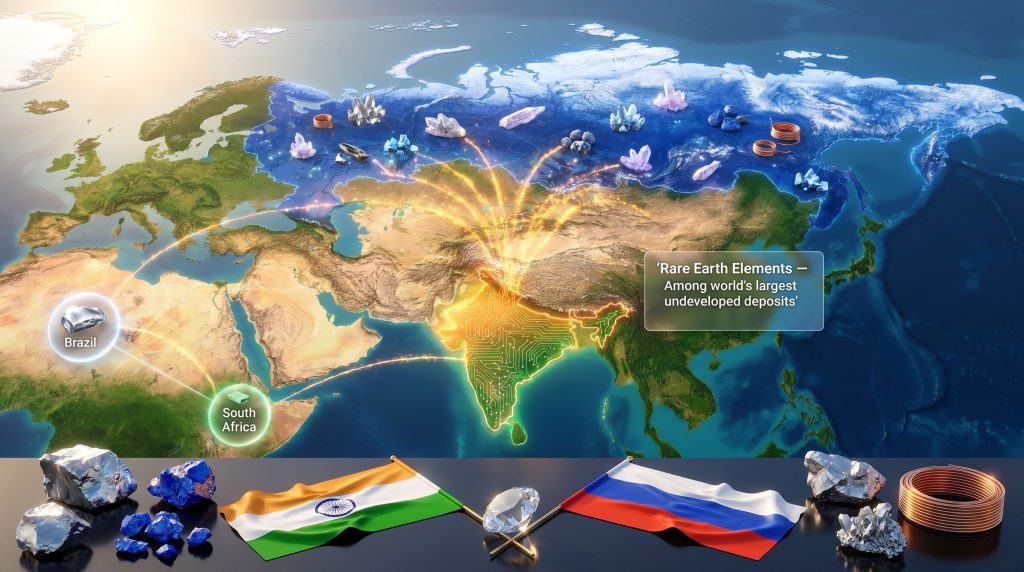
Russia's position in the global critical minerals landscape is one of the most misunderstood in the industry. The country is frequently described as a major mining nation on the basis of its nickel, palladium, and copper output through producers such as Norilsk Nickel. What receives far less attention is the scale of Russia's undeveloped rare earth potential — a resource base that many independent geological assessments suggest rivals or exceeds established deposit nations in aggregate tonnage, even while actual production capacity remains negligible by comparison.
The disparity between reserve potential and operational output is a defining characteristic of Russia's mineral situation. Several factors have historically contributed to this structural underutilisation:
- Soviet-era industrial priorities concentrated investment in energy and heavy metals rather than rare earth development, leaving REE deposits largely at the exploration stage
- Post-Soviet economic disruption collapsed the institutional and financial capacity needed to develop complex multi-stage mineral processing chains
- Chinese pricing strategies through the 1990s and 2000s suppressed global rare earth prices, removing the economic incentive for Russian development investment
- Permafrost and infrastructure constraints in key deposit regions including Yakutia and the Russian Far East significantly elevate capital costs per unit of production
- Western sanctions since 2022 have further restricted Russia's ability to access critical processing technology and international project financing
The key deposits that define Russia's rare earth potential include the Lovozero Massif on the Kola Peninsula, one of the world's largest known nepheline-syenite rare earth occurrences, and the Tomtor deposit in the Sakha Republic, which carries among the highest-grade niobium and rare earth concentrations documented globally. The Tomtor deposit's ore grades for certain rare earth oxides are reported to substantially exceed average grades at operating Chinese and Australian mines, though independent verification of Russian reserve classifications remains a persistent challenge for international investors.
The following table summarises the principal minerals in Russia's strategic endowment and their relevance to current industrial demand:
| Mineral | Reserve Significance | Primary Demand Drivers | Development Status |
|---|---|---|---|
| Rare Earth Elements | Among largest undeveloped global deposits | Defence magnets, EV motors, electronics | Minimal operational output |
| Lithium | Siberian pegmatite and brine occurrences | EV batteries, grid storage | Early-stage exploration |
| Cobalt | Co-product potential from nickel operations | Battery cathodes, aerospace alloys | Limited dedicated development |
| Copper | Major global producer via existing operations | Electrical infrastructure, EVs | Active and producing |
| Niobium | Tomtor deposit exceptionally high-grade | Specialty steels, superconductors | Undeveloped at commercial scale |
| Palladium | Dominant global producer | Catalysts, fuel cells, electronics | Active production at scale |
The role of Rosatom's Giredmet institute in bridging this resource potential to international partners is technically significant in ways that extend beyond simple exploration agreements. Giredmet's expertise encompasses the full rare earth processing chain, from ore beneficiation through to the production of separated rare earth oxides and downstream materials. This matters because separation technology represents the most strategically sensitive and technically complex phase of rare earth production — the precise stage where China has accumulated overwhelming global dominance, currently accounting for approximately 85 to 90 percent of global rare earth separation capacity according to US Geological Survey data.
India's Demand Profile and the Structural Case for Diversification
Why Does India Face a Processing Gap?
Understanding why India is actively pursuing Russian mineral cooperation requires examining India's supply vulnerability with precision rather than generality. India holds modest domestic reserves of certain rare earth minerals, most notably monazite in beach sand deposits along its southern and eastern coastlines, which contain economically significant concentrations of thorium alongside light rare earth elements. Yet despite this domestic resource base, India imports the overwhelming majority of its rare earth processing requirements.
This situation reflects not a shortage of ore but a near-complete absence of commercial processing infrastructure. The reasons for this processing gap are layered:
- Thorium regulatory complexity — India's monazite resources are classified as atomic minerals under national law due to their thorium content, creating regulatory constraints that have historically inhibited commercial development
- Separation technology deficiency — rare earth separation requires highly specialised solvent extraction chemistry; India has not developed indigenous commercial-scale capability in this domain
- Historical low-price environment — when global rare earth prices were depressed, the economic case for building domestic processing capacity was weak
- Chinese import convenience — separated rare earth oxides from China were consistently available at prices that made domestic investment economically unattractive until geopolitical concerns elevated the strategic premium
India's industrial demand trajectory is now moving sharply upward across precisely the sectors most dependent on critical minerals demand. The government's EV transition targets, semiconductor manufacturing ambitions under the India Semiconductor Mission, defence modernisation programmes, and renewable energy installation commitments collectively represent a demand curve that domestic supply cannot realistically service without major upstream investment or secured import partnerships.
The combination of rising domestic demand, constrained domestic supply, and political discomfort with dependence on Chinese processed materials creates a precise set of conditions in which an alternative supplier relationship with Russia carries strategic logic that transcends conventional trade economics.
India's relationship with China as a mineral supplier is complicated by broader strategic tensions, including ongoing border disputes, competitive industrial policies in electronics and solar manufacturing, and a broader geopolitical rivalry that makes deep supply chain dependence on Beijing uncomfortable for New Delhi's defence and industrial planners. Furthermore, India's Production-Linked Incentive schemes for electronics, specialty chemicals, and advanced battery manufacturing all presuppose access to upstream mineral inputs — making mineral security a direct policy enabler rather than an abstract strategic concern.
The Architecture of India-Russia Mineral Cooperation
The institutional structure emerging between India and Russia on minerals is built on three distinct pillars, each targeting a different phase of the value chain.
Pillar 1: Exploration and Geological Capacity Building
This involves joint mapping initiatives, the sharing of historical Soviet-era geological survey data with Indian research partners, and technical training programmes for Indian geoscientists. Russia's Soviet-era geological archives represent an underappreciated asset — systematic surveys conducted across the USSR produced an extensive dataset that has never been fully commercialised or shared internationally.
Pillar 2: Mining Technology Transfer
Russian mining technology, particularly for operations in challenging geological and climatic conditions, represents a capability set that could be adapted for Indian requirements. This encompasses both hard rock mining equipment and the operational methodologies developed for Arctic and sub-Arctic extraction conditions, which have applications in certain Indian geological settings.
Pillar 3: Processing and Refining Knowledge Exchange
This is the most strategically significant pillar. Giredmet's involvement specifically targets the processing chain — bringing Rosatom's institutional expertise in rare earth separation, materials science, and refining technology into a cooperative framework with Indian industrial partners. This is the dimension that distinguishes the current engagement from conventional mineral exploration agreements. According to reporting by Mining Frontier, this processing-focused collaboration reflects a deeper strategic alignment between both nations on supply chain independence.
An important analytical distinction applies here: the agreements confirmed between Giredmet and Indian companies reflect working-level institutional engagement, not yet fully operational supply chains. The gap between signed memorandums and functioning mineral corridors involves substantial execution risk, capital mobilisation requirements, and regulatory compliance challenges that remain unresolved. Treating these agreements as equivalent to established supply relationships would misrepresent their current status.
Is the BRICS Critical Minerals Alliance Real or Rhetorical?
The framing of India Russian rare earth BRICS mining cooperation within a broader BRICS context requires careful analytical disaggregation. The following assessment framework distinguishes verified progress from promotional narrative:
| Claim | Evidence Base | Confidence Assessment |
|---|---|---|
| India-Russia bilateral rare earth discussions at working level | Confirmed through institutional agreements | High |
| Giredmet memorandums with Indian industry partners | Reported and consistent with institutional activity | High |
| India advocacy for BRICS-level minerals cooperation framework | Consistent with New Delhi's stated multilateral positions | Medium-High |
| Formal BRICS-wide Critical Minerals Alliance with binding mechanisms | Promotional commentary, limited independent verification | Low-Medium |
| BRICS minerals trading exchange or pricing platform | Speculative, no confirmed institutional development | Low |
The BRICS institutional framework itself has a mixed track record on converting political declarations into operational economic mechanisms. The New Development Bank represents a genuine multilateral financial institution, but many BRICS-level economic cooperation proposals have remained aspirational. The mineral cooperation agenda faces additional complications given the varying mineral profiles, economic interests, and geopolitical alignments of member states.
South Africa brings platinum group metals to any hypothetical BRICS minerals framework. Brazil holds substantial lithium and niobium resources. Russia contributes rare earths and energy minerals. China already dominates the processing chain that all other members would theoretically seek to access or develop. The structural tension this creates within any genuine BRICS mineral cooperation architecture is significant — member states need each other's resources while simultaneously competing across overlapping industrial ambitions. Consequently, China's rare earth strategy continues to cast a long shadow over these multilateral negotiations.
Three Scenarios for the India-Russia Minerals Corridor
Projecting how the India-Russia minerals relationship develops requires scenario analysis rather than linear forecasting, given the multiple interdependent variables at play.
Scenario A: Incremental Technical Cooperation
Cooperation advances at the research and institutional level, producing knowledge transfer, joint pilot projects, and limited processing partnerships over a five to ten year horizon. This scenario does not materially alter global rare earth supply chains but builds foundational capability that positions India for more significant engagement in subsequent cycles. Probability: High in the near term.
Scenario B: Accelerated Integration Under Sanctions Pressure
Continued Western financial restrictions on Russian entities accelerate the formalisation of India-Russia mineral trade routes. India potentially emerges as a processing hub for Russian rare earth feedstock, with separated oxides and refined materials flowing into Indian manufacturing supply chains and potentially re-exported under Indian provenance. This scenario carries significant secondary sanctions risk for Indian firms and their international financing partners. Probability: Moderate over a five to seven year horizon.
Scenario C: BRICS Multilateral Mineral Architecture
A functioning BRICS critical minerals framework emerges, incorporating South African platinum group metals, Brazilian lithium and niobium, Russian rare earths, and potentially creating parallel supply chain infrastructure that challenges Western-aligned mineral security initiatives. In addition, strategic minerals deals between Western nations and resource-rich partners are accelerating in response to precisely this kind of non-Western coalition-building. Probability: Low to medium over a ten year horizon.
The next major ASX story will hit our subscribers first
The Risks That Could Derail This Partnership
Several structural barriers present genuine challenges to the realisation of this cooperation framework:
- Secondary sanctions exposure remains the most immediate constraint for Indian firms engaging with Rosatom-affiliated entities, given the potential implications for access to US dollar financing and Western technology markets
- Standards alignment friction between Russian industrial specifications and Indian manufacturing requirements creates technical integration costs that raise project economics
- ESG compliance gaps in Russian mining operations could limit the ability of India's internationally financed manufacturing sector to use Russian mineral inputs without reputational and compliance consequences
- Reserve verification challenges persist because independent international auditing of Russian geological reserve classifications under JORC or NI 43-101 standards is currently impractical, creating due diligence barriers for institutional investors
- Domestic political economy risks in both countries, where competing industrial interests and bureaucratic coordination challenges can delay the implementation of high-level agreements
Frequently Asked Questions: India Russian Rare Earth and BRICS Mining Cooperation
What Rare Earth Minerals Are Central to the India-Russia Cooperation Agenda?
The bilateral framework encompasses light and heavy rare earth elements used in permanent magnet applications for EV motors and defence systems, alongside lithium, cobalt, niobium, and copper. The rare earth separation technology exchange is currently the most strategically significant component.
Does India's Engagement With Russian Mineral Entities Create Sanctions Complications?
Yes, this is a genuine compliance consideration. India maintains a strategic autonomy foreign policy doctrine that permits simultaneous engagement across geopolitical blocs, but secondary sanctions exposure for Indian firms transacting with Rosatom-affiliated entities represents a material risk that international financing partners will scrutinise carefully.
What Specifically Does Giredmet Bring to the Partnership Beyond Exploration?
Giredmet's institutional expertise extends across the full rare earth processing chain, encompassing ore characterisation, beneficiation process design, solvent extraction separation technology, and downstream materials production. This processing capability is the dimension of the partnership with the highest strategic value for India's industrial development objectives.
How Does This Cooperation Relate to China's Dominance in Rare Earth Processing?
Both India and Russia are responding, in different ways, to the same structural problem: China's control of approximately 85 to 90 percent of global rare earth separation capacity. The partnership represents one potential pathway toward developing alternative processing infrastructure, though the timeline for meaningful displacement of Chinese capacity is measured in decades rather than years. The broader metals and mining geopolitics of this shift are reshaping investment strategies globally.
What Would Indicate That This Cooperation Is Generating Real Supply Chain Impact?
Key metrics to monitor include the establishment of joint processing facilities with confirmed capital investment, the publication of independently verified resource estimates for Russian deposits under international reporting standards, the commencement of physical mineral shipments between the two countries, and any indication that Indian manufacturers are substituting Russian-origin rare earth inputs for Chinese sources in their production processes. Furthermore, analysis from Al Jazeera on the recent India-US critical minerals deal highlights how New Delhi is simultaneously pursuing multiple supply chain partnerships, reinforcing that this is a deliberate diversification strategy rather than an exclusive pivot toward Russia.
The Decade Ahead: Transformation or Symbolism?
The strategic logic underpinning India Russian rare earth BRICS mining cooperation is analytically coherent. Russia has resource endowment without processing capacity or international market access. India has industrial demand without upstream mineral security. The bilateral relationship, insulated from Western financial pressure by India's strategic autonomy posture and Russia's orientation toward non-Western partnerships under sanctions, provides a framework within which these complementary interests can theoretically be aligned.
What separates transformative supply chain shifts from diplomatic symbolism in the mineral sector is almost never the logic of the partnership — it is the execution of capital-intensive infrastructure, the navigation of complex regulatory environments, and the sustained institutional commitment across political cycles that determines whether agreements become operational realities.
The India-Russia minerals engagement is currently positioned at the boundary between these two outcomes. The institutional foundations are being laid. The strategic incentives are aligned. Whether the execution matches the ambition will determine whether this partnership contributes meaningfully to the restructuring of global critical mineral supply chains, or remains one of many cooperative frameworks that never quite translate from paper to production.
Want to Track the Next Major Critical Mineral Discovery Before the Market Does?
Discovery Alert's proprietary Discovery IQ model delivers real-time alerts on significant ASX mineral discoveries — instantly cutting through complex data across 30+ commodities to surface actionable opportunities, including in the critical minerals driving today's most consequential supply chain shifts. Explore how historic discoveries have generated substantial returns on Discovery Alert's discoveries page, then begin your 14-day free trial to position yourself ahead of the market.