June 12, 2026
The Hidden Architecture of Mineral Power: Why the 21st Century Runs on Rocks, Not Oil
For most of the twentieth century, the country that controlled oil pipelines controlled geopolitical leverage. Energy security shaped alliances, triggered wars, and defined foreign policy doctrine for generations. That calculus has not disappeared, but it has been fundamentally complicated by a new category of strategic resource: critical minerals. The nations that dominate the extraction, processing, and distribution of these materials now hold structural power over the industries that will define the next fifty years, from electric vehicles and semiconductor fabrication to precision-guided weapons systems and grid-scale energy storage.
This shift from hydrocarbon dependency to mineral dependency has unfolded quietly, largely beneath the radar of mainstream economic commentary. However, inside Washington's policy architecture, a sharp consensus has formed: the United States faces a critical minerals vulnerability that rivals, and in some respects exceeds, the energy security crises of previous decades. The DOMINANCE Act critical minerals legislation, which passed the U.S. House of Representatives by voice vote in June 2026, represents the most structured legislative response to that vulnerability to date.
When big ASX news breaks, our subscribers know first
Why the U.S. Cannot Afford to Ignore Mineral Dependency
The breadth of industries exposed to mineral supply disruption is wider than most people appreciate. Unlike oil, which powers a relatively defined set of end uses, critical minerals demand is embedded across an extraordinary range of industrial processes simultaneously.
| Sector | Key Minerals Required | Strategic Importance |
|---|---|---|
| Electric Vehicles and Batteries | Lithium, Cobalt, Nickel, Graphite | Clean energy transition backbone |
| Defense and Military Systems | Rare Earth Elements, Gallium | Weapons, guidance, communications |
| Semiconductors and Electronics | Gallium, Rare Earths, Scandium | Advanced tech manufacturing |
| Renewable Energy Infrastructure | Lithium, Nickel, Cobalt | Grid storage, wind, solar |
| Advanced Industrial Manufacturing | Yttrium, Rare Earths | Precision components |
The United States currently imports 100% of its domestic consumption for at least 11 critical minerals, including graphite, gallium, scandium, and yttrium, according to data tracked by the U.S. Geological Survey. This is not merely an economic inconvenience. Each of these minerals sits at the intersection of national defense capability and clean energy infrastructure. A supply disruption affecting any one of them can cascade across multiple sectors simultaneously.
What makes this dependency particularly acute is that alternatives are not straightforward substitutes. Rare earth magnets, for instance, are not easily replaced by different materials in EV drivetrains or wind turbine generators. Gallium is structurally embedded in semiconductor wafer production for high-frequency electronics and military radar systems. The dependency, in other words, is technical as well as political.
China's Grip: Understanding Two Separate Chokepoints
A common misconception is that China's mineral dominance is primarily a mining story. In reality, the more consequential and harder-to-replicate advantage lies downstream, in processing and refining capacity. These are two distinct chokepoints, and conflating them leads to an underestimation of how entrenched Chinese control actually is.
Supply Chain Concentration: China's Critical Mineral Position
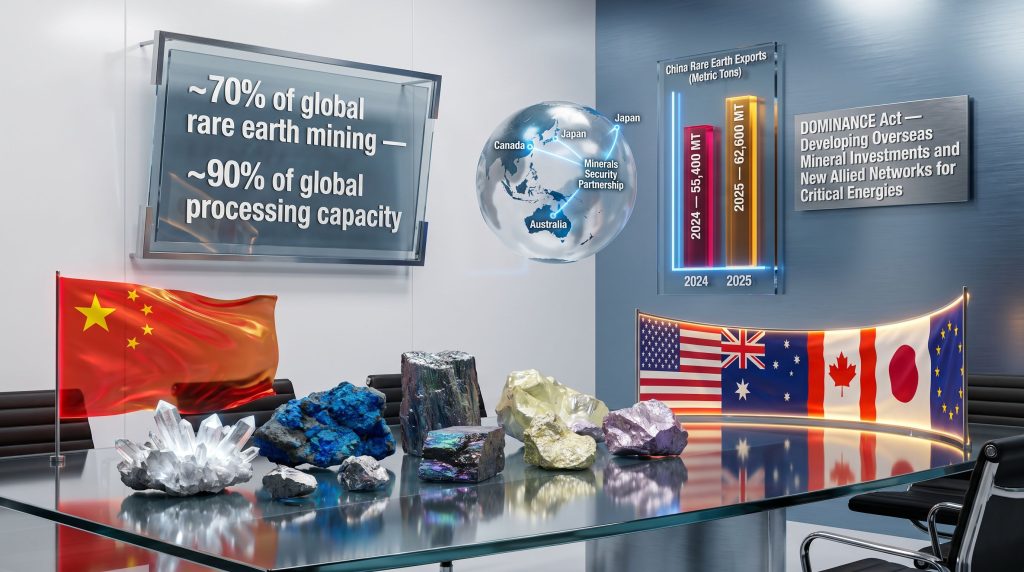
- Rare earth mining: approximately 70% of global output controlled by China
- Rare earth processing and refining: approximately 90% of global capacity
- Downstream magnet manufacturing: similarly concentrated, creating leverage over EV motors, wind turbines, and defence systems
Mining new deposits in allied nations is achievable within a five-to-ten year window given sufficient capital and permitting progress. Building the chemical separation plants, metallurgical processing facilities, and specialised refining infrastructure needed to convert raw ore into battery-grade lithium hydroxide or separated rare earth oxides is an entirely different undertaking. It requires decades of technical knowledge accumulation, significant upfront capital expenditure, and a trained specialist workforce that does not currently exist at scale outside China.
This distinction matters enormously for policymakers and investors alike. Several allied nations, including Australia, Canada, and select African and Latin American countries, possess substantial geological endowments of critical minerals in the ground. However, geological wealth and industrial capacity are not the same thing. The ore body exists; the supply chain infrastructure to make it industrially useful does not yet match the scale of demand.
China's Export Control Strategy: Expanding Volume, Selective Restriction
China's approach to mineral leverage is more sophisticated than a simple embargo strategy. Beijing has instead employed a dual-track method: continuing to grow overall export volumes while selectively tightening controls on specific materials or product categories to maximise diplomatic pressure without triggering a full market shock.
According to customs data cited by Reuters and tracked by Statista, China exported 62,600 metric tons of rare earth products in 2025, up from 55,400 metric tons in 2024. This marked the highest annual export volume recorded in at least a decade. At the same time, China's export restrictions have progressively expanded licensing requirements covering gallium, germanium, and specific rare earth compounds.
The paradox is intentional. By maintaining high overall volumes, China preserves its role as an indispensable supplier and avoids the economic self-harm of a full cutoff. By selectively restricting specific forms or grades of materials, it retains the ability to target particular industrial applications or geopolitical adversaries without a full decoupling event. Furthermore, this strategy allows Beijing to signal resolve without bearing the full cost of confrontation.
Decoding the DOMINANCE Act: Five Policy Mechanisms
The legislation's full title, the Developing Overseas Mineral Investments and New Allied Networks for Critical Energies (DOMINANCE) Act, was introduced as a bipartisan measure by Representatives Young Kim and Ami Bera. Its passage by voice vote in the House signals a level of cross-party consensus that is notably rare in the current Washington environment. The bill now advances to Senate consideration.
The DOMINANCE Act does not attempt to block Chinese mineral exports, impose new tariffs, or directly confront Beijing's market position. Its architecture is explicitly cooperative and multilateral. The five core mechanisms within the legislation are:
-
Institutionalising U.S. leadership within the Minerals Security Partnership (MSP) — converting ad hoc diplomatic coordination with allied nations into a formal, durable institutional commitment with clear roles and responsibilities.
-
Creating a Bureau of Energy Security and Diplomacy — establishing a dedicated agency structure headed by a Senate-confirmed assistant secretary, ensuring that mineral diplomacy has a permanent home within U.S. foreign policy bureaucracy rather than being distributed across agencies with competing priorities.
-
Aligning multi-agency financing tools — consolidating diplomatic, development finance, and investment instruments to enable coordinated support for mineral supply projects in allied and partner nations.
-
Establishing a unified national strategy — replacing the current fragmented multi-agency approach with a single coordinating framework, eliminating the institutional inefficiency that has historically slowed the U.S. response to supply chain threats.
-
Expanding workforce and expertise pipelines — introducing fellowship and visiting-scholar programmes to build domestic capacity in mining, mineral processing, and energy resource expertise, addressing the human capital gap that underpins the processing infrastructure deficit.
Policy Insight: The DOMINANCE Act is designed as a structural realignment of U.S. mineral diplomacy rather than a reactive emergency measure. Its core logic holds that diversification through allied networks is more durable and less escalatory than direct confrontation with a dominant supplier.
The Priority Mineral Landscape: What Is Actually at Risk
While the bill does not specify a formal priority mineral list, its policy logic clearly centres on materials where Chinese processing dominance intersects with acute U.S. import dependency. In addition, the US rare earth supply chain remains structurally exposed across nearly every high-value application.
| Mineral | Primary Applications | China's Position | U.S. Import Reliance |
|---|---|---|---|
| Rare Earth Elements | EV motors, defence magnets, electronics | ~70% mining, ~90% processing | High |
| Lithium | EV batteries, grid storage | Significant refining capacity | Substantial |
| Cobalt | Battery cathodes, military applications | Processing dominance via DRC supply | High |
| Nickel | Batteries, industrial manufacturing | Growing processing influence | Moderate to High |
| Graphite | Battery anodes | Dominant producer and processor | 100% import reliant |
| Gallium | Semiconductors, advanced electronics | Near-monopoly position | 100% import reliant |
| Scandium and Yttrium | Aerospace, electronics, alloys | Primary global supplier | 100% import reliant |
Rare earth supply chains deserve particular analytical attention because they are not a single material but a family of 17 chemically similar elements, each with distinct industrial applications. The distinction between light rare earths (such as lanthanum and cerium) and heavy rare earths (such as dysprosium and terbium) is critical for defence applications. Heavy rare earth elements are required in the high-performance permanent magnets used in precision-guided munitions, submarine propulsion, and advanced aircraft actuators. These are also the elements where Chinese processing concentration is most extreme and where substitute supply chains are most underdeveloped.
The Four Vulnerabilities the DOMINANCE Act Is Designed to Address
Congressional documents supporting the legislation identify four structural vulnerabilities in the current U.S. position:
-
Supply Disruption Risk — A single export restriction or geopolitical flashpoint could simultaneously slow production across EVs, electronics, defence, and clean energy sectors, given the cross-sector dependency on the same minerals.
-
Cost Volatility and Price Leverage — Concentrated supply gives dominant producers the ability to influence global pricing during periods of tension, increasing input costs for U.S. manufacturers at the worst possible moment.
-
National Security Exposure — Advanced weapons platforms, guidance systems, and military communications infrastructure require uninterrupted access to rare earths and specialty minerals that currently flow almost entirely through Chinese supply chains.
-
Clean Energy Transition Bottlenecks — Achieving domestic EV production targets, battery storage deployment, and renewable energy infrastructure buildout becomes structurally constrained when essential input materials remain under the control of a geopolitical competitor.
The next major ASX story will hit our subscribers first
Allied Nation Strategy: Who Fills the Gap?
The Minerals Security Partnership, which the DOMINANCE Act seeks to formally institutionalise, involves the U.S., European Union, Australia, Canada, Japan, and a growing number of partner nations. Each brings different assets to the diversification effort:
-
Australia holds major reserves of lithium, nickel, cobalt, and rare earths, with growing processing ambitions backed by significant capital investment in lithium hydroxide conversion facilities.
-
Canada possesses substantial rare earth and critical mineral deposits alongside strong regulatory alignment with the United States, making it a natural partner for joint investment frameworks.
-
Japan contributes advanced processing technology and refining expertise developed over decades of strategic resource investment, including rare earth separation capabilities built partially in response to China's 2010 export restriction episode.
-
African and Latin American nations represent the upstream resource frontier, with geological endowments that require sustained investment, infrastructure development, and governance support to become reliable supply chain contributors.
The critical minerals executive order framework has furthermore provided a policy foundation upon which the DOMINANCE Act builds its multilateral architecture. The National Association of Manufacturers has indicated that the legislation would meaningfully improve supply-chain resilience and reduce the leverage that a single dominant supplier currently holds over U.S. industrial production. Policy analysts, however, are clear-eyed about the challenge: closing the processing gap requires a depth and duration of allied cooperation that goes substantially beyond existing frameworks.
Scenario Analysis: What Happens Next
Senate Passage and Full Implementation
If the DOMINANCE Act clears the Senate and moves into full implementation, the United States gains a permanent institutional architecture for mineral diplomacy. Allied partnerships deepen through formalised MSP coordination. U.S. manufacturers consequently gain greater supply-chain predictability, reducing the risk premium embedded in domestic EV and defence manufacturing investment decisions.
Senate Delay or Dilution
Fragmented multi-agency approaches persist, slowing the U.S. response to future Chinese export restrictions. Allied nations may pursue independent bilateral mineral arrangements rather than participating in a U.S.-led multilateral structure, reducing the network coherence that gives the allied approach its strategic value.
China Escalates Before Alternatives Are Established
This scenario represents the most acute near-term risk. Export controls can be imposed within days. Building alternative processing infrastructure requires years to decades. This asymmetric timeline gap means that the United States remains exposed to a coercive supply shock throughout the entire construction period for alternative supply chains, regardless of what legislation is passed.
Analytical Note: The DOMINANCE Act addresses the institutional architecture of mineral security effectively. However, the physical infrastructure gap, particularly in processing and refining, will require separate and sustained capital investment over a decade or more to meaningfully reduce U.S. exposure to supply disruption.
Frequently Asked Questions: DOMINANCE Act and Critical Minerals
What does DOMINANCE stand for?
The full name is the Developing Overseas Mineral Investments and New Allied Networks for Critical Energies Act.
Which minerals carry the highest near-term risk?
Rare earth elements and gallium represent the most acute concentration risk due to near-total Chinese processing dominance combined with 100% U.S. import reliance. Graphite follows closely as a battery anode material with no meaningful non-Chinese processing infrastructure currently available at scale.
Does the DOMINANCE Act block Chinese mineral exports?
No. The legislation is designed to build alternative supply chains through allied partnerships. It does not impose trade restrictions or target Chinese commercial activity directly.
What is the Minerals Security Partnership?
A multilateral framework involving the U.S., EU, Australia, Canada, Japan, and allied partner nations, designed to coordinate investment and development of critical mineral supply chains outside Chinese-dominated networks.
How does this affect clean energy deployment timelines?
By securing access to lithium, cobalt, nickel, and graphite through diversified allied networks, the bill aims to reduce the supply-chain bottlenecks that could otherwise constrain domestic EV production volumes, grid-scale battery storage deployment, and renewable energy infrastructure expansion.
The Long View: Can Allied Nations Realistically Challenge China's Position?
Intellectual honesty requires acknowledging the scale of the challenge. China exported 62,600 metric tons of rare earth products in 2025, the highest volume in at least a decade, demonstrating that its market position is expanding, not contracting, even as geopolitical tensions intensify. The United States is currently 100% import-reliant on 11 critical minerals, a baseline that cannot be transformed quickly regardless of the legislative tools in place.
Genuine progress within a ten-year horizon is possible in several specific areas:
-
Upstream mining diversification in Australia, Canada, and select resource-rich nations where geological endowments are substantial and investment frameworks are improving.
-
Selective processing investment targeting specific high-value mineral streams, such as lithium hydroxide conversion and light rare earth oxide separation, where the technical barriers are lower than for heavy rare earth processing.
-
Demand-side mineral efficiency through battery chemistry innovation, including the ongoing shift toward lithium iron phosphate chemistries in stationary storage applications, which reduces cobalt and nickel intensity per unit of energy stored.
-
Recycling infrastructure development to recover critical minerals from end-of-life batteries, electronics, and industrial equipment, creating a domestic secondary supply that reduces primary import dependency over time.
The DOMINANCE Act critical minerals framework should be understood as a strategic declaration of intent as much as an operational framework. It signals to allied governments, private capital, and multilateral institutions that Washington is committed to a sustained, decades-long mineral security architecture. That signal itself has value, because private investment in processing infrastructure requires long-term policy certainty to justify the capital commitments involved.
The growing Washington consensus, treating mineral access as strategically equivalent to energy security, represents a fundamental shift in the intersection of industrial policy and foreign policy. Whether that consensus translates into the physical infrastructure and processing capacity needed to genuinely diversify supply will depend on sustained commitment across multiple administrations, significant allied coordination, and capital deployment at a scale that current frameworks are only beginning to mobilise. As the CFR's analysis on leapfrogging China's mineral dominance makes clear, the window for decisive action remains open, but it will not remain so indefinitely.
Readers seeking additional context on U.S. critical mineral policy developments, China's role in global supply chains, and clean energy commodity markets can find ongoing coverage at CarbonCredits.com, which tracks mineral markets, regulatory developments, and clean energy supply chain news.
This article contains forward-looking analysis and scenario projections based on publicly available data and legislative documents. It should not be construed as financial or investment advice. Readers should conduct independent research before making investment decisions related to critical mineral sectors or related equities.
Want to Invest in the Next Major Critical Minerals Discovery Before the Market Catches On?
As Western nations race to secure alternative supply chains for rare earths, lithium, gallium, and graphite, the ASX is emerging as a critical frontier for mineral exploration investment — and Discovery Alert's proprietary Discovery IQ model delivers real-time alerts the moment significant mineral discoveries are announced, ensuring subscribers can act on actionable opportunities ahead of the broader market. Explore how historic ASX mineral discoveries have generated substantial returns on Discovery Alert's dedicated discoveries page, and begin your 14-day free trial today to position yourself at the forefront of the critical minerals revolution.