May 18, 2026
The Quiet Dismantling of a Mining Empire Built on Diversification
For most of the twentieth century, the dominant logic in global mining was breadth. The larger the commodity mix, the more insulated a company remained against the violent price cycles inherent to any single resource. Anglo American, founded in Johannesburg in 1917 by Ernest Oppenheimer, embodied this philosophy perhaps more completely than any other mining group in history, building a sprawling empire that touched diamonds, platinum, gold, coal, copper, and iron ore across multiple continents.
That logic is now being systematically unwound. The Anglo American Australian coal mines sale to Dhilmar for up to $3.875 billion is not simply a transactional headline. It is the latest and most decisive chapter in a structural reinvention that is reshaping one of the world's most storied mining companies from the ground up, and sending a clear signal to every diversified miner still sitting on legacy coal exposure.
When big ASX news breaks, our subscribers know first
The Strategic Logic Behind Anglo American's Coal Exit
Portfolio Simplification as a Corporate Imperative
The decision to exit steelmaking coal did not emerge from a single board meeting. It is the product of years of pressure accumulating from multiple directions simultaneously: institutional investors demanding ESG-aligned portfolios, credit rating agencies scrutinising transition risk exposure, and the emerging reality that capital deployed in coal competes directly with far more compelling copper growth opportunities.
Anglo American restructuring has reshaped the company's revised strategic identity, which now rests on three core commodity pillars:
- Copper, targeting exposure to electric vehicles, renewable energy systems, and electricity grid expansion
- Premium iron ore, anchored by the Kumba Iron Ore business in South Africa
- Crop nutrients, through its Woodsmith polyhalite project in the United Kingdom
Steelmaking coal, despite its historically strong cash generation, does not fit cleanly into any of these pillars. Its retention would have required ongoing capital allocation to maintain ageing longwall mining equipment, manage methane gas risks in underground operations, and defend the business against increasingly aggressive ESG-based divestment mandates from European and North American institutional shareholders.
CEO Duncan Wanblad publicly confirmed that the Dhilmar transaction finalises the company's complete withdrawal from steelmaking coal, marking the end of an operational presence in Australian metallurgical coal that stretched back decades.
What the Bowen Basin Assets Represent
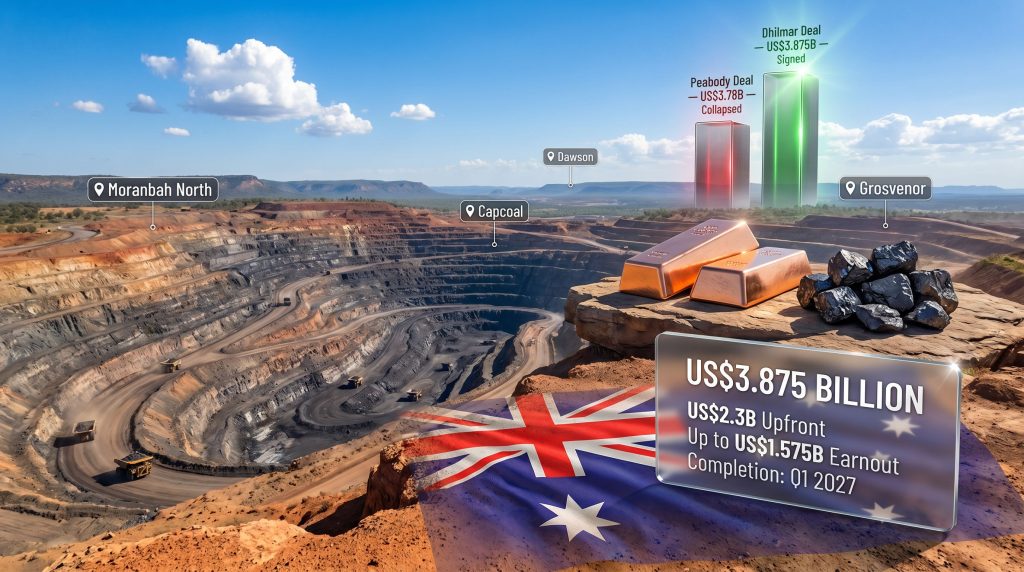
The Queensland Bowen Basin is not a peripheral coal district. It is the world's premier hard coking coal province, producing the highest-quality metallurgical coal grades used in blast furnace steelmaking across Asia, Europe, and the Americas. The assets being transferred to Dhilmar represent a geographically concentrated but operationally complex portfolio spanning multiple mining methods, joint venture structures, and development-stage properties.
The full asset list included in the transaction comprises:
- Moranbah North
- Grosvenor
- Capcoal
- Roper Creek
- Dawson
- Dawson South
- Theodore South
- Moranbah South
Several of these operations carry significant technical complexity. The Grosvenor mine, for example, experienced a major longwall gas ignition event in 2020 that forced an extended production suspension, and a subsequent fire incident that directly contributed to the collapse of the failed Peabody coal deal. Underground methane management in the Bowen Basin's thick, gassy Permian coal seams represents one of the most technically demanding challenges in global metallurgical coal production.
The transfer of this portfolio to a privately held acquirer raises an important but underappreciated question: private ownership removes the quarterly earnings pressure that constrains listed miners from investing aggressively in mine rehabilitation and longwall recommissioning. Dhilmar may have considerably more operational flexibility than a publicly traded coal producer in the same position.
How the $3.875 Billion Deal Structure Works
Breaking Down the Transaction Economics
| Component | Value |
|---|---|
| Upfront cash payment at completion | US$2.3 billion |
| Price-linked earnout (contingent payments) | Up to US$1.575 billion |
| Total maximum transaction value | Up to US$3.875 billion |
| Expected completion timeline | Q1 2027 |
The deal architecture is deliberately designed to allocate commodity price risk between buyer and seller in a way that reflects the cyclical uncertainty of metallurgical coal markets. The $2.3 billion guaranteed at completion provides Anglo American with meaningful balance sheet certainty regardless of what coal prices do between now and 2027. The additional $1.575 billion in contingent payments, linked to future coal price benchmarks, gives the seller upside participation if market conditions improve while shielding the buyer from overpaying at a price cycle peak.
Understanding the Price-Linked Earnout Mechanism
A price-linked earnout in mining mergers and acquisitions operates as a deferred consideration instrument tied to specific commodity price thresholds over an agreed measurement period. In practical terms, if hard coking coal benchmark prices trade above certain trigger levels after transaction completion, Anglo American receives incremental cash payments from Dhilmar up to the $1.575 billion ceiling.
Furthermore, this structure serves several sophisticated purposes:
- It allows the seller to avoid locking in an asset valuation at a point of price uncertainty
- It incentivises the buyer to proceed despite short-term market headwinds because the headline price adjusts with market conditions
- It preserves deal momentum by bridging valuation gaps that might otherwise cause negotiations to collapse
- It ensures alignment between sale price and the long-term productive capacity of the assets
For Anglo American specifically, this structure is particularly appropriate given the historical volatility of hard coking coal prices, which have ranged from below $100 per tonne to above $600 per tonne within the past decade alone. Current metallurgical coal prices continue to influence how earnout thresholds are calibrated in deals of this nature.
How Anglo American Plans to Deploy the Proceeds
Anglo American has been explicit that transaction proceeds will be directed primarily toward net debt reduction. This is not a casual statement. It directly addresses the company's deteriorating earnings profile, with the full-year 2025 net loss reaching $3.17 billion compared with a $2.79 billion loss in 2024. Reducing the debt burden ahead of the planned all-stock merger with Teck Resources materially improves the company's negotiating position and strengthens its credit profile at a moment when balance sheet quality has become a critical variable in large-scale mining mergers.
Who Is Dhilmar and Why Did They Win the Deal?
Profile of the Buyer
Dhilmar Limited is a privately held, UK-registered mining company with a growing track record of acquiring large, complex mining assets from major listed producers seeking to divest non-core operations. Its most recent precedent transaction prior to the Anglo American coal deal was the acquisition of the Eleonore underground gold mine in Quebec, Canada, purchased from Newmont Corporation.
The Eleonore acquisition provides important context for understanding Dhilmar's operational philosophy. Eleonore is a technically challenging narrow-vein gold operation in a remote subarctic location that requires specialised mining expertise and patient capital deployment. A buyer willing to take on that operational complexity is almost certainly not intimidated by the methane management challenges and longwall recommissioning requirements of the Bowen Basin portfolio.
The private ownership structure is strategically significant for a different reason. Listed coal producers face continuous pressure from equity analysts to justify coal exposure on ESG grounds, to demonstrate emissions reduction pathways, and to manage the reputational risk of association with a commodity that institutional shareholders are increasingly excluding from their portfolios. Dhilmar faces none of these constraints, giving it structural advantages in operating and investing in coal assets that public companies simply cannot replicate. According to Anglo American's official press release, the transaction represents a clean and decisive exit from steelmaking coal for the group.
Dhilmar vs. the Failed Peabody Energy Deal
| Factor | Peabody Energy Deal | Dhilmar Deal |
|---|---|---|
| Agreed sale price | US$3.78 billion | Up to US$3.875 billion |
| Buyer type | Listed US coal producer | Privately held UK miner |
| Deal outcome | Collapsed following mine fire | Signed; regulatory approval pending |
| Dispute status | Arbitration proceedings ongoing | Not applicable |
The collapse of the Peabody transaction deserves more analytical attention than it typically receives. The mine fire that derailed negotiations created a cascading set of problems: production disruptions affecting asset valuation, insurance claim uncertainty, regulatory investigations into safety management systems, and the fundamental question of whether the asset being sold was materially the same as the asset that had been contracted for purchase.
Anglo American is currently pursuing arbitration proceedings against Peabody Energy to recover damages from the failed deal. The outcome of this arbitration will be closely watched by the M&A community because it will establish important precedent around force majeure clauses, operational risk allocation, and seller obligations in mining asset transactions where unforeseen incidents occur between signing and completion.
The fact that Anglo American ultimately secured a higher headline value from Dhilmar than the original Peabody agreement, despite the intervening operational disruption at Grosvenor, reflects the sustained demand from well-capitalised private acquirers for premium Bowen Basin hard coking coal assets. This pricing outcome challenges the assumption that a mine fire event would necessarily impair an asset's marketability at scale.
What Is Driving Major Miners to Exit Steelmaking Coal?
The Global Capital Reallocation Trend
The Anglo American Australian coal mines sale to Dhilmar is part of a much broader and accelerating structural shift in how diversified mining majors are allocating capital. BHP's coal pivot saw the group complete its own exit from thermal coal through the South32 demerger and later divestments, while Rio Tinto exited coal entirely in 2018, selling its remaining Australian thermal coal operations. The pattern is consistent: companies with sufficient scale to choose their commodity mix are systematically reducing or eliminating coal exposure.
The drivers behind this trend operate at multiple levels simultaneously:
- Institutional investor pressure: Major European pension funds, sovereign wealth funds from Norway and the Netherlands, and university endowments have implemented coal exclusion policies that reduce the universe of potential Anglo American shareholders if the company retains coal exposure
- Credit market dynamics: Lenders to mining companies have increasingly incorporated coal exposure into credit risk assessments, with some European banks explicitly excluding coal-related financing from their lending criteria
- Carbon accounting evolution: As corporate Scope 3 emissions reporting becomes more rigorous, owning coal operations creates measurable emissions accounting obligations that complicate net-zero commitments
- Valuation multiples: Coal assets increasingly trade at lower earnings multiples than equivalent copper or iron ore operations, creating a structural argument for divestment even absent any ESG motivation
Steelmaking Coal vs. Thermal Coal: A Critical Distinction
A common misconception among general investors conflates steelmaking coal (also called metallurgical or coking coal) with thermal coal used for electricity generation. These are fundamentally different products with distinct demand profiles.
Thermal coal faces accelerating structural decline as coal-fired power stations are decommissioned across developed economies and increasingly across Asia. Steelmaking coal, by contrast, remains essential to the blast furnace steelmaking process, which still accounts for approximately 70% of global steel production. However, whilst emerging hydrogen-based direct reduction technologies offer a longer-term alternative pathway, widespread commercial deployment remains decades away for most steel-producing nations.
This distinction matters for asset valuation. Metallurgical coal assets in the Bowen Basin command premium pricing because the hard coking coal produced there ranks among the highest quality globally, characterised by low ash content, low sulphur levels, and high coke strength after reaction (CSR) ratings. These technical quality parameters directly affect the efficiency and productivity of blast furnace operations, making premium Bowen Basin coking coal genuinely difficult to substitute with lower-quality alternatives from competing regions.
Copper as the Strategic Counterweight
The strategic logic behind exiting coal becomes considerably clearer when viewed through the lens of where the capital is being redeployed. The looming copper supply crunch is driving demand projections substantially higher over the coming decade, fuelled by:
- Electric vehicle manufacturing, where a battery electric vehicle requires approximately three to four times more copper than a conventional internal combustion engine vehicle
- Utility-scale solar and wind power installations, which are copper-intensive in both generation and grid connection infrastructure
- Electricity grid expansion and modernisation programs underway across North America, Europe, and Asia
- Industrial electrification and data centre infrastructure growth
Anglo American's copper production declined 10% year-on-year to 695,000 metric tonnes in 2025, placing output at the lower end of its own guidance range. This production shortfall, set against a backdrop of rising copper demand projections, makes the case for the Teck Resources merger as a volume acquisition strategy rather than simply a financial engineering exercise.
How Anglo American's Financial Performance Shaped This Decision
Earnings Under Pressure: The 2025 Financial Snapshot
| Metric | 2025 Result | Year-on-Year Change |
|---|---|---|
| Full-year net loss | US$3.17 billion | Widened from US$2.79 billion |
| Annual copper production | 695,000 metric tonnes | Down approximately 10% |
| Market capitalisation | ~US$56 billion | Not directly comparable |
| Primary loss drivers | Restructuring costs, platinum demerger, De Beers writedowns | Multiple non-cash charges |
The widening net loss from $2.79 billion in 2024 to $3.17 billion in 2025 reflects the accounting intensity of simultaneous portfolio restructuring. Demerging the platinum business, writing down De Beers assets, and absorbing restructuring charges across multiple business units creates a concentrated period of earnings pressure that does not accurately reflect the underlying operational quality of the core copper and iron ore businesses that will remain post-transformation.
Investors who focus exclusively on the headline net loss number without disaggregating non-cash restructuring charges from operational earnings are likely misreading the company's underlying trajectory. This context also explains why the 1.7% share price decline on the day of the Dhilmar announcement, driven by broader mining sector weakness linked to inflation concerns, should not be interpreted as a market rejection of the deal's strategic logic.
The BHP Takeover Attempt: A Catalyst for Accelerated Transformation
Anglo American's restructuring timeline was significantly compressed by BHP Group's $49 billion unsolicited takeover bid, which the board ultimately rejected. The BHP approach forced Anglo American's leadership to articulate, under intense public scrutiny, a credible standalone value creation strategy that could justify rejecting a substantial premium to market price.
The strategic response that emerged from this pressure test became the blueprint for the current transformation: demerge platinum, divest coal and De Beers, focus on copper, iron ore, and crop nutrients, and pursue the Teck Resources merger to restore copper production scale. Consequently, every subsequent divestment, including the Anglo American Australian coal mines sale to Dhilmar, can be traced directly to the strategic framework that was crystallised under the pressure of the BHP bid.
There is a reasonable argument that BHP's takeover attempt, while unsuccessful, generated more shareholder value creation pressure than any previous governance intervention in Anglo American's modern history. The company's transformation roadmap is, in part, a product of that hostile external catalyst.
The next major ASX story will hit our subscribers first
What Happens to De Beers? Anglo American's Next Major Divestment Decision
The De Beers Divestment: Status and Structural Challenges
De Beers occupies a uniquely complicated position within Anglo American's divestment programme. Unlike the coal assets, which are being sold into a market of willing private acquirers, De Beers faces structural headwinds that significantly complicate its marketability and valuation.
The global natural diamond market has been materially disrupted by the rapid commercialisation of laboratory-grown diamonds, which can now be produced at a fraction of the cost of mined stones and are physically and chemically identical to natural diamonds. This technological disruption has compressed natural diamond prices and raised fundamental questions about the long-term demand trajectory for gem-quality mined diamonds, particularly in the critical US and Chinese consumer markets.
The Botswana government holds a 15% ownership stake in De Beers and has publicly expressed interest in increasing that position. Angola, another major diamond producer with close ties to De Beers through its Endiama partnership, represents another potential counterparty with strategic interest in the asset.
Three Possible De Beers Outcomes
-
Full sale to a strategic buyer: Maximises immediate cash proceeds but requires finding an acquirer prepared to absorb diamond market risk and navigate the political complexities of Botswana's ownership ambitions. The pool of credible buyers at meaningful valuations is narrow.
-
Partial sale with Botswana government increasing its stake: Politically constructive and consistent with Botswana's long-standing objective of capturing greater value from its diamond resources. However, this approach may not fully resolve the overhang of De Beers' valuation drag on Anglo American's share price.
-
IPO or demerger: Provides market-determined price discovery and distributes De Beers shares directly to Anglo American shareholders, but exposes the business to ongoing public market scrutiny of diamond demand trends at a particularly challenging moment for natural diamond sentiment.
Anglo American has indicated it intends to retain its stake in Kumba Iron Ore, signalling that the divestment programme is not a wholesale liquidation of all non-copper assets but rather a selective pruning process guided by commodity outlook, competitive positioning, and strategic fit.
What This Means for Queensland's Bowen Basin Mining Landscape
Implications for Operations, Workforce, and Investment
The transition of ownership from a London-listed multinational to a privately held UK acquirer carries operational implications that will be felt across the Bowen Basin communities that depend on these mines. The key questions facing affected stakeholders include how Dhilmar plans to approach capital investment in the recommissioning of suspended operations like Grosvenor, what workforce arrangements will be maintained or renegotiated under new ownership, and how community engagement commitments made by Anglo American will be honoured by the incoming owner.
The transaction remains subject to regulatory approval under Australian foreign investment legislation and relevant Queensland mining approvals, with completion targeted for the first quarter of 2027. This approximately 18-month timeline between announcement and completion reflects the complexity of transferring multiple joint venture interests, some involving third-party partners whose consent may be required under existing joint venture agreements.
The broader signal this transaction sends to other Queensland metallurgical coal asset owners is one of sustained demand. As reported by the ABC, if a portfolio complicated by a recent mine fire incident, ongoing arbitration with a previous buyer, and a mixed mix of operating and development assets can attract $3.875 billion from a well-capitalised private acquirer, the implied valuation floor for quality Bowen Basin hard coking coal assets remains robust.
Frequently Asked Questions: Anglo American's Sale of Australian Coal Mines to Dhilmar
What Australian coal mines is Anglo American selling to Dhilmar?
The transaction includes Anglo American's full Queensland Bowen Basin steelmaking coal portfolio: Moranbah North, Grosvenor, Capcoal, Roper Creek, Dawson, Dawson South, Theodore South, and Moranbah South.
How much is Anglo American receiving for its Australian coal assets?
Anglo American will receive $2.3 billion in upfront cash at transaction completion, with the potential for up to $1.575 billion in additional price-linked contingent payments, bringing the total maximum value to $3.875 billion.
When will the Anglo American–Dhilmar coal sale be completed?
Completion is targeted for Q1 2027, subject to regulatory approvals in relevant jurisdictions including Australian foreign investment review processes.
Why did the original sale to Peabody Energy fall through?
A mine fire at one of the Bowen Basin operations disrupted the original $3.78 billion agreement with Peabody Energy, ultimately causing the deal to collapse. Anglo American is currently pursuing arbitration proceedings against Peabody over the failed transaction.
What will Anglo American do with the proceeds?
Anglo American has indicated that proceeds from the Dhilmar transaction will be directed primarily toward net debt reduction, strengthening the balance sheet ahead of the planned all-stock merger with Teck Resources.
Is Anglo American still a South African company?
Anglo American was founded in Johannesburg in 1917 by Ernest Oppenheimer and retains a listing on the Johannesburg Stock Exchange. The company is now headquartered in London and operates as a global mining multinational, though it maintains significant operational and ownership ties to southern Africa through assets including Kumba Iron Ore.
Key Takeaways: Anglo American's Transformation in Numbers
Summary Snapshot
- US$3.875 billion: Maximum value of the Dhilmar coal transaction
- US$2.3 billion: Guaranteed upfront cash component at completion
- US$1.575 billion: Maximum price-contingent earnout potential
- Q1 2027: Targeted deal completion date
- 695,000 tonnes: Anglo American's 2025 copper output, down 10% year-on-year
- US$3.17 billion: Anglo American's full-year 2025 net loss
- US$2.79 billion: Prior year net loss for comparison
- US$53 billion: Estimated value of the proposed Anglo American–Teck Resources merger
- US$49 billion: BHP's rejected takeover bid that catalysed the restructuring programme
- ~US$56 billion: Anglo American's approximate current market capitalisation
The Anglo American Australian coal mines sale to Dhilmar is ultimately a story about the irreversible momentum of portfolio transformation in global mining. The assets being sold are not distressed. The mines being transferred to Dhilmar produce some of the highest-quality hard coking coal in the world, from a geological province that has no genuine peer for premium metallurgical coal production. The decision to sell them is not a reflection of their operational quality. It is, however, a reflection of the structural forces reshaping which commodities major mining companies believe belong in their portfolios for the next twenty years.
Disclaimer: This article is intended for informational purposes only and does not constitute financial advice. Past performance of commodity prices and company financial results is not indicative of future outcomes. Investors should conduct their own due diligence and consult a qualified financial adviser before making investment decisions. All figures referenced are sourced from publicly available company announcements and media reporting current at the time of publication.
Want to Track the Next Major ASX Mining Discovery Before the Market Moves?
While Anglo American reshapes its portfolio around copper and future-facing commodities, Discovery Alert's proprietary Discovery IQ model scans ASX announcements in real time, instantly identifying significant mineral discoveries across copper, iron ore, and over 30 other commodities — turning complex data into actionable investment insights. Explore how historic discoveries have generated substantial returns on Discovery Alert's dedicated discoveries page, and begin your 14-day free trial today to position yourself ahead of the broader market.