June 25, 2026
When Geography Becomes Strategy: The Rise of Copper Adjacency Mining
The mining industry has long wrestled with a fundamental tension: the world's best copper resources are often located in the most capital-intensive, logistically complex, and environmentally sensitive environments imaginable. As energy transition demand accelerates and greenfield discovery rates decline, the sector is being forced to ask a different question entirely. Rather than where can new copper be found, the more productive question has become: what untapped value already exists between what we have?
This reframing sits at the heart of one of the most consequential copper supply agreements of the decade. The completed Anglo American and Codelco Los Bronces Andina agreement represents a structural shift in how major miners approach resource development in a supply-constrained world. Rather than racing to build new mines from scratch, two of the industry's most significant players have chosen to unlock latent value through coordinated integration of adjacent, separately owned assets.
When big ASX news breaks, our subscribers know first
The Copper Supply Problem That Makes This Agreement Necessary
Global copper demand projections consistently point toward a structural deficit emerging through the late 2020s and into the 2030s. The combination of electric vehicle adoption, grid infrastructure buildout, and renewable energy generation capacity is expected to drive copper consumption well beyond what currently approved and producing mines can supply.
Critically, the pipeline of replacement supply is not keeping pace. Average discovery grades have declined significantly over recent decades, with many new copper deposits featuring ore grades well below 0.5% copper, compared to historical benchmarks that frequently exceeded 1%. Simultaneously, lead times from discovery to first production at a greenfield copper project regularly exceed a decade. This means that projects sanctioned today may not contribute meaningful tonnes until the mid-2030s at the earliest.
This copper supply crunch creates enormous strategic value for any mechanism that can deliver incremental copper tonnes with shorter lead times, lower capital requirements, and reduced permitting risk. That is precisely what makes proximity-based mine integration such an attractive proposition.
What the Los Bronces Andina Joint Mine Plan Actually Involves
The Los Bronces and Andina copper operations are located in Chile's central Andes, in a high-altitude mining district that sits adjacent to one another geographically but has historically been developed entirely independently. Anglo American holds a 50.1% ownership stake in Anglo American Sur S.A., the entity through which it controls the Los Bronces operation. Codelco, Chile's state-owned copper producer, operates the Andina mine as part of its broader national portfolio.
The joint mine plan, now formalised following receipt of required competition and regulatory clearances, creates a jointly owned operating company responsible for coordinating extraction sequencing and processing logistics across both assets simultaneously. Crucially, this structure does not involve a merger of ownership. Each party retains full legal title to its respective asset, preserving independent balance sheet treatment and standalone development optionality.
Key Agreement Milestones
| Milestone | Date |
|---|---|
| Memorandum of Understanding Signed | February 2025 |
| Landmark Agreement Announced | September 2025 |
| Regulatory and Competition Approvals Received | June 2026 |
| Expected Full Implementation (Subject to Environmental Permits) | 2030 |
The framework operates across a 21-year period, which reflects both the long-cycle nature of mining investment and the substantial coordination infrastructure required to meaningfully integrate two complex open-cut and underground operations at altitude. For further context on this major copper project development, the scale of coordination involved is genuinely unprecedented in the Chilean copper sector.
Breaking Down the Production and Financial Case
The headline numbers embedded in the Anglo American and Codelco Los Bronces Andina agreement are significant by any measure of the global copper market.
| Metric | Value |
|---|---|
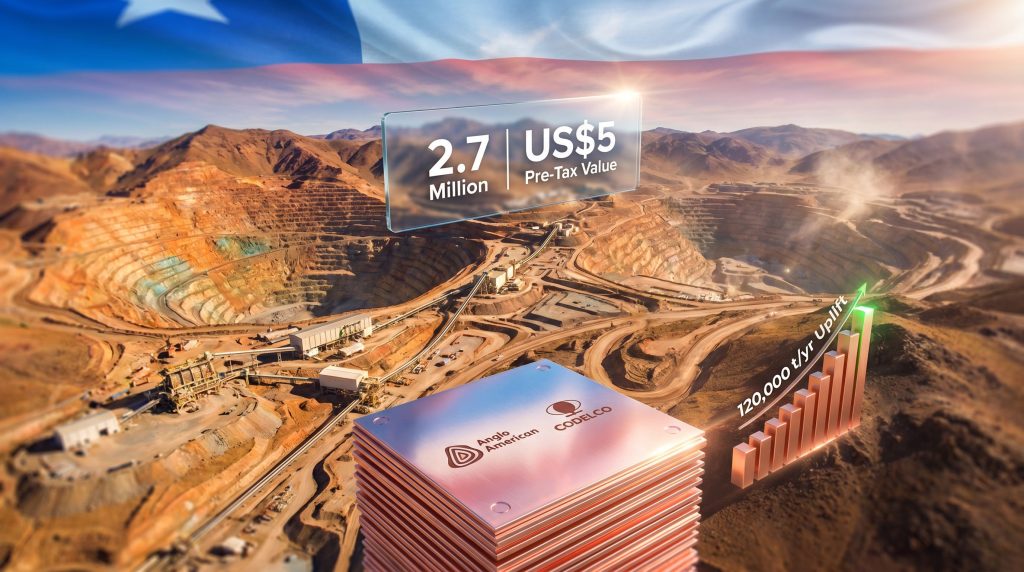
| Total Additional Copper Production | 2.7 million tonnes |
| Average Annual Production Uplift | 120,000 tonnes per year |
| Pre-Tax Shared Value Creation | At least US$5 billion |
| Unit Cost Reduction vs. Standalone Operations | ~15% lower |
| Capital Expenditure Requirement | Minimal incremental |
| Production Split | Equal share between both parties |
To contextualise the 120,000 tonne annual uplift: this figure is comparable to the annual output of a mid-tier standalone copper mine. Achieving equivalent production through greenfield development would typically require capital expenditure in the billions of dollars, environmental assessments spanning multiple years, community consultation processes, and construction timelines of seven to twelve years or more.
The efficiency gains embedded in this structure are substantial. By sharing processing infrastructure across two adjacent operations, both parties benefit from throughput optimisation that neither could achieve alone. This shared fixed-cost base is what drives the estimated 15% unit cost reduction versus standalone operations, a meaningful competitive advantage in a commodity market where cost positioning determines long-run profitability through price cycles.
Partnership vs. Traditional Expansion: A Comparative View
| Approach | Capital Intensity | Lead Time | Risk Profile | Value Capture |
|---|---|---|---|---|
| Greenfield Development | Very High | 10-15+ years | High | Uncertain |
| Brownfield Expansion | Moderate-High | 5-10 years | Moderate | Moderate |
| Adjacent Mine Integration (Los Bronces-Andina Model) | Low (Minimal Incremental) | ~4 years to permits | Lower | US$5B+ pre-tax |
How Copper Adjacency Works and Why It Is Genuinely Rare
The concept of copper adjacency in mining refers to situations where two or more separately owned deposits sit close enough together that coordinating their development, processing, or logistics creates measurable cost or volume advantages unavailable to either party independently. The value driver is typically shared infrastructure: processing plants, tailings facilities, water systems, power supply, roads, and workforce accommodation.
What makes genuine adjacency rare is the combination of geological proximity and separate ownership. In most cases, a single company controls an entire district and can optimise internally without requiring a partnership structure. When separately owned assets happen to be adjacent, the industrial logic for collaboration is compelling, but the corporate, legal, and regulatory complexity of executing that collaboration is formidable.
The Los Bronces and Andina operations represent an unusually clean version of this scenario. Both are established, producing mines with existing infrastructure. The coordination challenge is sequencing extraction and processing to optimise system throughput, not building new capacity from scratch. According to Anglo American's official announcement, the finalisation of this landmark agreement marks a pivotal moment in unlocking at least US$5 billion of value from these two neighbouring operations.
The Conditions That Still Stand Between Agreement and Production
Despite regulatory and competition clearances now being secured, the joint mine plan is not yet fully operational. Implementation remains conditional on the receipt of relevant environmental permits, which are currently expected to be in place by 2030.
Environmental permitting in Chile's high-altitude Andean mining zones is a technically complex process, particularly given the sensitivity of water resources, glacial systems, and biodiversity at elevation. Andina sits at approximately 3,500 to 4,500 metres above sea level, while Los Bronces operates at similar altitude, meaning that environmental assessment frameworks must account for hydrological impacts that can extend well beyond a mine's immediate footprint.
The agreement also embeds explicit sustainability principles as part of its implementation framework, including commitments to preserve existing social programmes and adhere to established environmental obligations at both operations. This reflects the increasing centrality of social licence to operate as a practical prerequisite for large-scale mining development in South America.
The next major ASX story will hit our subscribers first
What This Means for Anglo American's Copper Growth Strategy
For Anglo American, the Los Bronces Andina arrangement fits within a broader strategic pivot toward copper as a core portfolio driver. The company has progressively repositioned its asset base around commodities essential to energy transition, and copper sits at the centre of that thesis.
The 50.1% ownership of Anglo American Sur means Anglo American captures a majority share of the incremental value created through the joint mine plan while bearing a proportionate share of coordination costs. Importantly, the agreement explicitly preserves each party's right to independently advance standalone underground resource development during the joint mine plan period. This means Anglo American retains optionality over Los Bronces's longer-term underground potential without being locked into coordination obligations that could constrain future capital allocation.
Anglo American's CEO has stated publicly that integrating the Los Bronces and Andina mine plans unlocks one of the most significant copper adjacency opportunities available anywhere in the world, while also noting that such adjacencies are rare and underscore the value of responsible, partnership-led development.
Codelco's Strategic Calculus and Chile's National Production Ambitions
For Codelco, the agreement addresses a persistent structural challenge. The company carries a substantial debt load accumulated through years of capital-intensive investment across ageing operations, and its mandate from the Chilean state requires it to maximise returns to the national treasury without further expanding its debt burden. Furthermore, the context of Codelco's production decline in recent years makes the efficiency gains embedded in this structure all the more strategically important.
The Andina-Los Bronces structure offers Codelco a pathway to incremental production and shared pre-tax value creation of at least US$5 billion without requiring significant standalone capital deployment. This aligns precisely with the operational framework Codelco has articulated publicly around profitability without debt expansion, operational excellence, and resource efficiency. Indeed, the Codelco production comeback narrative is strengthened considerably by the long-term production certainty this agreement provides.
At a national level, the Chile copper supply gap has placed increasing pressure on the country's dominant position in global markets. Chile currently accounts for roughly 27% of global copper mine production, a position that has nonetheless been under competitive pressure as grade declines and ageing infrastructure have constrained output growth. The Chilean government has publicly articulated an ambition to increase national copper production to 6 million tonnes per year by 2030, a target that would require meaningful contributions from both brownfield expansions and exactly the kind of adjacency-driven efficiency gains this agreement is designed to capture.
Chile's copper production ambitions are substantial, but closing the gap between current output levels and a 6 million tonne annual target by 2030 is a formidable challenge requiring precisely the type of creative, infrastructure-sharing partnership that the Los Bronces Andina model demonstrates.
Frequently Asked Questions: Anglo American and Codelco Los Bronces Andina Agreement
What is the Los Bronces Andina joint mine plan?
It is a 21-year coordinated operating framework between Anglo American and Codelco that integrates the mine plans of their adjacent Los Bronces and Andina copper operations in Chile through a jointly owned operating company, without merging ownership of the underlying assets.
How much additional copper will the agreement produce?
The joint mine plan is projected to deliver 2.7 million tonnes of additional copper over 21 years, averaging approximately 120,000 tonnes per year, split equally between both companies.
When will the joint mine plan begin operating?
Full implementation is conditional on environmental permits being received, with the current expectation that this occurs by 2030.
How will production and profits be divided?
The incremental production and associated value creation will be shared equally between Anglo American (through Anglo American Sur) and Codelco. As Global Mining Review reports, the deal is structured to unlock at least US$5 billion in pre-tax shared value across the 21-year term.
Does the agreement affect standalone development plans?
No. Both parties retain the flexibility to independently advance their own underground resource development programmes during the term of the joint mine plan.
Why is this considered one of the most significant copper adjacency opportunities in the world?
The combination of geological proximity, existing infrastructure, established production at both operations, and the scale of incremental value achievable at minimal incremental capital cost makes this an exceptionally rare convergence of factors.
Five Strategic Implications for the Copper Market
The broader significance of the Anglo American and Codelco Los Bronces Andina agreement extends well beyond the two companies involved. Consequently, the following implications deserve careful consideration by anyone tracking the future of copper supply.
-
It validates the adjacency model as a viable supply pathway in an era of rising greenfield capital costs and longer permitting timelines.
-
It demonstrates that cross-ownership collaboration between state-owned and privately held miners can be structured in a way that preserves independent interests while capturing shared value.
-
It reframes infrastructure as a strategic asset, showing that existing processing and logistics capacity can function as a competitive moat when intelligently shared.
-
It applies pressure to the greenfield development paradigm, raising the question of whether collaboration between neighbouring asset holders should be explored more systematically across other major copper districts globally.
-
It signals that value creation in copper over the next decade may increasingly come from smarter coordination of existing resources rather than from discovery and development of entirely new ones.
The lesson embedded in this agreement is not simply one for Anglo American or Codelco. It is a lesson for the entire critical minerals sector: in a world where capital is constrained, permitting timelines are long, and environmental expectations are rising, the value of proximity and partnership may ultimately rival the value of discovery itself.
This article contains references to projected production volumes, financial value estimates, and forward-looking timelines. These figures are drawn from publicly announced company statements and are subject to regulatory, environmental, and operational conditions. Readers should not treat this content as financial advice. All investment decisions should be made with reference to independent professional guidance.
Want to Catch the Next Major Copper Discovery Before the Market Does?
Discovery Alert's proprietary Discovery IQ model scans ASX announcements in real time, instantly identifying significant mineral discoveries across copper and 30+ other commodities — turning complex data into actionable investment insights for traders and long-term investors alike. Explore how historic discoveries have generated substantial returns on Discovery Alert's dedicated discoveries page, and begin your 14-day free trial today to position yourself ahead of the market.