June 25, 2026
When Adjacency Becomes an Asset: The Strategic Logic Behind Chile's Most Ambitious Mining Partnership
The copper mining industry has long operated under a paradox: the metal most essential to decarbonising the global economy is becoming progressively harder and more expensive to extract. Greenfield copper project development timelines have stretched to 16 years or more on average, capital costs have ballooned, and social licence challenges have shelved projects that were technically viable a decade ago. Against this backdrop, the industry's most capital-efficient frontier is no longer in unexplored territory but directly beneath the boots of miners already on site.
This is the structural reality that makes the Codelco and Anglo copper district in Chile one of the most strategically significant mining developments of the decade. Rather than racing to discover new deposits, two of the world's most prominent copper producers are engineering a fundamentally new mine by dissolving the operational boundary between two adjacent ones.
When big ASX news breaks, our subscribers know first
Chile's Copper Plateau and the Case for District-Scale Thinking
Chile holds approximately 23% of the world's identified copper reserves, yet national production has been largely stagnant since peaking around 2004. The country produced roughly 5.3 million tonnes of copper in 2023, a figure that has oscillated within a narrow band for years despite enormous investment in sustaining capacity. The reasons are structural rather than geological.
Ore grades across Chile's major deposits have declined significantly over the past two decades. Average head grades at many of the country's largest operations have fallen from above 1.0% copper equivalent to below 0.7%, forcing miners to move more material per tonne of refined metal produced. Compounding this, many Chilean operations are now mining at greater depths or transitioning from open pit to underground methods, driving up unit costs and capital intensity.
Furthermore, the Chile copper price outlook for the coming years reflects these structural pressures acutely. Codelco, the state-owned enterprise that remains the world's largest copper producer by annual output, has been managing a multi-year production decline driven by geomechanical instability at legacy assets, aging processing infrastructure, and the extraordinary capital demands of its structural mine transformation projects at El Teniente and Chuquicamata.
The Chilean government, which depends on Codelco dividends as a meaningful source of national revenue, has a direct and pressing interest in reversing this trajectory without triggering a capital crisis at the miner. The solution, increasingly, lies not in building new mines but in optimising what already exists. The Andina and Los Bronces arrangement is the clearest expression of this philosophy to emerge anywhere in the global copper industry.
The Physical Geography That Makes This Deal Possible
Why Location Is Everything
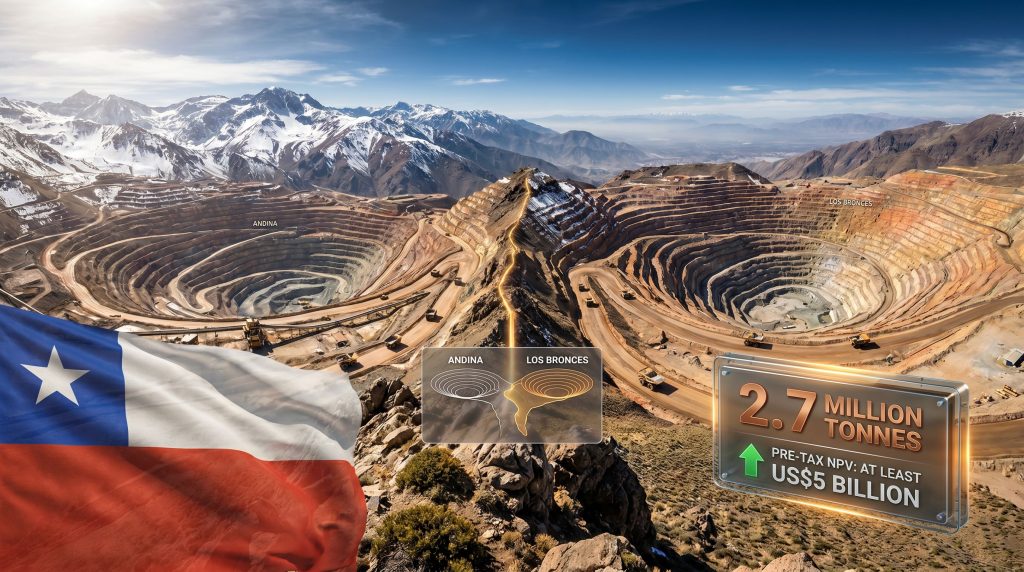
Located in Chile's central Andes at elevations exceeding 3,500 metres above sea level, Codelco's Andina operation and Anglo American Sur's Los Bronces mine sit adjacent to one another within the same geological corridor, separated by a shared rock barrier rather than a meaningful distance. This proximity is not merely geographical convenience — it reflects a shared mineralisation system, meaning both deposits draw from related copper porphyry geology.
Copper porphyry deposits of this type are among the largest ore bodies on Earth, characterised by disseminated copper mineralisation across enormous volumes of rock. The Andina–Los Bronces corridor is recognised as one of the highest-grade and largest porphyry copper systems in the Southern Hemisphere. The rock barrier separating the two operations represents ore that is presently uneconomical to extract on a standalone basis by either party, but becomes highly attractive when approached as a unified extraction unit.
This is the engineering core of the joint plan: mining through the shared barrier to create a unified pit geometry that unlocks ore inaccessible to either company acting independently. In this context, Chile's copper supply gap illustrates precisely why such collaborative approaches are gaining momentum across the industry.
Ownership Architecture: Complexity as the Precondition for Collaboration
Understanding the ownership structure of the two operations helps explain why this partnership took the form it did. Anglo American Sur, the entity that owns Los Bronces, carries a layered ownership structure:
| Shareholder | Stake in Anglo American Sur |
|---|---|
| Anglo American | 50.1% (controlling) |
| Codelco (via JV with Mitsui) | ~20.0% indirect |
| Mitsubishi Corporation | 20.4% |
| Other / Free float | ~9.5% |
Codelco's pre-existing indirect shareholding in Anglo American Sur, held through a joint venture structure with Mitsui, created a foundation of shared financial interest long before any joint operational discussion took place. This overlap meant that a cooperative arrangement was not a leap into unknown territory but a formalisation of an already entangled economic relationship.
Critically, the joint plan does not involve any transfer of asset ownership. Each company retains full legal title to its respective mine. What is created instead is a jointly owned and controlled operating company that coordinates integrated mine planning, infrastructure use, and production optimisation across both assets simultaneously. This structure preserves balance sheet integrity for both parties while enabling operational integration that a conventional partnership or merger could not achieve as efficiently.
According to Anglo American's official press release, the agreement represents a landmark moment for district-scale copper development in Chile.
Quantifying the Value: What the Numbers Actually Mean
The projected outcomes of the joint mine plan are significant by any measure. The key metrics are as follows:
| Metric | Projected Figure |
|---|---|
| Additional copper production | 2.7 million tonnes over the joint plan period |
| Operating timeline | Approximately 2030 to 2051 (21 years) |
| Average annual incremental output | Roughly 120,000 to 130,000 tonnes per year |
| Combined pre-tax NPV uplift | At least US$5 billion, split equally |
| Unit cost reduction vs. standalone | Approximately 15% lower |
| Incremental capital expenditure | Minimal, leveraging existing infrastructure |
Where the Efficiency Gains Come From
The 15% unit cost reduction deserves particular attention. In an industry where cost curves determine competitive survival, a 15% improvement in C1 cash costs on a combined production base of this scale is a transformative efficiency gain. The savings originate from several sources:
- Shared haulage corridors and truck fleets operating across the unified pit geometry
- Combined processing plant utilisation, enabling better throughput optimisation and reagent efficiency
- Elimination of duplicated administrative and technical overhead previously maintained by two separate operations
- Optimised ore blending from complementary mineralisation profiles across Andina and Los Bronces
- Integrated water management systems reducing per-tonne freshwater consumption at high altitude
The US$5 billion pre-tax NPV figure is, by the companies' own characterisation, a floor rather than a ceiling. The actual value outcome is highly sensitive to the copper price environment over the 21-year operating period. A base-case copper price assumption of approximately US$4.50 per pound supports the stated NPV. However, given consensus forecasts from institutions including Goldman Sachs and Wood Mackenzie projecting sustained structural copper price strength through the 2030s, driven by electrification demand, the upper scenarios are arguably more probable than historical base cases would suggest.
Molybdenum: The Underappreciated Co-Product Dimension
One aspect of this arrangement that receives insufficient attention in mainstream coverage is the role of molybdenum. Both Andina and Los Bronces produce molybdenum as a significant by-product of copper extraction, a characteristic of many porphyry copper systems. Molybdenum is a dense metallic element used primarily as an alloying agent in high-strength steel, and is also emerging as a material of growing strategic importance in high-temperature alloy applications relevant to aerospace and energy infrastructure.
Integrated operations across the unified district would create opportunities to optimise molybdenum circuit design, potentially improving recovery rates and concentrating production through a single, more efficient processing stream. At current molybdenum prices, which have fluctuated between US$20 and US$30 per pound in recent years, the by-product credit contribution to the economic case is non-trivial. For investors analysing the deal's full value, the molybdenum dimension adds a layer of commodity diversification that the headline copper figures alone do not capture.
The next major ASX story will hit our subscribers first
The Environmental Approval Challenge: Glaciers, Water, and the Dual-Track Filing
What Does Regulatory Approval Actually Involve?
Perhaps the most complex dimension of the Codelco and Anglo copper district in Chile is the regulatory pathway. The high-altitude location of Andina and Los Bronces places both operations within zones subject to Chile's evolving glacier protection framework — one of the most politically sensitive environmental issues in Chilean mining.
Chile's glacier protection legislation has been debated for over a decade without final enactment in comprehensive form, but regulatory practice has progressively tightened restrictions on activities that could affect periglacial and glacial zones. The unified pit design must navigate these constraints carefully, as any expansion encroaching on protected ice or permafrost formations would create both legal and reputational risk.
Regulatory Note: The environmental approval pathway for this project involves Chile's Sistema de Evaluación de Impacto Ambiental (SEIA). Both companies are pursuing separate but structurally aligned Environmental Impact Assessments, an approach described by industry observers as unprecedented for a jointly operated project of this nature. Target approval is the end of 2026.
Water rights represent an equally critical variable. High-altitude Andean mining operations face acute pressure to reduce freshwater consumption as Andean glaciers recede and downstream water availability becomes more contested. The joint plan's water efficiency case rests on integrated recycling infrastructure and, where economically viable, desalination supply chains transporting processed seawater from Chile's Pacific coast to the Andes. This approach, already in use at several Chilean copper operations including Escondida, adds capital and operating cost but satisfies increasingly strict regulatory water-use requirements.
Community consultation is scheduled to proceed through the second half of 2026, with engagement targeting Indigenous communities and local municipalities whose water and land interests overlap with the project's operational footprint. As reported by Mining Weekly, Chile's regulatory authorities have been actively engaged in evaluating the combined plan's feasibility.
Codelco's Strategic Rationale: Maximum Output, Minimum New Capital
For Codelco, the arithmetic of this arrangement is compelling. The state miner is simultaneously managing capital-intensive transformation programmes at El Teniente (the world's largest underground copper mine) and Chuquicamata (one of the largest open-pit operations globally). Both projects require sustained capital commitments stretching through the late 2020s, constraining Codelco's ability to fund entirely new development initiatives.
In addition, Codelco's copper strategy in the context of global trade tariffs makes capital discipline even more critical in the current environment. The Andina joint plan offers something rare: material production growth with minimal incremental capital outlay.
By leveraging existing processing, logistics, and workforce infrastructure already embedded within the Andina operation, Codelco can add roughly 120,000 tonnes per year of additional copper production without the capital intensity a greenfield equivalent would demand. For a company under pressure to restore output growth and maximise dividend capacity, this capital efficiency is as strategically valuable as the copper itself. Codelco's position as the world's top copper producer means that arrangements like this carry significant implications for global supply balances.
Anglo American's Portfolio Calculus
For Anglo American, the deal serves a different but equally coherent strategic purpose. Following its rejection of BHP's takeover bid in 2024, Anglo American has been executing a disciplined portfolio restructuring programme, divesting non-core assets and concentrating capital on its highest-quality copper, iron ore, and crop nutrients positions.
Los Bronces has historically been a lower-margin operation relative to Anglo American's Chilean peers, partly due to its isolated cost structure as a standalone high-altitude mine. A 15% unit cost reduction achieved through the joint plan materially repositions Los Bronces on the industry cost curve, improving its competitive standing and enhancing the asset's valuation within or outside the Anglo American portfolio. The equal-split US$2.5 billion NPV uplift attributable to Anglo American represents a significant value creation event requiring minimal new investment.
A Blueprint for the Industry's Next Chapter
The Codelco and Anglo copper district in Chile is not simply a bilateral operational agreement between two large miners. It represents a proof-of-concept for a fundamentally different approach to copper supply growth — one built on district-scale intelligence rather than greenfield ambition.
If the environmental approvals are secured on schedule and the unified pit begins operating in 2030 as planned, the arrangement will demonstrate that adjacent mining operations in mature districts can generate new copper supply with superior economics to almost any realistic greenfield alternative. That lesson, if it takes hold across the industry, could reshape how miners, investors, and policymakers think about addressing the broader copper supply crunch that analysts continue to forecast through the 2030s.
With approximately 2.7 million tonnes of incremental copper projected over the life of the joint plan, the district's contribution to global supply forecasts is meaningful but not transformative in isolation. Its greater significance may ultimately be the model it establishes: that the next great copper mine might already exist, waiting for two neighbours to agree to mine it together.
Disclaimer: This article contains forward-looking projections, NPV estimates, and production forecasts based on publicly available information and industry analysis. These figures involve assumptions about copper prices, regulatory outcomes, and operational performance that are inherently uncertain. Nothing in this article constitutes financial or investment advice. Readers should conduct independent due diligence before making any investment decisions.
Want to Identify the Next Major Mineral Discovery Before the Market Does?
Discovery Alert's proprietary Discovery IQ model delivers real-time alerts on significant ASX mineral discoveries, instantly translating complex mineral data into actionable investment insights for both short-term traders and long-term investors — explore historic discoveries and their returns to understand the potential, then begin your 14-day free trial at Discovery Alert to position yourself ahead of the market.