June 25, 2026
The Global Copper Market Converges on One City Each November
Few commodities carry the structural weight of copper in today's industrial economy. As electrification accelerates across every major economy, the metal sits at the intersection of energy transition ambitions, geopolitical rivalry, and industrial supply chain strategy. For those who trade it, mine it, smelt it, or invest in it, one question dominates: where do the most consequential conversations actually happen?
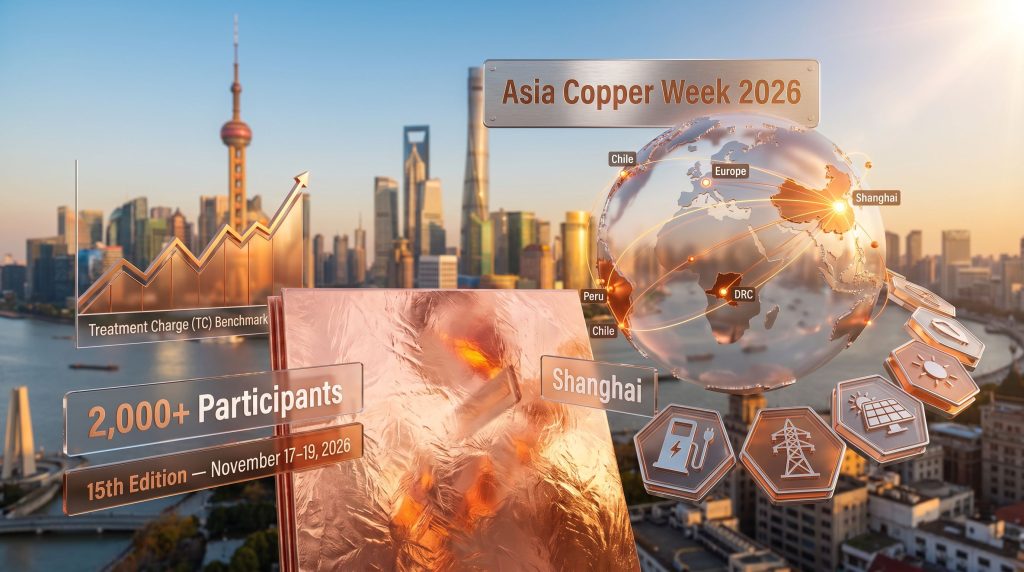
The answer, increasingly, is Shanghai. And for three days every November, Asia Copper Week in Shanghai becomes the single most important gathering in the global copper industry calendar.
When big ASX news breaks, our subscribers know first
What Makes Asia Copper Week Different From Every Other Copper Forum
The copper industry has no shortage of major events. London hosts LME Week each October, where financial market participants dominate the conversation around hedging, derivatives, and global pricing signals. Santiago hosts CESCO Week each April, anchored in Latin American supply dynamics and investment conditions. Lima's World Mining Congress draws a broad mining audience, with over 3,000 delegates from more than 50 countries expected at its 2026 edition.
Yet none of these forums can replicate what Asia Copper Week in Shanghai delivers: direct, face-to-face access to the world's dominant copper-consuming market, inside China itself.
Why Shanghai Is the Only Logical Host City
Shanghai is not merely a convenient meeting point. It sits at the nerve centre of the world's most consequential copper market ecosystem. China has maintained its position as the world's largest refined copper consumer for over two decades, absorbing the largest share of global refined copper output annually. Chinese industrial policy, from grid investment programmes to electric vehicle manufacturing mandates, sets the rhythm for global copper demand cycles.
Beyond consumption scale, Shanghai is home to the Shanghai Futures Exchange (SHFE), which operates one of the most liquid copper futures markets anywhere in the world. The SHFE copper contract is a primary benchmark for physical pricing across Asia, and its daily trading volumes reflect the real-time pulse of Chinese industrial demand. Holding a major copper forum anywhere other than China means working with second-hand information. Shanghai provides the primary source.
A Structural Comparison of the Major Copper Events
| Event | Location | Timing | Primary Focus |
|---|---|---|---|
| Asia Copper Week | Shanghai, China | November | China market, TC benchmarks, Asia demand |
| CESCO Week | Santiago, Chile | April | Latin American supply, investment, policy |
| LME Week | London, UK | October | Financial markets, hedging, global pricing |
| World Mining Congress | Lima, Peru | 2026 edition | Broad mining, 3,000+ delegates, 50 countries |
The Architecture of Asia Copper Week: Four Distinct Forums in Three Days
Asia Copper Week is not a single conference. It is a deliberately structured sequence of four distinct gatherings, each targeting a different layer of the copper value chain.
| Event Component | Format | Primary Audience |
|---|---|---|
| CEO Reception Dinner | Private dinner | C-suite executives |
| World Copper Conference Asia | Two-day conference (with CRU) | Analysts, traders, miners |
| CEO Summit | Closed roundtable | Senior leadership |
| Asia Copper Dinner | Gala dinner | Full delegate base |
The CEO Reception Dinner opens proceedings with high-level executive engagement in a setting designed for relationship-building rather than formal presentations. This is where deals are seeded, partnerships are explored, and long-term strategic conversations begin.
The World Copper Conference Asia, co-organised with CRU Group, forms the analytical core of the week. Running across two days (November 18 and 19 for the 2026 edition), it delivers structured market forecasting, supply-demand analysis, and thematic panels. The 2025 edition attracted over 420 attendees, demonstrating the depth of professional engagement it commands.
The CEO Summit provides a closed-door forum where senior industry leaders can engage in candid strategic dialogue away from the broader delegate audience. The absence of public record encourages frankness on sensitive topics including pricing strategy, geopolitical risk, and long-term supply positioning.
The Asia Copper Dinner closes the three-day programme, serving as the flagship networking event for the full delegate base and cementing the relationships and intelligence gathered across the preceding days.
The TC Benchmark: Why Traders and Miners Watch Shanghai So Closely
Among the most commercially significant outcomes of Asia Copper Week in Shanghai is its role in shaping the copper concentrate Treatment Charge (TC) benchmark — a pricing variable that cascades through the entire copper supply chain.
What is the copper TC benchmark?
The Treatment Charge (TC) is the fee that copper smelters charge mining companies to process copper concentrates into refined metal. Expressed in US dollars per tonne of concentrate, the TC directly influences smelter operating margins and miner revenues from concentrate sales. A higher TC benefits smelters; a lower TC benefits miners. The benchmark is typically negotiated annually and signals the balance of power between concentrate supply and smelting capacity at any given moment.
Asia Copper Week creates the concentrated physical environment in which these negotiations take shape. Chinese smelters, which represent the dominant global smelting capacity, meet directly with mining company representatives from Latin America, Africa, and the Asia-Pacific. The outcomes of bilateral conversations held across these three days frequently set the directional tone for annual TC benchmarks, well before formal contracts are signed.
Furthermore, understanding TC dynamics requires appreciating a lesser-known market mechanic: the TC is essentially a barometer of concentrate market tightness. When new mining supply enters the market faster than smelting capacity can absorb it, TCs rise as smelters gain negotiating leverage. When mine supply tightens — as has been increasingly the case in recent years — TCs compress, favouring miners but squeezing smelter margins. The copper leaching process is also gradually reshaping concentrate availability, adding further nuance to these negotiations.
This tension has become particularly acute given the structural decline in average copper ore grades across the world's major mining districts. Many of the largest porphyry copper deposits are experiencing progressive grade dilution, raising processing costs and affecting the quality and composition of concentrates delivered to smelters — adding complexity to TC negotiations beyond simple volume-based calculus.
The Forces Defining the 2026 Agenda
Energy Transition as the Structural Demand Driver
Copper's role in global electrification is both well-documented and frequently underestimated in its full scope. Every electric vehicle requires significantly more copper than its internal combustion equivalent. Every wind turbine, solar installation, and grid upgrade requires copper wiring, busbars, transformers, and connectors. Offshore wind platforms are particularly copper-intensive, with large installations requiring several tonnes of the metal per megawatt of installed capacity.
The trajectory of global net-zero commitments creates long-cycle demand growth scenarios that are difficult to reconcile with current project pipelines. The gap between projected copper demand and the supply that can realistically be brought online within the next decade is a central topic. Understanding the copper supply crunch in this context is essential for anticipating how these debates will unfold at the 2026 forum.
What makes this debate particularly complex is the lead time problem in copper development. From discovery to first production at a major greenfield copper project, the timeline typically spans 15 to 20 years. Projects currently in feasibility or early development will not contribute meaningful supply until the mid-2030s at the earliest. This timeline mismatch between demand acceleration and supply response is one of the most structurally significant dynamics the copper market faces.
Geopolitical Realignment and Supply Chain Fragmentation
The copper supply chain has never operated in a geopolitical vacuum, but the degree of strategic scrutiny it attracts has intensified markedly. Western governments have moved to classify copper as a critical mineral, reflecting concerns about supply concentration risk rather than any shortage of copper in the earth's crust.
The structural challenge is one of processing geography. A large share of the world's copper concentrate is refined in China, giving Chinese smelters and state-owned enterprises substantial influence over global refined copper availability. As the United States, European Union, and allied nations pursue supply chain diversification strategies, the copper processing segment has become a focal point of industrial policy tension.
For producers in Chile, Peru, the Democratic Republic of Congo, and Zambia, this creates both opportunity and complexity. Traditional offtake relationships with Chinese smelters are being weighed against emerging demand from Western buyers. Chinese copper buying patterns are consequently being scrutinised more closely than ever by producers and traders alike. These competing pressures make in-person dialogue at Asia Copper Week in Shanghai more strategically valuable, not less.
CESCO's executive leadership has noted that among the most consequential trends shaping the copper industry's trajectory, the interplay between copper's critical mineral status and shifting global power maps stands out as particularly significant. The world's geopolitical reconfiguration is inseparable from the copper market's evolution.
Technology Disruption Across the Copper Value Chain
Technological transformation is reshaping every segment of the copper industry simultaneously. In mining operations, AI-driven geological modelling is improving resource estimation accuracy and accelerating exploration targeting. Autonomous haulage systems are being deployed at scale in large open-pit copper operations, reducing operating costs and improving safety metrics.
At the smelting stage, process optimisation through machine learning is improving energy efficiency and reducing environmental footprint — both increasingly important given tightening emissions standards in key producing countries. One underappreciated technological trend is the growing role of hydrometallurgical processing, with advances in solvent extraction and electrowinning (SX-EW) gradually expanding the ore types that can be economically treated, potentially bypassing traditional smelter relationships entirely.
Understanding China's Market: The Intelligence That Cannot Be Replicated Remotely
One of the most frequently underappreciated aspects of Asia Copper Week in Shanghai is the quality of market intelligence it generates simply through the act of convening participants in the same physical space.
Chinese copper market behaviour is notoriously difficult to interpret from outside the country. Official statistics are published with lags, inventory data across bonded warehouses and exchange facilities provides only a partial picture, and the relationship between Chinese government policy signals and actual industrial purchasing behaviour requires contextual knowledge that is difficult to acquire through remote analysis alone.
CRU's regional leadership has emphasised that genuinely understanding China's copper market requires more than data aggregation. It demands familiarity with business culture, the interpretation of regulatory signals, and direct conversation with the smelter and fabricator operators making real-time procurement decisions. This intelligence asymmetry is one reason why Asia Copper Week consistently attracts participants who could theoretically attend a closer or cheaper event.
A Deeper Look at Chinese Copper Consumption Dynamics
China's copper consumption is not monolithic. It is distributed across several end-use sectors with very different cyclical characteristics:
- Power infrastructure remains the single largest domestic use category, driven by grid expansion and upgrading programmes
- Real estate and construction has historically been a major consumption driver but has experienced significant structural adjustment since 2021
- Electric vehicles and charging infrastructure represents the fastest-growing demand segment, with China dominating global EV production
- Consumer electronics and appliances provide relatively stable baseline demand linked to domestic consumption patterns
- Industrial machinery and equipment responds to broader manufacturing activity cycles
The relative weighting of these categories is shifting, with grid investment and EV-related demand partially compensating for the decline in property-sector consumption. Understanding this internal rebalancing is essential for accurate global copper demand forecasting — and it is precisely the kind of nuanced, ground-level intelligence that Asia Copper Week facilitates. In addition, the copper price drivers emerging from these sectoral shifts will be closely examined by delegates throughout the three-day programme.
The next major ASX story will hit our subscribers first
A 15-Year Evolution: From Regional Initiative to Global Institution
Asia Copper Week was founded in 2012 as a CESCO-led initiative designed to bridge Western mining producers with China's dominant consumption market. The foundational logic was straightforward: if China was the world's most important copper buyer, then the most consequential conversations needed to happen inside China.
The event's evolution across 15 editions reflects both the growth of Chinese copper consumption and the increasing strategic complexity of the global copper market.
| Year | Milestone |
|---|---|
| 2012 | Asia Copper Week founded by CESCO alongside key Chinese industry partners |
| 2019 | Final pre-pandemic edition held in Shanghai |
| 2023 | Return to Shanghai after four-year absence due to COVID-19; strong attendance recovery |
| 2025 | CRU World Copper Conference Asia attracts 420+ attendees |
| 2026 | 15th edition planned for November 17–19; 2,000+ participants expected |
The four-year hiatus imposed by COVID-19 restrictions paradoxically reinforced the event's value proposition. Virtual and hybrid formats demonstrated the limitations of remote engagement for an industry where relationship capital is as commercially significant as formal presentations. The return to Shanghai in November 2023 was met with strong attendance recovery, confirming that demand for in-person engagement had not diminished during the interruption. Consequently, copper investment strategies are increasingly being refined through the intelligence gathered at in-person forums such as this one.
The Organising Consortium Behind Asia Copper Week
The event's credibility and reach stem from the strength of its organising consortium:
- CESCO (Center for Copper and Mining Studies): The founding organiser and strategic convener, bringing Latin American mining sector relationships and deep copper market expertise
- CRU Group: Co-organiser of the World Copper Conference Asia, providing market intelligence, price forecasting, and analytical framework for the conference component
- China Minmetals Corporation: A key Chinese industry partner bringing state enterprise relationships and domestic market access
- China Non-Ferrous Metals Industry Association (CNFIA): The institutional co-organiser representing China's broader non-ferrous metals sector
This consortium structure bridges Western mining sector organisations with Chinese institutional partners — a combination that gives Asia Copper Week legitimacy and access that no single organisation could independently achieve.
Frequently Asked Questions: Asia Copper Week 2026
When Is Asia Copper Week 2026?
Asia Copper Week 2026 runs from November 17 to 19, 2026 in Shanghai, China. The CRU World Copper Conference Asia component spans November 18 and 19, 2026.
How Many Delegates Attend?
The 2026 edition is targeting more than 2,000 participants, drawn from mining companies, smelter operators, commodity trading houses, institutional investors, market analysts, and government representatives across Latin America, Europe, Asia-Pacific, and North America.
What Is the Significance of the TC Benchmark Discussions at This Event?
Treatment Charge negotiations between mining companies and Chinese smelters represent one of the most commercially consequential outcomes of Asia Copper Week. These discussions directly affect smelter operating margins and miner revenues from concentrate sales, making them closely watched by copper market participants globally.
Why Does In-Person Attendance Matter for Copper Market Intelligence?
Chinese copper market dynamics — including inventory positioning, policy-driven demand shifts, and fabricator purchasing behaviour — are difficult to interpret accurately through remote analysis. Direct engagement with Chinese market participants at Asia Copper Week provides a quality of intelligence that published data alone cannot replicate. The CRU World Copper Conference Asia programme is specifically designed to deliver this depth of insight across its two-day agenda.
Key Takeaways for Industry Participants and Investors
Asia Copper Week in Shanghai is not merely a networking event. It is the primary venue where global copper supply meets global copper demand, where pricing benchmarks are shaped, and where the strategic intelligence that drives investment decisions is exchanged.
For anyone with material exposure to the copper market — whether as a mining executive, smelter operator, commodity trader, or institutional investor — the three days in Shanghai each November offer:
- Direct access to Chinese smelter and fabricator decision-makers unavailable at Western-hosted events
- Real-time intelligence on Chinese domestic demand, inventory levels, and industrial policy direction
- Participation in TC benchmark discussions that set the commercial terms for the year ahead
- Strategic dialogue on energy transition demand trajectories, geopolitical supply chain dynamics, and technological disruption
- Relationship-building across the full copper value chain, from mine to fabricator
Disclaimer: This article is intended for informational purposes only and does not constitute financial advice. Copper market projections, demand forecasts, and supply gap estimates involve significant uncertainty and should not be relied upon as the basis for investment decisions without independent professional assessment.
Further reading on copper market developments and Latin American mining sector dynamics is available from Reporte Minero at reporteminero.cl.
Want to Know When the Next Major Copper Discovery Hits the ASX?
Discovery Alert's proprietary Discovery IQ model scans ASX announcements in real time, instantly alerting subscribers to significant mineral discoveries — including copper — so they can act ahead of the broader market, much like early investors in transformative discoveries such as those made by De Grey Mining and WA1 Resources. Explore Discovery Alert's dedicated discoveries page to see the historic returns major mineral discoveries have delivered, and begin a 14-day free trial to position yourself at the forefront of the next significant find.