June 25, 2026
The Hidden Energy Crisis Beneath Every Mine Site
Long before a single tonne of copper reaches a smelter, the process of liberating it from surrounding rock has already consumed a staggering proportion of a mine's total electricity budget. Comminution, the collective term for crushing and grinding ore into fine particles, accounts for somewhere between 3% and 4% of global electricity consumption when aggregated across all mining operations worldwide. Within individual mine sites, that figure climbs dramatically, with grinding circuits alone frequently representing 30% to 50% of total site energy demand.
This is not a problem that can be solved by switching to renewable power sources alone. Even if every mine on earth transitioned to solar or wind electricity overnight, the fundamental inefficiency of mechanically fracturing rock would remain unchanged. The core issue is thermodynamic: conventional ball mills and SAG mills apply energy indiscriminately across the entire ore mass, shattering both the valuable mineralised zones and the surrounding barren waste rock with equal force. The result is enormous energy waste directed at material that has no economic value.
For decades, incremental improvements to mill liner design, grinding media selection, and process control have delivered modest efficiency gains. However, as ore grades decline globally and miners push into lower-quality deposits to meet surging critical mineral demand, the arithmetic of conventional comminution is becoming increasingly unfavourable. A fundamentally different approach to rock breakage is required, and high voltage pulse technology in mining represents one of the most scientifically compelling candidates to emerge from the research pipeline.
When big ASX news breaks, our subscribers know first
How High Voltage Pulse Technology Actually Breaks Rock
The Physics Behind Electrical Fragmentation
High voltage pulse technology, often abbreviated as HVP, works by delivering controlled ultra-short electrical discharges directly into ore material submerged in water. The discharge lasts only microseconds, but in that instant it generates an intense electrical field capable of fragmenting rock through internal stress rather than external mechanical force.
The analogy to lightning is scientifically appropriate rather than merely illustrative. A natural lightning bolt propagates through the atmosphere by finding the path of least electrical resistance, typically through moisture-laden air columns. HVP replicates this principle at the scale of an individual rock fragment, with the electrical discharge seeking out conductive mineral inclusions embedded within the rock matrix and preferentially channelling energy through those zones.
The mechanism produces a critically different type of breakage compared to mechanical crushing:
- Conventional mechanical comminution applies compressive or impact forces to the outer surface of a rock particle, propagating fractures through the bulk material in a largely random pattern
- HVP electrical discharge generates shear and tensile stress fields from within the rock, initiating fractures that propagate preferentially along mineral grain boundaries where conductive sulphide minerals concentrate
- The result is that valuable mineral particles are liberated with significantly less damage to their crystal structure, and waste rock is rejected at an earlier processing stage
This distinction is not cosmetic. Fracturing rock along natural mineralisation boundaries produces fundamentally different particle surface chemistry than mechanical fracture. Furthermore, fresh mineral surfaces exposed by HVP treatment interact differently with the flotation reagents used downstream to recover valuable minerals, a phenomenon that is currently an active area of postgraduate research at the University of Queensland's Julius Kruttschnitt Mineral Research Centre (JKMRC). High-voltage technology research from UQ provides a strong scientific basis for these findings.
Selective Breakage vs. Conventional Mechanical Comminution
| Feature | Conventional Crushing and Milling | High Voltage Pulse Technology |
|---|---|---|
| Breakage mechanism | Mechanical compression and impact | Electrical discharge fragmentation |
| Selectivity for mineralisation | Low: breaks rock indiscriminately | High: targets conductive mineral zones |
| Energy distribution | Applied uniformly across ore mass | Concentrated at mineral inclusion boundaries |
| Surface characteristics of product | Smooth, mechanically fractured surfaces | Altered surface chemistry with micro-fracture networks |
| Pre-concentration potential | Minimal | Significant: enables early waste rejection |
"The particle surfaces produced by HVP fracture are not simply smaller versions of the original rock. They are chemically and structurally distinct in ways that can meaningfully alter how those particles behave in flotation tanks and leach circuits, for better or worse depending on ore type and reagent system."
Energy Reduction Potential Across the Processing Circuit
What the Research Numbers Actually Show
The energy savings figures associated with HVP technology require careful contextualisation, as they vary significantly depending on which stage of the processing circuit is being measured and under what operational conditions.
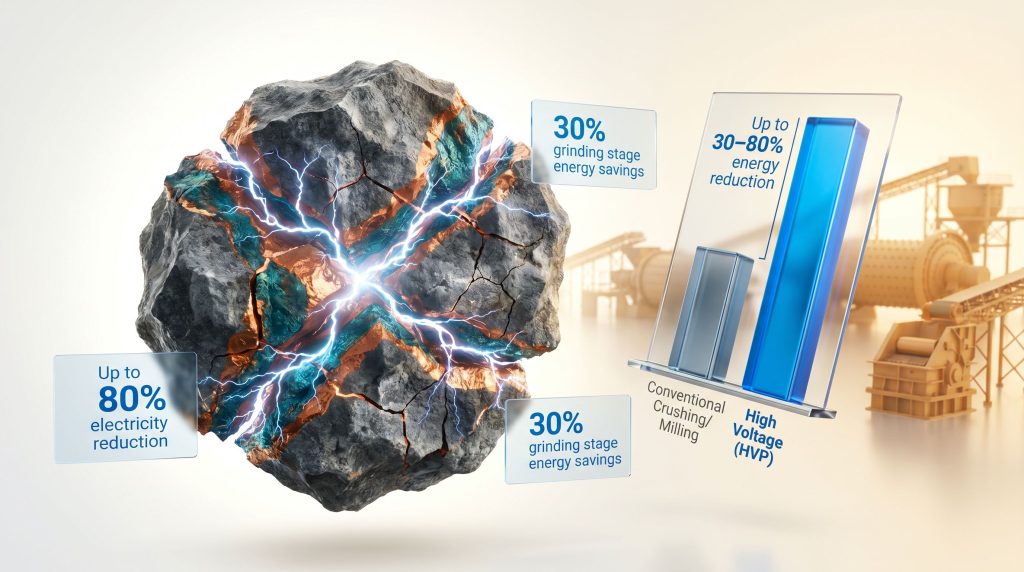
Research findings from the JKMRC and affiliated programs indicate that HVP pre-treatment applied before conventional grinding can reduce grinding stage energy consumption by approximately 30%. This figure reflects the energy benefit of liberating valuable minerals at a coarser particle size, reducing the proportion of ore that must be processed through energy-intensive fine grinding circuits.
A separate and more optimistic figure appears in estimates associated with Codelco's partnership with I-Pulse Inc., where internal assessments suggest electricity consumption in comminution could theoretically be reduced by up to 80% under optimised operational conditions. This figure represents a theoretical upper bound rather than a demonstrated industrial result, and the distinction matters considerably for anyone evaluating HVP's commercial readiness.
The mechanism connecting these two numbers is pre-concentration: by rejecting barren gangue material before it enters the grinding circuit, HVP can dramatically reduce the tonnage that must be processed through the most energy-intensive downstream stages.
Pre-Concentration as an Economic Multiplier
Early waste rejection is arguably HVP's most transformative economic feature, extending well beyond energy savings alone:
- Reduced mill feed volume means smaller grinding circuits can process equivalent amounts of valuable ore
- Lower reagent consumption follows from processing less total material through flotation and leaching stages
- Reduced tailings generation shrinks the environmental footprint of the operation and lowers tailings storage costs
- Lower-grade deposit viability improves because the effective cut-off grade of economically processable ore is lowered when barren waste can be rejected cheaply upstream
This last point carries significant strategic weight. As the global mining industry confronts a structural decline in average copper head grades, any technology that allows lower-grade material to be processed economically directly addresses the ongoing copper supply crunch that affects the entire energy transition metals pipeline.
Technical Constraints That Cannot Be Ignored
Where HVP Currently Falls Short
An honest assessment of high voltage pulse technology in mining must acknowledge the engineering realities that separate current performance from the commercial scale that would be required for broad adoption.
The particle size threshold problem is the most fundamental technical constraint. HVP efficiency degrades significantly when applied to particles smaller than 2 millimetres. At fine particle sizes, the specific energy input required per tonne of material processed rises disproportionately, eroding the economic advantage that makes the technology attractive in the first place. This means HVP is best positioned as a pre-treatment step applied to coarse ore before primary grinding, not as a replacement for fine grinding circuits.
Throughput scalability represents the other critical engineering challenge. Laboratory HVP systems typically operate in batch mode, treating small sample volumes under controlled conditions. Industrial copper mining operations run continuous processing circuits at throughputs measured in hundreds of tonnes per hour. Bridging the gap between a batch laboratory reactor and a continuous industrial system requires solving electrode durability, ore feed management, and discharge cycle management problems that are still being worked through at the pilot scale.
Capital intensity also requires honest acknowledgement. The power electronics and electrode systems required for industrial-scale HVP deployment represent a substantial upfront investment, and the maintenance cycles and electrode replacement requirements at sustained high-throughput operation are not yet fully characterised.
The Global Commercialisation Landscape
Where HVP Research and Deployment Stands Today
The transition of high voltage pulse technology in mining from laboratory research to industrial deployment is being pursued through several parallel programs across academia and the private sector.
At the University of Queensland, the JKMRC's Separation Group is running an active research program specifically investigating HVP comminution pre-treatment, with copper ore as the primary focus material. The research being conducted at doctoral level is examining how HVP-induced fracture alters the surface chemistry of mineral particles and how those altered surfaces subsequently behave in flotation circuits. A pilot plant capable of validating performance at throughputs exceeding 100 tonnes per hour is planned for construction at a sponsoring mine site, representing the critical bridge between laboratory demonstration and industrial proof of concept.
The doctoral research being conducted in this area at UQ illustrates an important but underappreciated aspect of HVP commercialisation: fundamental scientific questions about how electrically fractured ore behaves in downstream processing remain genuinely open. The altered surface characteristics created by HVP breakage could enhance flotation recovery by exposing fresh, reactive mineral surfaces, or could interfere with conventional reagent systems designed around mechanically fractured ore. Resolving these questions is a prerequisite for confident industrial deployment. Findings on HVP technology features published through ResearchGate provide further context on the science behind these distinctions.
Major Industry Pilot Programs
| Program | Partners | Target Milestone | Timeline |
|---|---|---|---|
| BHP-I-ROX Pilot | BHP and I-ROX (I-Pulse spinout) | 10 tonnes per hour throughput | Late 2025 |
| BHP Mine Site Deployment | BHP and I-ROX | Full pilot plant at mine site | 2026 |
| Codelco-I-Pulse Partnership | Codelco and I-Pulse Inc. | Feasibility assessment for large-scale copper operations | Active |
| UQ JKMRC Pilot Plant | UQ and industry sponsors | 100+ tonnes per hour validation | Planned |
The involvement of BHP through its collaboration with French technology company I-ROX carries particular commercial significance. I-ROX, a spinout of the established I-Pulse technology group, is working toward a 10 tonne per hour throughput demonstration by late 2025, with a full pilot plant deployment at a BHP mine site targeted for 2026. When a Tier 1 mining company commits to hosting a pilot plant, it signals a confidence level that laboratory results alone cannot communicate.
Codelco's engagement with I-Pulse Inc. adds another layer of validation. As one of the world's largest copper producers by volume, Codelco I-Pulse mining technology and its internal estimates regarding potential electricity reductions of up to 80% in comminution carry weight precisely because they reflect analysis conducted by an operator with deep expertise in large-scale copper processing.
The i-Mine Concept: Rethinking the Entire Extraction Cycle
Beyond comminution, a broader vision is emerging that places pulsed power technology at the centre of a redesigned underground mining system. The i-Mine concept proposes combining pulsed power drilling and rock fragmentation into a unified continuous mining machine that would eliminate the conventional drill-blast-clean operational cycle entirely.
The implications extend well beyond energy savings. Removing drill-and-blast from underground mining operations would eliminate blast fume ventilation requirements, reduce ground disturbance, and create fundamentally different occupational safety conditions for underground workers. Whether this concept can be engineered to match the tonnage rates of conventional underground mining methods remains an open question, but the directional ambition points toward a genuinely different paradigm for mine design.
How HVP Fits Into Mining's Decarbonisation Imperative
The Paradox at the Heart of the Energy Transition
Copper, lithium, nickel, and cobalt are the foundational materials of clean energy infrastructure. Electric vehicles, grid-scale batteries, and wind turbines all depend on these metals in significant quantities. The uncomfortable reality is that producing these metals at scale currently requires substantial electricity, much of it still fossil-fuel derived, and the energy intensity of ore processing is a major contributor to that carbon load.
High voltage pulse technology in mining sits at the intersection of two converging pressures: the need to process lower-grade critical mineral deposits economically, and the imperative to reduce the carbon intensity of doing so. In addition, the broader mining electrification trend amplifies the urgency for technologies like HVP that can reduce comminution energy by even 30% across a major copper operation, translating into meaningful absolute reductions in scope 2 emissions.
Comparing HVP Against Competing Innovation Pathways
| Innovation Pathway | Energy Reduction Potential | Selectivity | Commercialisation Stage |
|---|---|---|---|
| High Voltage Pulse (HVP) | 30-80% (stage-dependent) | High | Pilot scale |
| High-Pressure Grinding Rolls (HPGR) | 10-25% vs. conventional ball mills | Low | Commercially deployed |
| Microwave Pre-treatment | 15-40% (ore-dependent) | Moderate | Pre-commercial |
| Advanced Sensor-Based Ore Sorting | Variable | High | Commercially deployed |
| Stirred Media Milling | 20-40% vs. ball mills at fine sizes | Low | Commercially deployed |
"HVP occupies a distinctive position in this competitive field: it is the only emerging comminution technology that combines both high energy reduction potential and high mineralogical selectivity. No currently commercialised technology achieves both simultaneously at the same degree."
Consequently, understanding the mining decarbonisation benefits associated with HVP adoption helps contextualise why major miners are committing capital to pilot programs despite the technology's pre-commercial status.
The next major ASX story will hit our subscribers first
Key Research Questions Still Being Resolved
The Surface Chemistry Problem
When HVP fractures rock along mineral grain boundaries, it exposes fresh mineral surfaces that have never been in contact with the surrounding gangue material or processing chemicals. These surfaces carry different electrical charges, different oxidation states, and different reactive site densities compared to mechanically crushed equivalents.
In flotation circuits, where the attachment of air bubbles to mineral surfaces is governed by surface chemistry interactions with collector reagents, these differences can be decisive. The critical unknowns include:
- How does the altered surface chemistry of HVP-treated copper sulphide particles affect xanthate collector adsorption?
- Does the micro-fracture network created by HVP treatment increase or decrease the rate of surface oxidation between treatment and flotation?
- How do these effects vary across different copper ore types, including porphyry copper deposits versus vein-hosted mineralisation?
Doctoral research programs at UQ are specifically designed to close these knowledge gaps, and the outcomes will be determinative for how HVP is integrated into industrial flotation circuit design.
Scaling From Batch Processing to Continuous Operation
The transition from batch laboratory operation to continuous industrial processing involves solving interconnected engineering challenges that do not have straightforward laboratory analogues:
- Electrode system durability: How do electrode materials and geometries perform across millions of discharge cycles at sustained industrial throughput?
- Continuous ore feed management: How is ore fed into and discharged from a HVP reactor continuously without disrupting the electrical discharge environment?
- Water management: HVP operates with ore submerged in water, and continuous operation requires managing water quality, temperature, and conductivity across extended processing campaigns
- Maintenance scheduling: What inspection and electrode replacement intervals are required to sustain performance at rated throughput?
These are not theoretical obstacles. They are the engineering problems that pilot plants at the 10 to 100 tonne per hour scale are specifically designed to characterise and resolve. Furthermore, advances in mining efficiency technologies may support the broader process integration challenges as HVP moves toward commercial scale.
The Road From Pilot Plant to Industry Standard
Near-Term Milestones: 2025 to 2027
The next 24 months represent the most consequential period in HVP's commercial development trajectory:
- BHP-I-ROX pilot commissioning and throughput validation at 10 tonnes per hour, targeting late 2025
- BHP mine site pilot plant deployment, targeted for 2026, providing the first sustained operational data at a working mine
- UQ JKMRC pilot plant construction at a sponsor mine site, validating HVP performance at industrial throughput levels exceeding 100 tonnes per hour
- Publication of peer-reviewed findings on HVP surface chemistry effects in flotation circuits, providing the scientific foundation for industrial circuit design
- Codelco-I-Pulse feasibility assessment outcomes, which will signal whether one of the world's largest copper producers considers the technology commercially viable at scale
Medium-Term Adoption Scenarios
Whether HVP transitions from pilot demonstration to first commercial installation within the next five years will depend on several converging factors:
- Demonstrated continuous throughput performance matching or exceeding conventional circuit economics
- Carbon pricing trajectories in major copper-producing jurisdictions, which strengthen the business case for energy-intensive operations to invest in comminution alternatives
- The availability of capital for processing circuit upgrades in an environment where major miners are simultaneously managing sustaining capital requirements across large asset portfolios
- Whether HVP proves more naturally suited to new mine designs rather than retrofits of existing processing plants, which carry additional engineering complexity when integrating novel pre-treatment stages
The Long-Term Vision
If continuous operation at 100-plus tonnes per hour is validated with economics that compete with conventional comminution, HVP has the potential to redefine the standard processing flowsheet for copper and broader critical mineral operations. The downstream effects would extend to mine design itself: processing facilities configured around HVP pre-concentration could be physically smaller, operate with higher feed grades entering fine grinding circuits, and generate significantly reduced tailings volumes.
The more ambitious pulsed power vision, wherein underground drilling and rock fragmentation are also replaced by electrical discharge systems within a continuous mining machine, represents a longer-horizon possibility that would require engineering breakthroughs well beyond current pilot programs. However, the direction of travel is clear: electrical energy applied selectively and intelligently to rock is emerging as a credible alternative to the blunt mechanical force that has defined mineral processing for over a century.
This article contains forward-looking statements and references to research findings, pilot program targets, and energy reduction estimates that represent projections rather than guaranteed outcomes. Readers should conduct independent research before making any investment or commercial decisions based on information contained herein. Energy reduction figures cited reflect stage-specific estimates and theoretical upper bounds under optimised conditions, not guaranteed operational outcomes at industrial scale.
Want To Invest Ahead of the Next Major Copper Discovery?
Discovery Alert's proprietary Discovery IQ model scans ASX announcements in real time, instantly identifying significant mineral discoveries — including those tied to the critical minerals powering the energy transition — and delivers actionable alerts to subscribers before the broader market can react. Explore historic discoveries and their returns to understand the opportunity, then begin a 14-day free trial at Discovery Alert to position yourself ahead of the market.