August 5, 2026
When Legacy Assets Become a Liability: Reading Anglo American's H1 2026 Earnings Through a Strategic Lens
The history of large diversified mining companies is punctuated by cycles of overexpansion and painful contraction. When commodity supercycles peak, diversification looks like wisdom. When markets turn, those same sprawling portfolios begin to look like liabilities. Anglo American's first-half 2026 performance update captures exactly this tension, with its diamonds and steelmaking coal divisions posting negative underlying earnings at a moment when the group is deep into one of the most ambitious portfolio restructurings in its history.
Understanding the Anglo American first-half loss at diamonds and coal units requires looking beyond the headline numbers to examine what is structurally broken, what is cyclically depressed, and what the group is deliberately choosing to exit regardless of market timing.
When big ASX news breaks, our subscribers know first
What "Negative Underlying EBITDA" Actually Tells Investors
Before dissecting the divisional performance, it is worth establishing why underlying EBITDA matters so much in mining analysis. Unlike net profit, which can be distorted by depreciation schedules, asset write-downs, and financing costs, underlying EBITDA measures how much cash a business unit generates purely from its operations.
When a division reports negative underlying EBITDA, it means the operation is consuming cash at the operating level before a single dollar of debt repayment, capital expenditure, or corporate overhead is factored in. For a capital-intensive industry like mining, this is a serious signal.
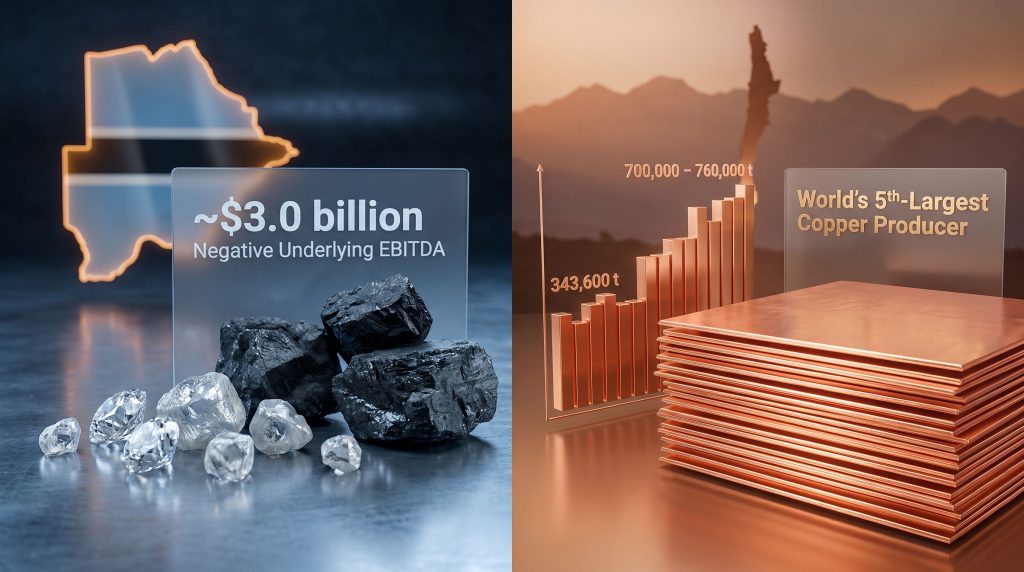
Anglo American's consolidated group underlying EBITDA for the first half of 2026 came in at approximately $3.0 billion. Both De Beers and the steelmaking coal segment dragged on this figure, contributing negative underlying earnings rather than supporting the total. The fact that two major divisions are simultaneously cash-negative at the operational level underscores why the divestiture strategy has moved from a medium-term ambition to an operational necessity. For further context on the broader Anglo restructuring update, the group's portfolio simplification has been well documented across successive reporting periods.
The De Beers Problem: Production Recovery Without Revenue Recovery
One of the most revealing data points from Anglo's H1 2026 update is the disconnect between diamond output and diamond revenue. De Beers achieved an 88% surge in rough diamond production during Q2 2026, a substantial operational recovery that under normal market conditions would be expected to drive meaningful revenue uplift. Instead, weak consumer demand and compressed realised prices continued to suppress earnings.
This divergence is not simply a pricing blip. It reflects a more fundamental shift in how rough diamonds are valued by the market's primary buyers, known as sightholders. These are the carefully selected manufacturers and polishers who purchase rough stones in periodic sales events called sights. When sightholders reduce purchasing volumes or decline stones at offered prices, it signals that margins in the midstream of the diamond pipeline have eroded to the point where purchasing at prevailing rough prices is uneconomical.
The Lab-Grown Diamond Effect on Rough Diamond Pricing
A dimension of the De Beers challenge that extends well beyond cyclical weakness is the accelerating penetration of laboratory-grown diamonds in consumer jewellery markets. Lab-grown diamonds are chemically and physically identical to mined stones, and their production costs have fallen dramatically over the past decade as chemical vapour deposition (CVD) and high-pressure, high-temperature (HPHT) technologies have matured.
The consumer perception gap between natural and synthetic diamonds has narrowed significantly in key purchasing demographics, particularly among younger buyers in the United States and China. This has created a structural ceiling on the pricing of natural rough diamonds at the lower end of the quality spectrum, since synthetic alternatives are readily available at a fraction of the cost.
The implications for a miner like De Beers, which built its entire business model on the scarcity and emotional premium of natural diamonds, are profound. Price recovery alone cannot resolve this challenge because the competitive dynamic has fundamentally changed. According to Anglo American's interim results, the structural pressures on De Beers remain a central consideration in the group's divestiture rationale.
Botswana's Right of First Refusal: A Geopolitical Variable
Anglo American has moved decisively on the De Beers sale process, selecting a preferred acquisition consortium led by Gareth Penny, the former chief executive of De Beers, as the prospective buyer. However, the transaction faces a meaningful variable that sits outside Anglo's direct control.
| Stakeholder | Ownership Position | Decision Status |
|---|---|---|
| Anglo American | Majority owner (divesting) | Preferred buyer consortium selected |
| Botswana Government | 15% equity stake | Evaluating right of first refusal |
| Gareth Penny-led Consortium | Preferred acquirer | Acquisition terms under negotiation |
Botswana holds a 15% stake in De Beers and retains the right of first refusal, meaning the government can elect to purchase the business at the agreed terms before the Penny-led consortium proceeds. A Botswana government official confirmed the country is weighing this option, including the possibility of exercising the right through a nominated third party.
Diamond revenues represent a foundational pillar of Botswana's national economy. The country has historically derived the majority of its export earnings from its diamond sector, primarily through the Jwaneng and Orapa mines operated through its Debswana joint venture with De Beers. Any change in the ownership structure of De Beers therefore carries significant strategic weight for Gaborone, well beyond a simple investment decision.
The Botswana right-of-first-refusal process introduces a layer of deal uncertainty that markets will monitor closely. If Botswana elects to exercise this right, either directly or through a third-party vehicle, it could meaningfully alter both the timeline and the structure of the eventual De Beers transaction.
Steelmaking Coal: Three Compounding Pressures on Earnings
The steelmaking coal division's negative underlying EBITDA in H1 2026 reflects a convergence of unfavourable factors rather than a single identifiable cause. Three distinct pressures have compounded to suppress divisional earnings below the zero line:
-
Benchmark price weakness — Premium hard coking coal prices have softened as steel production activity slowed across key consuming economies, including China, where the property sector contraction continues to weigh on steel demand. This is closely tied to broader challenges in the China steel and iron ore market, where demand signals have remained subdued throughout 2025 and into 2026.
-
Reduced sales volumes — Operational and logistics constraints limited the tonnage delivered to market, reducing the revenue base against which fixed costs must be recovered.
-
Elevated fixed cost structures — Mining operations carry substantial fixed costs in labour, maintenance, and infrastructure that do not scale down proportionally when production or sales volumes fall. At current price levels, these fixed costs cannot be fully absorbed by revenue.
It is important to note that Anglo American's exit from steelmaking coal is a deliberate strategic decision, not a market-forced retreat. The group committed to divesting these assets as part of its portfolio simplification well before the current pricing weakness emerged. The unfortunate consequence is that the divestiture process is now unfolding during a period of depressed valuations, which raises legitimate questions about the proceeds achievable compared to what a sale at the peak of the coking coal cycle in 2022 might have generated.
Coking Coal vs Thermal Coal: A Distinction That Matters
A common misconception conflates steelmaking (coking) coal with thermal coal used in power generation. These are fundamentally different products. Coking coal has specific metallurgical properties, particularly its ability to form coke when heated in the absence of air, that make it essential for blast furnace steelmaking. There is no scalable alternative for primary steel production in conventional blast furnace technology at present.
This distinction matters for how the divestiture is viewed. Unlike thermal coal, which faces an existential demand trajectory as power sectors decarbonise, coking coal retains a medium-term demand profile tied to global steel production. The buyers willing to acquire steelmaking coal assets at this point in the cycle are making a calculated bet on steel demand recovery, particularly from infrastructure spending in emerging markets.
Copper: The Strategic Anchor Holding Steady
While diamonds and coal generated losses, Anglo American's copper business delivered the operational stability that the portfolio restructuring thesis depends upon.
| Metric | H1 2026 | H1 2025 | Change |
|---|---|---|---|
| Copper Production (tonnes) | 343,600 | 342,200 | +0.4% |
| Full-Year Guidance (tonnes) | 700,000 to 760,000 | N/A | Maintained |
| 2026 Copper Cost Guidance | Revised downward | Prior guidance | Improvement |
The downward revision to copper cost guidance for 2026 deserves particular attention. In mining, lower unit costs at maintained production volumes directly translate to improved margins per tonne sold. This is a more meaningful positive indicator than a production beat alone, because it suggests operational efficiency gains rather than simply favourable grade or volume outcomes.
The Los Bronces operation in Chile remains central to Anglo's copper production base. Lower copper sales volumes from Chilean operations contributed to some earnings softness at the group level, but the maintained full-year guidance signals that management views this as a timing issue rather than a structural production problem. Furthermore, the broader copper supply crunch continues to underpin the long-term investment case for copper-focused producers like Anglo.
Why the Energy Transition Makes Copper So Central to Anglo's Future
Copper's role in the global energy transition is well understood in broad terms, but the magnitude of the demand shift is often underappreciated. Every electric vehicle contains roughly two to four times more copper than a conventional internal combustion engine vehicle. Grid infrastructure for renewable energy requires substantial copper in transmission lines, transformers, and connection hardware. This demand profile is not speculative; it is embedded in the physical requirements of the technologies being deployed at scale.
By concentrating its portfolio around copper and iron ore, Anglo American is positioning itself at the intersection of electrification infrastructure demand and traditional steel-intensive construction and manufacturing activity.
The Teck Resources Merger: One Approval Away From a Market Re-Ranking
The proposed combination with Teck Resources remains on track according to Anglo's H1 2026 update, with Chinese regulatory approval identified as the sole remaining hurdle before completion. Chinese antitrust review of major mining sector transactions has become an increasingly significant variable in global deal timelines, reflecting both the country's strategic interest in commodity supply chains and its use of regulatory processes as a geopolitical instrument.
Upon completion, the combined Anglo American-Teck entity would rank as the world's fifth-largest copper producer globally, sitting behind the dominant group of Codelco, Freeport-McMoRan, BHP, and Glencore. This scale matters beyond simple market share. Larger copper producers command advantages in long-term offtake negotiations with smelters and end-users, infrastructure investment capacity, and access to capital markets at preferential terms.
A merger of this scale, pending a single regulatory approval, represents a rare binary outcome for investors monitoring the copper sector. The deal either closes, vaulting the combined entity into the top five globally, or it faces unexpected regulatory complications that could reshape both companies' strategic trajectories.
The next major ASX story will hit our subscribers first
Portfolio Concentration: The Risk and Reward of Strategic Simplification
Anglo American's restructuring can be summarised through the lens of deliberate portfolio concentration, accepting reduced commodity diversification in exchange for exposure to commodities with more compelling long-term demand profiles. Mining industry consolidation of this kind has become a defining theme across major producers in recent years, as groups seek to streamline operations and sharpen their strategic focus.
| Asset Category | Strategic Action | Current Status |
|---|---|---|
| De Beers (Diamonds) | Full divestiture | Preferred buyer selected; Botswana decision pending |
| Steelmaking Coal | Sale and exit | Divestiture process underway |
| Nickel | Exit and disposal | Committed to sale |
| Copper | Core retention and growth | Production maintained; Teck merger pending |
| Iron Ore | Core retention | Ongoing operations |
The risk embedded in this strategy is straightforward: a more concentrated portfolio amplifies exposure to copper and iron ore price cycles. If copper prices weaken significantly in the years following the restructuring, Anglo will have far fewer earnings streams to cushion the impact compared to its previous diversified configuration.
The potential reward is equally clear. A simplified portfolio with lower administrative overhead, cleaner capital allocation, and direct exposure to electrification-driven copper demand could command a higher valuation multiple from equity markets than a sprawling, harder-to-analyse conglomerate structure. However, as Reuters reported, Anglo American's restructuring path has not been without costs, with the group posting a significant net loss as the transformation continues. Consequently, investors assessing undervalued mining stocks in the current environment will need to weigh these transitional pressures carefully against the group's longer-term strategic positioning.
Frequently Asked Questions
Why are Anglo American's diamond and coal units reporting losses in H1 2026?
Both divisions face a combination of lower realised commodity prices, constrained sales volumes, and fixed cost structures that cannot be adequately covered at current revenue levels. The diamond market is experiencing weak consumer demand and pricing pressure compounded by structural competition from lab-grown alternatives, while steelmaking coal is impacted by softened benchmark prices and logistics constraints.
What is Anglo American's total H1 2026 underlying EBITDA?
The group's first-half underlying EBITDA is approximately $3.0 billion, with the Anglo American first-half loss at diamonds and coal units identified as the primary contributors to the earnings shortfall.
Is Anglo American still selling De Beers?
Yes. A preferred acquisition consortium led by former De Beers chief executive Gareth Penny has been selected. Botswana, holding a 15% stake, is separately evaluating whether to exercise its right of first refusal, either directly or through a nominated third party.
How much copper did Anglo American produce in H1 2026?
Anglo American produced 343,600 tonnes of copper in the first half of 2026, marginally above the 342,200 tonnes recorded in the prior corresponding period. Full-year guidance of 700,000 to 760,000 tonnes was maintained, with 2026 cost guidance revised downward.
What is the status of the Anglo American and Teck Resources merger?
The proposed merger remains on track, with Chinese regulatory approval identified as the final outstanding hurdle before the transaction can be completed. Completion would rank the combined entity as the world's fifth-largest copper producer.
This article contains forward-looking statements and analysis based on publicly available information. Mining sector investments involve substantial risks including commodity price volatility, regulatory uncertainty, and operational variability. Nothing in this article constitutes financial advice. Readers should conduct their own due diligence or consult a qualified financial adviser before making investment decisions.
Want to Capitalise on the Next Major Copper or Mineral Discovery Before the Broader Market?
Discovery Alert's proprietary Discovery IQ model delivers real-time alerts the moment significant ASX mineral discoveries are announced, transforming complex geological and commodity data into clear, actionable investment insights for both short-term traders and long-term investors. Explore how historic discoveries have generated extraordinary returns on Discovery Alert's dedicated discoveries page, and begin your 14-day free trial today to position yourself ahead of the market.