May 18, 2026
The Quiet Shift Reshaping Global Mining Portfolios
Commodity cycles have always forced major mining houses to confront an uncomfortable question: which assets belong in the future, and which belong in the past? For decades, diversified miners treated coal as an anchor of earnings stability. Today, that calculus has reversed. The same assets once prized for their cash generation are increasingly viewed as liabilities, not because steelmaking coal has lost its industrial relevance, but because the strategic cost of holding it has become too high for companies repositioning around the metals of the energy transition.
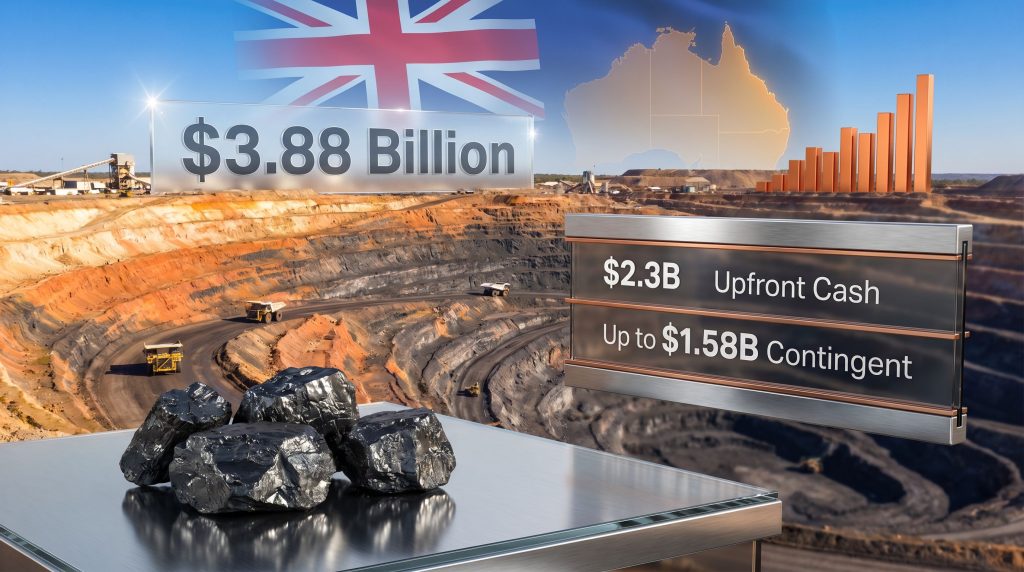
Anglo American's decision to sell its entire Australian steelmaking coal portfolio to UK-based Dhilmar for up to $3.88 billion is the clearest expression yet of this generational shift in how diversified miners manage their commodity exposure. Anglo American to sell Australian coal mines to Dhilmar, announced in May 2026, is not simply a financial transaction. It is the culmination of a multi-year strategic transformation that will reshape Anglo American's identity as a mining company for the decade ahead.
When big ASX news breaks, our subscribers know first
Why Anglo American to Sell Australian Coal Mines Represents a Defining Strategic Choice
From Diversified Miner to Copper Heavyweight
Anglo American's portfolio evolution has been building toward this moment for several years. The company has systematically identified copper, iron ore, and crop nutrients as its forward-facing commodity pillars, while coal, diamonds, and platinum group metals have been progressively repositioned as non-core or under strategic review.
The strategic logic is straightforward. Copper sits at the intersection of virtually every major energy transition in mining theme, from electric vehicle manufacturing to grid infrastructure and renewable energy deployment. Steelmaking coal, while still structurally relevant to global steel production, carries a different investment narrative. Its price volatility is significant, its capital intensity is high, and its ESG profile creates friction with the institutional shareholder base that now shapes capital allocation decisions at major London-listed miners.
The planned merger with Canada's Teck Resources accelerates the urgency of this repositioning. Combining with Teck to create a copper-focused heavyweight requires Anglo American to arrive at the merger with a leaner balance sheet, a simplified asset base, and a coherent strategic story. Retaining a large Australian coal portfolio while simultaneously declaring copper as the company's defining commodity would create strategic dissonance that institutional investors would not accept.
The coal divestment removes that contradiction entirely.
The Bowen Basin Portfolio: World-Class Assets, Non-Core Classification
The assets being sold are anything but marginal. Anglo American's Queensland holdings in the Bowen Basin represent interests in some of the most geologically significant steelmaking coal operations in the world, including Moranbah North, Capcoal, Roper Creek, Dawson, and Moranbah South.
The Bowen Basin occupies a unique position in the global supply chain for steel. Its geological formations produce premium hard coking coal, the highest-quality metallurgical coal grade, which is essential for blast furnace steelmaking. Unlike thermal coal, which generates electricity and faces structural demand decline, hard coking coal has no commercially scalable substitute in the blast furnace steelmaking process that currently dominates global steel production.
Hard coking coal is assessed on several quality parameters that determine its value to steel producers, including caking properties (measured by the Coke Strength after Reaction index, or CSR), ash content, sulfur content, and volatile matter. Premium Bowen Basin coking coal consistently scores favourably across these parameters, making it the benchmark product for Asian blast furnace operators.
This distinction between thermal coal and metallurgical coal is commercially critical and often misunderstood in broader ESG discussions. The decarbonisation pressure that has accelerated thermal coal exits does not apply with the same force to metallurgical coal, given that green steel technologies such as direct reduced iron using hydrogen remain decades away from replacing conventional blast furnace production at scale.
Despite this, Anglo American has classified these assets as non-core. Their sale is not a commentary on the quality of the coal or the durability of demand. It is a statement about where Anglo American believes its capital is most productively deployed.
How the $3.88 Billion Transaction with Dhilmar Is Structured
Breaking Down the Deal Economics
The financial architecture of the Dhilmar transaction reflects sophisticated risk management in a volatile commodity environment.
| Transaction Component | Value |
|---|---|
| Fixed Upfront Cash Payment | $2.3 billion |
| Price-Contingent Variable Component | Up to $1.58 billion |
| Total Maximum Consideration | $3.88 billion |
| Primary Use of Proceeds | Debt reduction and balance sheet deleveraging |
| Previous Peabody Energy Offer | Approximately $3.78 billion |
The $2.3 billion fixed component provides Anglo American with certainty of capital recovery regardless of what steelmaking coal markets do after completion. The variable component of up to $1.58 billion, representing approximately 40.7% of the total maximum consideration, is explicitly linked to prevailing steelmaking coal prices.
This price-contingent structure serves both parties. Anglo American retains meaningful exposure to coal price upside following the sale, capturing additional value if markets strengthen. Dhilmar receives built-in downside protection, reducing the effective entry cost if coal prices weaken during the period over which the contingent payments are calculated.
Contingent payment mechanisms of this type are increasingly common in large-scale mining asset transactions where commodity price volatility creates genuine valuation disagreement between buyers and sellers. They effectively convert a portion of the purchase price into a price participation instrument, bridging valuation gaps without requiring either party to accept the other's price assumptions.
At $3.88 billion, the Dhilmar deal modestly exceeds the Peabody coal deal of approximately $3.78 billion by roughly $100 million, or about 2.65%, despite the intervening operational disruption at Moranbah North that complicated the asset's valuation profile. This premium signals the continued strong demand for premium steelmaking coal assets among strategic acquirers.
Who Is Dhilmar and What Does Their Entry Signal?
Dhilmar's emergence as the successful acquirer is one of the more intriguing elements of this transaction. According to Reuters reporting on the sale, the UK-based mining entity was not among the most prominently discussed bidders during the re-tendering process, which reportedly attracted interest from established operators including Stanmore Resources, Mitsubishi Corporation, and Indonesia's BUMA Internasional.
The fact that a relatively less publicly prominent entity ultimately secured one of the world's premier steelmaking coal portfolios reflects a broader trend visible across the global coal M&A landscape. As major diversified miners exit the sector for ESG or strategic reasons, the assets do not disappear from the market. They transfer to a new class of acquirers, often private or semi-private entities with longer time horizons, less institutional ESG pressure, and strong appetite for cash-generative commodity assets at what they perceive to be attractive cycle entry points.
Whether Dhilmar possesses the operational expertise, management depth, and financial resilience to run these complex assets at their full potential is a question that the Australian mining industry and Queensland government stakeholders will watch closely. The workforce, communities, and regulatory relationships associated with these operations do not transfer seamlessly; they require active management from an engaged and capable new owner.
The Peabody Energy Collapse: Anatomy of a Failed Mining Transaction
What Brought Down a $3.78 Billion Deal
The original Peabody Energy transaction represented a significant international growth ambition for the US coal major, adding a world-class Australian coking coal portfolio to its predominantly domestic operations. The deal's collapse provides a revealing case study in mining M&A risk management.
The Moranbah North fire created the fracture point. In mining transactions of this scale, operational disruptions during the period between signing and completion can fundamentally alter the agreed valuation basis. The fire affected asset condition assessments, future production profiles, and arguably the reserve base assumptions underpinning the original price. Peabody's position was that the fire materially changed what it was buying; Anglo American's position, presumably, was that the price already reflected appropriate risk.
When the two parties could not agree on a revised price that reflected the disruption's true impact, Peabody withdrew rather than proceed at the original consideration. This outcome illustrates a critical aspect of mining M&A that differs from other sectors: physical assets can change dramatically in value between signing and completion, and the allocation of that operational risk is a fundamental negotiating variable.
The Parallel Arbitration Strategy
Anglo American confirmed it is continuing arbitration proceedings against Peabody over the collapsed transaction in parallel with completing the new deal with Dhilmar. This dual-track approach is legally sound and financially rational.
Arbitration in mining M&A typically involves claims centred on breach of contract, valuation methodology disputes, and interpretations of material adverse change clauses. The specific grounds of Anglo American's claim against Peabody are not publicly detailed, but potential outcomes could add meaningful incremental financial recovery beyond the Dhilmar transaction value.
Prosecuting arbitration simultaneously with a new transaction is not unusual for companies of Anglo American's legal and financial sophistication. It signals that the company views the Peabody withdrawal as a contractual breach rather than a legitimate exercise of deal optionality, and intends to recover accordingly.
The Teck Resources Merger: Why the Coal Exit Was Non-Negotiable
Copper as the Strategic Endgame
Anglo American's planned merger with Teck Resources represents one of the most strategically consequential corporate combinations in the global mining sector in recent years. The combined entity would create a copper-focused mining heavyweight with significant exposure to one of the most strategically critical metals across multiple demand growth themes. Furthermore, understanding broader copper market trends helps contextualise why Anglo American is so aggressively repositioning around this metal.
| Balance Sheet Impact | Detail |
|---|---|
| Upfront Cash Proceeds | $2.3 billion directed to debt reduction |
| Maximum Total Proceeds | $3.88 billion at full contingent realization |
| Strategic Purpose | Leaner capital structure entering Teck merger |
| Asset Profile Post-Sale | Copper-anchored, reduced commodity diversification |
The coal sale directly improves the financial profile Anglo American brings into the merged entity. Debt reduction at this scale materially strengthens the combined entity's balance sheet flexibility, reducing financing costs and expanding capital allocation optionality post-merger.
CEO Duncan Wanblad's confirmation that the Dhilmar transaction completes Anglo American's exit from steelmaking coal is significant not just operationally but as an investor communication. It closes a chapter that had been a source of strategic ambiguity, and it establishes an unambiguous identity for the company going forward.
How Anglo American's Portfolio Transformation Compares
The broader context for understanding Anglo American's coal exit is the parallel strategies pursued by BHP and Rio Tinto. BHP completed its own thermal and metallurgical coal exits over preceding years, progressively concentrating its portfolio around iron ore, copper, and potash. Rio Tinto exited coal earlier than its peers and has similarly anchored its strategy around iron ore and copper.
Anglo American's approach follows this trajectory but reflects the additional complexity of its South African operational heritage, its De Beers diamonds exposure, and its platinum group metals position. The coal exit is the most decisive portfolio simplification move yet, but it will not be the last.
The Bowen Basin's Irreplaceable Role in Global Steel Supply
Why Premium Hard Coking Coal Defies the Decarbonisation Narrative
Understanding why assets of this quality continue to attract multi-billion-dollar valuations requires a clear-eyed assessment of global steel production realities.
Blast furnace steelmaking, which accounts for the substantial majority of global steel output, relies on metallurgical coke derived from hard coking coal to provide both the reducing agent and the thermal energy required to convert iron ore into liquid steel. This is a chemical and thermodynamic process, not merely a fuel choice. There is no commercially available technology that replicates this function at scale without coking coal in conventional blast furnace operations.
| Market Variable | Context |
|---|---|
| Primary Demand Driver | Asian blast furnace steel production |
| Key Import Markets | Japan, South Korea, China, India |
| Supply Concentration | Bowen Basin is world's leading producing region |
| Quality Benchmark | Premium hard coking coal, highest CSR ratings |
| Green Steel Timeline | Decades-long transition; not near-term demand risk |
| Price Mechanism in Deal | Contingent payment reflects acknowledged price volatility |
Japan, South Korea, and India collectively represent a dominant demand base for Bowen Basin coking coal alongside the China steel market, and their steel industries are not scheduled for rapid green steel conversion. The capital intensity of replacing integrated blast furnace operations with hydrogen-based direct reduced iron facilities is enormous, and the green hydrogen supply chains required to support this transition do not yet exist at commercial scale in Asia.
This does not mean metallurgical coal faces no long-term demand risk. It means the risk is medium-to-long-term, not imminent. For an acquirer with a patient capital base like Dhilmar appears to have, that time horizon may represent a significant opportunity rather than a threat.
The next major ASX story will hit our subscribers first
ESG Pressure, Carbon Scrutiny, and the Governance of Asset Transfers
The Carbon Laundering Dilemma
One of the more contested aspects of major miners divesting coal assets is the question of whether the transaction actually reduces global carbon emissions or simply transfers them to operators with lower public accountability. When Anglo American sells its coal assets, the coal itself continues to be mined and burned. The operational carbon footprint does not disappear; it simply moves off Anglo American's ESG reporting dashboard.
This dynamic has attracted scrutiny from climate-focused institutional shareholders and ESG rating agencies, who increasingly distinguish between genuine emissions reduction and accounting reclassification. The governance standards, environmental compliance culture, and community engagement practices of the new operator become critical questions that the asset sale alone cannot resolve.
For the Queensland mining regions where these assets are located, the ownership transition matters beyond share registers and corporate strategy documents. Workforces, local suppliers, community investment programmes, and regulatory relationships are all affected by who ultimately controls these mines and what operational philosophy they bring.
What This Transaction Signals for Global Coal M&A
The resilience of steelmaking coal asset valuations, even as major miners systematically exit the sector, is perhaps the most commercially significant insight embedded in this transaction. The Anglo American press release confirms that the Dhilmar deal demonstrates premium metallurgical coal assets retain the ability to attract multi-billion-dollar valuations from motivated strategic buyers, even in an environment of heightened ESG scrutiny and major miner exits.
Several broader signals emerge from the structure and outcome of this deal:
-
Contingent pricing mechanisms are becoming a standard structural feature of large coal transactions, reflecting genuine commodity price uncertainty while enabling deals to close despite valuation disagreements.
-
Non-traditional acquirers are increasingly filling the gap left by exiting mining majors, with entities like Dhilmar representing a new generation of commodity-focused buyers less constrained by institutional ESG mandates.
-
Arbitration as a recovery tool is being deployed more aggressively in mining M&A, with Anglo American's parallel pursuit of the Peabody arbitration setting a precedent for how sellers can maximise financial recovery from collapsed transactions.
-
Asset quality still commands a premium, as evidenced by the Dhilmar deal marginally exceeding the original Peabody offer despite the intervening Moranbah North mine fire complicating the asset's condition profile.
Anglo American to sell Australian coal mines to Dhilmar is, at its core, a story about corporate identity in a transitioning global economy. The assets being sold are world-class. The buyer is motivated. The price is strong. And the seller is using the proceeds to fund the next chapter of its evolution. Whether that next chapter, defined by copper and the Teck merger, proves more valuable than the one being closed is a question that markets will answer over the years ahead.
This article contains forward-looking statements and analysis based on publicly available information as of May 2026. Financial outcomes, merger timelines, contingent payment realisations, and strategic projections are subject to material uncertainty. Readers should not rely on this content as investment advice. Independent financial and legal counsel should be sought before making any investment decisions.
For ongoing coverage of major mining transactions and commodity market developments, Mining Weekly at miningweekly.com provides comprehensive reporting across the global resources sector.
Want to Catch the Next Major Mineral Discovery Before the Broader Market Does?
Discovery Alert's proprietary Discovery IQ model scans ASX announcements in real time, instantly transforming complex mineral data into actionable investment insights across more than 30 commodities — the same kind of transformative opportunities that have historically generated extraordinary returns, as showcased on Discovery Alert's dedicated discoveries page. Begin your 14-day free trial today at Discovery Alert and position yourself ahead of the market.