May 18, 2026
The Shale Play the World Forgot to Watch Is Now Centre Stage
For most of the past decade, global capital chased unconventional hydrocarbons within the borders of the United States. The Permian Basin attracted billions in equity, debt, and operator attention, while international alternatives sat in the periphery of most portfolio conversations. That calculus is shifting in 2026, and the Argentina Vaca Muerta acreage offering is at the centre of it — driven by geography, geopolitics, and the growing recognition that energy security cannot be built on a single corridor of supply.
The Strait of Hormuz carries roughly 20% of global oil trade on any given day. When instability in the Middle East periodically threatens that corridor, the vulnerability of fuel-importing nations becomes uncomfortably visible. Furthermore, the broader oil price geopolitics reshaping supply chain thinking have accelerated the search for alternatives that offer both scale and political accessibility. That search is increasingly arriving at the same destination: the Neuquén Basin in Argentina's Patagonian steppe.
When big ASX news breaks, our subscribers know first
Understanding What Vaca Muerta Actually Represents at a Resource Level
Before evaluating the Argentina Vaca Muerta acreage offering currently attracting international attention, it is worth grounding the discussion in the geological and resource fundamentals that underpin the basin's strategic appeal.
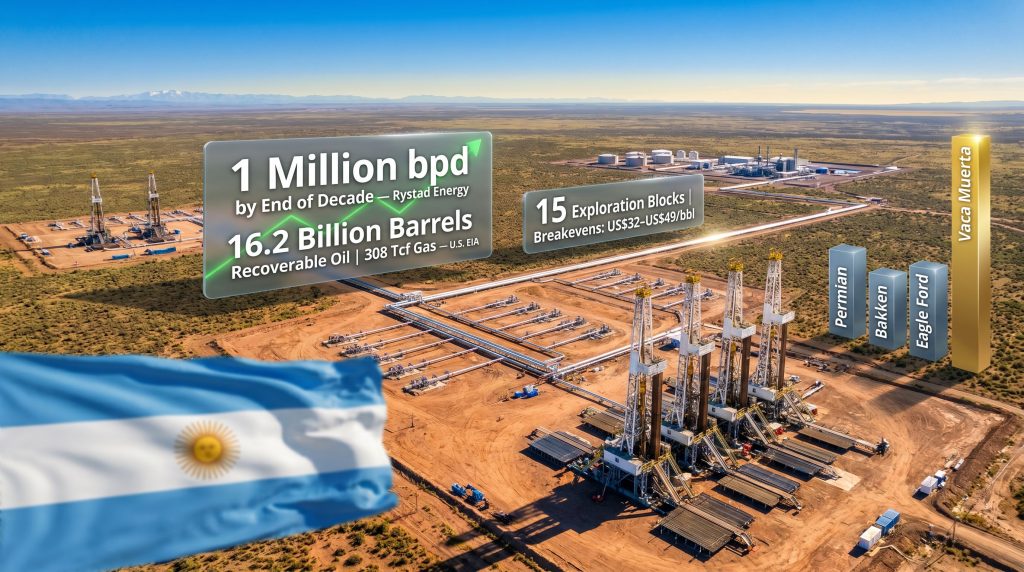
The U.S. Energy Information Administration, citing data consistent with Global Energy Monitor analysis, estimates the Vaca Muerta's recoverable resource base at approximately 16.2 billion barrels of oil and 308 trillion cubic feet (Tcf) of natural gas. These are not speculative figures generated during the early enthusiasm of a frontier play. They reflect years of drilling data, production history, and geological modelling accumulated since the formation was first commercialised.
Is the Geological Consistency Across the Basin a Key Differentiator?
What makes this resource base particularly significant is the geological consistency of the core fairway. Unlike many unconventional plays where resource quality degrades sharply outside a narrow sweet spot, the Vaca Muerta's productive intervals maintain relatively predictable characteristics across large portions of the basin. This reduces subsurface uncertainty for incoming operators in a way that genuinely frontier acreage simply cannot.
The formation sits within the broader Neuquén Basin, a sedimentary depocenter that has been studied and partially developed for conventional hydrocarbons for decades. That legacy of basin knowledge has produced something commercially valuable: a regional geology database, an understanding of structural complexity near the deformation front, and a calibrated picture of how fluid composition shifts from the oil window in the northeast to the condensate-rich northwest and the gas-dominant southern zones.
The 2026 Argentina Vaca Muerta Acreage Offering: Scale, Structure, and Entry Economics
The current bid round represents the most significant formal opening of the Vaca Muerta to international capital in approximately ten years. Administered by Gas y Petróleo del Neuquén (GyP), the Neuquén provincial energy company, the offering places 15 exploration blocks on the market simultaneously.
To contextualise that number: the previous provincial auction offered six blocks. The 2026 round is more than double that scale, representing a deliberate acceleration of the province's strategy to attract foreign operator expertise and capital. It is the largest single acreage offering in the basin since 2016.
Block Geography and Geological Targeting
The 15 blocks span the full geological breadth of the play, segmented broadly as follows:
| Zone | Primary Characteristics | Commercial Appeal |
|---|---|---|
| Northwest | Condensate-rich intervals, established corridors | High liquid yield, processing infrastructure nearby |
| Northeast | Core oil window, highest resource density | Near-term commercial development potential |
| Southern fringe | Frontier acreage, structural complexity | Higher geological risk, lower competitive intensity |
This geographic spread means the round serves multiple operator types. Majors with capital to absorb frontier risk may target southern fringe positions at lower entry costs. Mid-tier operators with strong shale execution capabilities are likely to focus on the northeast oil window, where the geological confidence is highest and the path to first commercial production is shortest.
Bid Terms and Competitive Structure
The bidding framework has been structured to attract serious, operationally capable participants rather than speculative acreage holders. Key components include:
- A working interest carry extended to GyP, aligning provincial interests with operator performance
- Royalties set incrementally above the statutory 15% minimum, creating a competitive dimension beyond the access bonus
- Work program commitments tied to drilling and seismic obligations, preventing block warehousing
- An access bonus with a minimum threshold of US$500,000 per block, establishing a floor for financial credibility
Well breakeven prices across the most prospective blocks range from approximately US$32 to US$49 per barrel, with independent research converging on a central estimate of roughly US$36 to US$45 per barrel. At current oil price levels, these economics are not marginal. They are competitive with the best-performing intervals in the Permian Basin, the Bakken, and the Eagle Ford, and in some cases superior when adjusted for land acquisition costs.
Benchmarking Vaca Muerta Against the World's Leading Shale Plays
The competitive positioning of the Argentina Vaca Muerta acreage offering only becomes fully legible when placed alongside global shale benchmarks.
| Metric | Vaca Muerta | Permian Basin | Bakken | Eagle Ford |
|---|---|---|---|---|
| Recoverable Oil (Bbbl) | 16.2 | ~70+ | ~11.3 | ~8.5 |
| Recoverable Gas (Tcf) | 308 | ~280+ | ~26 | ~66 |
| Typical Well Breakeven (US$/bbl) | $32–$49 | $35–$50 | $40–$55 | $38–$52 |
| International Acreage Access | Open via bid round | US-dominated, restricted | Restricted | Restricted |
| Current Production Trajectory | Accelerating | Plateauing in parts | Stable | Declining in zones |
Sources: U.S. EIA, Rystad Energy, Global Energy Monitor. Figures are indicative and subject to block-level and interval variation.
The comparison reveals something that often gets lost in coverage of global shale: Vaca Muerta is the only play of this resource scale where international operators can acquire fresh, government-issued primary acreage through a competitive bid process. The Permian Basin, for all its geological appeal, is effectively closed to new international entrants seeking organic acreage positions at this scale.
Consequently, Rystad Energy projects that crude output from the Vaca Muerta Basin will exceed 1 million barrels per day by the end of the decade, a trajectory that would position Argentina as a globally significant crude exporter and potentially a major LNG supplier to Asian and European markets seeking supply chain diversification.
The International Operator Footprint: Who Is Already There and What It Signals
The presence of Shell, Chevron, and Equinor in the Vaca Muerta is not incidental. These companies allocate capital to basins where the geology, infrastructure, and fiscal terms meet rigorous internal investment thresholds. Their sustained commitment to the basin provides an independent validation that does not require further qualification.
More instructive for understanding the current moment is the recent behaviour of Continental Resources, the US shale pioneer that built its reputation drilling the Bakken. Continental acquired a 90% working interest in the Los Toldos II Oeste block and followed that with a farm-in arrangement involving Pan American Energy assets. This sequence of transactions signals two things: first, that operators with deep unconventional expertise see genuine technical transferability between North American and Vaca Muerta shale; and second, that inorganic entry points are being pursued aggressively by those who have the capital and risk appetite to do so.
The pattern of inorganic deal activity since the last provincial round actually reinforces the value of the 2026 bid round for a different class of operator. Mid-tier international companies that were priced out of secondary market transactions, where incumbent operators embed acquisition premiums into farm-out economics, now have a direct pathway to primary acreage at bid terms set by the province rather than by a motivated seller.
Operational Realities: What New Entrants Must Genuinely Prepare For
The Argentina Vaca Muerta acreage offering represents a genuine opportunity, however presenting it without acknowledging the operational realities facing new entrants would be misleading.
Geological Complexity in Non-Core Zones
Blocks positioned near the deformation front present a materially different risk profile to those in the established core fairway. Incoming operators must demonstrate command of:
- Local faulting architecture and the orientation of the stress regime, which governs hydraulic fracture propagation and well productivity
- Landing zone variability across stratigraphic intervals, where the most productive target within the Vaca Muerta can shift laterally across a block
- Fluid composition changes as operators move between the oil, condensate, and dry gas windows, each requiring different surface handling and marketing arrangements
These are not insurmountable challenges. They are the normal complexity of a mature unconventional play. However, they require genuine geological competence, not just financial capacity.
Local Presence and Organisational Requirements
Successful bidders are expected to establish meaningful operational and supply chain presence in Neuquén province. This is partly a formal requirement and partly a practical necessity. The province has developed a mature service sector over more than a decade of unconventional drilling, including localised drilling contractors, completion service providers, and fluid management operations.
Argentina's macroeconomic environment, while showing improvement under current policy frameworks, continues to require active management of currency, fiscal, and regulatory risk. In addition, the shifting multipolar world economy means that energy investment decisions are increasingly shaped by strategic as well as financial considerations. These factors must all be modelled into investment theses rather than treated as background conditions.
Infrastructure as a Risk Mitigant
One factor that meaningfully distinguishes the 2026 entry window from earlier phases of the basin's development is the state of midstream infrastructure. The Vaca Muerta Sur oil pipeline and associated export terminal developments have substantially reduced the bottleneck between wellhead production and monetisable export volumes. Pipeline and export capacity construction is proceeding at pace, compressing the timeline to first commercial export for incoming operators.
The next major ASX story will hit our subscribers first
Argentina's LNG Ambitions and the Gas Resource Dimension
The 308 Tcf recoverable gas resource estimate deserves dedicated attention, because it positions Argentina not merely as an oil growth story but as a potential foundation for a significant LNG export programme. The broader LNG supply outlook for global markets further underscores why Argentina's gas ambitions are attracting sustained interest from importers in Asia and Europe.
Several LNG project proposals are at various stages of development, with international partners evaluating both offtake and equity participation structures. For fuel-importing nations in Asia and Europe that are actively seeking to reduce dependence on Russian pipeline gas and Middle Eastern LNG, Argentina represents a geographically distinct and politically accessible supply alternative.
This dual hydrocarbon profile — substantial oil in the northeast and condensate-rich gas in the northwest and southern zones — gives the basin unusual flexibility. Operators can calibrate their development focus based on commodity price signals and infrastructure access rather than being locked into a single product stream.
A Decade of Licensing Activity in Context
| Year | Round Type | Blocks Offered | Notable Activity |
|---|---|---|---|
| 2016 | GyP provincial round | Reference round | Established international and domestic participation |
| 2025 | Río Negro provincial auction | Multiple blocks | Broadened geographic scope |
| 2025–2026 | YPF asset divestment (Agua Salada) | Non-operated stake | Farm-out and asset reshuffling |
| 2026 | GyP provincial bid round | 15 blocks | Largest round in a decade |
The progression reflects a basin moving through recognisable maturation phases: early international entry, production ramp-up, inorganic consolidation, and now a formal reinvitation at scale for the next generation of operators. Furthermore, the evolving geopolitical landscape affecting global energy investment is making politically stable, resource-rich jurisdictions like Argentina's Neuquén province increasingly attractive to diversified portfolios.
Frequently Asked Questions: Argentina Vaca Muerta Acreage Offering
What is the Vaca Muerta acreage offering?
The Vaca Muerta acreage offering refers to Argentina's provincial bid rounds in which exploration and production blocks within the Vaca Muerta Shale formation are made available to domestic and international energy companies through a competitive tender process administered by Gas y Petróleo del Neuquén (GyP).
How many blocks are available in the 2026 round?
The 2026 round includes 15 exploration blocks, making it the largest single acreage offering in the Vaca Muerta since 2016 and more than double the six blocks offered in the previous provincial auction.
What are the breakeven economics for Vaca Muerta blocks?
Well breakeven prices across the most prospective blocks range from approximately US$32 to US$49 per barrel, with independent research suggesting a central range of US$36 to US$45 per barrel, competitive with established global shale benchmarks.
Which international companies are already active in Vaca Muerta?
Major international operators with confirmed positions include Shell, Chevron, Equinor, and Continental Resources, among others. The oil price shock experienced by other producing regions has, in addition, prompted a number of North American operators to evaluate Vaca Muerta as a portfolio diversification tool.
What is the production outlook for Vaca Muerta?
Rystad Energy projects that crude output from the Vaca Muerta will exceed 1 million barrels per day by the end of the decade.
What risks do new entrants face?
Key risks include geological complexity in frontier and deformation front zones, the requirement to establish local operational presence in Neuquén province, and Argentina's broader macroeconomic and fiscal environment, including currency and regulatory risk factors that must be actively managed.
Key Takeaways for Operators and Investors Evaluating the 2026 Round
- Scale: 15 exploration blocks on offer, the largest Vaca Muerta bid round in approximately ten years
- Economics: Breakeven prices of US$32 to US$49 per barrel, comparable to or better than leading US shale plays when land acquisition costs are factored in
- Resource base: 16.2 billion barrels of recoverable oil and 308 Tcf of recoverable gas, underpinned by U.S. EIA estimates
- Production trajectory: Rystad Energy projects output exceeding 1 million barrels per day by end of decade
- Access: The only major shale play of this scale offering fresh, primary government-issued acreage to international operators through a competitive bid process
- Infrastructure: Pipeline and export terminal development is actively reducing midstream risk, compressing the timeline to first commercial export
- Strategic timing: Geopolitical pressure on Persian Gulf supply chains is accelerating international interest in Patagonian crude as a diversification asset
Disclaimer: This article contains forward-looking statements, production projections, and resource estimates drawn from third-party research including U.S. EIA and Rystad Energy data. These figures are subject to revision and should not be construed as investment advice. Readers should conduct independent due diligence before making any investment or operational decisions related to the Vaca Muerta Basin or the 2026 acreage offering.
Further analysis and ongoing coverage of the Argentina Vaca Muerta acreage offering and broader global upstream developments is available at petroleumaustralia.com.au.
Want to Stay Ahead of the Next Major Resource Discovery Driving Market Returns?
Discovery Alert's proprietary Discovery IQ model delivers real-time alerts on significant ASX mineral discoveries, transforming complex resource data into actionable investment insights for both short-term traders and long-term investors — explore historic examples of exceptional discovery-driven returns to understand the scale of opportunity, then begin your 14-day free trial at Discovery Alert to position yourself ahead of the broader market.