May 18, 2026
When Markets Pull Back From the Edge: Reading the ASX's Retreat to 8,500 Points
Equity markets have a long history of testing investors precisely when the environment looks most promising. Record highs breed complacency, and complacency creates the conditions for sharp reversals. The S&P/ASX 200 index, known by its ticker XJO, is currently living through one of those defining moments. Having scaled to record highs near 9,200 points not long ago, the benchmark is now testing the 8,500-point zone — a level that carries significant weight for technical traders and long-term investors alike. ASX today XJO eyes 8500 points as a critical juncture in what has been a turbulent macro environment.
What makes this pullback especially instructive is that it is not being driven by a single factor. Instead, it reflects the convergence of several macro forces: geopolitical uncertainty, US inflation pressure, Federal Reserve leadership transition, commodity market volatility, and a fragile global risk appetite. Understanding each of these threads separately, and then together, is the key to interpreting where Australian equities go from here.
When big ASX news breaks, our subscribers know first
The Technical Architecture of the XJO's Decline
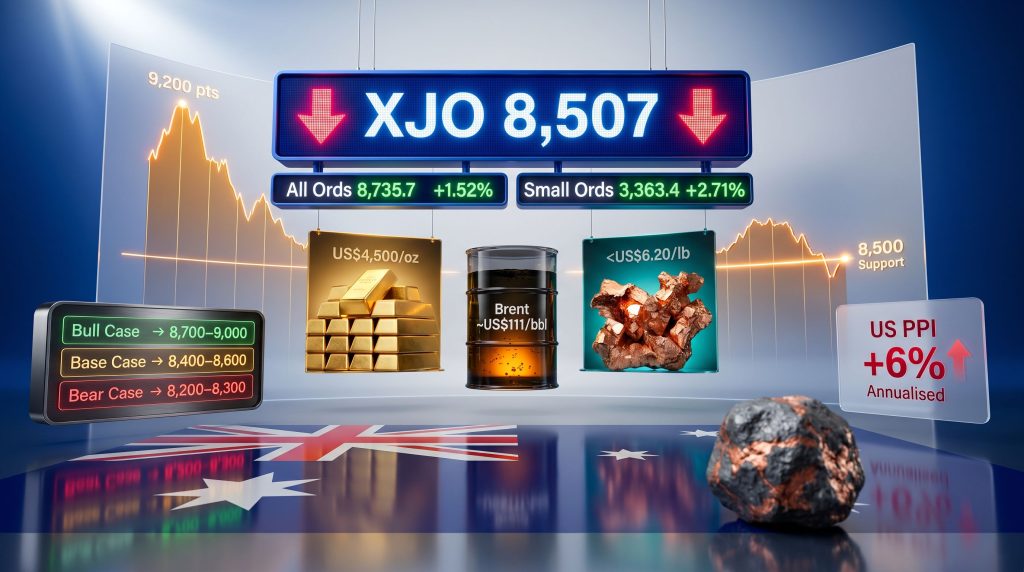
For context, ASX today (Monday, 18 May 2026) sees the XJO eyeing 8,500 points after trading at approximately 8,507 points in afternoon sessions, representing a meaningful retreat from the index's recent peak near 9,200 points. That is a drawdown of roughly 7.5% from highs — a level that historically prompts institutional reassessment of trend direction.
What makes this technically significant is the divergence between the XJO and the broader market. The All Ordinaries Index was tracking at 8,735.7 points, up 1.52%, while the S&P/ASX Small Ordinaries was outperforming at 3,363.4 points, up 2.71%. This divergence suggests that the pressure is concentrated in the large-cap segment of the market, where global macro sensitivity is highest, rather than reflecting a broad-based capitulation across all Australian equities.
| Index | Level | Movement |
|---|---|---|
| S&P/ASX 200 (XJO) | ~8,507 pts | Testing key support |
| All Ordinaries | 8,735.7 pts | +1.52% |
| S&P/ASX Small Ordinaries | 3,363.4 pts | +2.71% |
| XJO Record High (2026) | ~9,200 pts | Prior peak reference |
The ASX market performance at the 8,500-point zone functions as a confluence of psychological and technical support. A sustained break below this level would represent a more serious structural deterioration, potentially opening the path toward 8,400 points as the next meaningful floor. Conversely, a defence of this level could establish the base for a recovery attempt toward the 8,700 range.
Wall Street's Red Friday and the Offshore Contagion Effect
The ASX does not operate in isolation. Its sensitivity to overnight US market movements is well-documented, and Monday's session reflected this dynamic clearly. Wall Street closed in negative territory on Friday as profit-taking accelerated following a high-profile diplomatic meeting between US and Chinese leadership that failed to deliver any tangible progress on the ongoing Iran conflict.
Markets had, perhaps optimistically, positioned for a more constructive diplomatic outcome. When that did not materialise, the reversal was swift. This is a classic example of markets pricing in expectations rather than realities — and being punished when reality disappoints.
The commodity complex absorbed much of the resulting volatility:
- Brent Crude: Trading near US$111 per barrel, sustained by geopolitical risk premiums tied to the Iran conflict
- Gold: Approaching US$4,500 per ounce, reflecting elevated gold safe-haven demand from investors seeking shelter from equity risk
- Copper: Slipping to just below US$6.20 per pound, a notable pullback given the metal's structural demand story remains intact
High oil prices above US$100 per barrel create a dual pressure dynamic for Australian equities: they compress consumer spending power domestically while simultaneously inflating input costs across sectors that rely on energy for operations.
The US Inflation Problem: PPI at 6% Is Not a Rounding Error
Two separate inflation readings out of the United States last week are now reshaping market expectations in ways that extend well beyond the immediate session. The Consumer Price Index confirmed continued upward pressure at the consumer level, but it is the Producer Price Index that is drawing the sharper reaction.
US PPI climbed 6% in the twelve months to April — a reading that reflects wholesale inflation driven largely by tariff pass-through. This is not a transitory spike. A 6% annualised wholesale inflation rate indicates that businesses have been absorbing higher input costs and are now moving to pass those costs downstream to consumers. The implications are significant:
- Bond market reaction: The PPI reading triggered a sell-off in US Treasuries, pushing yields higher as investors priced in a greater probability of Federal Reserve tightening.
- US dollar strength: Rising yields attracted flows into US dollar assets, strengthening the greenback and creating headwinds for commodity-priced assets globally.
- Rate hike expectations: The consensus view has shifted toward anticipating a Fed rate increase at the next meeting — a scenario that historically weighs on growth-oriented and commodity-linked equity markets worldwide.
- Delayed consumer impact: Because PPI leads CPI, a sustained 6% wholesale inflation reading implies that consumer price pressures are likely to intensify further in coming months, potentially compounding the Fed's policy challenge.
For Australian investors, the indirect transmission mechanism is critical to understand. Tighter US monetary policy strengthens the US dollar, which typically pressures the Australian dollar lower and compresses the local currency value of commodity exports. Furthermore, it also tends to reduce global risk appetite, which disproportionately affects commodity-export-driven economies like Australia.
Kevin Warsh, the Fed, and the Uncertainty Premium
Adding another layer of complexity to an already complicated macro backdrop is the transition in Federal Reserve leadership. Jerome Powell's tenure concluded last week, with Kevin Warsh — appointed by the Trump administration — now assuming the role of Fed Chair.
Markets are grappling with a binary uncertainty: will Warsh operate as a genuinely independent central banker prioritising inflation control, or will he align more closely with the administration's documented preference for lower interest rates? This ambiguity is itself a market risk, because monetary policy predictability is one of the key inputs into institutional asset allocation decisions.
Policy uncertainty at the Federal Reserve has historically elevated volatility in commodity-linked and emerging markets. Australia, as a resource-export-driven economy with significant trade exposure to Asia, sits directly in the crossfire of any shift in US monetary policy direction.
The Warsh uncertainty is not simply about one rate decision. It is about whether the Fed's institutional credibility as an inflation-fighting body remains intact over the medium term. If markets conclude it does not, the implications for gold, bonds, and risk assets could be significant.
NVIDIA's Earnings: A Single Result With Global Implications
Amid the macro pressure, one upcoming catalyst stands out as capable of materially shifting sentiment: NVIDIA's quarterly earnings report, scheduled for later in the week. The company's results carry outsized significance far beyond the technology sector.
As the world's dominant AI chip designer, NVIDIA's revenue trajectory functions as a real-time indicator of global artificial intelligence infrastructure investment momentum. The AI investment boom has underpinned much of the 2024–2026 equity bull run, and when NVIDIA disappoints, it raises questions about whether that wave has peaked.
The connection to Australian markets runs through copper. Morgan Stanley has reclassified BHP as an AI-adjacent investment, citing the extraordinary volumes of copper required to construct and power the data centres that underpin AI infrastructure. A single large-scale hyperscale data centre can require several thousand tonnes of copper for wiring, cooling systems, and power distribution.
This framing creates an interesting dual-exposure dynamic for BHP: the stock now effectively provides investors with indirect exposure to both traditional industrial demand cycles and the AI infrastructure build-out. If NVIDIA's results confirm that AI capex spending remains robust, copper demand expectations could re-accelerate and provide a meaningful catalyst for BHP and the broader materials sector.
The next major ASX story will hit our subscribers first
Sector Analysis: Materials, Critical Minerals, and Defence Tech
BHP Under Copper Price Pressure
BHP (ASX: BHP) fell more than -2% intraday on Monday, reflecting a combination of broad market weakness and the specific headwind of declining copper price volatility. Copper dropped approximately -5% on Friday alone — a significant single-session move that illustrates how the metal's elevated price levels create amplified volatility risk.
BHP's deliberate strategic pivot toward copper as its primary growth metal means the company's share price correlation with daily copper price movements has intensified. Investors accustomed to tracking iron ore as the key BHP valuation driver need to update their mental model. Copper is now the lever.
Northern Minerals and the FIRB Divestment Pattern
Northern Minerals (ASX: NTU) fell approximately -8% intraday following a Foreign Investment Review Board ruling requiring Chinese-affiliated shareholders to divest their holdings on national security grounds. Critically, this marks the second forced divestment Northern Minerals has experienced under FIRB oversight.
This pattern is becoming a structural feature of the critical minerals landscape. Australia's critical minerals sector is increasingly viewed through a national security lens, creating a situation where the regulatory risk premium for these companies is now a genuine valuation input — not a tail risk.
The forced divestment dynamic can cut both ways for domestic investors. Divestment by foreign holders can create short-term price pressure, but it also opens the register to Australian institutional capital and may ultimately reduce the regulatory overhang on the stock.
Ktek Aerosystems: A Geopolitical Debut
On a more positive note, Israeli-backed drone technology company Ktek Aerosystems debuted on the ASX on Monday with a surge of more than +100%, reaching approximately 41.5 cents per share in lunchtime trading. The company's value proposition is directly linked to defence and surveillance applications, with demand elevated by the ongoing Iran conflict.
The strong debut appears to have created some capital rotation away from existing ASX-listed defence technology players, with DroneShield potentially absorbing some of the reallocation effect. This is a common dynamic when new entrants arrive in a thematic sector with strong momentum.
Australia vs. the US: An Inflation Divergence That Actually Matters
One of the most underappreciated aspects of the current market environment is the stark contrast between Australian and US inflation dynamics. While the US is dealing with a 6% annualised PPI reading and CPI trending upward, Australia's domestic inflation environment has been comparatively contained.
Australian CPI rose just 0.7% in the June quarter of 2025, with annual inflation tracking at approximately 2.1% — comfortably within the Reserve Bank of Australia's 2-3% target band. This divergence creates a meaningful policy asymmetry: while the Fed may be moving toward rate hikes, the RBA retains flexibility to hold or ease, which is structurally supportive for Australian equities over the medium term. You can track live ASX 200 index data to monitor how this policy divergence continues to play out in real time.
Scenario Framework: Three Paths From 8,500 Points
| Scenario | Key Triggers | XJO Likely Range |
|---|---|---|
| Bull Case | NVIDIA beats; copper rebounds; Fed signals patience | 8,700 to 9,000 pts |
| Base Case | Mixed NVIDIA result; ambiguous Fed language | 8,400 to 8,600 pts |
| Bear Case | NVIDIA disappoints; Fed signals rate hike; oil holds above $110 | 8,200 to 8,300 pts |
The bull case is not unrealistic. Australian domestic fundamentals remain sound, the RBA has room to manoeuvre, and the structural copper and AI demand thesis has not fundamentally changed. However, the near-term risk environment is genuinely elevated, and investors should size positions accordingly.
Key Market Snapshot: ASX Today in Numbers
| Metric | Figure | Significance |
|---|---|---|
| XJO (S&P/ASX 200) | ~8,507 pts | Testing psychological support |
| All Ordinaries | 8,735.7 pts (+1.52%) | Broader market resilience |
| S&P/ASX Small Ords | 3,363.4 pts (+2.71%) | Smallcaps outperforming |
| Brent Crude | ~US$111/bbl | Elevated geopolitical premium |
| Gold | ~US$4,500/oz | Safe-haven demand intact |
| Copper | Below US$6.20/lb | Key BHP valuation driver |
| US PPI (April, annualised) | 6% | Tariff cost pass-through |
| BHP intraday | -2%+ | Copper price sensitivity |
| Northern Minerals intraday | -8% | FIRB divestment impact |
| Ktek Aerosystems debut | +100%+ | Defence tech demand |
Consequently, with ASX today XJO eyes 8500 points serving as a critical inflection point, the weeks ahead will test the resolve of both institutional and retail investors alike. For those monitoring the index closely, live XJO charts and analysis can provide a useful real-time reference as the market works through these competing forces.
This article is intended for informational purposes only and does not constitute financial advice. All figures referenced reflect intraday data as at Monday, 18 May 2026 and are subject to change. Past index performance is not indicative of future results. Readers should consult a qualified financial adviser before making investment decisions.
Want to Identify the Next Major ASX Mineral Discovery Before the Broader Market?
While the XJO tests critical support levels and macro uncertainty clouds large-cap valuations, significant mineral discovery opportunities continue to emerge across the ASX — and Discovery Alert's proprietary Discovery IQ model delivers real-time alerts the moment they are announced, transforming complex geological and commodity data into clear, actionable insights for investors at every level. Explore historic discoveries and the substantial returns they generated to understand what early positioning in a transformative discovery can mean for a portfolio, then begin a 14-day free trial to secure a genuine market-leading edge.