August 6, 2026
When the Cycle Turns: Structural Fragility in Metallurgical Coal and the Lessons of the Vitrinite Vulcan Mine Receivership
Commodity markets have a long history of separating well-capitalised, diversified operators from those whose financial architecture was built on the assumption that peak-cycle conditions would persist. The metallurgical coal sector is no exception. When prices surge, undercapitalised entrants and single-asset producers can appear viable, even profitable. When the cycle reverses, the same operations can unravel with alarming speed, leaving creditors, workers, and regional communities to absorb the consequences.
The Vitrinite Vulcan mine receivership, now unfolding in Queensland's Bowen Basin, is precisely this kind of story. But it is more than a corporate insolvency. It is a case study in how commodity price timing, operational model transitions, regulatory delays, financing structures, and subscale production can converge into a failure that exceeds $400 million in total debt, affects 348 workers, and leaves a 20-year mine project collapsed within five years of first production.
When big ASX news breaks, our subscribers know first
The Scale of the Insolvency and What It Means for Stakeholders
The Vitrinite group of companies entered voluntary administration on 22 February 2026, carrying debts confirmed by Federal Court documents to exceed $400 million. The Vulcan mine itself sits approximately 200 kilometres south-west of Mackay near Dysart, within the Bowen Basin, which Geoscience Australia recognises as one of the world's most significant sources of high-quality metallurgical coal for steelmaking.
The mine commenced coal production in 2021 with an original projected operational lifespan of roughly 20 years, meaning this collapse represents a premature failure by a wide margin. Two insolvency processes are running concurrently:
| Process | Appointed Party | Initiated By | Primary Objective |
|---|---|---|---|
| Voluntary Administration | Cor Cordis | Vitrinite directors | Explore restructuring or DOCA options |
| Receivership | KordaMentha | Secured creditor Trafigura | Recover secured debt via asset sale |
| Winding Up Application | Federal Court (Minespec) | Unsecured creditor | Force liquidation if debts unresolved |
The full creditor exposure breaks down as follows:
| Creditor Category | Estimated Exposure | Priority Ranking |
|---|---|---|
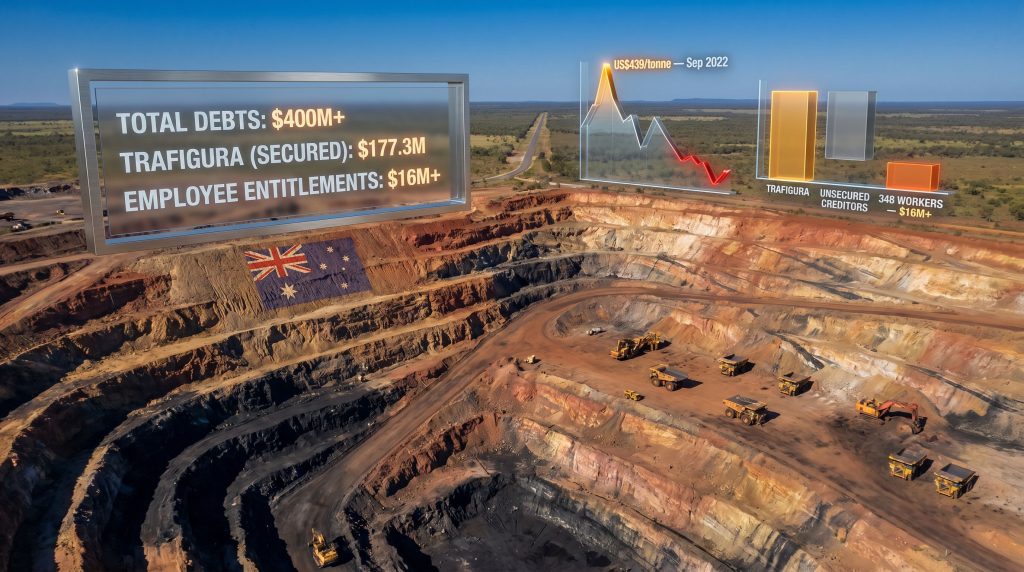
| Trafigura (secured) | $177.3 million | First priority |
| Unsecured creditors (total pool) | $265.9 million | Lower priority |
| Employee entitlements | $16+ million | Statutory priority (above unsecured) |
| Isaac Regional Council (haulage fees) | $2.2 million | Unsecured |
This is not an isolated event. Furthermore, coal remains Australia's second-most valuable export commodity, with total coal export earnings exceeding AUD 120 billion during the 2022–23 peak period, according to the Department of Foreign Affairs and Trade's Trade and Investment at a Glance 2024. The systemic importance of the sector means that even individual mine failures carry broader implications for regional employment, state royalty revenue, and investor confidence in new Bowen Basin projects.
How a 20-Year Mine Failed in Five Years: The Converging Fault Lines
The Commodity Price Trap and Peak-Cycle Deployment
Understanding the Vitrinite Vulcan mine receivership requires understanding the price environment into which the project was launched. Metallurgical coal prices reached a historic high of $US439 per tonne in September 2022, driven partly by the global energy disruption following Russia's invasion of Ukraine and the subsequent scramble for substitute energy and steelmaking inputs. This peak arrived shortly after the Vulcan mine commenced commercial operations, creating a seductive but deceptive revenue picture.
The mine's financial architecture, including its debt structure and projected cash flows, appears to have been calibrated during a period of elevated price assumptions. This is a well-documented risk pattern in resource extraction: capital deployment decisions made near the top of a commodity cycle embed structural fragility that only becomes apparent when prices normalise or decline. Understanding commodity prices and mining performance is therefore essential context for evaluating what went wrong here.
"From a strategic risk perspective, a business model that requires sustained peak-cycle pricing to service its debt obligations is not a business model built for commodity cycles. It is a business model built for commodity peaks."
Metallurgical coal prices declined materially from 2023 onward, compressing margins across Bowen Basin producers. For operators with high fixed costs and limited balance sheet flexibility, this compression was not merely uncomfortable. It was potentially fatal.
The Owner-Operator Transition: A Critical Miscalculation in Timing
One of the most revealing insights from the administrator's creditors report concerns the June 2024 transition from a contract-mining model to an owner-operator model. This structural shift is worth examining closely because it illustrates a risk that is rarely discussed in public commentary on mine failures.
Under a contract-mining model, the mine owner engages an external contractor to provide mining equipment, personnel, and operational management. The contract miner bears much of the variable cost risk, while the owner pays a fee per tonne of coal produced. The arrangement reduces capital exposure for the mine owner but also limits operational control.
An owner-operator model reverses this dynamic. The mine owner takes direct responsibility for all equipment, workforce, and operational costs. Fixed cost obligations increase substantially, but so does potential margin capture in favourable price environments.
The problem for Vitrinite was one of timing. The transition to owner-operator status occurred precisely as metallurgical coal prices were declining. Administrator Cor Cordis identified this transition as the point at which financial pressures became acute rather than merely manageable. By internalising fixed costs at the wrong point in the price cycle, Vitrinite significantly amplified its downside exposure.
Highwall Mining Delays and the Production Volume Dependency
The administrator's report also identified a critical operational vulnerability: the Vulcan mine's business model depended on uninterrupted, high-volume production to cover its cost structure. Any disruption to throughput translated directly into cashflow stress.
Highwall mining is a technique used to extract coal from exposed seam faces in open-cut operations where the overburden has already been removed. It involves driving a series of parallel entries into the coal seam from the highwall face, typically using an auger or continuous miner-based system. It is particularly valuable for extending the productive life of an open-cut pit without the cost of further overburden removal.
The delayed introduction of highwall mining technology at Vulcan disrupted planned production volumes at a critical juncture. Consequently, this is an under-appreciated aspect of the insolvency: the delay was not merely an operational inconvenience. It created a cashflow gap at precisely the moment when falling coal prices were already compressing revenue per tonne.
Compounding this, the slower-than-expected regulatory approval of the Vulcan South mine extension in late 2024 further constrained the operation's production outlook. Extensions of this type require environmental approvals, mining lease amendments, and community consultation processes that can extend well beyond initial planning timelines. A thorough definitive feasibility study in the early stages may have better anticipated these regulatory risks and their impact on cashflow.
The Subscale Producer Problem and the Acquisition That Never Happened
Vitrinite's directors disclosed to administrators that a failure to acquire a neighbouring coal project represented a significant missed opportunity. The company had previously demonstrated consolidation ambitions by acquiring the Callan coking coal project (formerly BHP's Picardy asset) in 2023. However, the inability to complete a further strategic acquisition left Vitrinite operating as a subscale producer in a sector where scale matters enormously. Broader mining industry consolidation trends have reinforced that smaller operators without diversified asset bases face mounting structural disadvantages.
In capital-intensive resource extraction, subscale operations face disproportionate risk during commodity downturns for several reasons:
- Fixed costs (equipment, labour, royalties, debt service) cannot be spread across a larger production base
- Revenue volatility has a more immediate impact on liquidity because there is no offsetting income from other assets
- Lenders and offtake partners have less security over a single-asset operation than over a diversified portfolio
- There is limited ability to defer capital expenditure across projects to manage cashflow through cycle troughs
Vitrinite's inability to achieve scale through acquisition was therefore not simply a missed growth opportunity. It left the operation structurally exposed to the precise conditions that materialised from 2023 onward.
The Safe Harbour Mechanism: Protection or Delay?
One of the more technically significant aspects of the Vitrinite insolvency involves the use of safe harbour provisions under the Australian Corporations Act 2001. These provisions, introduced in 2017, protect company directors from personal liability for insolvent trading while they pursue a course of action that is reasonably likely to lead to a better outcome for the company than immediate administration or liquidation.
The administrator estimated that Vulcan Mine Management and Holston were likely insolvent from 30 September 2025. Directors invoked safe harbour protection five days later, on approximately 5 October 2025, to pursue a restructuring pathway.
The safe harbour period ultimately did not produce a viable recovery, and the group entered voluntary administration on 22 February 2026, approximately five months later. This sequence raises an important question for restructuring practitioners and resource sector investors: in commodity-dependent businesses where the primary driver of distress is an external price variable rather than an operational or managerial failure, is safe harbour an effective restructuring tool, or does it primarily function as a legally protected delay?
"The answer may depend on whether a price recovery is realistic within the safe harbour window. For a metallurgical coal producer facing structurally lower prices and high fixed costs, a five-month restructuring period may simply be insufficient to generate the operational or financial changes needed to restore viability."
Trafigura's Secured Position and the Creditor Recovery Hierarchy
Receivership was triggered by Trafigura, a Singapore-headquartered global commodities trading firm, which Federal Court documents dated 17 March 2026 confirm is owed $177.3 million as a secured creditor. This secured position gives Trafigura priority over all unsecured creditors in the asset recovery process.
Trafigura's role in this insolvency is notable for what it reveals about the financing structures common in mid-tier coal operations. Commodity trading houses frequently provide financing to resource producers in exchange for offtake agreements or secured lending arrangements. These structures can provide essential capital access for producers who cannot easily access traditional bank financing, but they concentrate recovery risk in the hands of a single, commercially sophisticated creditor when insolvency occurs.
The presence of $265.9 million in unsecured claims alongside Trafigura's secured position means that unsecured creditors face material recovery uncertainty. Employee entitlements, while carrying statutory priority over general unsecured claims under Australian insolvency law, still depend on the quantum of proceeds generated by the KordaMentha-led asset sale.
Workers and the Regional Community: The Human Dimension of the Collapse
The 348 workers employed at the Vulcan mine when it ceased operations represent the most immediate human cost of this insolvency. Federal Court documents confirm these workers are collectively owed more than $16 million in unpaid entitlements, with the majority stood down from January 2026 when the mine reached an effective operational standstill.
Under Australian insolvency law, employee entitlements carry statutory priority above general unsecured creditor claims. However, actual recovery depends entirely on the proceeds generated through asset sales. For workers in regional communities around Dysart and Moranbah, where the Vulcan mine represented a significant source of direct and indirect employment, the financial disruption is compounded by limited alternative employment options in the immediate region.
The Fair Entitlements Guarantee (FEG) scheme provides a federal government safety net for eligible employees who lose entitlements due to employer insolvency. It covers unpaid wages, annual leave, long service leave, payment in lieu of notice, and redundancy (subject to caps). Workers at the Vulcan mine may be eligible to access FEG if asset sale proceeds do not fully cover the $16 million entitlement shortfall.
The position of Isaac Regional Council adds another layer of complexity. The council accumulated a $2.2 million debt in unpaid coal haulage fees, a debt it knowingly allowed to grow rather than suspending services. Mayor Kelly Vea Vea confirmed the council monitored the mounting arrears closely and made a deliberate decision to continue haulage, reasoning that withdrawing services earlier would have accelerated the mine's closure and amplified regional job losses.
This situation illustrates a structural dilemma for local governments near distressed major employers: enforcing commercial credit limits may protect the council's balance sheet but at the cost of accelerating community-wide employment losses. The council expressed reasonable confidence in recovering the debt, though its unsecured status in the creditor hierarchy creates genuine uncertainty.
The next major ASX story will hit our subscribers first
The KordaMentha Sale Process: Scenarios and Outcomes
Receiver KordaMentha confirmed a shortlist of undisclosed bidders for the Vulcan mine assets, with final bids expected by 26 May 2026. A separate winding-up application filed by mining services company Minespec is scheduled for further Federal Court hearing on 1 July 2026.
Three plausible scenarios exist for the asset's future:
Scenario A: Full Asset Sale to a Strategic Acquirer
A larger coal producer acquires the Vulcan mine as a going concern, resuming operations under new ownership. This outcome offers the greatest recovery potential for creditors and preserves regional employment. It is most likely if metallurgical coal prices stabilise or recover before bid finalisation.
Scenario B: Partial Asset Sale or Selective Acquisition
A financial or strategic investor acquires mining leases, equipment, and infrastructure without assuming the full operational footprint. The Vulcan South extension may be separated and sold independently. Unsecured creditors face deeper haircuts; employee entitlements are partially met.
Scenario C: Liquidation and Asset Wind-Down
No viable buyer emerges at acceptable price levels, and assets are progressively liquidated. This represents the maximum loss scenario for all creditor classes and the most severe employment outcome for the region. The presence of multiple shortlisted bidders makes this the least probable near-term scenario, though it cannot be excluded entirely.
"The ultimate recovery quantum for creditors will hinge on the bid prices relative to the $177.3 million secured debt floor held by Trafigura. Any proceeds above that threshold begin flowing toward the $265.9 million unsecured pool and the $16 million employee entitlement shortfall."
Queensland's Royalty Regime and Structural Sector Risk
The Vitrinite collapse has prompted commentary on Queensland's progressive coal royalty structure, which was revised upward in 2022 to introduce higher tiers at elevated price thresholds. While the royalty regime was designed to capture windfall revenue during price spikes, critics within the industry argue it disproportionately burdens marginal producers during the subsequent price correction.
For subscale producers operating near breakeven, even modest royalty increases can compress the margin of safety to the point where operational viability becomes price-sensitive at lower thresholds than would otherwise be the case. In addition, government intervention in mining policy decisions — including royalty structures — increasingly shape the financial viability of smaller operations across the cycle. Queensland's resources minister has maintained the state remains open for business, a statement that reflects the political sensitivity of mining sector failures in a royalty-dependent state budget environment.
This creates a structurally challenging environment for smaller, newer coal operations that cannot achieve the production volumes needed to dilute royalty costs across a larger revenue base. The broader lesson for investors and mine developers is that royalty regimes, particularly those with progressive structures, must be modelled carefully across a range of price scenarios, not just at peak-cycle assumptions.
Key Takeaways for Investors and Industry Observers
The Vitrinite Vulcan mine receivership delivers several instructive lessons for anyone analysing capital-intensive resource sector investments. Industry analysts have detailed the broader implications of this collapse for Queensland's Bowen Basin investment outlook. Furthermore, the following structural lessons apply across commodity sectors more broadly:
- Peak-cycle capital deployment without rigorous downside scenario modelling embeds structural fragility that only becomes visible during price corrections
- Owner-operator model transitions carry significant fixed cost implications; timing this transition relative to the commodity cycle is a critical strategic variable
- Subscale, single-asset producers face disproportionate risk during downturns because they cannot cross-subsidise underperforming assets or absorb sustained margin compression
- Safe harbour provisions may be insufficient restructuring tools for commodity-dependent businesses where the primary distress driver is an external price variable outside management's control
- Secured commodity trader financing concentrates recovery priority in commercially sophisticated hands, leaving unsecured creditors and workers exposed in insolvency scenarios
- Regulatory timing for mine extensions and technology approvals is not a peripheral operational matter; it is a direct cashflow variable that must be stress-tested in financial modelling
Disclaimer: This article is intended for informational and analytical purposes only. It does not constitute financial or investment advice. Readers should conduct their own due diligence and consult a licensed financial adviser before making investment decisions. All financial figures are sourced from publicly available court documents and news reporting as cited. Forecasts and scenario projections are speculative and subject to material uncertainty.
Want to Identify the Next Major ASX Mineral Discovery Before the Market Does?
Discovery Alert's proprietary Discovery IQ model delivers real-time alerts on significant ASX mineral discoveries, cutting through complex data to surface actionable investment opportunities the moment they are announced — precisely the kind of early intelligence that separates informed investors from the crowd. Explore Discovery Alert's dedicated discoveries page to understand how historic discoveries have generated substantial returns, and begin your 14-day free trial today to position yourself ahead of the market.