June 11, 2026
When Supply Chains Fracture, Asset Structures Must Adapt
The global scramble for reliable critical mineral supply has exposed a fundamental tension inside diversified resource companies: projects with genuinely different development profiles, commodity exposures, and investor audiences increasingly struggle to coexist within a single corporate vehicle. When one asset requires patient, long-horizon capital and another is ready to move toward production, the combined structure can actually suppress value rather than create it. This dynamic, playing out across the ASX's critical minerals sector, forms the strategic backdrop to the Brazilian Rare Earths demerger of Alurion Resources and the separation of the Amargosa Bauxite-Gallium Project into a purpose-built standalone company.
Understanding why this matters requires looking beyond the transaction mechanics and examining the industrial realities driving bauxite demand, the geological characteristics that make Amargosa unusual among global development-stage projects, and what the demerger structure actually delivers to shareholders on both sides of the split.
When big ASX news breaks, our subscribers know first
The Amargosa Asset: Why Scale and Grade Matter More Than Most Investors Realise
A Resource Built on Decades of Exploration Work
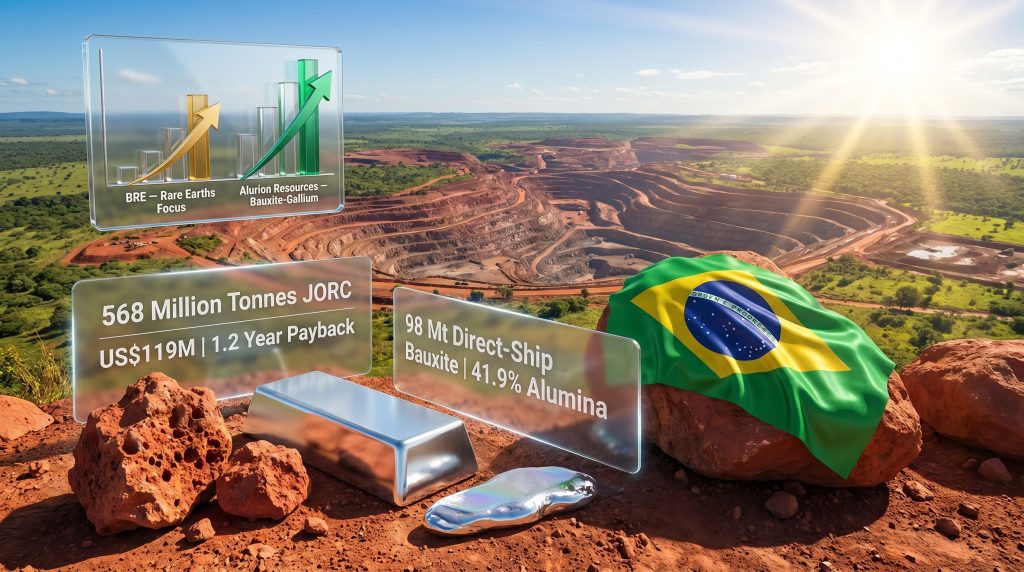
Most development-stage bauxite projects require extensive drilling campaigns before a credible resource estimate can be established. Amargosa arrives at its IPO with a substantial head start. Rio Tinto conducted early exploration across the project area, laying the geological groundwork that Brazilian Rare Earths subsequently built upon through its own programs. The result is a JORC-compliant resource of 568 million tonnes, a scale that sits in rare company among emerging bauxite developments globally.
Within that total resource, 98 million tonnes carries direct-ship bauxite classification at an average alumina grade of 41.9%. This distinction is commercially critical and frequently misunderstood by generalist investors. Direct-ship bauxite can be mined, processed minimally, and exported without passing through a beneficiation plant, which is the capital-intensive facility typically required to upgrade lower-grade material to exportable specification. The absence of beneficiation infrastructure in the first-stage development plan is not a shortcut or a compromise; it reflects genuine ore quality.
The Gallium Dimension: A Dual Critical Mineral Proposition
Bauxite deposits occasionally contain gallium as a trace element within the aluminium-bearing minerals, typically gibbsite, boehmite, or diaspore. Gallium is not mined as a primary product anywhere in the world; it is almost exclusively recovered as a byproduct of aluminium refining. This makes every significant bauxite-alumina operation a potential gallium source, but only when the ore characteristics and processing economics align.
Gallium's importance has escalated sharply in recent years. The role of gallium in semiconductors underpins radar systems, 5G infrastructure, electric vehicle power electronics, and solar panel efficiency improvements. China controls an estimated 80% or more of global refined gallium production, a concentration that has triggered export restrictions and supply anxiety among manufacturers in Western nations. The co-occurrence of gallium potential at Amargosa positions Alurion as a dual critical mineral developer with exposure to both the conventional aluminium supply chain and the emerging semiconductor materials market.
Gallium is one of the few critical minerals where supply concentration arguably exceeds even that of rare earth elements, making any credible alternative source of meaningful scale strategically valuable to non-Chinese buyers.
How the Brazilian Rare Earths Demerger of Alurion Resources Actually Works
The Mechanics of the Separation
The structural design of this transaction follows a well-established capital markets template: an in-specie distribution combined with a concurrent IPO. The sequence works as follows:
- Brazilian Rare Earths establishes a record date, at which point the shareholder register is snapshotted to determine entitlements.
- Eligible shareholders on the record date receive 0.5607 Alurion Resources shares for every BRE share held, at no cost and without any requirement to participate in the IPO.
- Alurion Resources conducts a public offer targeting up to A$50 million in fresh capital to fund project advancement.
- Existing BRE shareholders receive priority allocation rights within the IPO, giving them the option to increase their Alurion position at the offer price before the general public.
- Alurion Resources seeks independent ASX listing as a standalone critical minerals development company.
- Brazilian Rare Earths retains approximately 17 to 18% of Alurion post-IPO, maintaining alignment between the two entities.
The 0.5607 ratio reflects the relative value attributed to the Amargosa asset within BRE's broader portfolio at the time of structuring. It is not an arbitrary number; it represents the board's assessment of fair distribution of existing shareholder value into the new vehicle. For further detail on the Amargosa project demerger, Brazilian Rare Earths has published its formal announcement through standard ASX channels.
Key Transaction Metrics at a Glance
| Metric | Value |
|---|---|
| Total JORC Resource | 568 million tonnes |
| Direct-Ship Bauxite Component | 98 million tonnes |
| Alumina Grade (Direct-Ship) | 41.9% |
| Stage 1 Development Cost (Scoping) | US$119 million |
| Projected Payback Period | 1.2 years |
| IPO Fundraising Target | Up to A$50 million |
| In-Specie Share Ratio | 0.5607 Alurion per BRE share |
| BRE Retained Stake Post-IPO | ~17 to 18% |
| BRE Share Price Movement on Announcement | +4.9% to A$5.60 |
| Canaccord Genuity Price Target for BRE | A$8.00 |
What BRE Shareholders Actually Receive
The in-specie distribution model is one of the most shareholder-friendly mechanisms available in corporate restructuring. Unlike a trade sale where proceeds are retained at the corporate level, an in-specie spin-off delivers asset exposure directly into shareholder portfolios. BRE investors who hold their shares through the record date will find themselves with two separate holdings: their original BRE position, now representing a purer rare earths and critical minerals exposure focused on the Bahia province, plus a new Alurion position with direct leverage to Amargosa's development trajectory.
The priority allocation right within the IPO adds another layer of optionality. Shareholders who form a positive view on Alurion's standalone prospects can elect to increase their position at the IPO price, while those who prefer not to participate simply retain the in-specie shares they receive.
The Bauxite Supply Problem No One Talks About Enough
Guinea's Grip on the Global Supply Chain
The aluminium industry's raw material supply chain has quietly undergone a structural shift that carries significant geopolitical weight. Guinea, a West African nation with substantial governance challenges and infrastructure constraints, now supplies approximately 70% of China's imported bauxite feedstock. This level of concentration would be considered alarming in any strategic industry, and aluminium is no peripheral commodity; it is essential to aerospace, automotive manufacturing, construction, packaging, and renewable energy infrastructure.
China processes the majority of the world's alumina and aluminium, meaning Guinea's bauxite effectively underpins a significant proportion of global metal supply. Any disruption to Guinean exports, whether from political instability, infrastructure failure, or resource nationalism, would reverberate through aluminium markets with speed and force. Furthermore, critical mineral export controls of the kind already implemented for gallium demonstrate just how rapidly supply chains can be weaponised by dominant producers.
The Aluminium Supply Chain: A Primer
For investors unfamiliar with the upstream structure:
- Bauxite is the ore. It contains aluminium oxide in mineral form (primarily gibbsite, boehmite, and diaspore) embedded in iron-rich laterite material.
- Alumina (aluminium oxide, Al₂O₃) is produced by refining bauxite through the Bayer Process, which uses hot caustic soda to dissolve the aluminium minerals and precipitate pure alumina.
- Aluminium metal is produced by smelting alumina through the Hall-Heroult electrolytic process, which is extremely energy-intensive.
- Approximately 4 to 5 tonnes of bauxite are required to produce one tonne of aluminium metal, underscoring the strategic importance of upstream supply security.
Where Brazil Fits in the Global Picture
Brazil is already among the leading bauxite production leaders globally, with established operations in Pará and Minas Gerais states. However, the Bahia region where Amargosa sits represents a relatively underexplored frontier within Brazil's bauxite landscape. The project's logistics profile, including proximity to port infrastructure relative to interior Amazon basin deposits, forms part of the cost competitiveness argument embedded in the first-quartile cost curve positioning ambition cited in the scoping study.
Assessing the Development Plan: Simplicity as a Competitive Advantage
Why Low-Capex Direct-Ship Matters in the Current Capital Environment
Junior resource companies seeking project financing in 2025 and 2026 face a materially different lending environment than the resource boom era. Debt capital for development-stage miners is available but expensive, and equity markets reward capital efficiency. Against this backdrop, the Amargosa first-stage development design carries genuine appeal.
| Phase | Feature |
|---|---|
| Stage 1 Mining | Direct-ship bauxite without beneficiation |
| Infrastructure Requirement | No tailings facility or major fixed plant |
| Capital Cost (Scoping) | US$119 million |
| Payback Period (Scoping) | ~1.2 years |
| Cost Curve Target | First quartile globally |
| Expansion Pathway | Larger resource base supports future stages |
A US$119 million development cost with a 1.2-year payback, if validated through subsequent definitive feasibility studies, would represent an exceptional return profile by any standard in the mining industry. For context, many comparably sized bauxite or laterite projects carry development costs exceeding US$300 million and payback periods of three to seven years.
It is important to note that scoping study outcomes are preliminary by nature. They carry a higher level of uncertainty than pre-feasibility or definitive feasibility studies and should not be treated as confirmed development economics. Investors should review updated studies as they become available.
Comparing Amargosa to Typical Development-Stage Bauxite Projects
| Attribute | Amargosa (Alurion) | Typical Early-Stage Bauxite Project |
|---|---|---|
| Resource Size | 568 Mt total JORC | Often sub-100 Mt |
| Direct-Ship Component | 98 Mt at 41.9% alumina | Frequently requires beneficiation |
| Infrastructure Requirement | Minimal by design | Often capital-intensive |
| Payback Period (Scoping) | ~1.2 years | Typically 3 to 7 years |
| Stage 1 Development Cost | US$119 million | Often US$300M+ at comparable scale |
| Exploration Pedigree | Rio Tinto + BRE programs | Highly variable |
Brazil's Critical Minerals Moment and What It Means for Capital Flows
A Nation Sitting on an Underutilised Resource Endowment
Brazil holds the second-largest rare earth reserves on the planet, yet its current production remains a fraction of what its geological endowment would suggest is possible. The same pattern applies to bauxite, niobium, lithium, and several other strategic minerals. The gap between reserve base and production reality reflects decades of infrastructure underinvestment, complex permitting environments, and the historical dominance of a few large incumbents.
That dynamic is shifting. Western governments seeking to reduce dependency on Chinese processing capacity have identified Brazil as one of a small number of geologically endowed, diplomatically accessible jurisdictions capable of contributing meaningfully to alternative supply chains. Consequently, critical minerals demand from Western buyers has driven a wave of investment attention, exemplified by the proposed US$2.8 billion acquisition of Serra Verde by USA Rare Earth, a transaction significant enough to attract scrutiny from Brazil's antitrust regulator, CADE.
Capital Allocation Trends: What the Demerger Signals
The Brazilian Rare Earths demerger of Alurion Resources reflects a broader maturation trend in ASX-listed critical minerals companies. Early-stage explorers often aggregate multiple projects into a single vehicle to spread overhead costs and maintain market relevance. As projects advance toward development, however, the single-vehicle model becomes a constraint. Different projects require different management expertise, different investor audiences, and different capital structures.
Separating Amargosa into Alurion Resources allows the bauxite-gallium project to attract dedicated industrial minerals investors and commodity-focused institutions that may have limited appetite for rare earth exposure. Conversely, BRE's remaining portfolio can appeal more cleanly to the specialist rare earth investment community without the bauxite narrative creating analytical complexity.
The next major ASX story will hit our subscribers first
Key Risks Investors Should Evaluate Before the Alurion IPO
Transparency about risk is essential when evaluating any development-stage resource company. The following factors warrant careful consideration:
- Scoping study limitations: The US$119 million development cost and 1.2-year payback are based on scoping-level analysis, which carries a cost accuracy range typically of plus or minus 35 to 50%. Pre-feasibility and feasibility studies could revise these figures materially in either direction.
- Commodity price sensitivity: Bauxite is not traded on a centralised exchange like many metals. Prices are typically set through bilateral contracts, making market price benchmarking more opaque than for exchange-traded commodities. Gallium prices are highly volatile and thinly traded.
- New company execution risk: Alurion will be a newly formed entity with a management team that must demonstrate its capacity to execute against the development plan. Track record at the project level exists through BRE's stewardship, but organisational capability as a standalone entity remains to be demonstrated.
- IPO pricing and liquidity: Small-cap resource IPOs on the ASX can experience significant early volatility. Liquidity in the secondary market may be limited in the months following listing.
- Jurisdiction complexity: Brazil offers a substantial geological endowment but also a regulatory and permitting environment that can introduce timeline uncertainty for development-stage projects.
- Record date and IPO timeline: As of the announcement, neither the record date nor the IPO completion date had been formally confirmed. Investors should monitor ASX releases from Brazilian Rare Earths for updated timelines.
Frequently Asked Questions: BRE Demerger and Alurion Resources
What is the Brazilian Rare Earths demerger of Alurion Resources?
Brazilian Rare Earths (ASX: BRE) is separating its Amargosa Bauxite-Gallium Project into a newly incorporated company called Alurion Resources Ltd, which will seek an independent ASX listing following a public offer targeting up to A$50 million in fresh capital.
How many Alurion shares will BRE shareholders receive?
Shareholders on the register at the announced record date will receive 0.5607 Alurion Resources shares for each Brazilian Rare Earths share held, at no cost to the shareholder.
What does BRE focus on after the split?
Post-demerger, Brazilian Rare Earths concentrates exclusively on advancing its core rare earth and critical minerals portfolio in the Bahia province, described by management as one of the most strategically significant rare earth provinces globally.
Why is bauxite considered strategically important right now?
Bauxite is the sole commercial feedstock for aluminium production. With Guinea supplying approximately 70% of China's imported bauxite and China dominating global aluminium processing, supply chain concentration has elevated the strategic premium on new, reliable-jurisdiction bauxite sources.
What role does gallium play in the Amargosa project?
Gallium occurs naturally within bauxite deposits and is recovered as a byproduct during alumina refining. Given China's dominance of global gallium supply and its strategic importance to semiconductor and defence electronics manufacturing, gallium co-production potential adds a second critical mineral dimension to the Amargosa asset beyond conventional bauxite value.
Has the IPO date been confirmed?
As of the announcement date, the record date and IPO completion timeline remained to be finalised. Investors should refer directly to ASX announcements from Brazilian Rare Earths for updated information on the Brazilian Rare Earths demerger of Alurion Resources and any changes to the proposed transaction structure.
This article contains general information only and does not constitute financial advice. It has been prepared without taking into account any individual's investment objectives, financial situation, or needs. Past performance is not indicative of future results. Investing in development-stage resource companies involves significant risk, including the possible loss of capital. Scoping study outcomes are preliminary and subject to material revision. Readers should seek independent financial advice before making any investment decision.
Readers interested in Brazil's broader role in global critical minerals supply chains can find additional sector context through Motley Fool Australia's resources coverage at fool.com.au.
Want To Be First When the Next Major Mineral Discovery Hits the ASX?
Discovery Alert's proprietary Discovery IQ model scans ASX announcements in real time, instantly identifying significant mineral discoveries across critical commodities — from bauxite and gallium to rare earths — and delivering actionable alerts directly to subscribers before the broader market can react. Explore why historic mineral discoveries have generated extraordinary returns and begin a 14-day free trial today to secure a market-leading edge.