June 11, 2026
The Structural Shift Redefining Who Builds the World's Energy Infrastructure
Battery chemistry has quietly become one of the most consequential disciplines in modern infrastructure planning. For most of the past decade, the conversation centred almost exclusively on electric vehicles: range anxiety, charging networks, and the race to drive down per-kilowatt-hour costs. However, a deeper transformation has been underway beneath that surface narrative, one that is now reshaping how the world's largest battery manufacturer allocates its capital, its R&D resources, and its long-term ambitions.
The CATL energy storage pivot from EV batteries represents far more than a single corporate announcement. It signals a fundamental reordering of where battery technology creates the most durable economic value, and which end markets offer the most structurally resilient demand. Understanding that reordering requires stepping back from the headline numbers and examining the confluence of forces that made this pivot not just logical, but arguably inevitable.
When big ASX news breaks, our subscribers know first
From Two Percent to Fifty: The Arithmetic of a Strategic Repositioning
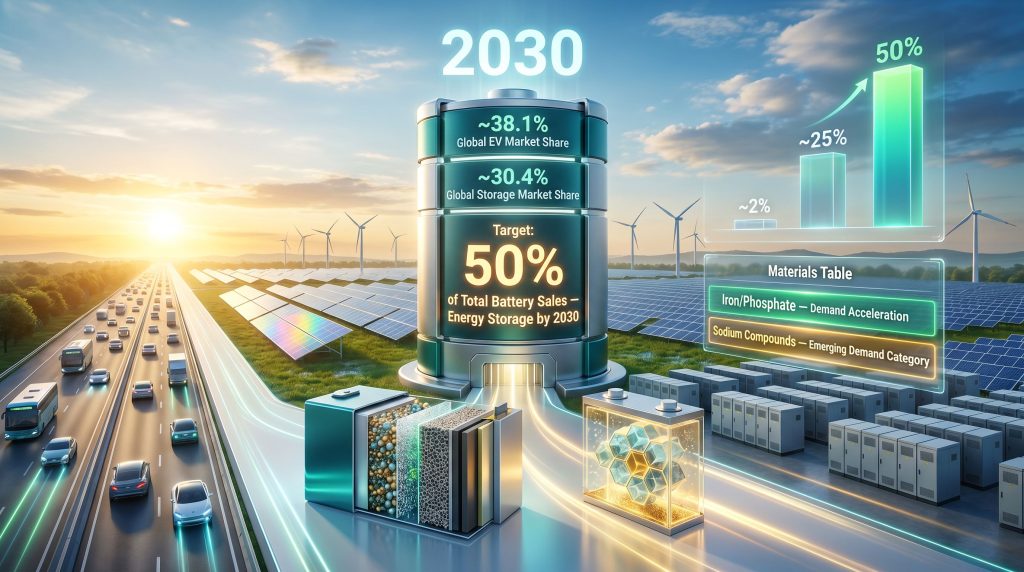
Five years ago, stationary energy storage accounted for roughly 2% of CATL's total sales. That figure has since risen to approximately 25%, and the company has publicly committed to reaching 50% by 2030. This is not a reactive pivot triggered by a single market disruption. It reflects a deliberate, multi-year capital allocation strategy that predates the current policy environment in both China and the United States.
To contextualise the scale of CATL's market position before examining why this shift matters:
| Metric | Value |
|---|---|
| Global EV battery market share | ~38.1% |
| China domestic battery market share | ~50% |
| Global energy storage market share | ~30.4% |
| Current energy storage share of total sales | ~25% |
| Energy storage share of total sales five years ago | ~2% |
| Target energy storage share of total sales by 2030 | 50% |
| Consecutive years as world's largest stationary storage supplier | 5 years |
What makes this pivot structurally significant is the combination of existing dominance and growth trajectory. CATL is not entering stationary storage as a newcomer seeking early-mover advantage. It has held the position of the world's largest supplier of stationary storage batteries for five consecutive years. The 2030 target is therefore an acceleration of an existing trajectory, not a course correction. Furthermore, the broader battery storage expansion underway globally is creating the demand conditions that make this target commercially achievable.
Investor Consideration: When a single company controls more than one-third of global EV battery supply and simultaneously commands nearly a third of global energy storage capacity, its portfolio rebalancing decisions ripple through critical minerals markets, grid infrastructure investment timelines, and EV pricing dynamics across multiple continents. This is not a niche corporate story.
Three Macro Forces Converging at the Same Moment
Policy Disruption and the Evaporation of EV Demand Certainty
The rollback of Biden-era EV incentive structures under the Trump administration introduced a level of demand uncertainty into North American EV markets that proved difficult for supply chain participants to absorb. For companies like General Motors and LG, which had built medium-term capacity planning around the assumption of sustained EV subsidy frameworks, the sudden policy reversal created an urgent need to identify alternative growth vectors.
Grid-scale energy storage absorbed much of that redirected strategic attention. Unlike EV demand, which fluctuates with consumer sentiment, model availability, and subsidy cycles, utility-scale storage procurement is driven by grid operators and energy companies with long-term capital commitments and relatively inelastic demand profiles. The contrast made energy storage a compelling hedge. For instance, Ford's pivot to energy storage using Chinese battery technology illustrates how this strategic reorientation is playing out across the broader automotive sector.
General Motors communicated this perspective directly. Kurt Kelty, the company's Vice President of Batteries, Propulsion and Sustainability, stated publicly that the market for grid-scale batteries and backup power is no longer simply expanding, it is becoming essential infrastructure, with electricity demand climbing at an accelerating pace that requires domestically deployable storage solutions. This framing, positioning battery storage as critical national infrastructure rather than a consumer product category, has become a recurring theme across the industry.
AI Data Centres and the Inelastic Electricity Demand Phenomenon
The exponential buildout of artificial intelligence infrastructure has created a category of electricity demand that behaves differently from almost every other consumption variable in the energy system. Data centre power requirements are not subject to the behavioural elasticity that characterises residential or even industrial demand. Operators do not reduce server loads because electricity prices rise.
They procure the energy security they need, at whatever cost is necessary, because downtime carries consequences measured in hundreds of millions of dollars per hour. This inelastic demand characteristic makes AI data centre power procurement structurally valuable for energy storage developers. Grid operators serving hyperscale data centre clusters require dispatchable, reliable storage capacity that can smooth renewable intermittency and provide frequency regulation services.
The predictability of that demand, combined with the premium pricing tolerance of the customer base, creates commercial storage opportunities with unusually durable economics. Consequently, the battery metals investment landscape is increasingly being shaped by these data centre demand signals rather than EV adoption rates alone.
Geopolitical Energy Risk and the Storage Security Premium
Ongoing Middle East conflict, including disruption scenarios around the Strait of Hormuz, has compressed the typical adoption timeline for grid-scale battery deployments. Nations and corporations facing acute fossil fuel supply uncertainty are accelerating storage procurement not as an energy transition measure, but as a hard-nosed risk management decision.
This geopolitical dimension introduces a demand driver that is largely independent of clean energy policy frameworks. Even in environments where renewable energy incentives are weakened or withdrawn, the energy security case for storage investment remains compelling. For CATL, this means its stationary storage growth thesis does not depend on any single government's policy commitments.
Chemistry as Competitive Strategy: LFP, Sodium-Ion, and the Material Cost Equation
Why LFP Dominates Stationary Storage Applications
Lithium iron phosphate chemistry has become the dominant technology for stationary storage deployments, and understanding why requires a brief chemistry primer. LFP cells sacrifice energy density compared to nickel manganese cobalt formulations, but deliver superior thermal stability, a substantially longer cycle life (often exceeding 4,000 to 6,000 charge cycles before meaningful degradation), and a materially lower cost structure.
In a stationary storage application, where physical footprint is less constrained than inside a vehicle and cycle longevity directly determines revenue over the system's operating life, LFP's trade-offs become advantages. CATL's dominance in LFP chemistry gives it a structural cost advantage in bidding for large-scale grid storage contracts. The absence of cobalt in LFP formulations also removes a supply chain vulnerability that has historically destabilised battery economics and created ESG procurement complications for utility customers.
Sodium-Ion: The Long-Duration Differentiator
Perhaps the least widely understood dimension of CATL's storage strategy is its investment in sodium-ion battery technology. Sodium-ion cells replace lithium with sodium, which is orders of magnitude more abundant and geographically distributed than lithium reserves. The commercial implications are significant:
- Material cost reduction: Sodium is dramatically cheaper than lithium as a raw material, with no comparable price volatility history
- Supply chain diversification: Reduced exposure to lithium price cycles, which have historically swung by 60% to 80% within single calendar years
- Cobalt and nickel elimination: Sodium-ion architectures remove two of the most geopolitically sensitive battery materials from the supply chain entirely
- Thermal performance: Sodium-ion cells maintain electrochemical stability across a wider temperature range than many lithium formulations
The trade-off is energy density. Sodium-ion cells currently deliver lower energy per kilogram than lithium alternatives. For applications where volume and weight are constrained, this matters. For ground-mounted grid storage installations where physical space is plentiful and the priority is cost per kilowatt-hour delivered over a 20-year project life, the density trade-off is commercially acceptable. In addition, CATL's sodium-ion mass production launch signals that this technology is transitioning from pilot to commercial scale.
Speculative Insight: If sodium-ion manufacturing scales to the point where cost per kilowatt-hour falls below LFP, it could fundamentally restructure the economics of long-duration storage and reduce the lithium intensity of global grid buildout by a meaningful margin. This is not yet the consensus view, but it represents a plausible medium-term scenario that battery analysts are beginning to model seriously.
How CATL's Critical Minerals Exposure Shifts With the Pivot
The CATL energy storage pivot from EV batteries does not simply redistribute battery volumes across application categories. It changes which materials are consumed in what quantities, with downstream implications for commodity markets.
| Material | EV Battery Role | Storage Battery Role | Net Direction |
|---|---|---|---|
| Lithium | High demand, NMC and LFP | Continues in LFP, declines in sodium-ion | Demand profile shifts, total volume depends on sodium-ion adoption rate |
| Cobalt | NMC chemistry requirement | Largely absent in LFP storage | Potential demand softening |
| Iron and Phosphate | LFP EV chemistry | LFP dominant in stationary storage | Accelerating demand |
| Sodium Compounds | Minimal current role | Sodium-ion storage growth | Emerging demand category |
| Manganese | LMFP chemistry development | Grid storage applications | Growing strategic relevance |
| Nickel | NMC EV chemistry | Limited storage application | Potential demand softening |
The most consequential implication for critical minerals investors is the potential softening of cobalt and nickel demand relative to consensus forecasts built on EV-centric adoption models. Furthermore, innovations in direct lithium extraction could further reshape the lithium supply equation as demand profiles shift with the storage pivot. If CATL's storage pivot is replicated across the industry, cobalt demand forecasts in particular may need material downward revision.
The Second-Life Battery Economy: Value Recovery as a Parallel Revenue Architecture
Retired EV Batteries as a Storage Asset Class
EV batteries reaching the end of their useful vehicle service life typically retain 70% to 80% of their original electrochemical capacity. At that degradation threshold, they no longer meet the range performance standards required by automotive applications, but they remain viable for stationary storage where round-trip efficiency requirements are less demanding.
The value recovery opportunity is substantial. Each repurposed battery pack can generate thousands of dollars in additional energy value through an extended operating life in solar or wind storage applications. For EV manufacturers, fleet operators, and recycling companies, this creates a supply chain economics model where battery value does not terminate at vehicle retirement. Progress in battery recycling in China is further demonstrating how closed-loop material recovery can complement second-life strategies.
The Waymo and B2U Model
Waymo, the autonomous vehicle company, has entered a partnership with B2U Storage Solutions to develop a commercial second-life battery program across California and Texas. The program converts retired robotaxi battery packs into stationary storage units supporting renewable energy grids. This model is particularly notable because autonomous vehicle fleets generate predictable, high-volume battery retirement streams at known intervals, creating a supply chain certainty that scattered consumer EV retirements cannot match.
The commercial logic is compelling in theory. However, the practical constraints are significant:
- Volume immaturity: The total volume of retired EV batteries currently available for second-life processing remains insufficient to support industrial-scale operations
- Chemistry variability: Batteries from different manufacturers, vintages, and duty cycles degrade differently, complicating automated refurbishment workflows
- Upfront capital intensity: Testing, repackaging, and system integration infrastructure requires substantial investment before unit economics become favourable
- Standardisation gaps: The absence of common form factors and battery management system protocols across manufacturers increases processing cost per unit
As Latitude Media reported, recycling companies are only now beginning to encounter meaningful volumes of recyclable EV battery materials, making it genuinely difficult to operate refurbishment facilities at the throughput levels required for favourable economics. The Chinese battery recycling breakthrough may, however, offer scalable processing insights applicable to second-life operations globally. The Waymo model is a commercially significant proof of concept, but it is not yet a scalable template.
The next major ASX story will hit our subscribers first
Competitive Scenario Analysis: What the Pivot Means for the Broader EV Battery Market
Three Plausible Trajectories to 2030
Scenario A: Gradual Transition (Base Case)
CATL expands storage revenues at a faster compound rate than EV battery revenues while maintaining absolute EV battery volumes. Competitors gain incremental EV market share without experiencing a supply shock. EV battery prices remain broadly stable.
Scenario B: Accelerated Storage Scaling
CATL prioritises storage manufacturing capacity investment at the direct expense of EV battery expansion. Global EV battery supply tightens. Korean and Japanese suppliers gain strategic positioning in premium automotive segments. Consumer EV prices firm in markets already constrained by battery cost.
Scenario C: Full Portfolio Bifurcation
CATL effectively operates as two parallel businesses with separate capital allocation frameworks, manufacturing footprints, and management structures. The storage division targets utility and grid operator customers while the EV division maintains automotive OEM relationships. Each business optimises independently.
Analyst Warning: Scenario B carries the most significant implications for EV affordability in emerging markets, where battery costs remain the primary barrier to mass adoption. A reduction in CATL's incremental EV capacity expansion could disproportionately affect price-sensitive consumers in Southeast Asia, Latin America, and parts of Africa, where EV penetration is still in early stages.
The 2030 Target in Context: What Success Actually Requires
Reaching 50% storage revenue share by 2030 requires CATL to approximately double storage's contribution to total revenues from its current ~25% level. This implies storage revenues growing at a materially higher compound annual rate than EV battery revenues over the next four years. Three structural forces are expected to sustain that differential:
-
Renewable energy capacity expansion: Global solar and wind installation rates are creating an expanding addressable market for grid-scale storage. The International Energy Agency has projected that battery storage capacity additions need to increase by a factor of six by 2030 to support clean energy transition pathways.
-
AI and data centre electricity demand: Inelastic, high-growth electricity consumption from digital infrastructure is creating premium-priced storage procurement that was not modelled in most pre-2023 market forecasts.
-
Energy security imperatives: Geopolitical instability and fossil fuel supply disruption risk are compressing adoption timelines and creating procurement urgency that substitutes for policy incentives in markets where clean energy support frameworks are weakening.
The scenario also carries dependencies: continued global renewable energy investment, sustained AI infrastructure buildout, and grid modernisation investment in key markets. These are plausible but not guaranteed. Consequently, the CATL energy storage pivot from EV batteries should be understood as a directional strategic commitment rather than a certified financial forecast, and investors should treat the 50% target accordingly.
Disclaimer: This article is intended for informational purposes only and does not constitute financial or investment advice. Forward-looking statements regarding CATL's strategic targets, market share projections, and technology development timelines involve assumptions and uncertainties that may cause actual outcomes to differ materially from those described. Readers should conduct their own due diligence before making any investment decisions.
Want to Capitalise on the Next Major Battery Minerals Discovery Before the Broader Market?
As the structural shift from EV batteries to grid-scale energy storage reshapes critical minerals demand — from lithium and iron phosphate to emerging sodium compounds — Discovery Alert's proprietary Discovery IQ model delivers real-time ASX alerts the moment a significant mineral discovery is announced, turning complex data across 30+ commodities into clear, actionable opportunities. Explore how historic mineral discoveries have generated substantial returns, then begin your 14-day free trial at Discovery Alert to position yourself ahead of the next major find.