August 22, 2026
The Midstream Gap That Could Make or Break Shale's Next Frontier
Every major shale basin in history has confronted the same paradox: the faster upstream production grows, the more urgently it exposes the infrastructure that isn't there yet. The Permian Basin learned this lesson painfully in the late 2010s when flaring rates surged and wellhead gas prices briefly went negative because takeaway capacity couldn't keep pace with the drill bit. Vaca Muerta, Argentina's vast shale formation in the Neuquén province, is now navigating an almost identical inflection point, but with one critical difference: the capital is arriving before the crisis fully materialises.
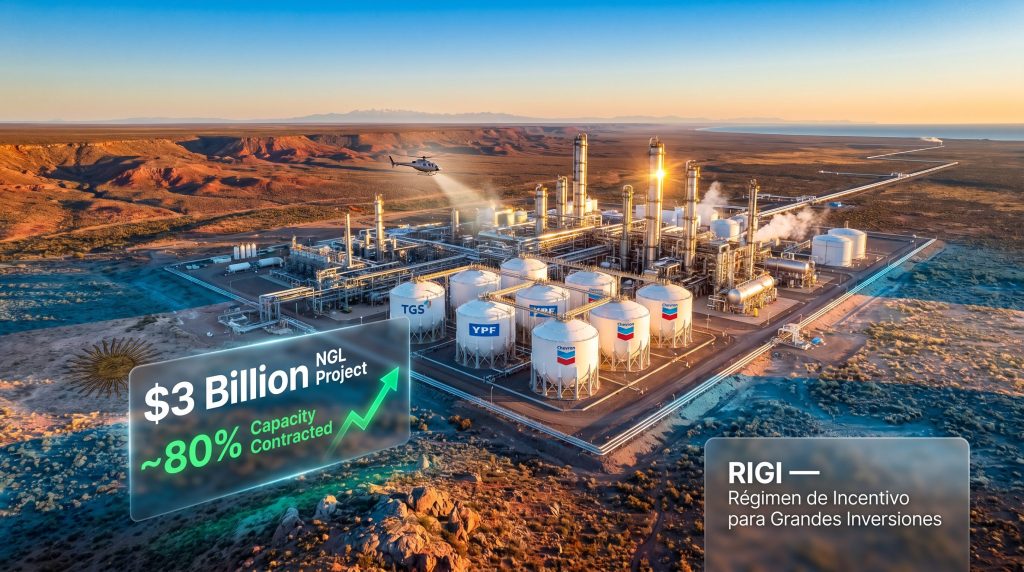
The decision by Chevron to join YPF and Pluspetrol in backing a $3 billion natural gas liquids (NGL) processing venture led by Transportadora de Gas del Sur (TGS) is far more than a midstream infrastructure announcement. It is a statement of strategic conviction by three of the most consequential operators in the basin, and it effectively pre-empts the bottleneck problem that has constrained Vaca Muerta's export ambitions for years.
When big ASX news breaks, our subscribers know first
Understanding the Associated Gas Problem in Vaca Muerta
When shale oil wells are drilled and fractured, they produce crude oil as the primary target, but natural gas invariably comes along for the ride. This co-produced stream, known as associated gas, becomes a logistical and commercial challenge when processing infrastructure doesn't exist at sufficient scale to handle it.
In the absence of dedicated separation and fractionation facilities, upstream operators face a set of unattractive choices:
- Flare the gas at the wellhead, wasting a valuable hydrocarbon and generating environmental liability
- Reinject it back into the reservoir, deferring value and consuming compression energy
- Throttle oil production rates to stay within whatever limited gas processing capacity exists
That third option is the most commercially damaging because it directly caps the revenue-generating potential of the oil well itself. As Vaca Muerta's shale oil output has accelerated, particularly through the productive Loma Campana and Bandurria Sur blocks, the associated gas volumes have grown proportionally, making the midstream processing constraint increasingly acute.
Natural gas liquids represent the most commercially attractive way to resolve this problem. NGLs are the heavier hydrocarbon components — specifically butane, propane, ethane, and condensate — that can be separated from the raw gas stream during processing. Unlike dry pipeline gas, which requires domestic demand or LNG export terminals to monetise, NGLs are internationally tradeable commodities that can be loaded onto tankers and shipped to petrochemical markets in Asia, Europe, and across Latin America.
Natural gas liquids (NGLs) are hydrocarbon components, including butane, propane, ethane, and condensate, separated from raw natural gas during processing. In shale basins like Vaca Muerta, NGLs extracted from associated gas streams represent a high-value export commodity distinct from both dry gas and crude oil.
Propane and butane, the two primary outputs of the TGS project, function as critical feedstocks for petrochemical manufacturing and residential cooking fuel across emerging markets. Their pricing is benchmarked against international LPG indices, giving Argentine producers direct exposure to global LPG benchmarks rather than the more constrained domestic gas pricing environment.
What the TGS NGL Project Actually Involves
TGS, formally known as Transportadora de Gas del Sur, operates Argentina's largest natural gas transmission network and holds extensive midstream infrastructure across the Neuquén basin. The company is the developer and operator behind the NGL processing venture, which involves constructing dedicated separation, fractionation, and export loading facilities capable of handling associated gas volumes from Vaca Muerta's shale oil wells.
The financial architecture of the project combines direct equity investment from TGS with external bank financing. Lenders are reported to be in advanced stages of finalising credit terms, a process that has been significantly de-risked by the anchor capacity contracts now being executed.
| Parameter | Detail |
|---|---|
| Total Project Value | ~$3 billion USD |
| Primary Developer | TGS SA |
| Anchor Partner Capacity | ~80% of total project throughput |
| Financing Structure | TGS equity + external bank debt |
| Primary Output Products | Butane, propane, and exportable NGLs |
| Feedstock Source | Associated gas from Vaca Muerta shale oil wells |
The significance of the 80% capacity commitment cannot be overstated from a project finance perspective. In midstream infrastructure development, lenders require contracted revenue streams before they will advance debt capital. A facility with only 20% of its capacity uncontracted carries a fundamentally different credit risk profile than one with zero committed volumes. The three anchor partners have effectively neutralised the primary bankability obstacle in a single move.
Chevron Joins YPF and Pluspetrol: The Consortium That Changes Everything
Chevron's Escalating Commitment to Vaca Muerta
Chevron has operated in Vaca Muerta for over a decade, establishing technical credibility through its long-running upstream partnership with YPF. That relationship, centred on the Loma Campana block, gave Chevron deep familiarity with the formation's reservoir characteristics and operational requirements.
Participation in the TGS NGL project signals a deliberate shift toward vertical integration. By securing dedicated processing capacity, Chevron ensures that its upstream production volumes have a guaranteed midstream outlet, eliminating the throughput uncertainty that can suppress drilling programme economics.
The NGL commitment sits alongside an even larger strategic declaration: Chevron has applied under President Javier Milei's RIGI investment incentive framework for a separate $13.8 billion oil drilling programme in the Vaca Muerta basin. This application represents one of the most substantial US corporate investment commitments to Argentina since the current administration took office in late 2023.
Chevron's simultaneous backing of midstream NGL infrastructure and a multi-billion-dollar upstream drilling programme reflects a long-horizon conviction in Vaca Muerta's tier-one global competitiveness, not opportunistic deal participation driven by short-term pricing cycles.
YPF's Role as the Sovereign Anchor
As Argentina's national oil company, YPF brings more than production volumes to the consortium. Its participation functions as a form of sovereign-backed capacity guarantee that materially improves lender confidence. International banks financing energy infrastructure in emerging markets look closely at whether a state-owned entity is party to the throughput contracts, because sovereign involvement typically implies a lower probability of commercial disruption.
YPF holds the largest acreage position in Vaca Muerta and has been the primary architect of the formation's commercialisation strategy. Its involvement in the NGL project aligns logically with its stated goal of transforming Argentina from a net energy importer — which it was as recently as the early 2010s — into a significant global hydrocarbon exporter. This ambition is further supported by the broader Argentina resource opportunity that continues to attract international capital across multiple commodity sectors.
Pluspetrol: Independent Validation of Commercial Logic
Pluspetrol is one of Latin America's most substantial privately held upstream operators, with operational presence across Argentina, Peru, and broader Andean markets. The company has been expanding its gas processing infrastructure at La Calera in Neuquén, positioning itself within the NGL and LNG export supply chain that is beginning to take shape across the basin.
The fact that Pluspetrol, as an independent private operator with no state backing, has committed capacity alongside YPF and Chevron provides a commercially objective validation of the project's economics. Private operators with capital discipline do not commit to long-term throughput contracts on projects whose financial logic is questionable.
From Contract Signing to First Exports: The FID Pathway
Large-scale midstream infrastructure projects follow a structured development sequence that moves from commercial agreements through financing to construction and commissioning. The capacity contracts being executed by the three anchor partners represent a pivotal step in that sequence.
- Upstream producers quantify midstream requirements — Operators assess associated gas volumes, NGL content in the gas stream, and the processing capacity needed to support planned drilling programmes
- TGS designs facility specifications — Engineering studies, cost estimates, and capacity allocation frameworks are developed based on contracted volumes
- Anchor capacity contracts are executed — Chevron, YPF, and Pluspetrol commit to long-term throughput volumes covering approximately 80% of project capacity
- Bank financing reaches financial close — Contracted revenues underpin the debt service model, allowing lenders to complete credit documentation
- Final Investment Decision is declared — TGS formally sanctions the project, triggering mobilisation of engineering, procurement, and construction (EPC) contractors
- Construction and commissioning — A multi-year build phase targeting separation, fractionation, and export loading infrastructure
- First NGL exports commence — Processed butane and propane enter international commodity markets
The contract signings and FID are described as going hand in hand, meaning the commercial and sanction steps are being treated as near-simultaneous events rather than sequential milestones separated by months of further negotiation.
Vaca Muerta's Broader Midstream Transformation
The TGS NGL facility is a single node within a larger and increasingly coordinated infrastructure network. Running parallel to the gas processing buildout is the Vaca Muerta Sur (VMOS) pipeline, a crude oil export corridor connecting Neuquén production directly to an Atlantic marine terminal capable of accommodating Very Large Crude Carriers (VLCCs), the largest class of oil tankers in global service.
Chevron, alongside YPF, Pluspetrol, Shell, Vista, Pampa Energía, and Pan American Sur, has been reported as holding equity options in VMOS S.A., the corporate vehicle behind the oil export pipeline. The simultaneous development of NGL processing and crude oil export infrastructure suggests a coordinated strategic logic rather than a series of independent commercial decisions.
Argentina vs. Competing Shale and Hydrocarbon Frontiers
| Dimension | Vaca Muerta (Argentina) | Permian Basin (USA) | Offshore Brazil (Pre-Salt) |
|---|---|---|---|
| Formation Type | Shale/Tight Oil and Gas | Shale/Tight Oil | Deepwater Carbonate |
| Infrastructure Maturity | Rapidly developing | Highly mature | Mature offshore |
| Foreign Investment Climate | Reform-driven acceleration | Stable, established | Stable, licensing-based |
| NGL Export Infrastructure | Under construction | Fully operational | Limited |
| Key Policy Driver | RIGI investment incentives | Established regulatory framework | ANP licensing rounds |
What the comparison above illustrates is that Vaca Muerta is at an earlier but rapidly advancing stage of infrastructure maturity than the Permian. The NGL processing gap that currently constrains the basin is the same problem that constrained the Permian a decade ago, and closing it through committed capital at scale is the proven mechanism for unlocking exponential production growth.
The next major ASX story will hit our subscribers first
Argentina's RIGI Framework and the Investment Climate Shift
The Milei administration's Régimen de Incentivo para Grandes Inversiones, or RIGI, offers qualifying large-scale projects a package of preferential tax treatment, import duty exemptions, and long-term regulatory stability commitments. The framework is designed specifically to attract the kind of multi-billion-dollar, multi-year capital commitments that Argentina's upstream and midstream sectors require.
Chevron's $13.8 billion upstream RIGI application is among the most prominent foreign investment commitments made under the programme to date. The scale of that application, combined with the NGL capacity commitment, reflects a corporate assessment that Argentina's policy trajectory has improved sufficiently to justify long-duration capital exposure.
It is worth distinguishing between policy framework availability and project-specific support. RIGI is a broadly available incentive structure that any qualifying project can apply to access. Chevron's application represents the company seeking to utilise that framework, not a guarantee of approval or a form of government backing specific to its projects.
Risks That Investors and Observers Should Not Overlook
Macroeconomic and Sovereign Risk
Argentina's history includes multiple sovereign debt restructurings, periods of acute currency instability, and policy reversals that have previously caused foreign capital withdrawal at scale. While the Milei administration's reform programme has improved the macro environment, investors making long-duration commitments to Argentine infrastructure must factor in:
- Residual currency risk and the trajectory of peso stabilisation efforts
- The possibility of policy continuity risks beyond the current electoral cycle
- Contractual protections typically sought by foreign investors, including dollar-denominated revenue structures and international arbitration clauses
Construction Execution Risk
A $3 billion facility build in an emerging market environment carries material execution risk. Cost overruns, specialised contractor availability, equipment procurement timelines, and permitting sequencing can all introduce delays or budget pressure. Bank financing terms have not yet formally closed, introducing some residual timing variability before FID is formally declared.
NGL Price Sensitivity
Butane and propane export economics are directly tied to international LPG benchmark prices, which in turn correlate with crude oil price cycles. Furthermore, the broader global oil benchmarks that underpin hydrocarbon pricing more generally can amplify or compress NGL project returns significantly. A sustained low-price environment for hydrocarbons could consequently alter the relative attractiveness of NGL extraction versus alternative gas monetisation pathways, such as domestic pipeline supply or LPG and LNG trade into Asian markets.
This article contains forward-looking references and analysis based on publicly available information. It does not constitute financial advice. Readers should conduct independent due diligence before making any investment decisions related to the companies or projects discussed.
Frequently Asked Questions
What is the TGS NGL project in Vaca Muerta?
The TGS NGL project is a $3 billion natural gas liquids processing venture led by Transportadora de Gas del Sur in Argentina's Neuquén province. It is designed to convert associated gas from Vaca Muerta shale oil wells into exportable liquid hydrocarbons, primarily butane and propane, resolving a critical midstream infrastructure gap that has constrained upstream production growth.
Why did Chevron join YPF and Pluspetrol in backing the Vaca Muerta NGL project?
Chevron joins YPF and Pluspetrol in backing the Vaca Muerta NGL project primarily to secure dedicated midstream processing capacity that supports its upstream drilling programmes in the basin. The NGL commitment also complements Chevron's separate $13.8 billion oil drilling programme application under Argentina's RIGI investment incentive framework, reflecting a vertically integrated strategic approach to the Vaca Muerta opportunity.
What is RIGI and why does it matter for Vaca Muerta investment?
RIGI is Argentina's Régimen de Incentivo para Grandes Inversiones, a large-scale investment incentive framework introduced under President Javier Milei. It offers qualifying projects tax advantages, import duty exemptions, and long-term regulatory certainty. Access to RIGI is available to any qualifying project that meets the programme's thresholds, and it has become an important factor in improving Argentina's attractiveness for major upstream and midstream capital commitments.
How does the TGS NGL project differ from the Vaca Muerta Sur pipeline?
These are distinct but strategically complementary infrastructure projects. The TGS NGL facility processes associated gas into liquid hydrocarbons for international export. The Vaca Muerta Sur pipeline is a crude oil export corridor linking Neuquén basin production to an Atlantic marine terminal capable of loading VLCC-class tankers. Together, they form part of the coordinated midstream buildout that underpins Vaca Muerta's transition from a domestic supply basin to a global energy exporter.
What are the main risks in the Vaca Muerta NGL project?
Key risks include Argentina's macroeconomic and sovereign risk history, construction execution challenges common to large-scale emerging market infrastructure builds, unfinished bank financing documentation, and sensitivity of NGL export economics to international LPG and crude oil price cycles.
Want to Track the Next Major Resource Discovery Before the Market Moves?
Discovery Alert's proprietary Discovery IQ model delivers real-time alerts on significant ASX mineral discoveries — cutting through complex data across more than 30 commodities to surface actionable opportunities the moment they are announced. Explore historic discoveries and their exceptional returns to understand why early positioning matters, then begin your 14-day free trial to secure a market-leading edge.