May 18, 2026
The Invisible Gas That Could Reshape Global Resource Security
Few commodities expose the fragility of modern industrial civilisation quite like helium. Unlike iron ore, copper, or even lithium, helium cannot be manufactured, synthesised, or meaningfully substituted in its most critical applications. Once released into the atmosphere, it escapes Earth's gravity permanently. It is, in the most literal sense, a finite and irreplaceable resource, and the systems that supply it to the world are under mounting strain.
That strain is now visible in market data, in industrial procurement boardrooms, and increasingly in the strategies of exploration companies positioning themselves to fill an emerging void. Among those companies, Noble Helium Ltd (ASX: NHE, OTC: NBHEF) and its flagship Noble Helium North Rukwa project in Tanzania represent one of the most closely watched development stories in the sector heading into the second half of 2026.
When big ASX news breaks, our subscribers know first
A Market Under Simultaneous Pressure From Multiple Directions
The Supply Shock That Changed Everything
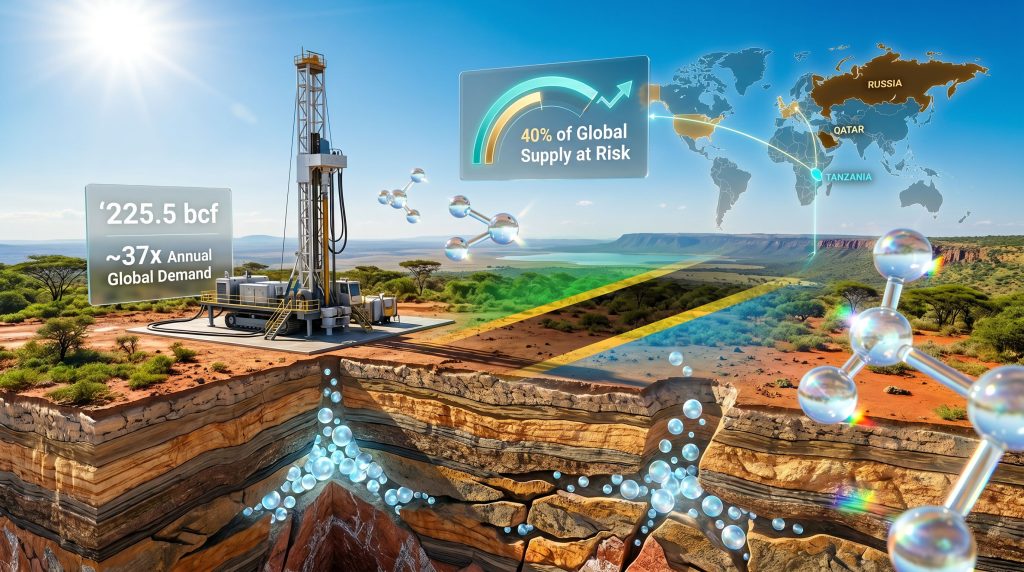
The global helium supply crisis has been driven by two simultaneous and structurally distinct shocks. Russia's decision to halt helium exports removed a meaningful share of globally traded supply at a stroke, while prolonged technical and operational difficulties affecting helium output from Qatar, one of the world's largest producers, compounded the shortfall. Together, these disruptions have placed an estimated 40% of global helium supply in question, a figure that has sent supply anxiety rippling through industrial supply chains from semiconductor fabs to hospital imaging departments.
What makes this situation particularly challenging for buyers is the nature of helium itself:
- It cannot be stockpiled efficiently at scale without significant infrastructure investment in cryogenic containment
- It has no functional substitute in applications such as MRI superconducting magnets, semiconductor wafer fabrication, and cryogenic research environments
- Global annual consumption sits at approximately 6 billion cubic feet (bcf), a figure that is expected to rise as technology sectors including artificial intelligence, nuclear fusion research, and space launch systems expand their helium dependency
- Over 95% of commercially produced helium arrives as a byproduct of natural gas processing, meaning supply is structurally intertwined with fossil fuel economics
Why This Is a Structural Problem, Not a Cyclical One
It is worth understanding why the current supply crisis differs from previous helium shortages. Earlier disruptions, such as the periodic instability caused by the managed drawdown of the US Federal Helium Reserve, were largely cyclical and policy-driven. The present situation is more complex.
The convergence of geopolitical disruption and technical failures across two major producing regions means the supply gap is unlikely to self-correct quickly. Furthermore, the long lead times required to develop new helium production capacity — which can span years from exploration to first commercial output — mean that supply responses are slow even when commercial incentives are strong. This also mirrors broader critical minerals demand surge dynamics playing out across multiple resource sectors simultaneously.
This creates a rare window in the commodity cycle where exploration-stage companies with credible, large-scale resource positions may attract significant interest from industrial buyers seeking long-term supply security, well before any production commences.
Why Tanzania and the Rukwa Basin Are Attracting Serious Geological Attention
A Different Kind of Helium Deposit
The East African Rift Valley is home to one of the most geologically distinctive helium-generating environments on the planet. To understand why, it helps to know how most helium forms commercially. In conventional hydrocarbon-associated deposits, helium is a trace component of natural gas extracted alongside methane. The helium concentrations are typically low, and the economics of recovery are tied entirely to the viability of the associated gas project.
The Rukwa Basin in southwest Tanzania operates on a fundamentally different geological model. Here, helium is generated through the radioactive decay of uranium and thorium within ancient Precambrian basement rocks, a process that has been occurring over geological timescales measured in billions of years. The helium migrates upward through fault systems created by rifting and accumulates in structural traps within the sedimentary basin above.
This distinction carries several commercially important implications:
- Production economics are independent of oil and gas markets, removing a major source of supply volatility
- ESG-aligned industrial consumers can source helium without the reputational and regulatory complexity of hydrocarbon-linked supply chains
- Helium concentrations in rift-hosted accumulations can be significantly higher than those found in conventional gas fields, potentially improving processing economics
- The geological model is proven in analogous settings across the East African Rift, providing scientific confidence in the prospectivity of the broader region
The North Rukwa Project: Scale That Commands Attention
Noble Helium's North Rukwa project covers approximately 1,467 square kilometres across 12 granted prospecting licences in the Rukwa Basin. The project's certified prospective helium resource of 225.5 bcf positions it among the largest exploration-stage helium resource positions in Africa.
To contextualise that figure:
| Metric | Value |
|---|---|
| Certified prospective resource | 225.5 bcf |
| Annual global helium demand | ~6 bcf |
| Resource-to-demand ratio | ~37x annual global consumption |
| Project area | ~1,467 km² |
| Granted prospecting licences | 12 |
The Mbelele-1 well, drilled at an earlier stage of the program, provided direct geological validation of the project's prospectivity. Mud-gas readings during drilling detected helium above background levels across an interval from approximately 75 metres to 125 metres depth, confirming that the system is actively generating and trapping helium as the geological model predicted.
Collaborative geoscientific work conducted alongside the University of Dar es Salaam, including shallow seismic surveys and resistivity profiling, has further matured the company's drilling targets and refined its understanding of the structural trapping mechanisms present across the licence area.
Inside the Kinambo Drilling Campaign
Program Design and Technical Preparation
The upcoming drilling campaign at the Kinambo prospect within the Noble Helium North Rukwa project area represents Noble Helium's most operationally advanced milestone to date. The program comprises five wells targeting both the Mbelele-1A and Kinambo prospects, with objectives spanning both confirmation of existing helium indications and testing of deeper gas horizons with the potential for resource expansion.
What has been done before the first drill bit turns:
- Extensive peer review by international geoscientists and technical advisory board members
- Completion of shallow seismic and resistivity surveys in partnership with the University of Dar es Salaam
- Detailed structural geological mapping to identify optimal well locations and target intervals
- Full drilling contractor and rig procurement, with mobilisation to site underway
- Geological de-risking work described internally as producing highly encouraging early indications
Drilling is scheduled to commence during the first two weeks of July 2026, with the rig already contracted and logistics in active progress. The initial well at Mbelele-1A will target a probable free gas zone in a shallow offset configuration, designed to deliver rapid confirmation data before moving to the deeper Kinambo targets.
Capital Position and Funding Allocation
Noble Helium secured A$12 million in a capital raising completed in April 2026, providing dedicated funding for the Noble Helium North Rukwa drilling campaign. The allocation of those proceeds covers:
- Full execution of the five-well drilling program
- Technical appraisal work and data interpretation post-drilling
- Early-stage commercialisation analysis to support future offtake discussions
The level of technical preparation invested before drilling is notably extensive for an exploration-stage company, reflecting both the scale of the opportunity being tested and the commercial sensitivity of delivering credible results to an increasingly attentive market.
Helium as a Strategic Resource: The Rare Earth Parallel
Reclassifying Helium in the Critical Minerals Conversation
An important but underappreciated dimension of the current helium market dynamic is the gradual shift in how governments and industrial strategists are categorising the gas. For much of its commercial history, helium was treated as a specialty industrial gas — important but not strategically classified in the way that rare earth elements, cobalt, or lithium have been.
That framing is beginning to change. The convergence of supply concentration risk, irreplaceability in critical technology applications, and accelerating demand from sectors deemed strategically important has led to helium appearing more frequently in critical minerals analyses and national supply chain reviews. Indeed, the strategic supply chain risks associated with helium now closely parallel those that have long surrounded rare earth elements.
The key technology sectors driving incremental helium demand include:
| Sector | Helium Application | Strategic Sensitivity |
|---|---|---|
| Medical imaging | MRI superconducting magnet cooling | Extremely high |
| Semiconductor manufacturing | Wafer fabrication and process cooling | Very high |
| Artificial intelligence | Data centre and quantum system cooling | Rapidly growing |
| Nuclear fusion research | Superconducting magnet systems | Strategically critical |
| Space launch systems | Rocket pressurisation and purging | Mission-critical |
| Aerospace and defence | Leak detection, pressurisation | High |
The Non-Hydrocarbon Advantage in a Decarbonising Economy
Noble Helium's positioning as a non-hydrocarbon-linked helium producer addresses a structural preference that is beginning to crystallise among large industrial buyers. As energy security pressures tighten supply chain scrutiny across many industries — mirroring the energy security pressures reshaping critical minerals procurement more broadly — procurement officers at semiconductor companies, medical device manufacturers, and technology firms are increasingly sensitive to the origins of their critical inputs.
Helium sourced from rift-basin geology, without any connection to oil and gas extraction infrastructure, offers a cleaner supply chain profile. Over the long term, as natural gas processing volumes face pressure from decarbonisation policy across multiple jurisdictions, non-hydrocarbon helium sources may represent the only growth vector for new primary supply. Furthermore, the uranium market dynamics provide a useful parallel here, demonstrating how geopolitically independent supply sources attract a structural premium during periods of concentrated risk.
Commercial Signals: What Early Customer Engagement Tells Investors
Pre-Drilling Offtake Interest
Noble Helium has disclosed that multiple major helium end-users have proactively contacted the company to discuss future supply arrangements. No formal offtake agreements have been announced, and investors should treat this disclosure as indicative of market interest rather than confirmed commercial outcomes.
Nevertheless, the fact that pre-drilling commercial conversations are occurring at all is meaningful context. Large industrial helium buyers, particularly those in semiconductor manufacturing and medical imaging, typically operate on multi-year procurement horizons and are acutely aware of supply concentration risk. The willingness of such buyers to engage before a resource has been converted from prospective to contingent classification reflects the severity of current supply anxiety.
Catalyst Sequence to Watch Through the Remainder of 2026
For investors and market observers tracking the Noble Helium North Rukwa drilling program, the following sequence of catalysts is expected to drive information flow through the remainder of 2026:
- Rig mobilisation confirmation to site in the Rukwa Basin
- Drilling commencement at Kinambo, targeted for early July 2026
- Initial well results from Mbelele-1A, testing the probable free gas zone
- Data releases from additional wells across the five-well program
- Resource update potential, with successful results possibly supporting conversion from prospective to contingent classification
- Commercial engagement updates, particularly any developments in formal supply discussions with industrial end-users
The next major ASX story will hit our subscribers first
Frequently Asked Questions: Noble Helium North Rukwa Drilling Tanzania
What is the North Rukwa helium project?
North Rukwa is Noble Helium's flagship helium exploration project in southwest Tanzania's Rukwa Basin. It covers approximately 1,467 km² across 12 granted prospecting licences and holds a certified prospective helium resource of 225.5 bcf, one of the largest such positions in Africa.
When will drilling begin at North Rukwa?
Drilling at the Kinambo prospect is targeted for commencement during the first two weeks of July 2026, with the drilling rig contracted and mobilisation to site underway as of May 2026.
How many wells are planned?
The campaign comprises five wells targeting the Mbelele-1A and Kinambo prospects, designed to confirm existing helium indications and test deeper geological horizons for potential resource expansion.
Why is the global helium market under pressure?
Simultaneous disruptions affecting helium output from Russia and Qatar have placed an estimated 40% of global helium supply at risk, creating strong demand for geopolitically independent new supply sources.
How does Noble Helium's project differ from conventional helium production?
Unlike more than 95% of global helium supply, which originates as a byproduct of natural gas processing, the North Rukwa project targets helium generated through radioactive decay in ancient crustal rocks. This non-hydrocarbon origin makes production economics independent of fossil fuel markets and positions the project favourably against long-term energy transition headwinds.
This article is intended for informational purposes only and does not constitute financial advice. Noble Helium Ltd (ASX: NHE) is an exploration-stage company, and all resource figures cited represent prospective resources carrying inherent geological and commercial uncertainty. Prospective resources have a higher level of uncertainty than contingent or proved resources. Investors should conduct their own independent due diligence and consult a licensed financial adviser before making any investment decision. Past performance is not indicative of future results. Forward-looking statements and timelines referenced in this article are subject to change based on operational, geological, and market conditions.
Want to Stay Ahead of the Next Major ASX Resource Discovery?
Discovery Alert's proprietary Discovery IQ model scans ASX announcements in real time, instantly identifying significant mineral and resource discoveries across more than 30 commodities — delivering actionable insights to subscribers before the broader market reacts. Explore why major resource discoveries have historically generated extraordinary returns and begin your 14-day free trial today to secure a genuine market-leading edge.