May 18, 2026
The Invisible Bottleneck: Why Graphite Anode Processing Could Define the Western Battery Race
Most conversations about battery supply chain risk orbit around lithium, cobalt, and nickel. These metals dominate policy briefings, investor presentations, and news cycles. Yet sitting quietly beneath all of that attention is a material that constitutes the largest single component by weight in every lithium-ion battery cell: graphite. The battery raw materials market has, however, begun to shift focus toward this often-overlooked element.
More specifically, the refined, shaped, and coated form of graphite known as coated spherical purified graphite, or CSPG, forms the anode in virtually every commercial battery produced today. The anode is the negative electrode in a lithium-ion cell. During charging, lithium ions migrate from the cathode and intercalate into the graphite structure of the anode, storing energy at the atomic level.
This mechanism is well understood, but what is less appreciated is how technically demanding the production of anode-grade graphite actually is. Raw graphite concentrate must be micronised into spherical particles, purified to carbon purity levels exceeding 99.95%, and then coated with a carbon layer to control first-cycle lithium loss and improve long-term cycling performance. Each of these steps requires specialised equipment, proprietary process chemistry, and years of product qualification with battery cell manufacturers.
Today, almost the entirety of global CSPG processing capacity sits within China. According to industry estimates, China accounts for well over 90% of anode material production, encompassing both natural and synthetic graphite processing. This concentration reflects decades of integrated industrial development, domestic graphite mining, government-supported research, and deep customer relationships with Chinese battery cell manufacturers. The graphite shortage risks this creates for Western battery producers and automakers attempting to build independent supply chains represent a structural challenge that cannot be resolved simply by announcing new projects.
When big ASX news breaks, our subscribers know first
What Falcon Energy Materials Is Actually Building in Morocco
Against this backdrop, the Falcon Energy Materials anode material project in Morocco is advancing at the Jorf Lasfar industrial zone near Casablanca. The company has made a deliberate strategic shift away from upstream graphite mining and toward what its leadership characterises as the material sciences business: the transformation of graphite concentrate into finished anode material for battery cell manufacturers.
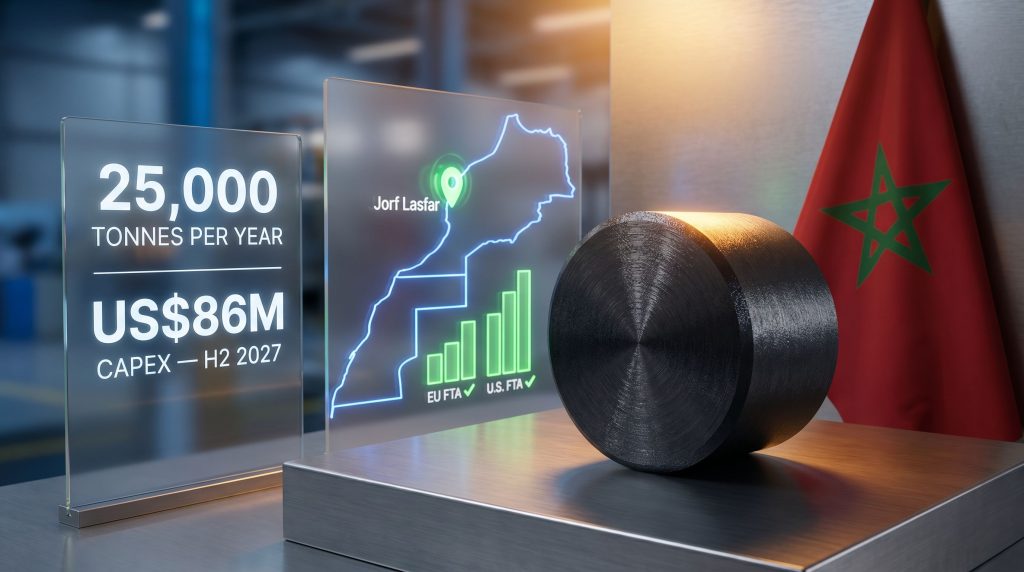
The project targets an annual output of 25,000 tonnes of CSPG, with a capital expenditure of US$86 million confirmed through a robust study completed in November 2025. The target for first production is the second half of 2027, contingent on completing the financing structure, finalising offtake agreements, and progressing through the pilot plant qualification phase.
In April 2026, the company announced a non-binding term sheet for US$70 million in project financing, structured with US$65 million in non-dilutive financing and US$5 million in equity support. The non-dilutive component is particularly significant given the tendency for junior battery materials companies to fund development through repeated equity raises that erode per-share value over time.
The project's key partnerships include:
- Hensen Graphite & Carbon Corporation (partnership announced September 2024): providing technical process knowledge and supply chain integration capabilities
- Fluoralpha (partnership announced May 2025): supporting pilot plant development and broader anode plant buildout
Furthermore, the Falcon Energy Materials anode material project in Morocco represents one of the more advanced non-Chinese CSPG development initiatives currently in the public domain, though it remains in an advanced development phase rather than a construction phase as of mid-2026.
Why Morocco Is Not an Arbitrary Location Choice
The decision to site an anode processing facility in Morocco requires explanation, because at first glance the country does not feature prominently in most Western battery supply chain discussions. The strategic logic, however, is multi-layered and commercially grounded.
The single most structurally important factor is Morocco's dual free trade agreement position. Morocco holds active free trade agreements with both the European Union and the United States. Crucially, the EU and the US do not hold a comprehensive free trade agreement with each other. This creates a rare situation where a single processing facility in Morocco can produce CSPG that qualifies for preferential trade terms in both of the world's two largest electric vehicle markets simultaneously.
| Location Factor | Morocco's Position |
|---|---|
| EU Free Trade Agreement | Active |
| U.S. Free Trade Agreement | Active |
| Major Port Access | Direct industrial port at Jorf Lasfar |
| Renewable Energy Base | Significant solar and wind capacity |
| Industrial Zone Incentives | Special economic zones and tax structures |
| Proximity to European EV Markets | Short Mediterranean shipping distance |
| HF Feedstock Development | Domestic hydrofluoric acid supply project in development |
Beyond trade access, Morocco offers practical industrial advantages. The Jorf Lasfar industrial zone is a purpose-built heavy industrial hub with direct port access, established logistics infrastructure, and proximity to phosphate processing and chemical industries. This matters because CSPG production requires reliable supply of hydrofluoric acid, a hazardous but essential chemical used in the purification stage.
Morocco's development of domestic HF supply capacity creates a potential feedstock adjacency that most competing jurisdictions simply cannot replicate. In addition, Morocco's green energy infrastructure is increasingly relevant. As European battery cell manufacturers face growing pressure to demonstrate low-carbon supply chains, the ability to power processing operations with renewable energy becomes a commercial differentiator, not merely an environmental footnote.
The Project Timeline: Milestones Achieved and the Path Ahead
Understanding where the Falcon Morocco project sits in its development lifecycle requires a clear view of what has already been accomplished versus what remains conditional.
| Milestone | Date | Detail |
|---|---|---|
| Hensen Graphite & Carbon Partnership | September 2024 | Technical process integration and supply chain alignment |
| Fluoralpha Strategic Partnership | May 2025 | Pilot plant and anode plant development support |
| Technical-Economic Study Completion | November 2025 | US$86M capex confirmed; H2 2027 first production target set |
| US$70M Financing Term Sheet | April 2026 | US$65M non-dilutive + US$5M equity; conditions outstanding |
The steps that remain before construction can commence include:
- Finalisation of a binding offtake agreement with a battery cell manufacturer or downstream customer
- Conversion of the non-binding financing term sheet into binding commitments
- Completion of regulatory approvals and permitting requirements in Morocco
- Successful pilot plant production of customer qualification samples
- Customer qualification of those samples against specific battery cell specifications
The pilot plant phase deserves particular attention because it is not merely a technical exercise. In the CSPG industry, each anode material producer must supply sample material that a battery manufacturer tests within its specific cell format, validates against its electrochemical performance targets, and formally qualifies before placing commercial purchase orders. This qualification process can take 12 to 24 months depending on the customer's internal timelines, making early sample production a critical-path activity for the overall project schedule.
The term sheet announced in April 2026 is non-binding and subject to conditions including a finalised offtake agreement. Investors and analysts should treat the project as being in advanced development rather than construction, and monitor offtake progress as the primary leading indicator of advancement toward the financing conversion milestone.
The Bespoke Supply Chain Problem That Policy Rhetoric Ignores
One of the most practically important insights to emerge from serious engagement with the anode materials sector is how poorly the broader policy conversation understands the structural rigidity of the supply chain. Western governments and multilateral bodies frequently discuss battery supply chain resilience as though it were a matter of building sufficient processing capacity in the right jurisdictions. The reality is considerably more constrained.
CSPG production is not a commodity activity. Each anode material facility is engineered to produce a product meeting precise particle size distributions, specific surface area parameters, tap density specifications, and electrochemical performance characteristics co-developed with a specific battery cell customer. That customer's cell format then goes through qualification for specific vehicle platforms at specific automakers.
This means that a new anode plant cannot simply begin producing generic graphite material and expect to find ready buyers. The material must be developed in close collaboration with the intended customer, the plant must be qualified to that customer's specification, and the supply agreement must be in place before the plant can justify its construction financing. This bespoke dynamic is fundamentally different from how policymakers tend to conceptualise supply chain diversification.
A useful way to understand the challenge is through the analogy of bespoke tailoring. The suit is made for one person's measurements. Even if you find someone with a nearly identical build, the fit will be imperfect. Building five anode plants in Western jurisdictions does not create five interchangeable units of supply chain resilience. It creates five highly specific production assets, each of which only delivers value if the full downstream qualification chain is in place.
For Western supply chain ambitions to translate into real industrial capacity, the following conditions must be met simultaneously:
- Offtake agreements signed before or concurrent with construction financing
- Customer qualification processes initiated at the pilot plant stage, not post-construction
- Feedstock supply arrangements secured across the full graphite concentrate, purification chemical, and coating precursor chain
- Financing structures that can tolerate the 18 to 24 month customer qualification cycle without project-level distress
Furthermore, the broader critical minerals demand trajectory only intensifies the urgency of resolving these structural constraints before the decade's end.
Jurisdictional Risk: A Framework Built From Hard Experience
Evaluating where to site a critical minerals project requires a more rigorous framework than simply mapping political risk ratings. The most consequential dimension of jurisdictional risk for any extractive or processing business is security of title: the confidence that the assets you control today will remain yours tomorrow.
This is not an abstract concern. Several mining jurisdictions have moved in recent years toward resource nationalism, renegotiation of concession terms, or in the most severe cases, outright expropriation of mining assets without adequate compensation. When this happens, the damage extends beyond the affected company. Foreign capital withdraws from the entire jurisdiction, and development timelines across the sector collapse.
A practical framework for assessing jurisdictional quality across the dimensions most relevant to battery materials projects would examine:
| Risk Dimension | Key Questions |
|---|---|
| Title Security | Is ownership legally enforceable with a track record of respect? |
| Regulatory Predictability | Are permitting timelines transparent and historically consistent? |
| Trade Framework | Does the jurisdiction provide preferential access to target markets? |
| Infrastructure Readiness | Are ports, energy supply, and logistics already operational? |
| Chemical Supply Access | Can key process inputs be sourced domestically or nearby? |
| Capital Repatriation | Can proceeds be removed without restriction or punitive taxation? |
Morocco performs strongly across most of these dimensions. Its legal system has a documented history of respecting commercial contracts and foreign investment. Its permitting environment, while not without complexity, is broadly predictable. Its combination of port infrastructure, industrial zone development, and emerging chemical feedstock capacity makes it operationally credible for a technically demanding facility like an anode plant.
The broader lesson for project developers is that geopolitical themes — such as domestic content requirements or strategic mineral designations — can create favourable policy environments. However, they cannot substitute for the foundational requirement that the host jurisdiction will honour the legal rights that underpin the investment.
The next major ASX story will hit our subscribers first
Capital Strategy: Why Non-Dilutive Financing Matters for Battery Materials Projects
The financing architecture of the Falcon Morocco project reflects a deliberate approach to preserving equity value through the development phase. The US$65 million non-dilutive component of the term sheet is structured to avoid the repeated equity raises that typically erode shareholder value in junior critical minerals projects.
This matters because battery materials projects occupy a difficult position in the battery metals investment landscape. They are too technically complex and too capital-intensive for retail-driven equity markets to sustain through development, but they have historically lacked the long-term offtake certainty that debt markets require before committing at scale.
The emergence of strategic financing structures — sometimes involving industrial partners, offtake-linked debt facilities, or export credit support — has begun to fill this gap. What institutional and strategic capital providers assess when evaluating projects of this technical specificity goes well beyond financial modelling. They are evaluating whether the management team possesses the technical fluency to understand, defend, and operationally deliver on the claims embedded in their feasibility studies.
The investor base for Falcon Energy Materials includes Lanchca, a sophisticated private mining investment vehicle with a track record across gold and select battery materials investments. While not a large position relative to the size of the fund, the participation of this type of investor signals that the project's technical and commercial logic has been stress-tested against a demanding standard.
The Market Opportunity: Why 25,000 Tonnes of CSPG Is Strategically Meaningful
Global demand for natural graphite anode material is projected to grow substantially through the 2030s, driven by three converging forces:
- EV penetration rates continuing to increase across Europe, North America, and emerging markets
- Battery gigafactory expansions in Europe and North America requiring localised, qualified anode material supply
- Stationary energy storage deployment adding an additional demand vector outside the automotive sector
Against this demand trajectory, the supply picture outside China remains thin. The number of natural graphite CSPG processing facilities operating at commercial scale outside China can be counted on one hand. This is not because the technical knowledge is unavailable, but because the qualification cycle, capital intensity, and offtake dependency have made it difficult for non-Chinese projects to reach financial close.
Consequently, innovations such as recycled graphite products are also emerging to supplement primary supply, though they remain at early stages of commercial scale. A facility producing 25,000 tonnes per year of CSPG would represent a meaningful contribution to Western supply diversity at this stage of market development.
Risk Assessment: What Must Go Right and What Could Go Wrong
A balanced evaluation of the Falcon Energy Materials anode material project in Morocco requires honest acknowledgement of the risks that remain outstanding alongside the milestones already achieved.
Financing conditionality is the most proximate risk. The US$70 million term sheet is non-binding and explicitly conditioned on finalising a binding offtake agreement. Until that offtake agreement is signed, the financing cannot close, and the project cannot move to construction. This is a standard structure for battery materials project finance, but it means that the critical path runs through commercial negotiations with battery manufacturers rather than through engineering or permitting.
Customer qualification timing introduces schedule risk. Even with a signed offtake agreement, the battery manufacturer must qualify the anode material produced at the pilot plant against its internal specifications. If qualification takes longer than projected, or if the initial samples require reformulation, the H2 2027 production target could be under pressure.
Competitive dynamics in the non-Chinese anode space are evolving. Several other projects in Europe, North America, and Africa are pursuing similar positioning, and the number of available offtake slots at major battery manufacturers is finite. First-mover qualification advantages are real in this industry.
Technical scale-up risk from pilot to commercial production is present in every processing project of this type. Particle morphology, coating uniformity, and purification efficiency do not always translate linearly from pilot to full-scale operations, and managing this transition requires experienced process engineering teams.
This article contains references to forward-looking milestones, financial targets, and production timelines that are based on company guidance and have not been independently verified. Readers should conduct their own due diligence and consult a licensed financial adviser before making investment decisions.
Frequently Asked Questions About the Falcon Morocco Anode Project
What is coated spherical purified graphite and why does it matter for batteries?
CSPG is the finished anode material used in lithium-ion batteries. Natural graphite concentrate is processed through shaping, purification, and carbon coating stages to produce particles that can efficiently store and release lithium ions during battery charge and discharge cycles. Its performance characteristics directly affect battery energy density, cycle life, and fast-charging capability.
Where is the Falcon Morocco anode plant located?
The Morocco anode plant is planned for the Jorf Lasfar industrial zone, a major heavy industrial hub located on Morocco's Atlantic coast with direct port access. Jorf Lasfar hosts significant phosphate processing and chemical industry infrastructure.
How much will the Morocco anode plant cost to build?
The technical-economic study completed in November 2025 confirmed a capital expenditure of US$86 million for a facility targeting 25,000 tonnes per year of CSPG output.
When is first production expected?
The company has guided for first production in the second half of 2027, subject to completion of financing, offtake finalisation, and regulatory approvals.
What is the significance of Morocco's free trade agreements?
Morocco holds free trade agreements with both the European Union and the United States. Because the EU and US do not hold a comprehensive FTA with each other, producing CSPG in Morocco provides access to both markets under preferential trade terms from a single facility — a structurally rare advantage.
What is the current financing status of the project?
As of April 2026, the company has secured construction financing via a non-binding term sheet for US$70 million, comprising US$65 million in non-dilutive financing and US$5 million in equity support. The term sheet remains subject to conditions including a binding offtake agreement.
Key Takeaways for Investors and Industry Observers
- Morocco's dual FTA position creates a structurally unique access point for serving both EU and US battery markets from a single processing facility
- CSPG production is technically bespoke: supply chain resilience in anode materials requires end-to-end customer qualification, not simply additional processing capacity
- The US$86 million capex figure and H2 2027 production target establish a credible near-term development pathway, but remain contingent on offtake finalisation
- Non-dilutive financing structures are increasingly important for preserving shareholder value in battery materials projects through the long development and qualification cycle
- Jurisdictional selection must be evaluated across title security, trade access, infrastructure readiness, and feedstock adjacency rather than geopolitical themes alone
- The pilot plant qualification phase is the critical operational milestone to monitor before the financing term sheet can convert to binding commitments
Listeners interested in hearing directly from mining executives navigating the battery materials supply chain can explore the Dig Deep Mining Podcast, where industry conversations on critical minerals strategy, jurisdictional risk, and capital markets are regularly featured.
Want To Stay Ahead Of The Next Major Battery Materials Discovery?
Discovery Alert's proprietary Discovery IQ model instantly scans ASX announcements across 30+ commodities — including critical battery materials like graphite — delivering real-time alerts on significant mineral discoveries before the broader market reacts. Explore how historic discoveries have generated substantial returns on the Discovery Alert discoveries page, and begin your 14-day free trial today to ensure you never miss a market-moving opportunity.