June 8, 2026
The Structural Trap Africa Has Been Trying to Escape for Decades
Raw material wealth and economic prosperity are not the same thing. This distinction sits at the heart of why so many resource-rich African nations have remained structurally poor despite sitting atop some of the world's most valuable mineral and energy deposits. The problem is not a lack of resources. It is a lack of industrial transformation. Value is not captured at the point of extraction. It is captured at the point of processing, manufacturing, and distribution. For generations, that value capture has happened elsewhere.
Nigeria's current industrial agenda under President Bola Tinubu represents a deliberate attempt to break this pattern. The Tinubu Africa-first industrial strategy is not simply a domestic growth plan. It is a structural argument about who should benefit from Africa's resource endowments, and how the continent can reposition itself within global supply chains before another commodity cycle passes without lasting development.
When big ASX news breaks, our subscribers know first
Why Nigeria's Industrial Pivot Matters Beyond Its Own Borders
Nigeria is not just another developing economy pursuing industrialisation. As the largest economy in sub-Saharan Africa, representing roughly 17% of the region's total GDP, its economic trajectory carries disproportionate influence over continental outcomes. When Nigeria industrialises, it creates demand for inputs from neighbouring economies, builds supply chain linkages that can anchor regional trade, and signals to international investors that African manufacturing is a credible asset class.
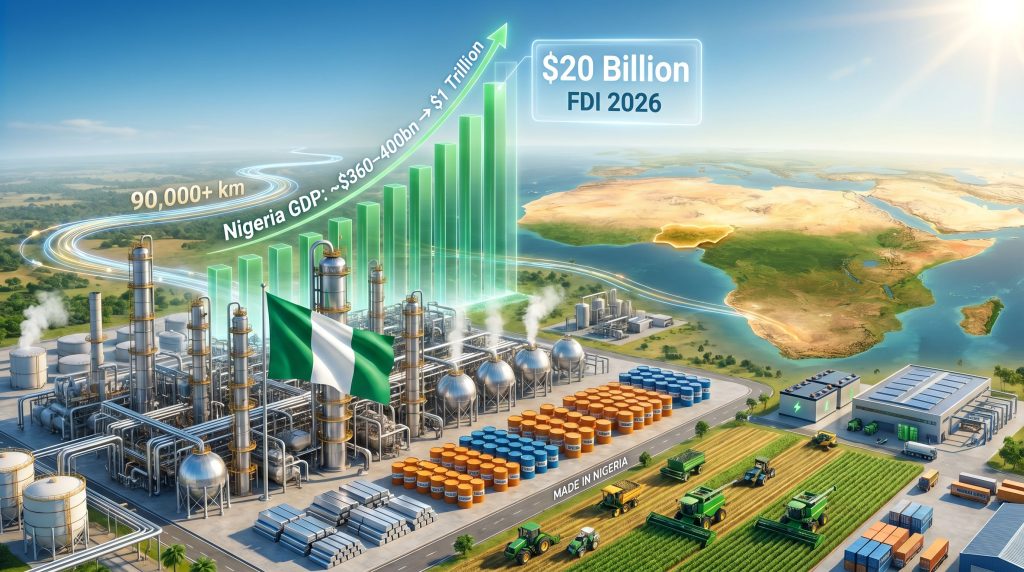
The scale of the ambition is significant. Nigeria's current GDP sits in the range of $360 to $400 billion in nominal terms, and the administration has explicitly tied its industrial programme to a national target of reaching $1 trillion in GDP. That is not a modest increment. It requires near-tripling of economic output, with industrialisation rather than oil revenue identified as the primary growth engine.
Comparable transitions have happened before. Indonesia and Vietnam both underwent manufacturing-led structural transformation over 15 to 20 year horizons through disciplined policy consistency and sustained infrastructure investment. Neither began from a position of industrial strength. Both required deliberate choices to absorb short-term disruption in exchange for long-term structural gains. Nigeria is now making similar bets.
The Nigeria Industrial Policy 2025–2035: Architecture of a Ten-Year Roadmap
The centrepiece of the Tinubu Africa-first industrial strategy is Nigeria's first comprehensive industrial policy framework, structured as a formal ten-year roadmap. President Tinubu's launch of this policy signals an intent to move beyond aspirational declarations toward concrete industrial architecture. The policy is built around six interlocking pillars:
- Manufacturing expansion across key domestic production sectors
- Export competitiveness to position Nigerian industries in regional and global markets
- Local value chain development ensuring raw materials are processed domestically before export
- Infrastructure enablement covering energy, logistics, and digital connectivity
- Skills and workforce alignment connecting technical education to industrial labour demand
- Public-private partnerships mobilising private capital alongside government facilitation
What distinguishes this framework from previous Nigerian industrial policy attempts is its explicit integration with continental trade architecture. The policy does not exist in isolation. It is designed to function as a supply-side anchor within the African Continental Free Trade Area, positioning Nigerian manufacturers as producers for a market of 1.4 billion African consumers rather than solely the domestic market of 220 million.
| Metric | Current Estimate | Strategic Target |
|---|---|---|
| Nigeria GDP (nominal) | ~$360–400 billion | $1 trillion |
| Manufacturing share of GDP | ~9–10% | 20%+ |
| Intra-African trade share | ~15–16% of African trade | Significantly expanded |
| Fibre optic infrastructure | 90,000+ km deployed | Nationwide digital backbone |
The $20 Billion FDI Projection: Reform as Investment Signal
At the Africa CEO Forum in Kigali, Rwanda, President Tinubu stated publicly that Nigeria is on course to attract close to $20 billion in foreign direct investment in 2026. That figure carries weight only if the structural conditions supporting it are sustainable.
The reforms credited with restoring investor confidence are substantive:
- Removal of foreign exchange controls that had previously deterred capital inflows and enabled significant rent-seeking through currency arbitrage
- Elimination of fuel subsidies, freeing fiscal resources for productive infrastructure and industrial investment
- Regulatory simplification across manufacturing, energy, and digital sectors
Nigeria spent approximately two years navigating the consequences of a sharp naira devaluation and record consumer price inflation. That period compressed real incomes and rattled investor sentiment. The FX liberalisation, while painful in the short term, normalised exchange rate discovery and removed the round-tripping risk that had made Nigeria particularly unattractive to foreign capital seeking transparent operating environments.
The critical investor calculus for Nigeria is whether reform momentum is durable or dependent on a single administration's political will. Structural reforms that outlast election cycles generate compounding credibility dividends. Those that do not tend to trigger sharp capital reversals when political conditions shift.
Furthermore, African mining finance trends suggest that reform credibility is increasingly decisive in directing capital toward processing and industrial investment, rather than purely extractive operations.
Energy Sector Industrialisation: The Dangote Refinery as a Policy Model
Perhaps no single asset better illustrates the gap between Nigeria's resource position and its historical industrial reality than its refining capacity. Nigeria has been one of Africa's most significant crude oil producers for decades, yet remained heavily dependent on imported refined petroleum products for most of that period. Foreign exchange reserves were systematically drained by fuel import bills that should never have existed at that scale.
The Dangote Petroleum Refinery changes that calculus. With a nameplate capacity of 650,000 barrels per day, it is the largest single-train refinery in the world and has positioned Nigeria as a net exporter of petroleum motor spirit, aviation fuel, and other refined derivatives rather than a net importer. Tinubu has specifically cited the refinery as a demonstration of what public-private cooperation can produce in capital-intensive industrial sectors.
The refinery model carries replicable lessons:
- Scale matters: Industrial facilities built to export-competitive scale change unit economics fundamentally
- Private capital can lead: Government's role is facilitation, regulatory clarity, and risk-sharing rather than direct ownership
- Downstream diversification follows: A functioning refinery creates demand for petrochemical industries, packaging, and related manufacturing
| Sector | Current Status | Strategic Direction |
|---|---|---|
| Petroleum refining | 650,000 bpd Dangote capacity operational | Reduce import dependency; expand exports |
| Battery manufacturing | Early-stage policy framework | Leverage mineral resources for domestic production |
| Mineral processing | Largely raw export model | Enforce value-addition requirements before export |
| Renewable energy | Nascent investment pipeline | Industrial energy supply diversification |
Value-Addition Mandates: Nigeria's Raw Material Export Restriction Policy
One of the most consequential and contested elements of the Tinubu Africa-first industrial strategy is its position on raw material exports. The administration has stated clearly that no metal should leave Nigeria without first undergoing domestic value addition. This is a structural policy choice with direct implications for battery supply chains, petrochemicals, and agricultural commodity processing.
The comparison to Indonesia is instructive and intentional. Indonesia's nickel strategy involved a 2020 nickel ore export ban that was initially met with significant international pushback, including a World Trade Organisation challenge from the European Union. Yet within several years, that ban had catalysed more than $15 billion in domestic nickel processing investment, transforming the country into a critical node in the global electric vehicle battery supply chain.
Zimbabwe has pursued a parallel approach with lithium and platinum group metals, with early data suggesting that export restrictions have driven mineral sales toward nearly $1 billion as processing capacity has begun to develop domestically. Similarly, Chile's lithium strategy demonstrates how value-addition requirements can anchor industrial capacity in resource-rich economies over time.
The value-addition mandate is not without risk. Export bans can deter upstream mining investment, trigger trade disputes, and create short-term revenue gaps if downstream processing capacity is not built fast enough. Nigeria's execution of this policy will depend heavily on how quickly it can attract processing-oriented industrial investment to fill the gap.
Africa holds approximately 30% of the world's critical mineral reserves yet captures a disproportionately small fraction of the value generated across those supply chains. The broader critical minerals demand picture reinforces why this matters: every stage of processing that happens domestically represents value retained within the economy rather than transferred abroad.
The next major ASX story will hit our subscribers first
Digital Infrastructure: 90,000 Kilometres and What It Means for Industry
Nigeria has deployed more than 90,000 kilometres of fibre optic cable nationally as part of its digital connectivity drive. The industrial implications extend well beyond consumer broadband access:
- E-commerce enablement connecting domestic manufacturers to regional and global markets without traditional intermediary costs
- Agricultural supply chain digitisation reducing post-harvest losses through real-time logistics coordination and storage management
- Technical education delivery supporting the workforce development pipeline needed to staff industrial facilities
- Financial inclusion infrastructure enabling digital payments critical for small and medium manufacturing enterprises
| Infrastructure Type | Traditional Industrial Model | Nigeria's Current Approach |
|---|---|---|
| Physical logistics | Roads, ports, rail | Roads and ports integrated with digital logistics |
| Energy | Grid power | Grid combined with distributed renewables and industrial zones |
| Connectivity | Basic telephone networks | 90,000+ km fibre combined with mobile broadband |
| Finance | Bank branch networks | Digital payments integrated with fintech infrastructure |
Agricultural Industrialisation: The Often Overlooked Growth Multiplier
Agricultural value chain development receives less attention than energy and manufacturing in discussions of Nigerian industrial policy, yet it functions as a critical multiplier across the entire system. Nigeria's government has embedded mechanised farming zones and structured post-harvest storage infrastructure within its broader industrial framework.
The rationale is compelling. Post-harvest losses for certain perishable crops in Nigeria are estimated at 40 to 50%, representing an enormous destruction of value that undermines rural incomes, food security, and agricultural investment returns simultaneously. Reducing those losses through cold chain infrastructure, improved storage, and digitised logistics creates economic value without requiring additional land or inputs.
Beyond waste reduction, agricultural industrialisation generates upstream demand for domestic manufacturing: processing equipment, packaging materials, agricultural machinery, and logistics infrastructure. Within the AfCFTA framework, processed food exports represent a significant opportunity. Nigeria's scale, climate diversity, and large domestic consumer base give it natural competitive advantages in food processing that manufacturing-only strategies cannot replicate.
The National Industrial Manpower Development Policy: Skills as a Strategic Input
Physical infrastructure and policy frameworks cannot drive industrialisation if the workforce capable of operating modern industrial facilities does not exist. The Tinubu administration has recognised this explicitly through Nigeria's first National Industrial Manpower Development Policy, which attempts to align the technical education and vocational training system with the actual skill demands of the industrial sectors the economy is trying to build.
Nigeria's demographic position makes this policy critically important. With a median age of approximately 18 years and one of the world's fastest-growing working-age populations, the country has a genuine demographic dividend available to it. Whether that dividend translates into industrial productivity or social fragility depends almost entirely on how effectively skills investment is targeted and delivered.
The Manufacturers Association of Nigeria has specifically identified skills gaps, alongside financing constraints, as the two most critical structural barriers to industrial expansion. Policy frameworks that ignore workforce development in favour of infrastructure alone historically underdeliver on industrial output targets.
The AfCFTA Dimension: Why Regional Integration Is Inseparable From Industrial Scale
Intra-African trade currently represents only approximately 15 to 16% of total African trade volume, compared to more than 60% for intra-European trade. That gap represents both a profound structural failure and an enormous untapped opportunity. Nigerian manufacturers gaining preferential access to 54 African markets under AfCFTA changes the fundamental economics of domestic industrial investment.
Tinubu has been unambiguous that AfCFTA must move from a framework document to operational reality. His Africa-first positioning, delivered publicly at the Africa CEO Forum, was that the continent must follow through on commitments with tangible financial and institutional action rather than allowing the agreement to remain aspirational.
Key sectors positioned to benefit most from AfCFTA market access include:
- Processed foods and agricultural commodities
- Petrochemicals and refined energy products
- Textiles and apparel manufacturing
- Pharmaceuticals and healthcare products
- Consumer goods and fast-moving packaged goods
The Credit Rating Agency Critique: A Financing Argument, Not Just Politics
Tinubu used the Africa CEO Forum platform to challenge major Western credit rating agencies, arguing that their methodologies systematically undervalue African economies and misrepresent the continent's risk profile relative to its actual growth fundamentals.
This critique connects directly to the industrial financing problem in ways that are often underappreciated. Rating methodology matters because it determines borrowing costs. If Nigerian sovereign bonds, and by extension Nigerian corporate borrowers, are rated below their fundamental creditworthiness, then the cost of industrial financing is artificially elevated. The broader metals and mining geopolitics context further illustrates how financial architecture shapes which economies capture industrial value.
The structural biases identified include:
- Overweighting of political risk relative to economic fundamentals in African sovereign assessments
- Underrepresentation of informal economic activity that constitutes a substantial share of African GDP
- Benchmark comparisons weighted toward advanced-economy performance standards that do not reflect emerging market growth trajectories
The proposed solution is not lobbying for more favourable ratings but building African-owned financial architecture: deeper continental capital markets, stronger development finance institutions such as the African Development Bank and Afreximbank, and expanded intra-African investment flows that reduce dependence on external capital formation.
The Execution Gap: Where Policy Ambition Meets Structural Reality
Nigeria has produced industrial policy frameworks before. The 2025 to 2035 roadmap is differentiated by its comprehensiveness, its continental integration, and its explicit linkage to a measurable $1 trillion economy target. However, Tinubu himself has framed the measure of success in concrete operational terms: factories built, jobs created, and exports generated. Not documents published.
The Manufacturers Association of Nigeria has welcomed the policy direction while issuing clear-eyed warnings about execution risks. Their assessment identifies several priority barriers:
| Challenge | Current State | Required Intervention |
|---|---|---|
| Industrial financing | Significant credit access gaps for manufacturers | Development finance, concessional lending, de-risking instruments |
| Energy reliability | Persistent power supply inconsistency | Industrial power zones, off-grid solutions, grid reform |
| Regulatory environment | Improving but still complex | Further streamlining, single-window approvals |
| Infrastructure gaps | Roads, ports, and logistics constrained | Sustained capital expenditure, PPP frameworks |
| Skills misalignment | Technical workforce shortfall | Manpower development policy implementation |
The financing gap identified by Nigerian manufacturers is not a marginal concern. Without accessible and affordable capital, even well-designed policy frameworks will consistently underdeliver. Industrial investment decisions are made on the basis of expected returns relative to cost of capital. Artificially high borrowing costs suppress investment below the level that policy intent alone cannot compensate for.
How Nigeria Compares: Regional and Global Industrial Benchmarks
| Country | Industrial Strategy | Key Focus | Stage |
|---|---|---|---|
| Nigeria | Industrial Policy 2025–2035 | Manufacturing, energy, minerals, digital | Active implementation |
| South Africa | Industrial Policy Action Plan | Automotive, green economy, advanced manufacturing | Ongoing, multi-cycle |
| Kenya | Bottom-Up Economic Model | Manufacturing, food security, affordable housing | Policy evolution phase |
| Ethiopia | Industrial Parks Strategy | Export-oriented light manufacturing | Established, expanding |
| Rwanda | Made in Rwanda / Vision 2050 | High-value services, light manufacturing | Advanced implementation |
| Indonesia | Nickel ore ban + downstream incentives | EV battery supply chain integration | Transformation achieved |
| Vietnam | Manufacturing FDI attraction | Electronics assembly, diversified exports | Two-decade transition complete |
The common thread across successful emerging market industrialisation cases is not any single policy instrument. It is sustained consistency over time combined with infrastructure investment and deliberate skills development. One-off announcements produce attention. Decade-long policy consistency produces transformation.
Frequently Asked Questions
What is the Tinubu Africa-first industrial strategy?
It is a dual-track policy framework combining Nigeria's Industrial Policy 2025–2035 domestic roadmap with a continental positioning agenda linking Nigerian manufacturing growth to African trade integration, value-addition mandates, and regional economic self-sufficiency under the AfCFTA framework.
How much FDI is Nigeria targeting in 2026?
The administration has projected foreign direct investment of close to $20 billion in 2026, supported by foreign exchange liberalisation, fuel subsidy reform, and regulatory improvements across key industrial sectors.
What is the role of the Dangote refinery in this strategy?
The 650,000-barrel-per-day Dangote Petroleum Refinery serves as both a practical instrument for reducing Nigeria's fuel import dependency and a demonstrated model for public-private cooperation in capital-intensive industrial development.
What are the main risks to successful execution?
Key execution risks include industrial financing gaps, inconsistent energy supply, infrastructure deficits, regulatory complexity, and workforce skills misalignment. All have been identified by the Manufacturers Association of Nigeria as priority structural constraints.
How does Nigeria plan to enforce value-addition on raw materials?
The administration has signalled restrictions on raw mineral exports without domestic processing, mirroring frameworks adopted by Indonesia and Zimbabwe, with the objective of capturing downstream industrial value within the Nigerian economy.
Disclaimer: This article contains forward-looking statements, economic projections, and policy forecasts that are subject to significant uncertainty. GDP targets, FDI projections, and industrial outcomes referenced herein represent government objectives and comparative benchmarks rather than guaranteed results. Readers should conduct independent analysis before drawing investment or policy conclusions from the information presented.
Want To Identify The Next Major Mineral Discovery Before The Market Does?
Discovery Alert's proprietary Discovery IQ model scans ASX announcements in real time, delivering instant alerts on significant mineral discoveries — including the critical minerals central to Africa's industrial transformation — so subscribers can act on actionable opportunities ahead of the broader market. Explore historic discoveries and their returns or start your 14-day free trial today to secure a market-leading edge.