July 15, 2026
The Strategic Architecture Behind Africa's Diamond Ownership Ambitions
The global mining industry has long operated on an asymmetry that resource-rich nations have quietly tolerated for decades: the nations whose soil yields the world's most valuable commodities rarely control the commercial machinery that determines how those commodities are priced, distributed, and marketed. That structural imbalance is now being directly challenged, and nowhere is this challenge more visible than in the unfolding contest for the Angola De Beers stake.
Angola's pursuit of an Angola De Beers stake is not simply a financial transaction. It represents a carefully considered sovereignty play, one designed to insert a major producing nation into the boardrooms and strategy committees that have historically been the exclusive domain of European and Anglo-American capital. Understanding this negotiation requires looking past the headline percentage figures and examining the governance logic, geopolitical context, and structural market forces shaping every decision being made at the table.
When big ASX news breaks, our subscribers know first
Angola's Diamond Sector: More Than a Mining Story
Angola consistently ranks among the world's top five global diamond producers by both volume and value, a position underpinned by some of the most significant alluvial and kimberlite diamond deposits on the African continent. The country's diamond endowment is not merely a geological fact; it is the foundation of a strategic identity that Angola's government has spent years attempting to translate into economic leverage.
Two state-owned entities sit at the centre of Angola's commercial diamond infrastructure:
- Endiama, the national diamond mining company, responsible for extraction operations and licensing partnerships with international producers.
- Sodiam, the national diamond trading entity, which manages the commercialisation and export of Angola's gem production.
These two institutions would formally represent Angola in any De Beers equity transaction, and their operational depth in both extraction and trading provides Angola with a level of technical credibility that distinguishes its bid from a purely financial investment play.
Diamond revenues contribute materially to Angola's fiscal position. The country's mineral wealth has funded infrastructure development, social programmes, and foreign exchange reserves, making the health of the global diamond market a direct concern for Angolan economic planners rather than an abstract commodity cycle.
What Stake Angola Is Actually Targeting, and Why the Number Has Changed
Angola's ownership ambitions have evolved through at least three distinct phases since the De Beers divestiture process accelerated, and each shift reveals something important about the country's risk calculus.
| Phase | Timeline | Stake Target | Strategic Rationale |
|---|---|---|---|
| Phase 1: Minority Partnership | September 2025 | Minority interest | Coalition-building with regional African producers |
| Phase 2: Majority Bid | October 2025 | 85% (Anglo American's full stake) | Maximum control over De Beers strategy and distribution |
| Phase 3: Recalibrated Target | February 2026 onwards | 20% to 30% | Risk-adjusted exposure; sustainable minority governance position |
The retreat from a majority ambition is instructive. Luxury commodity businesses are fundamentally different from infrastructure or utility assets. Their financial performance is tightly coupled to discretionary consumer spending, sentiment cycles, and competitive disruption from substitutes. Angola's mining ministry officials identified the 20% to 30% range as an economically sustainable exposure level, one that delivers genuine strategic influence without concentrating sovereign capital in a sector facing structural pricing headwinds.
Angola's Petroleum and Mineral Resources Minister Diamantino Azevedo articulated the country's objective clearly at a Doing Business Angola conference in Lisbon in July 2026: Angola wants a shareholding that allows it to participate in executive-level discussions and shape company strategy. The emphasis is on governance presence rather than operational dominance. This resource sovereignty strategy mirrors approaches adopted by other resource-rich nations seeking greater control over their natural assets.
What Angola is describing is a governance-first ownership model. A 20% to 30% stake is not about controlling production schedules or managing distribution logistics. It is about having a legitimate voice when decisions are made about pricing strategy, marketing direction, and the industry's response to synthetic diamond competition.
The Governance Value of a Minority Stake: What the Numbers Actually Mean
There is a critical distinction in corporate governance between a minority stake that confers strategic influence and one that is purely financial. The specific threshold at which minority shareholders gain meaningful power varies by jurisdiction and shareholder agreement, but certain structural principles apply broadly:
- A stake in the range of 20% to 25% typically triggers equity accounting treatment, signalling a presumption of significant influence under international financial reporting standards.
- Stakes above 25% often confer blocking rights on special resolutions in many corporate frameworks, preventing majority shareholders from pushing through structural changes unilaterally.
- Board representation is usually negotiated alongside any substantial minority position, with seat allocation proportional to ownership percentage.
- Strategy and audit committee access can be secured through shareholder agreements independent of formal board seats.
For Angola, the most valuable outcome of a 20% to 30% position would be formal board representation combined with rights to participate in the executive discussions that determine De Beers' response to synthetic diamond growth, its sight-holder distribution network composition, and its approach to producer-nation relationships.
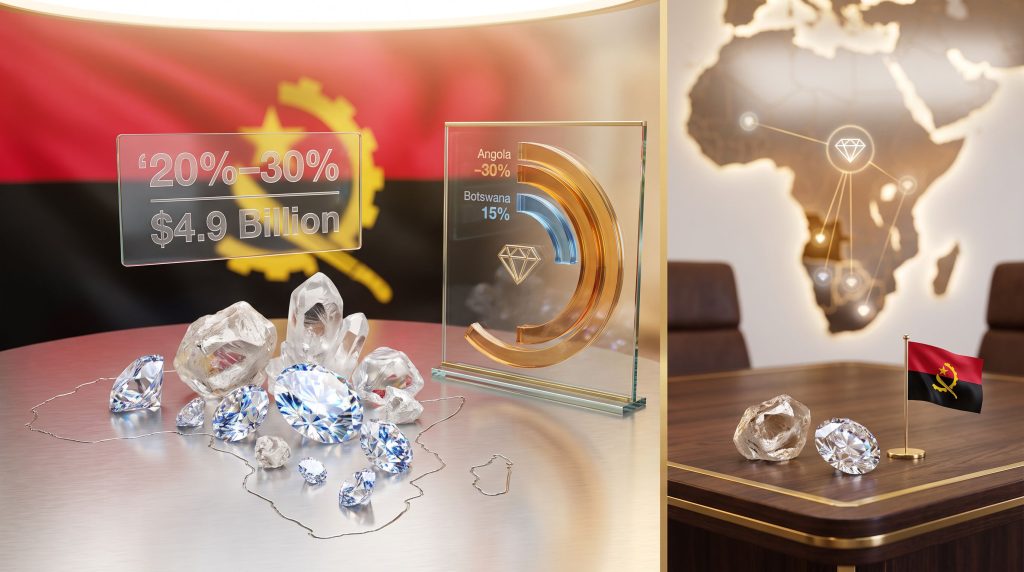
Botswana currently holds 15% of De Beers, a stake it has held for decades as part of its foundational partnership with the company. A combined Angolan and Batswanan position in the range of 35% to 45% would represent a significant African producer-nation bloc, potentially sufficient to influence strategic decisions even without formal majority control.
The Multi-Party Race: Anglo American's Exit and the Competing Bidders
Anglo American's decision to divest its 85% controlling stake in De Beers emerged from a broader corporate restructuring programme, and the divestiture has been assigned a benchmark valuation of approximately $4.9 billion. This figure establishes the financial framework against which all prospective acquirers are sizing their bids and financing requirements.
The competitive landscape as of mid-2026 includes at least three distinct bidder profiles, and the broader context of mining geopolitics continues to shape how each party approaches negotiations.
1. The Gareth Penny-led consortium: Former De Beers CEO Gareth Penny leads a group backed by major natural gem traders. The consortium's strategic intent is to reorient De Beers toward natural stone promotion, reversing what the group perceives as a period of strategic drift under Anglo American's ownership. This group is reported to be the frontrunner following disruptions to rival bids caused by the US-Israeli conflict with Iran, which complicated the financing arrangements of competing investors.
2. Botswana's sovereign bid: Botswana has expressed interest in acquiring a majority position, potentially up to 50%, which would be a dramatic expansion from its current 15% holding. The financing and operational management complexity of such an acquisition represents the primary uncertainty around Botswana's ambitions.
3. Angola via Endiama and Sodiam: Angola's recalibrated 20% to 30% target positions it as a strategic minority investor seeking governance rights rather than operational control.
A fourth and potentially most consequential scenario involves all four major African diamond-producing nations coordinating a unified bid. Angola, Botswana, Namibia, and South Africa have reportedly held confidential discussions about a joint framework, but no consensus has emerged publicly.
| Scenario | Likely Outcome | Strategic Implication |
|---|---|---|
| Penny Consortium wins | De Beers refocuses on natural diamonds | Reduced African state governance influence |
| Angola secures 20% to 30% | Board presence; Angola shapes supply and marketing strategy | Moderate influence; combined with Botswana potentially 40%+ |
| Botswana acquires majority | African state controls world's leading diamond brand | High financing and management risk |
| Pan-African consortium formed | Unified bloc with 50%+ governance rights | Maximum producer-nation leverage; complex coordination required |
If Angola and Botswana pursue independent strategies rather than building a coordinated position, they risk driving the acquisition price upward while diluting the governance influence either could achieve alone. The strategic case for African producer-nation coordination is compelling on paper; the political will to execute it remains the critical unknown.
De Beers as a Technology and Brand Asset: The Deeper Investment Thesis
One of the most strategically significant framings offered by Angola's minister is the characterisation of De Beers not as a mining company but as a technology, distribution, network, consumer, and geopolitical asset. This framing is important because it explains why a minority stake at a meaningful premium to pure asset value might still represent sound sovereign investment.
De Beers controls several proprietary systems that have no direct equivalent in the mining sector:
- The sight-holder system: De Beers distributes rough diamonds through an invitation-only network of approved buyers called sight-holders. Access to this network is a commercial privilege that shapes the entire downstream cutting, polishing, and jewellery manufacturing industry globally.
- Forevermark and diamond grading infrastructure: De Beers' branded gem certification and quality assurance systems command premium pricing and consumer trust that no other producer can replicate without decades of brand investment.
- Consumer marketing heritage: The A Diamond Is Forever campaign, arguably the most successful product marketing campaign in history, created the cultural association between diamonds and permanent commitment that underpins natural stone demand. Angola's ownership stake would give it a voice in how that brand heritage is protected and evolved.
For a producing nation seeking to move up the diamond value chain, from raw extraction into cutting, polishing, jewellery manufacturing, and retail, access to De Beers' distribution networks and brand equity is worth considerably more than the financial return on a 20% to 30% equity position alone.
The next major ASX story will hit our subscribers first
The Lab-Grown Diamond Challenge: A Structural Threat Angola Cannot Ignore
The rise of synthetic diamonds represents the most significant structural disruption the natural diamond industry has faced in its modern history. Laboratory-grown diamonds, chemically and physically identical to mined stones, have achieved dramatic cost reductions through advances in chemical vapour deposition (CVD) and high-pressure high-temperature (HPHT) manufacturing techniques.
The consequences for natural diamond pricing have been material. De Beers itself has experienced an extended period of financial underperformance under Anglo American's ownership, a period that coincided with accelerating lab-grown market penetration. The synthetic segment has captured significant market share in the bridal and fashion jewellery categories, historically the core demand pillars for natural stones.
Angola's ministerial position on synthetics is pragmatic rather than protectionist. Rather than advocating for market restrictions on lab-grown diamonds, Angola's focus is on mandatory consumer transparency: ensuring that buyers know with certainty whether they are purchasing a natural mined stone or a laboratory-produced one. This approach reflects several important strategic calculations:
- Consumer transparency requirements would protect the price premium associated with natural diamonds' geological rarity and provenance narrative.
- Disclosure frameworks create a legal distinction between product categories that supports brand differentiation and justifies price differentials.
- Angola, as a producing nation with a seat in De Beers governance, would be positioned to advocate for international disclosure standards through De Beers' marketing and regulatory influence.
The lab-grown challenge also adds urgency to Angola's push for De Beers equity. If synthetic market penetration continues at its current trajectory, the window in which natural diamond producers can use the De Beers brand as a defensive marketing instrument may be narrowing. Securing governance influence now, while De Beers retains its brand leadership, is strategically preferable to acquiring a diminished asset later.
The Unresolved Financing Question
Angola has not publicly disclosed specific funding mechanisms for the acquisition. Official statements confirm that various financing sources are being considered, but the precise capital structure remains opaque. According to reporting by Reuters, Angola's senior officials confirmed the 20% to 30% target range, though financing details remain unresolved. The main pathways available to Angola likely include some combination of:
- Sovereign wealth or state reserves channelled through Endiama and Sodiam.
- Participation from development finance institutions or African multilateral lenders.
- Co-investment arrangements with strategic partners from within the African producing bloc or external investors.
- Debt instruments secured against Angola's existing diamond revenue streams.
The absence of public financing clarity creates a meaningful execution risk. Committing sovereign capital to a $4.9 billion valuation benchmark in a luxury commodity sector facing structural disruption requires rigorous justification to domestic stakeholders and creditors alike. Angola's ability to close on its target stake will ultimately depend on resolving this financing question with specificity.
Three Strategic Scenarios for Angola's De Beers Ambition
Scenario 1: Angola Secures a Meaningful Minority Stake (Base Case)
Angola acquires 20% to 25% through Endiama and Sodiam, gaining board representation and committee access. Combined with Botswana's 15%, the African producer-nation bloc approaches 40%, creating collective influence over De Beers' pricing philosophy, marketing strategy, and response to synthetic competition. Angola leverages the distribution network to accelerate domestic downstream processing capacity.
Scenario 2: Angola Is Outbid or Marginalised (Downside Case)
The Penny-led consortium closes the transaction before African state negotiations finalise. Angola is offered a smaller, non-governance position below the strategic influence threshold. Botswana's 15% becomes the sole African voice at the De Beers board table, and Angola's resource sovereignty agenda suffers a significant strategic setback.
Scenario 3: Pan-African Diamond Bloc Emerges (Upside Case)
Angola, Botswana, Namibia, and South Africa reach a coordinated framework and acquire a combined majority position. As Forbes Africa has reported, Angola's ownership ambitions have attracted significant international attention, and a unified African producer-nation governance structure could reshape De Beers' global supply, pricing, and marketing strategy. This outcome would represent the most consequential shift in diamond industry power dynamics since De Beers' own formation.
Key Considerations for Investors and Industry Observers
Several variables will determine how this negotiation resolves, and each carries implications beyond the Angola De Beers stake and into broader mining asset sales trends across the continent.
- Regional coordination between Angola and Botswana is the single most important variable. A unified bid dramatically changes the governance outcome compared to competing individual bids.
- Financing transparency will be the credibility test. Angola's ability to demonstrate a concrete capital structure will determine how seriously the selling parties treat its proposal.
- Timing pressure from Anglo American's restructuring mandate creates urgency that may work against the more complex multi-party African coordination scenario.
- Synthetic diamond dynamics will influence De Beers' long-term valuation trajectory and therefore the risk-adjusted return on any sovereign capital committed to the acquisition.
Furthermore, how this transaction ultimately resolves will inform Angola's broader resource export strategy and its ambitions to capture greater value from its natural endowments in the years ahead.
This article contains forward-looking analysis and scenario projections. These represent analytical frameworks rather than confirmed outcomes. Investors and stakeholders should conduct independent research and professional due diligence before drawing financial conclusions from the scenarios discussed.
Want to Stay Ahead of the Next Major Mineral Discovery?
Discovery Alert's proprietary Discovery IQ model delivers real-time alerts on significant ASX mineral discoveries, transforming complex geological data into actionable investment insights for both short-term traders and long-term investors — explore the historic returns major discoveries have generated or start your 14-day free trial today to secure your market-leading edge.