May 21, 2026
Southern Africa's diamond-rich regions face a fundamental infrastructure paradox that could reshape continental mining economics. While abundant renewable energy generation exists across the region, transmission bottlenecks create artificial scarcity, limiting industrial development potential. This mismatch between generation capacity and distribution infrastructure represents a strategic investment opportunity where targeted Angola power grid expansion unlocks exponential returns through enhanced mining productivity and rural economic development.
Regional Power Infrastructure Investment Dynamics
Angola's Lunda Norte province exemplifies how transmission constraints can limit mining sector growth despite adequate generation capacity. The region's energy profile demonstrates the complex interplay between renewable resources, industrial demand, and infrastructure gaps that characterize many African mining regions.
Generation Capacity Analysis:
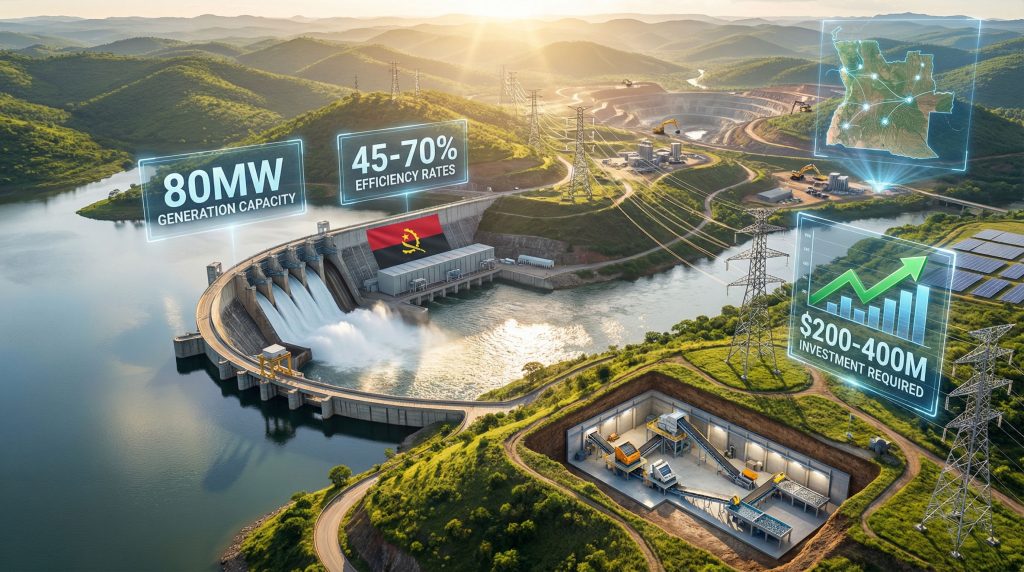
- Hydroelectric facilities provide approximately 40MW of baseload capacity through established infrastructure
- Thermal backup systems contribute an additional 40-50MW during peak demand periods
- Solar potential remains largely untapped despite favourable climatic conditions
- Combined capacity exceeds current transmission network utilisation rates
The fundamental challenge lies not in energy production but in delivery mechanisms. Existing transmission lines operate below optimal efficiency levels, creating artificial bottlenecks that restrict mining operations and limit rural electrification progress. Furthermore, these constraints significantly impact the mining industry evolution across the region.
Key Infrastructure Metrics:
| Component | Current Status | Efficiency Rate | Investment Priority |
|---|---|---|---|
| Transmission Lines | Limited coverage | Below 70% | High |
| Distribution Networks | Rural gaps | Variable | Medium |
| Generation Assets | Adequate capacity | 80-85% | Low |
| Grid Stability Systems | Requires upgrades | 60-75% | High |
Mining operations require continuous power supply for extraction equipment, processing facilities, and support infrastructure. Current grid limitations force operators to rely on expensive diesel generators, reducing profitability and limiting expansion potential.
Strategic Investment Frameworks
Public-private partnership models emerge as viable solutions for addressing transmission bottlenecks while supporting broader economic development objectives. These arrangements leverage mining sector demand certainty to secure financing for infrastructure improvements that benefit entire regions.
Partnership Structure Components:
- Mining companies provide guaranteed minimum demand commitments
- Government agencies facilitate regulatory approvals and land access
- Development finance institutions offer concessional funding terms
- Equipment manufacturers supply technology and maintenance services
Successful implementation requires careful risk allocation between partners, with mining companies accepting demand risk while government maintains policy stability. In addition, international development partners can provide technical assistance and reduce political risk through multilateral involvement. These partnerships often incorporate capital raising strategies that optimise funding structures across multiple stakeholders.
When big ASX news breaks, our subscribers know first
Renewable Energy Portfolio Optimisation Strategies
Diversified energy portfolios reduce single-source dependency while supporting industrial development requirements. Angola's renewable energy potential spans multiple technologies, each contributing distinct advantages to overall grid stability and economic competitiveness.
Hydroelectric resources provide reliable baseload generation with minimal operating costs once infrastructure investments are complete. The Luachimo facility demonstrates established hydroelectric capability, though expansion projects require careful assessment of water resource availability and environmental considerations.
Hydroelectric Development Parameters:
- Consistent 40MW baseload capacity from existing infrastructure
- Expansion potential limited by seasonal water flow variations
- Low marginal generation costs after capital recovery
- Long asset lifespan supports favourable project economics
Solar integration offers peak generation alignment with industrial operational schedules, particularly during daylight hours when mining processing activities typically occur. Distributed solar installations can reduce transmission load requirements while providing backup capacity during grid maintenance periods. However, effective implementation of renewable energy innovations requires sophisticated grid management systems.
Solar Implementation Framework:
- Peak generation during typical mining shift schedules
- Reduced transmission infrastructure requirements through distributed deployment
- Declining technology costs improve investment returns
- Grid stabilisation through peak load management
Thermal backup systems maintain grid reliability during renewable source maintenance or seasonal variations. While environmental considerations favour renewable prioritisation, strategic thermal capacity ensures continuous mining operations during critical production periods.
Legislative Oversight and Regulatory Frameworks
Parliamentary oversight mechanisms establish accountability structures for infrastructure investments while maintaining transparent project evaluation processes. Angola power grid expansion benefits from legislative frameworks that balance central coordination with provincial implementation authority, creating predictable regulatory environments for long-term capital deployment.
Central government agencies maintain responsibility for transmission network planning and interstate coordination, while provincial authorities focus on local distribution networks and community engagement. This division of responsibilities allows specialised expertise application while maintaining democratic accountability.
Governance Structure Analysis:
| Authority Level | Responsibility Scope | Decision Timeline | Accountability Mechanism |
|---|---|---|---|
| Central Agencies | Transmission planning | 12-24 months | Parliamentary oversight |
| Provincial Government | Distribution coordination | 6-12 months | Local assemblies |
| Municipal Authorities | Community engagement | 3-6 months | Public consultation |
| Regulatory Bodies | Technical standards | Ongoing | Professional review |
Policy stability supports long-term investment planning by providing predictable regulatory frameworks that protect investor interests while ensuring public benefit optimisation. Consequently, transparent oversight mechanisms reduce regulatory uncertainty and facilitate international development finance participation.
Investment Security Mechanisms
Parliamentary committees monitor project performance through regular reporting requirements and site visits, ensuring infrastructure investments deliver promised benefits to mining operations and rural communities. This oversight framework provides investor confidence while maintaining public accountability.
Regulatory risk assessment processes evaluate policy continuity, environmental compliance, and social impact metrics throughout project lifecycles. These comprehensive evaluation frameworks reduce uncertainty for private sector participation while protecting community interests.
Mining Sector Demand Anchoring and Revenue Security
Diamond processing operations create predictable electricity demand patterns that support infrastructure investment business cases through guaranteed revenue streams and reduced market risk. Continuous power requirements for extraction, sorting, and processing equipment generate stable cash flows that justify transmission network upgrades.
Mining Power Demand Analysis:
| Operation Category | Power Requirement | Operating Pattern | Revenue Stability |
|---|---|---|---|
| Extraction Systems | 15-25MW continuous | 24/7 operations | Very High |
| Processing Equipment | 10-20MW variable | Shift-based | High |
| Support Infrastructure | 5-10MW baseline | Continuous | High |
| Administrative Facilities | 2-5MW steady | Business hours | Medium |
Long-term power purchase agreements provide revenue certainty that enables debt financing for transmission infrastructure while ensuring mining operations receive reliable electricity supply. These arrangements typically span 10-20 year terms, matching infrastructure asset depreciation schedules.
Mining sector growth projections support demand forecasting accuracy, with diamond market fundamentals indicating sustained production requirements over medium-term planning horizons. For instance, industry consolidation trends favour larger operators with greater financial capacity to support infrastructure investments.
Investment Security Framework:
- Power purchase agreements guarantee minimum revenue streams
- Mining lease terms provide demand certainty over project lifecycles
- Diversified customer base reduces single-operator concentration risk
- Escalation clauses protect against inflation and cost increases
Diamond mining operations generate significant economic multiplier effects through employment, tax revenue, and supply chain development that justify public sector infrastructure investment participation. These broader benefits support government co-financing while private operators secure reliable power supply.
Development Finance and International Partnership Integration
Multilateral development institutions provide concessional financing structures that improve project economics while supporting comprehensive development objectives including rural electrification and economic diversification. These partnerships reduce private sector risk exposure while leveraging public development mandates.
World Bank geospatial analysis supports optimal grid planning through satellite imagery, demographic data, and economic modelling that identifies high-impact transmission corridors. Technical assistance programmes improve project preparation quality and reduce implementation delays.
Development Finance Components:
- Concessional loan terms reduce capital costs below market rates
- Grant funding supports feasibility studies and technical assistance
- Risk mitigation instruments protect against political and regulatory changes
- Environmental and social safeguards ensure sustainable development practices
Bilateral development partnerships provide equipment financing and technical expertise transfer, particularly from countries with established mining-grid integration experience. These relationships facilitate technology adaptation to local conditions while building domestic capacity.
Private Sector Mobilisation Strategies
Development finance institutions serve as catalysts for private investment participation by providing anchor funding that demonstrates project viability. Their involvement signals due diligence completion and risk assessment that encourages commercial lender participation.
Technical assistance improves project preparation through engineering studies, environmental assessments, and financial modelling that meet international standards. This support reduces preparation costs for private developers while ensuring projects meet bankability criteria.
Policy dialogue supports regulatory framework development through technical assistance to government agencies and capacity building for oversight institutions. These activities create enabling environments that facilitate private sector participation.
Long-Term Planning Through Strategic Scenario Development
Comprehensive scenario modelling incorporates demand growth variables, technology cost trajectories, and regional integration opportunities to optimise investment sequencing across multiple development pathways. This analytical framework enables adaptive planning that maintains flexibility while capturing immediate opportunities.
Base case scenarios assume steady mining sector growth driving consistent electricity demand increases over 10-15 year planning horizons. Rural electrification mandates create additional demand that supports network expansion economics through diversified customer bases. However, effective planning requires integration of energy transition strategies that align with global decarbonisation objectives.
Planning Scenario Framework:
| Scenario Type | Growth Rate | Investment Trigger | Timeline |
|---|---|---|---|
| Base Case | 3-5% annually | Current commitments | 5-7 years |
| Accelerated Growth | 7-10% annually | Major discoveries | 3-5 years |
| Conservative | 1-3% annually | Market constraints | 8-10 years |
| Regional Integration | Variable | Cross-border demand | 10-15 years |
Accelerated growth scenarios incorporate potential major mining discoveries that could dramatically increase power requirements within short timeframes. These contingencies require flexible infrastructure designs that enable rapid capacity expansion without major system redesigns.
Regional interconnection opportunities create additional revenue streams through electricity exports to neighbouring countries while improving grid stability through larger network effects. Southern African Development Community power pool integration facilitates these arrangements through harmonised technical standards.
Risk Assessment and Mitigation Planning
Commodity price volatility represents primary risk factor affecting mining sector demand patterns and investment capacity. Scenario planning incorporates price sensitivity analysis to identify minimum viable project parameters under various market conditions.
Climate variability affects hydroelectric generation reliability through seasonal precipitation patterns and long-term climate change impacts. Diversified generation portfolios reduce weather-related risks while maintaining system reliability.
Political and regulatory developments influence cross-border projects and long-term investment security. Multi-country development finance participation helps mitigate these risks through diplomatic engagement and treaty frameworks.
The next major ASX story will hit our subscribers first
Investment Evaluation and Due Diligence Frameworks
Systematic investment evaluation incorporates technical feasibility, financial returns, regulatory stability, and development impact metrics to assess risk-adjusted returns across different infrastructure components and implementation timelines. Moreover, modern approaches increasingly emphasise data-driven mining operations that optimise grid utilisation through predictive analytics.
Technical due diligence requires comprehensive grid stability analysis, load flow modelling, and equipment specification review to ensure proposed investments integrate effectively with existing systems. Environmental and social impact assessments identify potential complications and mitigation requirements.
Evaluation Framework Components:
- Engineering feasibility studies and grid integration analysis
- Financial modelling with scenario-based sensitivity analysis
- Regulatory compliance review and approval timeline assessment
- Environmental impact evaluation and mitigation planning
- Social consultation processes and community benefit analysis
Financial analysis incorporates capital expenditure requirements, revenue projections, operating cost optimisation, and maintenance planning across project lifecycles. Multiple financing structures should be evaluated to identify optimal risk-return profiles for different investor categories.
Risk-Return Assessment Matrix
Investment risks span technical, financial, regulatory, and operational categories that require systematic evaluation and mitigation planning. Technical risks include equipment reliability, grid integration challenges, and capacity factor variations that affect project performance.
Currency exposure and commodity price correlation create financial risks that require hedging strategies or contractual protections. Long-term power purchase agreements typically include inflation escalation and currency adjustment mechanisms to protect both buyers and sellers.
Risk Mitigation Strategies:
- Political risk insurance through development finance institutions
- Currency hedging through forward contracts or local currency financing
- Technical performance guarantees from equipment suppliers
- Operational risk sharing through experienced joint venture partners
- Force majeure protection through comprehensive insurance coverage
Regulatory risks encompass policy changes, tariff adjustments, and environmental regulation evolution that could affect project economics. Stable regulatory frameworks with transparent change procedures reduce these uncertainties.
Technology Integration and Future Development Pathways
Emerging technologies create opportunities for operational efficiency improvements and cost reductions that enhance infrastructure investment returns. Smart grid technologies enable demand management, fault detection, and system optimisation that reduce operational costs and improve reliability.
Energy storage systems enhance grid stability by smoothing renewable generation variability and providing backup power during maintenance periods. Battery technology cost reductions make storage increasingly economically viable for mining applications requiring high reliability.
Technology Integration Roadmap:
- Smart grid deployment for operational efficiency
- Energy storage systems for grid stability enhancement
- Distributed generation to reduce transmission requirements
- Advanced metering infrastructure for demand management
- Predictive maintenance systems for asset optimisation
Distributed generation reduces transmission load requirements while providing backup capacity during grid maintenance. Solar installations at mining sites can offset peak demand while maintaining grid connection for baseload requirements.
Regional Integration and Export Opportunities
Southern African Development Community power pool participation creates export market opportunities that improve project economics through additional revenue streams. Cross-border transmission projects enhance regional energy security while providing market access for surplus generation capacity.
Harmonised regulatory frameworks reduce transaction costs for regional electricity trade while establishing common technical standards that facilitate equipment standardisation and reduce maintenance costs.
Regional Integration Benefits:
- Market expansion beyond domestic demand constraints
- Improved grid stability through interconnected networks
- Reduced investment risks through diversified demand base
- Technology standardisation and economies of scale
- Enhanced energy security through mutual support arrangements
Future development pathways must accommodate technological advancement while maintaining compatibility with existing infrastructure investments. Flexible design approaches enable system evolution without stranding capital investments. Ultimately, successful Angola power grid expansion requires coordinated planning that balances immediate infrastructure needs with long-term technological evolution.
Investment decisions in power grid infrastructure require comprehensive analysis of technical, financial, and regulatory factors specific to local conditions. This analysis provides general frameworks and should not be considered specific investment advice. Prospective investors should conduct detailed due diligence and consult qualified professionals before making investment decisions.
Looking to Capitalise on Africa's Mining Infrastructure Revolution?
Discovery Alert's proprietary Discovery IQ model delivers real-time alerts on significant ASX mineral discoveries, instantly empowering subscribers to identify actionable opportunities ahead of the broader market as mining companies navigate evolving infrastructure challenges across emerging markets. Begin your 14-day free trial today and secure your market-leading advantage in the rapidly evolving mining sector.