May 21, 2026
When the Rally Becomes the Risk: Understanding Institutional Valuation Logic in Commodity Equities
Commodity equity markets have a peculiar rhythm. The stocks that attract the most institutional enthusiasm during a raw material price surge are often the same ones that trigger valuation warnings once the rally has fully matured. This pattern is not a contradiction; it is the natural arc of price discovery in cyclical sectors. When a broker upgrades a stock anticipating a commodity move, and that move subsequently arrives faster and larger than modelled, the rational response is not to celebrate but to reassess whether the original opportunity still exists.
This is precisely the dynamic playing out with Norsk Hydro in mid-2026. Citi downgrades Norsk Hydro after aluminium rally boosts shares has become one of the more instructive stories in the base metals equity space this year. However, it signals not a problem with the underlying business, but rather a fundamental principle of institutional valuation: a share price that has already captured the upside of a thesis leaves little room for further gains, regardless of how constructive the macro backdrop remains.
When big ASX news breaks, our subscribers know first
The Anatomy of a Valuation Downgrade Versus a Fundamental One
Not all broker downgrades carry the same message. Investors who treat every rating cut as a warning about business quality are misreading the communication. For instance, there are two structurally different types of downgrade in institutional research.
The first reflects genuine concern about a company's earnings trajectory, balance sheet, competitive position, or operational execution. The second, which is far less alarming and frequently misunderstood, reflects a judgement that the share price has appreciated to the point where the expected return no longer justifies the risk at current entry levels.
Citi's move on Norsk Hydro is unambiguously the latter. The brokerage simultaneously raised its price target from NKr105 (approximately USD 11.55) to NKr110 (approximately USD 12.10) while cutting the rating from buy to neutral. This pairing of a higher target with a lower rating carries a very specific message to institutional investors: the earnings outlook has improved, but the share price has already incorporated that improvement and then some.
Furthermore, this pattern is not unique to Hydro. Similar alcoa downgrade analysis dynamics have emerged across the aluminium sector, where strong commodity price momentum eventually triggers valuation-led rating reversals.
When a broker raises its price target and downgrades simultaneously, the underlying communication is that the original thesis played out faster than the model anticipated, and the opportunity window has effectively closed. This is distinct from any negative judgement on the underlying business.
Norsk Hydro shares surged approximately 25% from February 2026, outperforming global aluminium producer peers by an estimated 15% in the two months leading into the rating change. That kind of relative outperformance compresses forward return potential and shifts the risk-reward calculus, even when the fundamental backdrop remains supportive.
How Aluminium Prices Drove the Norsk Hydro Share Re-Rating
The 2026 Aluminium Price Surge and Its Unusual Driver
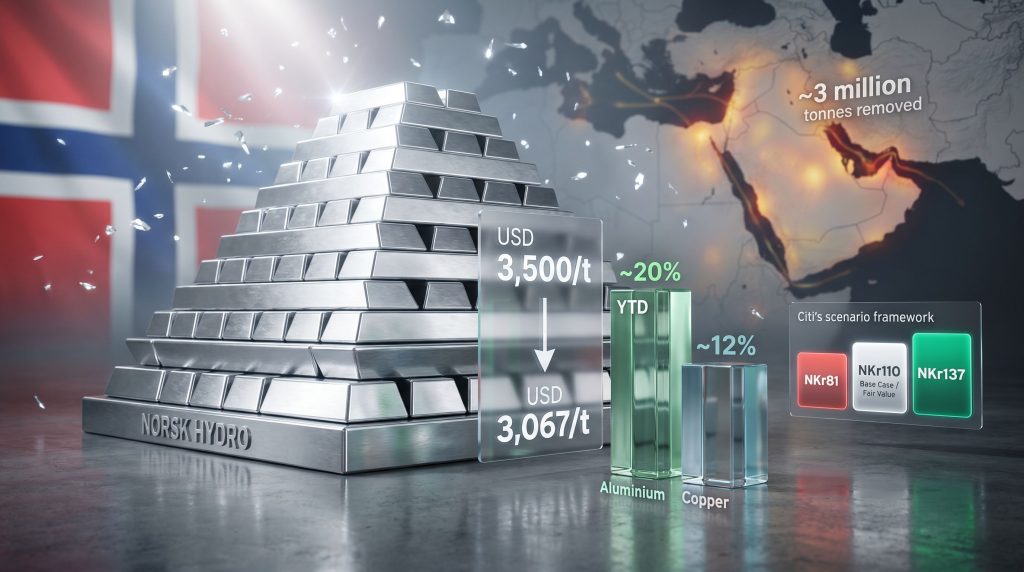
Aluminium prices climbed approximately 20% year-to-date in 2026, meaningfully outpacing copper, which gained around 12% over the same period. While copper's performance was driven by a combination of energy transition demand and constrained mine supply, aluminium's outperformance had a more specific and geopolitically concentrated origin.
Middle East conflict disruptions removed an estimated 3 million tonnes of aluminium production capacity from global markets. To contextualise the scale of this removal, that figure represents roughly 4% of total global aluminium supply and approximately 11% of production capacity located outside China. For a market where supply-demand balances can shift on relatively modest volume changes, the removal of that capacity in a compressed timeframe created a significant price premium.
| Supply Disruption Metric | Estimated Volume |
|---|---|
| Capacity removed from active market | ~3 million tonnes |
| Share of total global aluminium supply | ~4% |
| Share of ex-China production capacity | ~11% |
| Capacity still exposed to geopolitical risk | ~4 million tonnes |
Critically, an additional ~4 million tonnes of production capacity remains within the active conflict zone, meaning the supply-side risk premium is not yet fully resolved. Any further escalation or prolonged disruption to this remaining capacity would consequently extend the upward pressure on prices.
Why Aluminium Was More Vulnerable Than Copper to This Disruption
The Middle East's role in global aluminium supply is structurally more significant than its role in copper production. The Gulf region, particularly countries such as the UAE, Bahrain, and Qatar, hosts a meaningful concentration of modern, energy-efficient primary smelting capacity. This capacity was developed deliberately to exploit low-cost hydrocarbon energy, giving these facilities a competitive cost advantage in the global production hierarchy.
Copper production, by contrast, is dominated by South American and African sources largely insulated from Middle Eastern geopolitical stress. This supply concentration difference explains why the same geopolitical event produced a larger aluminium price response than copper. In addition, the broader China metals outlook continues to shape demand-side dynamics that interact with these supply disruptions in complex ways.
Interestingly, Citi noted that while the aluminium price rally aligned directionally with its earlier bullish call on Norsk Hydro, the specific mechanism driving the rally differed from what the brokerage had originally anticipated. The directional thesis proved correct; the pathway was unexpected.
Consensus Forecasts Versus Spot Prices: The Central Tension for Investors
A 14% Gap That Shapes the Entire Sector's Risk Profile
One of the most important and underappreciated tensions in aluminium equity valuations right now is the divergence between where the metal is trading and where the analyst community expects it to trade over the medium term.
Current analyst consensus estimates aluminium at approximately USD 3,067 per tonne through 2027. Spot prices at the time of Citi's downgrade were trading near USD 3,500 per tonne. That gap of roughly USD 433 per tonne represents a divergence of approximately 14% between near-term market reality and medium-term professional forecasting consensus.
This tension creates two distinct risk scenarios for investors holding aluminium-linked equities at elevated price levels:
-
If spot prices remain elevated and consensus forecasts are revised upward over time, earnings upgrade cycles across the sector become possible, supporting current equity valuations.
-
If spot prices revert toward the USD 3,067 consensus as geopolitical disruptions ease and displaced production returns to market, current equity valuations could face meaningful downward pressure.
Neither outcome is certain. What is certain is that investors buying aluminium equities near current levels are implicitly making a bet on which of these two scenarios unfolds. Understanding the commodity price impact on equity valuations is therefore essential for navigating this uncertainty. This asymmetric uncertainty is a core reason why Citi's valuation model yields a neutral rating at NKr110 rather than a continued buy.
Norsk Hydro's Earnings Architecture: Where the Leverage Lives
EBITDA Revisions Following Q1 2026 Results
Following Norsk Hydro's first-quarter 2026 results, Citi raised its 2026 underlying EBITDA forecast by 9.3% to NKr37 billion (approximately USD 4.07 billion). The 2027 EBITDA estimate was simultaneously increased to NKr38.8 billion (approximately USD 4.27 billion).
| Financial Metric | 2026 Estimate | 2027 Estimate |
|---|---|---|
| Group Underlying EBITDA | NKr37B (~USD 4.07B) | NKr38.8B (~USD 4.27B) |
| Earnings Per Share | NKr8.92 | NKr9.18 |
| Downstream EBITDA (Metals Markets + Extrusions) | NKr6.5B (~USD 715M) | NKr7.3B (~USD 803M) |
| Energy Division EBITDA | NKr3.38B (~USD 372M) | N/A |
The 10% Sensitivity Rule: Understanding Aluminium Price Leverage
Perhaps the most important number in Citi's analysis for long-term investors to understand is Norsk Hydro's earnings sensitivity to aluminium price movements. According to the brokerage's modelling, a 10% movement in aluminium prices translates to approximately NKr7.3 billion (USD 803 million) in group EBITDA impact.
To appreciate the magnitude of that sensitivity, consider that NKr7.3 billion is roughly equivalent to the entire combined EBITDA contribution from Norsk Hydro's downstream Metals Markets and Extrusions divisions in 2027. In practical terms, a single-digit percentage swing in the metal price can effectively add or erase the earnings equivalent of the company's entire downstream business in a given year.
Norsk Hydro's earnings structure means that aluminium price movements in either direction can create EBITDA swings that dwarf the contributions of its more stable downstream segments. This operating leverage is what made the stock so attractive during the rally and what now creates genuine valuation risk at elevated entry prices.
This leverage profile is a double-edged characteristic. During a commodity upswing, it amplifies returns beyond what the percentage price move alone would suggest. During a commodity pullback, however, it can erase earnings quickly and compress multiples simultaneously, creating a compounding downside effect that tends to surprise investors who focused only on the upside case.
The Energy Division: Norway's Hydropower as an Earnings Stabiliser
One element of Norsk Hydro's business that distinguishes it from most global aluminium producers is its dedicated energy division, which generates earnings largely independent of global commodity cycles.
The energy segment reported EBITDA of NKr4.15 billion (USD 456.5 million) in 2025, up from NKr3.54 billion (USD 389.4 million) in 2024. However, Citi forecasts a year-on-year decline for 2026, with the segment expected to contribute NKr3.38 billion (USD 371.8 million).
Critically, this division's earnings are driven primarily by Norwegian rainfall levels and domestic electricity pricing rather than global energy market dynamics. Norway's hydropower system means that precipitation variability directly affects the energy available for smelting operations and for sale into the domestic grid. This creates an earnings variable that is structurally uncorrelated with aluminium prices, oil markets, or global energy benchmarks, consequently providing a genuine diversification buffer within the overall earnings mix.
For investors, this is an often-underappreciated feature of the Norsk Hydro investment case. The energy division functions as a partial natural hedge, dampening overall earnings volatility during periods of commodity price stress.
Citi's Three-Scenario Valuation Framework
Bull, Base, and Bear: Mapping the Return Distribution
Citi's scenario analysis for Norsk Hydro presents a wide distribution of outcomes, reflecting the inherent uncertainty in both aluminium pricing and geopolitical resolution timelines.
| Scenario | Price Target | Implied Return from Current Levels |
|---|---|---|
| Bull Case | NKr137 (~USD 15.07) | +31% upside |
| Base Case (current target) | NKr110 (~USD 12.10) | Near fair value |
| Bear Case | NKr81 (~USD 8.91) | -22% downside |
The bull case at NKr137 requires a specific combination of outcomes: sustained aluminium spot prices above consensus through 2027, continued or escalating Middle East supply disruptions driving further capacity removal, and strong operational delivery across downstream and energy segments.
The bear case at NKr81 reflects a scenario where spot aluminium prices revert toward the USD 3,067 consensus forecast, displaced production capacity returns to market as geopolitical conditions stabilise, Norwegian rainfall underperforms expectations reducing energy division earnings, and broader macroeconomic weakness compresses industrial aluminium demand.
The asymmetry is notable. The bull case offers 31% upside while the bear case implies 22% downside, but the base case sitting at current price levels means that investors need the bull case to materialise to earn meaningful returns from current entry points. This asymmetry profile is precisely what a neutral rating reflects in institutional research parlance. UBS similarly downgraded Norsk Hydro following the sharp rally, reinforcing the broader institutional consensus around valuation constraints at current levels.
The next major ASX story will hit our subscribers first
Green Aluminium and Long-Term Structural Demand Themes
Beyond the Current Price Cycle
While the immediate investment debate around Norsk Hydro centres on the geopolitical supply disruption premium and its sustainability, there are longer-duration structural themes that frame the company's strategic positioning in ways that extend well beyond the current price cycle.
Energy transition infrastructure represents a powerful and growing source of secular aluminium demand. Solar panel frames and mounting systems, electric vehicle battery enclosures and structural components, high-voltage transmission cables for grid expansion, and lightweight vehicle bodies for fuel efficiency improvement all represent application areas where aluminium consumption is structurally growing. Furthermore, the broader green metals transition across the mining and materials sector is accelerating demand for low-carbon production credentials.
Norsk Hydro's investment in low-carbon and recycled aluminium production positions the company to capture premium pricing as industrial buyers face increasing pressure to document the carbon intensity of their supply chains. Green aluminium, produced using renewable hydropower in Norway, commands a measurable price premium over conventionally smelted product in markets where carbon accountability matters.
This is a dimension of the Norsk Hydro investment case that pure commodity price modelling tends to underweight. The company's hydropower-based smelting operations in Norway generate some of the lowest carbon footprint primary aluminium produced anywhere in the world, a characteristic that is becoming commercially relevant as carbon border adjustment mechanisms expand across major trading blocs.
The Valuation Timing Problem in Commodity Equities
A recurring challenge for investors in resource-linked equities is what might be described as the visibility paradox. By the time a commodity rally becomes widely confirmed and the investment thesis feels most comfortable and well-supported by evidence, the equity market has typically already priced in the improvement.
Citi downgrades Norsk Hydro after aluminium rally boosts shares is a textbook illustration of this dynamic. The brokerage upgraded the stock earlier in 2026 when the aluminium price outlook was constructive but not yet confirmed. The rally subsequently materialised, the shares outperformed, and now at the point when the fundamental picture looks strongest and most visible, the rating is being cut because the share price has already done the work.
This timing problem is not unique to Norsk Hydro. It is endemic to commodity equity investing and explains why institutional analysts frequently appear to be sending contradictory signals, raising price targets while downgrading ratings, or upgrading stocks during periods of macro uncertainty when the business outlook appears least clear. Understanding the broader commodities investment cycle helps investors contextualise these signals more accurately.
Key Signals Worth Monitoring for a Directional Shift
For investors tracking this space, several indicators are worth watching closely in coming months:
-
Middle East capacity restoration: Any confirmed return of the approximately 3 million tonnes of displaced production to market would remove the primary support for spot prices above consensus forecasts.
-
Status of the 4 million tonnes still at risk: Further disruption to this capacity would extend and potentially deepen the supply premium, supporting a bull case scenario.
-
Chinese production policy: Over the medium to long term, China's aluminium output decisions remain the single largest variable in global supply balances, with domestic policy shifts capable of overwhelming the impact of regional geopolitical disruptions.
-
Consensus forecast revision trajectory: If professional forecasters begin converging toward current spot prices of USD 3,500 rather than the current USD 3,067 consensus, sector-wide EBITDA upgrades would follow, potentially reopening upside in current equity valuations.
-
Norwegian hydrological conditions: For the energy division's performance, precipitation patterns in Norway during the winter refill season will determine whether the forecast NKr3.38 billion EBITDA for 2026 is achieved or missed.
FAQ: Citi's Norsk Hydro Downgrade and Aluminium Market Dynamics
Why did Citi downgrade Norsk Hydro if aluminium prices are still elevated?
The downgrade is a valuation judgement, not a negative assessment of the business. After a roughly 25% share price rally, the stock is trading near Citi's estimate of fair value, leaving limited near-term return potential even if commodity prices remain supportive.
What does a simultaneous target upgrade and rating downgrade communicate?
It signals that earnings have improved but the share price has already reflected that improvement. The opportunity that existed when the stock was trading at a discount to fair value has consequently been captured.
How sensitive is Norsk Hydro's EBITDA to aluminium prices?
A 10% movement in aluminium prices is estimated to shift group EBITDA by approximately NKr7.3 billion, a figure roughly equivalent to the entire combined annual EBITDA from the company's downstream Metals Markets and Extrusions operations.
What is the gap between consensus forecasts and current aluminium spot prices?
Analyst consensus through 2027 sits near USD 3,067 per tonne, while spot prices were trading close to USD 3,500 per tonne at the time of the downgrade, a divergence of approximately 14%.
What is unique about Norsk Hydro's energy division?
It generates earnings primarily based on Norwegian hydropower output, which depends on rainfall and domestic electricity pricing rather than global energy markets, creating a structurally uncorrelated earnings buffer within the group.
This article is informational in nature and does not constitute financial advice. All forecasts, price targets, and scenario analyses are sourced from publicly reported analyst commentary and carry inherent uncertainty. Investors should conduct independent research before making any investment decisions. Commodity prices and equity valuations can move materially and rapidly in response to geopolitical, macroeconomic, and sector-specific developments.
Want to Catch the Next Major Mineral Discovery Before the Market Does?
Discovery Alert's proprietary Discovery IQ model delivers real-time alerts on significant ASX mineral discoveries, transforming complex mineral data into actionable insights for both short-term traders and long-term investors — explore historic discoveries and their exceptional returns to understand the opportunity, then begin your 14-day free trial at Discovery Alert to position yourself ahead of the broader market.