May 21, 2026
The Hidden Economics of Coking Coal: Why Not All Coal Is Created Equal
Most discussions about coal's future focus on the energy transition, renewable substitution, and thermal plant closures. Yet buried within that narrative is a fundamentally different commodity that operates under an entirely separate set of market rules. Metallurgical coal, the carbon-rich input that makes integrated steelmaking chemically possible, is not facing the same demand trajectory as its thermal cousin. It cannot be replaced by solar panels, wind turbines, or natural gas in a blast furnace. It is a reactive chemical agent, not a fuel, and that distinction changes everything for producers operating in premium coking coal provinces like southern West Virginia.
Understanding this separation is the starting point for evaluating what Clinch Resources met coal production in West Virginia actually represents within the broader North American supply picture.
When big ASX news breaks, our subscribers know first
Why Metallurgical Coal Occupies a Structurally Distinct Market Position
The steelmaking process inside a blast furnace requires coke, a porous, high-carbon material derived from coking coal, to serve as both a reducing agent and a physical support structure for iron ore as it descends through the furnace. No commercially viable substitute currently performs both functions simultaneously at industrial scale.
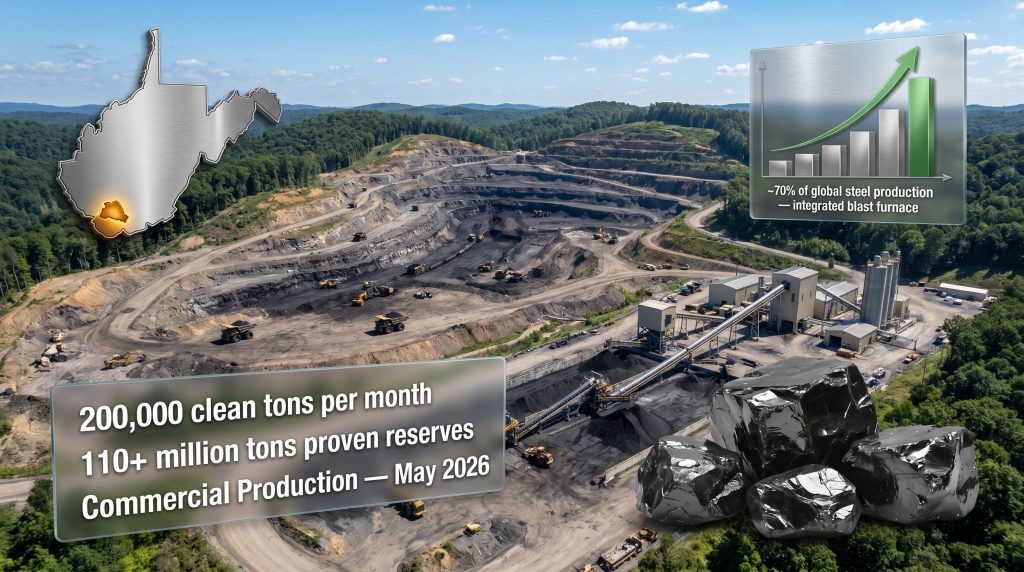
This chemical dependency is reflected in a striking statistic: integrated steelmaking facilities relying on metallurgical coal account for approximately 70% of total global steel production capacity. That figure has proven remarkably stable across decades of technological development, underscoring how difficult it is to displace the blast furnace route even as electric arc furnace technology expands.
The implications for met coal pricing and demand are significant. Furthermore, metallurgical coal prices are benchmarked separately from thermal coal and historically command a substantial premium:
- Met coal prices are benchmarked separately from thermal coal and historically command a substantial premium
- Demand is directly correlated with global crude steel output rather than electricity generation cycles
- Supply disruptions in key producing regions, such as Queensland, Australia, can trigger sharp benchmark price movements within weeks
- The quality spectrum within met coal is wide, with premium hard coking coal commanding meaningfully higher prices than semi-soft or pulverised coal injection grades
For context, premium hard coking coal benchmark prices have ranged from below $100 per tonne to above $400 per tonne across different points in recent market cycles, illustrating the commodity's inherent price volatility alongside its structural demand resilience.
West Virginia's Coking Coal Heritage and What Makes It Globally Competitive
Southern West Virginia sits within one of the world's most historically significant metallurgical coal regions. The Appalachian coalfields spanning Wyoming, Logan, McDowell, and Mingo counties have supplied domestic and international steel mills for well over a century, developing deep logistical infrastructure, processing knowledge, and seam-level geological data in the process.
What makes this region particularly valuable to global steel producers is its coal quality versatility. The coalfields produce both high-volatile and low-volatile coking coals, which serve different but complementary roles in coke blend formulations:
| Coal Type | Role in Coke Blend | Key Quality Attribute |
|---|---|---|
| Low-volatile coking coal | Structural strength contributor | High coking index, low fluidity needed |
| High-volatile coking coal | Fluidity and blend softening agent | High Gieseler fluidity, blending flexibility |
| Semi-soft coking coal | Volume filler at lower cost | Moderate coking properties |
Steel mills around the world blend multiple coal types to achieve optimal coke strength after reaction (CSR) and coke strength (DI) values. West Virginia producers offering multiple volatile matter ranges within a single operational footprint provide real blending value to customers. Geographic access to Atlantic seaboard export terminals further enhances competitiveness against Australian suppliers when shipping to European steel mills.
Clinch Resources' Asset Architecture in the ARI Land Package
Clinch Resources is a TSX-listed metallurgical coal company whose primary operational presence is concentrated within the southern West Virginia coalfields. Its core asset base derives from the ARI asset package, covering approximately 54,000 acres of permitted and prospective metallurgical coal ground.
The company has disclosed a proven reserve base exceeding 110 million tons within the ARI package, with an additional 51 million tons attributable to its 39% equity stake in JJ Resources, a separate mid-volume met coal producer.
The asset structure provides three distinct value levers operating on different timelines:
| Asset | Mining Method | Current Status | Clinch Ownership |
|---|---|---|---|
| Lanes Branch | Surface (open-cut) | Commercial production commenced May 2026, ahead of schedule | 100% |
| Mine 8 | Underground (historical producing mine) | Permitted, development-stage | 100% |
| JJ Resources | Multiple methods | First production Q2 2026 | 39% equity |
This tiered structure is strategically deliberate. Surface mining at Lanes Branch delivers near-term cash generation with lower capital intensity and faster scalability. The permitted Mine 8 underground operation represents a longer-horizon, higher-volume optionality play within the same land package. The JJ Resources equity position adds a third production stream without requiring Clinch to deploy full capital across all assets simultaneously.
The Lanes Branch Commercial Production Milestone: What It Means Beyond the Headline
The transition from mine development to commercial Clinch Resources met coal production in West Virginia at Lanes Branch, completed ahead of the original operational schedule, carries significance that extends beyond the operational announcement itself. According to a recent industry report, the milestone positions Clinch as a credible near-term supplier within the North American met coal landscape.
For junior mining companies, the development-to-production transition is statistically one of the highest-risk phases in the project lifecycle. Cost overruns, permitting delays, equipment commissioning failures, and workforce challenges routinely push timelines and budgets beyond initial projections. Delivering ahead of schedule signals execution discipline that the market consistently rewards with improved valuation multiples.
Several operational characteristics of Lanes Branch deserve closer examination:
- Surface mining economics: Open-cut mining typically carries lower unit operating costs than underground methods due to reduced ventilation, ground support, and safety infrastructure requirements. This cost structure provides a margin buffer during met coal price downturns
- Wyoming County location: Situated within an established coal-producing county with existing rail access and preparation plant infrastructure, reducing the greenfield capital hurdle
- Coal quality targeting: Initial production is being prepared for delivery to steel-based manufacturing facilities both domestically and internationally, indicating Clinch is already engaging across multiple offtake channels
- Ramp-up target: The company is scaling toward approximately 200,000 clean tons per month from its West Virginia operations
The clean tons metric is important to understand. Raw run-of-mine coal extracted from the seam contains varying levels of impurities, ash, moisture, and rock dilution. Clean tons represent the marketable product after coal preparation plant processing, which removes these contaminants to meet steel mill quality specifications. Achieving 200,000 clean tons per month requires not just mining capacity but consistent preparation plant throughput and yield management.
Understanding the Critical Minerals Classification for Met Coal
Metallurgical coal's inclusion among the 60 critical minerals designated by the U.S. government reflects a strategic assessment of domestic industrial vulnerability rather than a geological scarcity argument. Unlike lithium or cobalt, met coal is not rare, but its role as a non-substitutable input in domestic steel production, which underpins defence manufacturing, infrastructure construction, and heavy industrial output, justifies its strategic classification.
This classification creates a policy environment that acknowledges the importance of domestic met coal supply. In addition, the broader US mineral production policy framework establishes a regulatory and strategic context at the national level, though it is worth being precise about what this means in practice. Whether any specific project receives direct government support, preferential permitting treatment, or dedicated financing depends on separate project-level assessments and agency decisions that have not been confirmed for Clinch's operations.
What the classification does achieve is a clearer strategic narrative for domestic producers, positioning U.S. met coal supply within the same conversation as battery metals and rare earths when policymakers discuss industrial supply chain resilience. Consequently, the growing focus on critical minerals demand further reinforces the strategic value of domestic producers.
The next major ASX story will hit our subscribers first
Key Risks Investors Should Understand
The Lanes Branch production commencement is a genuine milestone, but a balanced assessment requires acknowledging the risk factors that will shape execution over the coming quarters.
Production ramp-up variability is the most immediate concern. Early-stage surface mining operations must work through initial equipment synchronisation, overburden management, and preparation plant calibration before achieving consistent throughput at target capacity. The 200,000 clean tons per month figure represents a ramp-up target, not a current run rate.
Coal quality consistency is critical for steel mill customer retention. Blast furnace operators blend coal specifications with precision, and a supplier that delivers variable ash, sulfur, or volatile matter readings risks being deprioritised in future purchasing rounds. Maintaining seam-level quality control as the operation scales is a technical challenge that receives less attention than volume metrics but matters equally to commercial outcomes.
Price cycle exposure remains a structural feature of the met coal market. The commodity's close correlation with global steel output means that macroeconomic slowdowns, particularly in construction-intensive emerging markets, can compress margins rapidly.
JJ Resources operational independence adds a layer of complexity. With only a 39% equity position, Clinch does not exercise operational control over this entity. Production performance, capital allocation decisions, and cost management at JJ Resources reflect decisions made by a separate management structure, creating a passive exposure that differs fundamentally from Clinch's directly operated assets.
Near-Term Milestones and the Path Toward Mid-Tier Producer Status
The production roadmap for Clinch Resources over the next twelve to eighteen months centres on three interconnected developments:
- Lanes Branch ramp-up execution: Demonstrating consistent monthly clean ton volumes tracking toward the 200,000 tonne target is the primary near-term credibility benchmark
- JJ Resources production trajectory: With first production having commenced in Q2 2026, the output profile and cost structure of this mid-volume producer will receive increasing investor scrutiny
- Mine 8 development timeline: The permitted underground operation represents the most significant longer-term volume expansion pathway within the ARI asset package, though no specific development timeline has been publicly confirmed
The combination of a 161 million-plus total ton reserve base across directly held and equity-attributed resources, two permitted projects at different development stages, and an established surface operation entering commercial production positions Clinch as a company building toward a production profile that goes meaningfully beyond typical junior mining company scale.
What Global Steel Demand Signals for West Virginia Met Coal Producers
Long-run metallurgical coal demand is anchored by a structural reality: the world's installed blast furnace capacity represents decades of capital investment that cannot be written off quickly. The broader steel and iron ore market dynamics, particularly across emerging economies, continue to underpin demand for premium coking coal through the medium term. Furthermore, the global steel outlook suggests that emerging market steel intensity growth, particularly across South and Southeast Asia where per-capita steel consumption remains well below developed economy levels, provides additional structural support.
West Virginia producers are particularly well-positioned to serve Atlantic basin steel markets in Europe and the eastern United States, where freight economics favour Appalachian coal over Queensland supply. As global steel trade patterns continue to evolve and supply chain diversification becomes a priority for mills seeking to reduce geographic concentration risk, the case for a reliable, high-quality domestic U.S. met coal supplier — such as the one advancing through Clinch Resources met coal production in West Virginia — grows incrementally stronger.
Disclaimer: This article is intended for informational purposes only and does not constitute financial advice. Metallurgical coal prices, production targets, and company operational timelines are subject to change based on market conditions, operational factors, and regulatory developments. Past performance of commodity prices is not indicative of future results. Readers should conduct their own independent research before making investment decisions.
Want to Stay Ahead of the Next Major ASX Mineral Discovery?
Discovery Alert's proprietary Discovery IQ model delivers real-time alerts on significant ASX mineral discoveries across 30-plus commodities, turning complex data into actionable insights for both traders and long-term investors — explore historic discoveries that have generated substantial returns or begin your 14-day free trial today to position yourself ahead of the broader market.