July 14, 2026
The Hidden Bottleneck: Why Port Infrastructure Determines Who Wins the Global Phosphate Race
In commodity markets, the ability to physically move product often matters more than the ability to produce it. A nation can sit atop world-class mineral reserves and still lose market share to a less endowed competitor simply because its export logistics are inferior. This dynamic has defined Algeria's position in the global phosphate trade for decades, and it is precisely this structural disadvantage that the Annaba phosphate port expansion is designed to permanently correct.
Algeria holds substantial phosphate rock reserves, particularly across the Tebessa and Souk Ahras provinces in the country's northeast. Yet for years, the country exported far below its geological potential, constrained by port infrastructure that could only accommodate vessels of up to 55,000 tonnes under existing Somiphos operations. In a global bulk commodity market where freight economics are disproportionately tied to vessel size, this ceiling was a chronic competitive liability against Morocco's OCP Group, Jordan's JPMC, and Egyptian exporters who had long invested in superior maritime logistics.
What is unfolding now at Annaba is not simply an infrastructure upgrade. It is the physical manifestation of a broader industrial strategy to capture value across the entire phosphate supply chain, rather than simply digging rock out of the ground and selling it at the lowest point of the value curve. Furthermore, this approach mirrors what we have seen with other vertically integrated projects, such as the Ammaroo phosphate project in Australia, where integrated supply chain thinking has redefined what phosphate development can achieve.
When big ASX news breaks, our subscribers know first
What Is Algeria's Integrated Phosphate Project and Why Does the Architecture Matter?
The Three-Layer Value Chain Algeria Is Building
The Integrated Phosphate Project (IPP) is a state-led initiative structured around a partnership between Sonatrach, Algeria's dominant energy enterprise, and Sonarem, the national mining authority. What distinguishes the IPP from a conventional mine expansion is its vertical integration across three distinct industrial layers.
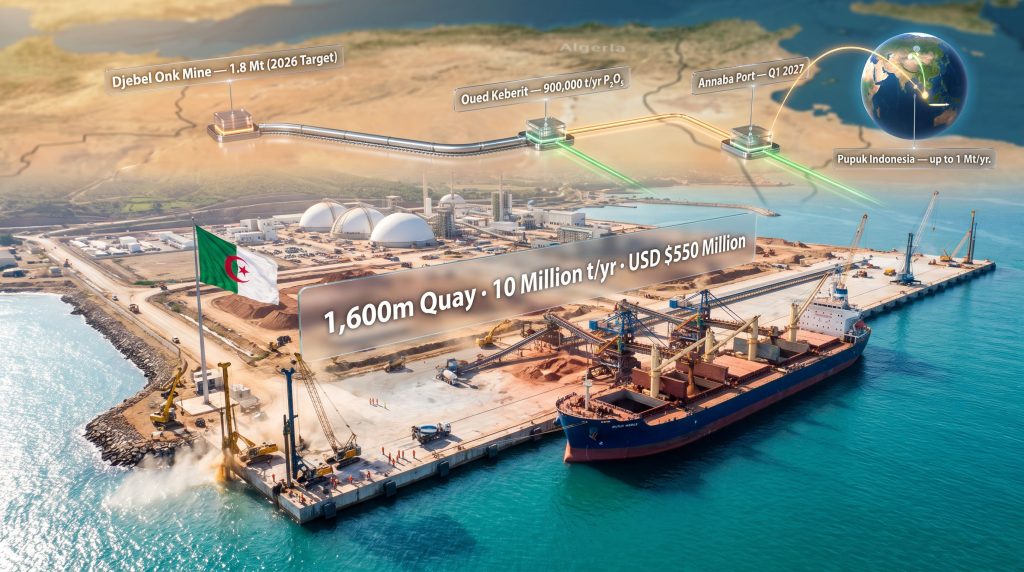
1. Upstream mining: The project draws on two phosphate deposit complexes. The Bled El-Hadba mine in Tebessa province is already operational and actively building stockpiles in preparation for downstream processing. The Djebel Onk mine complex, also within the Tebessa region, currently operates at approximately 1.5 million tonnes per year and is scheduled for a 1 million t/yr capacity expansion by July 2027, targeting 1.8 million tonnes of production across 2026 as an interim ramp milestone.
2. Midstream processing: The Oued Keberit chemical facility in Souk Ahras province forms the value-adding core of the IPP. This greenfield complex is designed to produce phosphoric acid, sulphuric acid, and ammonia, with a phosphoric acid nameplate capacity of 900,000 tonnes per year of P₂O₅. That processing volume implies a phosphate rock demand of approximately 3 million tonnes per year, drawing heavily on both Bled El-Hadba and the expanded Djebel Onk output.
3. Downstream export logistics: The Annaba port terminal represents the IPP's commercial gateway to global markets.
IPP at a Glance: Key Project Metrics
| IPP Component | Specification |
|---|---|
| Phosphoric acid production capacity | 900,000 t/yr of P₂O₅ |
| Implied phosphate rock demand | ~3 million t/yr |
| Djebel Onk current production capacity | ~1.5 million t/yr |
| Djebel Onk expansion target | +1 million t/yr by July 2027 |
| Djebel Onk 2026 production target | 1.8 million tonnes |
| Bled El-Hadba mine status | Operational; stockpiling for Oued Keberit supply and export |
| Oued Keberit production start (targeted) | Q1 2027 |
Strategic Insight: Rather than exporting raw phosphate rock at low margins, the IPP is designed to monetise phosphoric acid, a higher-value intermediate product used directly in fertilizer manufacturing. This represents a fundamental shift in Algeria's position within the global phosphate value chain.
Annaba Phosphate Port Expansion: Engineering Scope and Investment Scale
Breaking Down the Infrastructure at Annaba
The physical transformation planned for Annaba port is substantial. The core construction involves a 1,600-metre deepwater mineral quay engineered to a depth of 16 metres, capable of accommodating vessels of up to 80,000 tonnes. This represents a meaningful step-change from the current 55,000-tonne limit, as larger vessel sizes directly reduce per-tonne freight costs and improve landed price competitiveness in Asian and European destination markets.
Beyond the quay itself, 82 hectares of industrial land behind the terminal will be developed to support storage, handling, and logistics operations. Annual throughput capacity at full build-out is targeted at 10 million tonnes of phosphate. For context on how mine-to-port logistics shape a project's commercial viability, the integration of rail, storage, and marine infrastructure is consistently the deciding factor between projects that succeed and those that stall.
Full Infrastructure Specifications
| Infrastructure Element | Detail |
|---|---|
| New mineral quay length | 1,600 metres |
| Quay depth | 16 metres |
| Maximum vessel size supported | 80,000 tonnes |
| Annual throughput capacity | 10 million tonnes |
| Industrial land development | 82 hectares |
| Total project investment | 89 billion Algerian dinars (~USD $550 million) |
| Construction consortium | China Harbour Engineering Company (CHEC), Cosider-TP, Meditram |
| Estimated jobs created (Annaba region) | ~2,000 |
| Targeted completion | Q1 2027 |
The Rail Link That Makes It All Work
A deepwater terminal is only as valuable as its ability to receive product reliably and at scale. The IPP's logistical backbone is a dedicated railway corridor linking the Bled El-Hadba mine in Tebessa province directly to the Annaba port terminal. This rail-to-port corridor integrates with existing transport infrastructure across Tebessa, Souk Ahras, and Skikda provinces, eliminating the cost inefficiencies and throughput limitations of road-based ore haulage across difficult terrain. Without this connection, the port's 10 million tonne capacity would remain a theoretical figure rather than an operational reality.
The July 2026 Acceleration: Why Algeria Is Pushing Hard Now
Construction Urgency and Political Oversight
In July and August 2026, Algeria's works and infrastructure ministry directed a doubling of the project workforce and the deployment of additional heavy machinery and equipment to the Annaba site. Active construction phases at that point included dredging operations, pile driving progressing at approximately 10 piles per day, and ongoing concrete pouring across multiple work fronts.
Prime Minister Sifi Ghrieb conducted a direct site inspection in July 2026, a signal that the project carries significant political weight at the highest levels of the Algerian government. President Abdelmadjid Tebboune's administration has designated the IPP as a national industrial priority, reflecting how central the project is to Algeria's broader economic diversification agenda beyond hydrocarbons.
The Synchronisation Imperative
The Q1 2027 deadline is not simply an infrastructure milestone. It must coincide with the commissioning of the Oued Keberit phosphoric acid facility to avoid a costly and commercially damaging misalignment. If the port opens while the processing plant faces delays, Algeria would be left with a world-class export terminal but limited high-value product to ship through it.
Conversely, if Oued Keberit reaches production readiness before port completion, stockpile bottlenecks would accumulate, creating operational and financial pressure. Recognising this risk, Somiphos has adopted a pragmatic interim strategy: marketing Bled El-Hadba phosphate rock directly for export before phosphoric acid production at Oued Keberit comes online. This approach generates near-term revenue while building commercial relationships with buyers ahead of the IPP's full production ramp.
Scenario Analysis: Three Possible Trajectories for Algeria's Phosphate Export Ramp
Scenario 1: On-Time Delivery and Full Ramp-Up (Base Case)
Port and plant activate simultaneously in Q1 2027. Algeria enters the global phosphate rock and phosphoric acid market as a credible volume supplier. The Djebel Onk expansion completes by July 2027, unlocking the Pupuk Indonesia supply agreement of up to 1 million tonnes per year.
Combined output from Djebel Onk and Bled El-Hadba positions Algeria to serve multiple export markets concurrently, with European and Asian buyers able to draw on a geographically proximate, mid-tier supplier.
Scenario 2: Partial Delay with Phased Export Ramp (Moderate Risk Case)
Port infrastructure reaches completion in Q1 2027 but Oued Keberit faces commissioning delays common in first-of-kind greenfield chemical complexes. Algeria pivots to maximising phosphate rock exports through the new terminal while phosphoric acid production ramps over a 6-12 month lag. Near-term commercial revenues are lower than projected, but the strategic export position is established.
Scenario 3: Sustained Delays and Competitive Window Narrows (Downside Case)
Construction or commissioning setbacks push full operational readiness beyond mid-2027. Competing North African and Middle Eastern exporters consolidate market share in key Asian and European markets during the window of delay. The Pupuk Indonesia agreement timeline comes under commercial pressure, and Indonesian procurement could diversify to alternative suppliers. This scenario would be particularly damaging given the capital already committed.
The Djebel Onk Expansion and the Pupuk Indonesia Agreement
A Strategic Export Anchor in Southeast Asia
The January 2026 agreement between Somiphos and Pupuk Indonesia, Indonesia's state-owned fertilizer group, represents a significant commercial anchor for Algeria's expanded phosphate output. The agreement covers up to 1 million tonnes per year of phosphate rock, with delivery contingent on the completion of the Djebel Onk mine expansion by July 2027.
Indonesia is a particularly attractive destination market. As one of Southeast Asia's largest agricultural economies, it has substantial domestic fertilizer production ambitions, and Pupuk Indonesia is central to that strategy. For Algeria, this bilateral arrangement provides a degree of demand certainty that reduces the commercial risk of the Djebel Onk capacity expansion, while establishing a presence in a fast-growing Asian import market.
The agreement also carries a geopolitical dimension. Algeria-Indonesia trade cooperation reflects a broader pattern of South-South resource partnerships, where developing nations with complementary resource and industrial profiles build direct commercial relationships, partially bypassing traditional Western-dominated commodity trading channels.
The next major ASX story will hit our subscribers first
How Annaba Compares to Major Global Phosphate Export Terminals
Benchmarking Algeria's Future Export Infrastructure
| Port / Terminal | Country | Max Vessel Size | Annual Throughput | Key Exporter |
|---|---|---|---|---|
| Annaba (post-expansion) | Algeria | Up to 80,000 t | 10 million t/yr | Somiphos / IPP |
| Jorf Lasfar | Morocco | 100,000+ t | 30+ million t/yr | OCP Group |
| Safi Port | Morocco | Up to 60,000 t | ~8 million t/yr | OCP Group |
| Aqaba | Jordan | Up to 60,000 t | ~8 million t/yr | JPMC |
| Damietta / Ain Sokhna | Egypt | Up to 60,000 t | Variable | EFIC / private |
Analyst Note: At full operational capacity, Annaba's 10 million t/yr throughput positions Algeria as a meaningful but mid-tier phosphate exporter. Morocco's OCP Group, with over 30 million tonnes of annual export capacity and a dominant share of global phosphate trade, remains the industry benchmark by a considerable margin. Algeria's competitive proposition will ultimately depend on pricing flexibility, contract reliability, and its geographic proximity advantage to Mediterranean and European buyers.
Global Fertilizer Market Implications: What New Algerian Supply Means for Phosphate Pricing
Supply-Side Effects and Input Cost Pressures
The addition of approximately 3 million tonnes per year of phosphate rock demand from Oued Keberit alone will have ripple effects on global rock supply balances. More significantly, 900,000 t/yr of P₂O₅ capacity entering a phosphoric acid market that has navigated periodic supply tightness could influence pricing dynamics in intermediate fertilizer markets. Indeed, the broader commodity price impacts on producer economics underscore how sensitive these projects are to global market timing.
A less discussed but critical input risk surrounds sulphur. Phosphoric acid production requires sulphuric acid, which is manufactured from elemental sulphur. Tampa third-quarter 2026 liquid sulphur contract prices settled at a record $705 per long tonne, up from $655/lt in the prior quarter, according to Argus Media reporting. This record high follows a period in which reduced Middle East export flows of sulphur have pushed US Gulf spot prices to $1,100-1,150/t fob. Oued Keberit's sulphur procurement strategy will be critical to the facility's cost competitiveness, particularly if global sulphur supply tightness persists through the IPP's ramp-up period.
Ammonia procurement presents a related challenge. The Oued Keberit complex includes ammonia production capacity, but Algeria's options for balancing domestic versus imported ammonia supply will influence the facility's operational flexibility and production economics.
Regional Trade Flow Shifts and Food Security Dimensions
Algeria's geographic position offers a structural freight advantage for European buyers, particularly those in the Mediterranean and Adriatic markets. If Algerian phosphoric acid can be delivered at competitive landed costs relative to established suppliers, it could gradually redirect procurement patterns away from Middle Eastern and Central Asian sources.
For sub-Saharan Africa, there is a longer-term food security dimension worth noting. Proximity and potential preferential pricing could make Algerian phosphate a viable input for regional fertilizer manufacturers seeking to reduce dependency on distant suppliers, supporting African agricultural productivity in markets chronically underserved by accessible fertilizer supply. However, these resource export challenges are not unique to Algeria, as producers worldwide navigate similar structural hurdles in connecting supply to demand.
Key Risks and Execution Challenges
Engineering, Financial, and Market Risk Factors
-
Marine construction complexity: Deepwater quay construction involving 16-metre draft, large-scale dredging, and continuous pile driving carries inherent timeline risk from weather disruptions, seabed conditions, and equipment availability.
-
Multi-party contractor dynamics: Coordinating between China Harbour Engineering Company (CHEC), Cosider-TP, and Meditram across a project of this scale introduces multi-party execution risk that can compound schedule pressure.
-
Currency and inflation exposure: The ~USD $550 million investment (89 billion Algerian dinars) is exposed to macroeconomic pressures in Algeria's currency environment, potentially affecting procurement costs for imported equipment and materials.
-
Greenfield commissioning risk: Oued Keberit is a first-of-kind integrated phosphoric acid, sulphuric acid, and ammonia complex in Algeria. Greenfield chemical facilities frequently encounter commissioning delays that extend well beyond initial projections.
-
Sulphur supply volatility: With Tampa Q3 2026 liquid sulphur contracts already at record levels and Middle East export flows constrained, any further tightening of global sulphur markets would directly compress Oued Keberit's phosphoric acid production economics.
-
Market timing risk: If global phosphate rock or phosphoric acid prices soften materially before the IPP reaches full production, commercial returns could fall below state projections, creating pressure on the project's financial rationale.
Frequently Asked Questions: Annaba Phosphate Port Expansion
What is the Annaba phosphate port expansion project?
The Annaba phosphate port expansion is a major maritime infrastructure development in northeastern Algeria centred on constructing a 1,600-metre deepwater mineral quay capable of handling vessels up to 80,000 tonnes, with an annual throughput target of 10 million tonnes. It forms the export logistics centrepiece of Algeria's Integrated Phosphate Project.
When will the Annaba phosphate port expansion be completed?
The targeted completion date is Q1 2027. Construction was accelerated in July and August 2026 through a doubling of the workforce and the deployment of additional heavy equipment.
How much does the Annaba port expansion cost?
Total investment is approximately 89 billion Algerian dinars, equivalent to roughly USD $550 million.
Who is building the Annaba phosphate port?
The construction consortium comprises China Harbour Engineering Company (CHEC), Cosider-TP (Algeria), and Meditram, an Algerian-Chinese joint venture partnership. For further context on the Algeria-China joint port dredging venture, the bilateral cooperation underpinning this project reflects a broader pattern of Chinese infrastructure engagement across North Africa.
What is Algeria's Integrated Phosphate Project?
The IPP is a vertically integrated phosphate development initiative combining Sonatrach and Sonarem. It spans phosphate mining at Bled El-Hadba and Djebel Onk, chemical processing at Oued Keberit in Souk Ahras province, and maritime export logistics through Annaba port. In addition, projects such as the Toolse phosphate project in Estonia demonstrate how vertically integrated phosphate thinking is gaining traction globally, not just in North Africa.
What is the phosphoric acid production capacity at Oued Keberit?
The facility is designed for 900,000 t/yr of P₂O₅, requiring approximately 3 million tonnes per year of phosphate rock as feedstock.
Which countries will Algeria supply phosphate to?
Somiphos signed an agreement with Pupuk Indonesia for up to 1 million tonnes per year of phosphate rock in January 2026. European and broader Asian markets are anticipated as additional export destinations as IPP production scales up.
Algeria's Phosphate Ambition: The Defining Test Ahead
The convergence point of Q1 2027, when port completion, Oued Keberit commissioning, and Djebel Onk expansion progress are all expected to align, represents the most critical test of Algeria's ability to execute a complex, multi-site industrial programme on schedule and within budget.
What makes this moment particularly significant for global phosphate markets is the broader context in which it arrives. Post-2022 disruptions to fertilizer supply chains have accelerated buyer interest in supply diversification. Sulphur input costs are at historic highs. And geopolitical instability in regions that have historically supplied phosphate intermediates has elevated the commercial value of reliable, proximate alternatives.
Algeria is not positioned to challenge Morocco's dominance in global phosphate trade in the near term. However, the IPP's design as a vertically integrated value chain, rather than a simple rock export operation, gives Algeria a structurally differentiated market offering. The longer-term question is whether the country can build the commercial track record, logistics reliability, and pricing discipline required to sustain and grow its market position over a multi-decade horizon.
The signals worth monitoring closely include Djebel Onk expansion progress against the July 2027 milestone, the commissioning timeline at Oued Keberit, commencement of deliveries under the Pupuk Indonesia agreement, and whether sulphur procurement arrangements for the phosphoric acid facility are secured at commercially viable terms.
Disclaimer: This article contains forward-looking analysis, scenario projections, and market commentary. These do not constitute financial advice. All timelines, production figures, and investment values are based on publicly available reporting from Argus Media and are subject to change. Readers should conduct independent due diligence before making any investment or commercial decisions based on information contained herein. Readers seeking further context on phosphate commodity pricing and African fertilizer market developments can explore related market intelligence published by Argus Media at argusmedia.com.
Want to Track the Next Major Mineral Discovery Before the Market Moves?
Discovery Alert's proprietary Discovery IQ model delivers real-time alerts on significant ASX mineral discoveries, transforming complex geological and commodity data into actionable investment insights for both short-term traders and long-term investors — explore historic discoveries and the returns they generated to understand what early positioning can mean, then begin your 14-day free trial at Discovery Alert to secure your market-leading edge.