
July 14, 2026
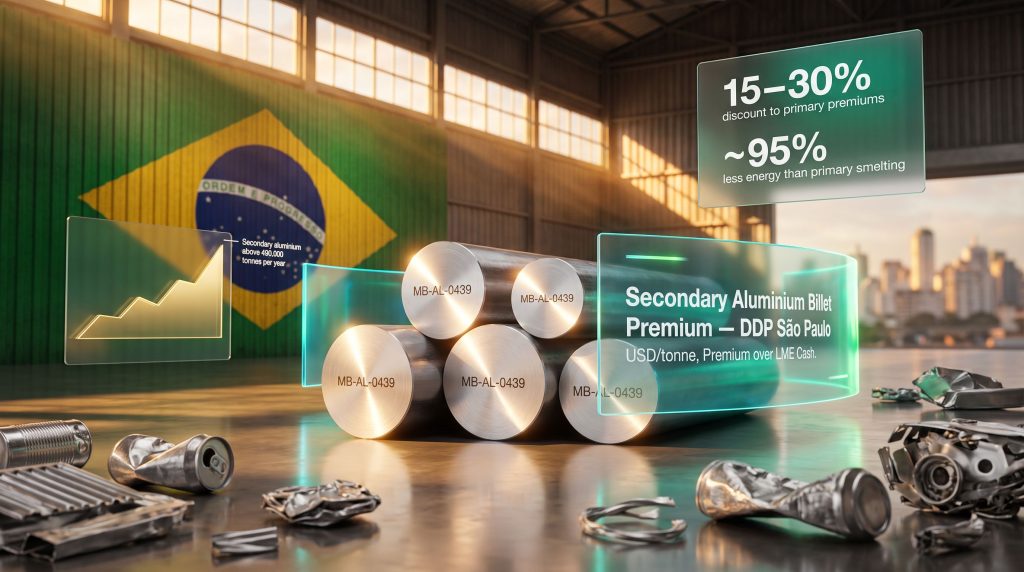
Brazil's Recycling Economy and the Pricing Gap That Needed Filling
Commodity markets tend to develop pricing infrastructure long after physical trading volumes justify it. Secondary aluminium in Latin America is a textbook example: a robust, high-volume recycling economy has operated in Brazil for decades, yet until now, participants in the São Paulo secondary billet market were navigating transactions without a dedicated, independently governed price benchmark. That structural gap carried real commercial consequences, and the formalisation of a São Paulo secondary aluminium billet premium marks a genuine inflection point for the region's metals market infrastructure.
Brazil's relationship with aluminium recycling is genuinely exceptional by global standards. The country's aluminium can recycling rate has consistently exceeded 90%, placing it among the highest of any nation worldwide. This is not the product of regulatory enforcement analogous to European packaging mandates; it is driven almost entirely by economic incentives. The scrap value of aluminium is sufficiently high relative to average incomes in Brazil that informal and formal collection networks have achieved recovery rates that developed economies with far more elaborate legislative frameworks have struggled to match.
São Paulo state sits at the centre of this activity. Its concentration of automotive manufacturing, construction, and extrusion-grade fabrication facilities creates both the scrap feedstock supply and the downstream demand that makes a secondary billet market viable. Investment in secondary aluminium remelting capacity across the Greater São Paulo industrial corridor, including facilities targeting annual recycled aluminium output above 490,000 tonnes, underscores the scale of the sector that this new assessment will serve.
When big ASX news breaks, our subscribers know first
Why Secondary and Primary Billet Premiums Follow Different Logic
Understanding why a dedicated secondary benchmark is necessary requires a clear grasp of how primary and secondary billet premiums are structurally distinct, not merely numerically different.
Primary aluminium billet premiums are anchored to the London Metal Exchange cash price and layered with regional delivery costs, import logistics, and smelter output dynamics. The scrap market plays essentially no role in primary billet pricing. Furthermore, top aluminium producers tend to operate within entirely different cost structures compared to secondary remelters, reinforcing why a separate benchmark is warranted.
Secondary billet premiums operate on an entirely different cost architecture. Three overlapping layers determine where the secondary premium settles:
- Global LME price direction, which sets the universal aluminium cost floor and serves as the reference against which all premiums are expressed
- Brazilian scrap market conditions, including feedstock acquisition costs, competing foundry demand, and seasonal fluctuations tied to automotive production and construction activity cycles
- Regional logistics and supply dynamics, encompassing inland freight from São Paulo's industrial clusters to delivery points, port infrastructure at Santos, and the capacity utilisation rates of operating remelters
Historically, secondary billet premiums have traded at a 15 to 30% discount to equivalent primary billet premiums, a range that shifts depending on scrap availability, alloy recovery rates, and end-user quality tolerance. In the São Paulo region, scrap buyers in industrial corridors such as Barueri have typically quoted 6063-grade billet scrap at approximately $0.300 to $0.450 per kilogram, providing a rough floor for the secondary billet cost structure.
Without a published, methodology-governed benchmark, this discount relationship was effectively invisible to market participants who lacked bilateral connections to well-sourced traders. Smaller processors and buyers faced asymmetric pricing information compared to larger, better-networked counterparts — a structural disadvantage that the São Paulo secondary aluminium billet premium is designed to resolve. The broader aluminium tariffs impact on import flows has also heightened urgency around developing robust domestic benchmarks like this one.
Full Specification: What MB-AL-0439 Actually Measures
The new assessment, designated MB-AL-0439, provides a formally governed price reference for secondary aluminium extrusion billet traded on a delivered, duty-paid basis in São Paulo, Brazil. The complete specification is as follows:
| Parameter | Specification |
|---|---|
| Assessment Code | MB-AL-0439 |
| Material | Secondary aluminium extrusion billet AA6060/AA6063 |
| Maximum Primary Content | 30% primary aluminium |
| Diameter Range | 4 to 7 inches |
| Incoterm | DDP (Delivered Duty Paid) |
| Location | São Paulo, Brazil |
| Unit | USD/tonne, premium over LME cash price |
| Minimum Quantity | 25 tonnes |
| Payment Terms | Cash against documents (7 days after bill of lading); other terms normalised |
| Delivery Window | Within 4 weeks of assessment date |
| Publication Frequency | Monthly, second Tuesday of each month |
| Publication Time | 3:00 to 4:00 PM London time |
| Data Window | Second Tuesday of the month (4:00 PM London) to the following second Tuesday (3:00 PM London) |
| Holiday Schedule | Follows non-ferrous metals price reporting holiday calendar |
The choice of AA6060 and AA6063 alloy grades is deliberate. These two specifications represent the workhorses of the global extrusion industry, valued for their extrudability, surface finish quality, and structural performance in construction profiles, automotive components, and industrial fabrications. They are the grades where secondary-to-primary substitution is most commercially viable, making them the logical anchor for a secondary billet benchmark. For broader context on how billet markets have evolved across different regions, European trends offer a useful comparative reference.
The 30% maximum primary content threshold deserves particular attention. This specification defines the ceiling for primary aluminium addition during the remelting process, ensuring that the benchmark genuinely reflects secondary production economics rather than capturing billets that are effectively primary metal diluted with scrap. For buyers with sustainability commitments, this specification provides a contractually verifiable minimum recycled content level.
Expressing the São Paulo secondary aluminium billet premium as a USD per tonne figure above the LME cash price allows buyers and sellers to isolate the regional and quality-related cost components from underlying metal price volatility, enabling cleaner procurement comparisons across time periods.
How MB-AL-0439 Compares to the Primary Billet Benchmark
The São Paulo primary billet premium (MB-AL-0425) has been in operation since August 26, 2025, providing a reference point for fully primary-grade AA6060/AA6063 billet delivered to the same market. Having both assessments active simultaneously enables something that was previously impossible: a formally governed, continuously updated primary-to-secondary spread for São Paulo's extrusion market.
| Feature | Primary Billet (MB-AL-0425) | Secondary Billet (MB-AL-0439) |
|---|---|---|
| Material Type | Fully primary AA6060/AA6063 | Secondary/recycled, max 30% primary |
| Launch Date | August 26, 2025 | July 14, 2026 |
| Reference Level | ~$520 to $560/tonne (Dec 2025) | To be established via market discovery |
| Key Price Drivers | LME, smelter output, import logistics | Scrap costs, remelting, alloy recovery rates |
| Carbon Intensity | Higher (primary smelting) | Lower (secondary remelting) |
| End-User Profile | Highest-purity extrusion applications | Cost-sensitive and ESG-motivated buyers |
The primary-to-secondary spread functions as a real-time diagnostic tool. When scrap feedstock is tight, the cost advantage of secondary production narrows, compressing the spread. When scrap is abundant, the discount widens. Procurement teams at extrusion manufacturers can use this spread to make dynamic material substitution decisions rather than relying on periodic renegotiation of bilateral supply agreements.
How the Monthly Assessment Is Constructed
The methodology underpinning MB-AL-0439 follows the principles that Price Reporting Agencies operating under IOSCO (International Organization of Securities Commissions) commodity price reporting standards apply globally. The step-by-step construction process works as follows:
- Data window opens at 4:00 PM London time on the second Tuesday of each month
- Market participants including buyers, sellers, and brokers submit transaction data, bids, and offers to the Fastmarkets pricing team
- Payment term normalisation adjusts all non-standard submissions to a cash-equivalent basis, anchored to seven-day payment after bill of lading date
- Specification filtering excludes any transactions outside the AA6060/AA6063 grade range, the 4 to 7 inch diameter specification, or the 30% primary content ceiling
- Data window closes at 3:00 PM London time on the following second Tuesday
- Assessment is published between 3:00 and 4:00 PM London time on the assessment date
- Holiday adjustments apply where the assessment date coincides with a non-ferrous metals price reporting holiday
Monthly publication frequency reflects the current liquidity profile of the São Paulo secondary billet market. This is a market where deal flow does not yet support daily or weekly price discovery, and forcing a higher-frequency assessment before sufficient transaction volume exists would undermine rather than enhance benchmark credibility. If market activity grows substantially, assessment frequency could be reviewed.
Practical Applications for Market Participants
The real-world utility of the São Paulo secondary aluminium billet premium differs meaningfully across the participant types active in Brazil's extrusion supply chain.
For extrusion manufacturers and billet buyers:
- Benchmark procurement contract pricing against an independently governed reference rather than accepting supplier-quoted premiums at face value
- Use the published primary-to-secondary spread to run formal cost-optimisation models for material sourcing decisions
- Incorporate the monthly assessment into annual budgeting processes and cost forecasting frameworks
For secondary aluminium producers and remelters:
- Structure offtake agreements with reference to MB-AL-0439, reducing exposure to information asymmetries in bilateral negotiation
- Use the published assessment as evidence of market-aligned pricing when serving sustainability-motivated customers who require transparent supply chain cost disclosure
For traders and brokers:
- Identify arbitrage opportunities between São Paulo secondary premiums and equivalent European secondary billet benchmarks
- Explore structuring forward or derivative contracts referencing MB-AL-0439 as the market matures and hedging demand develops
The next major ASX story will hit our subscribers first
Brazil Within the Global Secondary Aluminium Benchmark Landscape
Positioning the São Paulo secondary aluminium billet premium within the broader international context reveals both how far Brazil's secondary market has advanced and how much pricing infrastructure development remains ahead.
| Market | Key Benchmark | Assessment Frequency | Notable Characteristics |
|---|---|---|---|
| Europe | MB-AL-0383 (DDP Europe) | Established | Mature recycling infrastructure, strong regulatory drivers |
| São Paulo, Brazil | MB-AL-0439 (DDP São Paulo) | Monthly (new) | Rapidly expanding capacity, high scrap collection rates |
| North America | Various regional premiums | Weekly/Monthly | USWC and Midwest delivery hubs dominate |
| Asia | Multiple regional assessments | Weekly | China-driven scrap import and export dynamics |
Brazil's market has one characteristic that distinguishes it sharply from most other emerging-market secondary aluminium sectors: its scrap collection economics are primarily demand-driven rather than regulation-driven. The can recycling rate exceeding 90% was not engineered by legislation but by the economic value of the material relative to local incomes. This creates a scrap supply base that is structurally robust across economic cycles in a way that regulatory-dependent collection systems are not. Indeed, aluminium industry investment patterns globally reflect growing recognition of these structural strengths in demand-led recycling economies. According to recent analysis of Brazil's aluminium sector, however, rising import competition is adding new complexity to domestic premium dynamics that participants will need to monitor carefully.
The Sustainability Dimension and Premium Dynamics
Secondary aluminium production requires approximately 95% less energy than primary smelting from bauxite ore. This energy intensity differential is becoming an increasingly material factor in procurement decisions as corporate ESG commitments translate into supply chain requirements with contractual force. Consequently, progress in aluminium operations decarbonisation and broader low-carbon metals production globally is intensifying scrutiny of embedded carbon across the entire metals supply chain.
Historically, the secondary-to-primary discount existed because secondary billet carried quality and consistency risks relative to fully primary material. As remelting technology and alloy control processes have improved, those quality gaps have narrowed substantially for the AA6060/AA6063 grade range. The combination of narrowing quality differentials and expanding ESG-motivated demand creates conditions where the traditional 15 to 30% discount to primary premiums could compress structurally over time.
If sustainability-driven demand for secondary aluminium accelerates faster than remelting capacity can expand, the secondary-to-primary spread could narrow significantly, potentially testing the outer bounds of that historical discount range.
This scenario remains speculative rather than certain, and it is important to note that capacity expansions currently underway in the São Paulo region could equally increase secondary billet supply and sustain or widen the discount. Investors and procurement teams should therefore treat the primary-to-secondary spread as a dynamic indicator rather than a fixed structural constant.
Forward Scenarios for Latin America's Secondary Pricing Infrastructure
The establishment of MB-AL-0439 raises legitimate questions about where secondary aluminium price benchmarking in Latin America goes from here.
A successfully adopted São Paulo secondary aluminium billet premium could serve as a structural template for equivalent assessments in other Latin American industrial centres where secondary aluminium sectors are growing but formal price transparency infrastructure does not yet exist. Mexico, Argentina, and Colombia each host meaningful secondary aluminium processing activity, but none currently has a dedicated, independently governed secondary billet benchmark.
Nearer term, the critical milestone is benchmark adoption by a sufficient mass of São Paulo market participants to generate robust data submission volumes. If major regional extrusion manufacturers and secondary producers incorporate MB-AL-0439 as a standard contract reference within the next 12 to 18 months, the data density required to support a shift toward bi-weekly assessment frequency could develop.
Market participants wishing to submit data or feedback can contact Fastmarkets at pricing@fastmarkets.com and basemetals@fastmarkets.com, indicating whether their comments are confidential. Full methodology documentation is available through the Fastmarkets Methodology page.
This article contains forward-looking analysis and scenario projections that are speculative in nature. They do not constitute financial advice. Commodity markets are subject to significant uncertainty, and historical price relationships are not a reliable guide to future outcomes.
Want to Stay Ahead of the Next Major ASX Mineral Discovery?
Discovery Alert's proprietary Discovery IQ model delivers real-time alerts on significant ASX mineral discoveries, instantly transforming complex data across more than 30 commodities into clear, actionable insights for both short-term traders and long-term investors — explore Discovery Alert's discoveries page to see how historic finds have generated extraordinary returns, and begin your 14-day free trial today to position yourself at the forefront of the market.