July 14, 2026
The Stubborn Economics of Going Underground: Why Drilling Dominates Exploration Capital in 2026
There is a recurring pattern in capital-intensive industries where enthusiasm for emerging technology consistently outpaces actual spending on it. Exploration geology is no exception. The mining sector has spent the better part of a decade absorbing advances in artificial intelligence, satellite imagery, airborne geophysics, and subsurface data integration. Yet when exploration professionals are asked where budgets are actually growing, the answer remains strikingly consistent: the drill bit.
This tension between technological optimism and capital conservatism shapes everything about how mineral exploration drilling budgets are structured, debated, and ultimately allocated in 2026. Understanding why physical drilling retains such a firm grip on exploration spending requires looking beyond surface-level enthusiasm and examining the economic and geological mechanics that govern decision-making underground.
When big ASX news breaks, our subscribers know first
Why Physical Drilling Cannot Be Displaced by Technology Alone
The appeal of remote sensing and AI-assisted targeting is genuine. These tools can dramatically reduce the search space for viable drill targets, lower the cost of initial reconnaissance, and improve the probability of success before a single rod is turned. However, there is a fundamental epistemological constraint at the heart of mineral exploration: certainty about what lies underground can only be obtained by going underground.
No satellite imagery, no gravity gradiometry survey, and no machine learning model trained on geochemical datasets can produce the kind of physical sample data required to:
- Satisfy resource estimation criteria under reporting codes such as JORC or NI 43-101
- Support mineralogical analysis of ore texture, alteration style, and structural controls
- Provide geotechnical data for mine planning and slope stability assessment
- Underpin the bankable feasibility studies required by project financiers
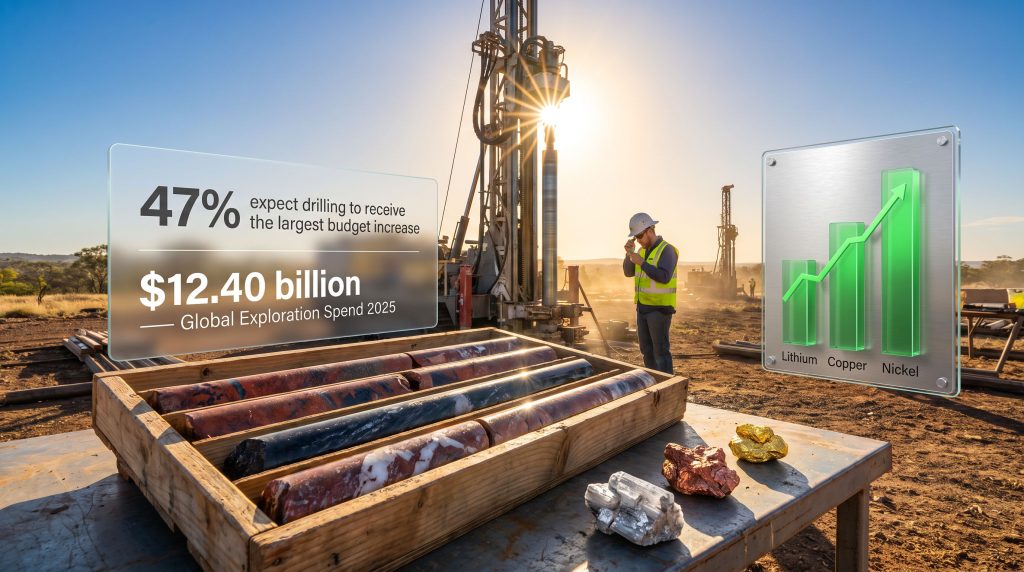
This is why survey data from 75 mineral exploration professionals captured in MiningIQ's annual Exploration Survey reveals that approximately 47% of industry participants expect drilling to receive the largest budget increase over the next 12 months, outpacing every other category including geophysics, remote sensing, and data analytics platforms.
The finding is not a rejection of innovation. It reflects a more fundamental reality about where risk capital ultimately must flow to generate investable outcomes. Furthermore, drilling programs continue to serve as the primary mechanism through which geological hypotheses are tested and resource inventories are grown.
Global Mineral Exploration Spending: The Headline Versus the Detail
The aggregate picture of global exploration spending in 2025 presents a somewhat misleading narrative. Global nonferrous mineral exploration expenditure reached $12.40 billion in 2025, representing a third consecutive year of nominal decline, down approximately 0.6% year-over-year. On the surface, this suggests a sector in retreat.
The reality, however, is more selective. Within that contracting aggregate, specific company tiers and commodity categories are experiencing genuine capital growth.
| Company Tier | Estimated Annual Exploration Budget (2025-2026) |
|---|---|
| Major Mining Corporations | $4.8-$6.2 billion (sector total ~$6 billion in 2026) |
| Mid-Tier Operators | $400-$800 million per company |
| Junior Mining Companies (3,200+ on Canadian exchanges) | Collective $1.8-$2.4 billion |
Major mining companies increased exploration budgets by 1-2% in 2026, reaching approximately $6 billion in aggregate. Mid-tier operators with priority growth targets are authorising individual drill programs exceeding $25 million per asset. Meanwhile, over 3,200 junior mining companies listed on Canadian exchanges collectively represent a significant pool of early-stage exploration capital, though individual budgets vary enormously based on treasury health and equity market conditions.
Two forces are driving selective capital growth within the broader declining trend:
- Sustained gold prices above $2,000 per ounce have reclassified previously marginal drill targets as economically viable, directly triggering new program authorisations
- Government grant programs for critical mineral commodities are supplementing private exploration budgets across North America, Australia, and parts of Europe, though the extent and eligibility criteria vary significantly by jurisdiction
Drilling Cost Structures: What Exploration Budgets Actually Need to Absorb
How Much Does It Actually Cost Per Metre?
One of the most consequential and frequently underestimated variables in mineral exploration drilling budget planning is per-metre drilling cost. These figures vary substantially depending on methodology, target depth, rock competency, and the logistical complexity of the operating jurisdiction. According to ABS mineral exploration data, Australia's drilling activity reflects these cost pressures across multiple commodity categories.
| Drilling Method | Estimated Cost Per Metre (2026) |
|---|---|
| Diamond Core Drilling | $65-$120/m |
| Reverse Circulation (RC) | $35-$65/m |
| Aircore Drilling | $12-$25/m |
The choice of drilling method carries enormous implications for budget construction. Aircore drilling, suited to shallow regolith environments common in Australian gold exploration, delivers cost-effective early-stage sampling but provides no structural orientation data and cannot penetrate fresh basement rock. RC drilling offers an effective middle ground for hard rock sampling to moderate depths, delivering chips rather than core but at meaningfully lower cost than diamond. Diamond core drilling remains mandatory for deep, structurally complex, or resource-definition programs where sample quality, geotechnical data, and mineralogical detail are non-negotiable.
Cost inflation alert: Canadian diamond core drilling costs rose from approximately $140 per metre in 2014 to $201 per metre in 2023, representing a 43% increase over nine years. This inflationary pressure on labour, consumables, fuel, and rig mobilisation costs has significant implications for any budget model anchored to historical benchmarks.
Budget Ranges by Exploration Stage
Exploration programs are not monolithic, and treating them as such is a common planning error. Budget requirements scale dramatically with project maturity:
- Early-stage reconnaissance: Shallow drill programs typically range from $1 million to $3 million
- Intermediate exploration: Annual expenditure commonly falls between $500,000 and $5 million, depending on program scale and commodity
- Advanced resource definition: Feasibility-grade drilling can require $20 million or more per year, with high-density patterns and tight quality assurance requirements
- Greenfield drilling contractor establishment: Starting a new drilling business from scratch requires capital expenditure exceeding $37 million, with a single primary drill rig accounting for approximately $25 million of that figure
That last figure deserves particular attention. The capital intensity of drilling equipment ownership creates a significant barrier to new entrant competition in contract drilling markets, which in turn sustains pricing power among established operators and contributes to cost stickiness even during exploration downturns.
The Commodities Reshaping Budget Priorities
Critical Minerals Claim a Growing Share of Exploration Capital
The energy transition has altered the commodity hierarchy embedded within exploration budgets in ways that are still playing out. While gold commands the largest total exploration expenditure of any single commodity, the most significant incremental growth in mineral exploration drilling budgets in 2026 is concentrated in three materials. In addition, critical minerals demand continues to reshape how exploration capital is prioritised across jurisdictions.
- Lithium – Battery supply chain demand, combined with government incentive frameworks across multiple jurisdictions, has elevated lithium exploration from a niche activity to a mainstream budget priority
- Copper – Electrification infrastructure requirements, including grid expansion, EV charging networks, and renewable energy generation, have placed structural demand pressure on copper supply chains that is translating into sustained exploration investment
- Nickel – EV battery chemistry demand continues to underpin exploration interest, though near-term price volatility following the 2023-2024 market disruption has introduced caution into budget approvals
An aspect less commonly appreciated is the difference between grassroots lithium exploration and brownfields lithium targeting. Several jurisdictions with established mining histories contain historical drill holes that intersected lithium-bearing pegmatites but were not assayed for lithium because the commodity had no commercial relevance at the time. Relogging and reassaying historical core from these programs has become a low-cost entry strategy for junior explorers, effectively extracting new value from existing physical samples without drilling a single new hole.
Gold's Enduring Role as the Budget Anchor
Despite the critical minerals surge, gold retains its position as the primary economic justification for exploration drilling across the junior and mid-tier universe. Prices sustained above $2,000 per ounce have produced three measurable effects on budget planning:
- Extended the economic life of lower-grade drill targets by improving the revenue-per-tonne calculation
- Reduced the minimum grade threshold required to justify continued drilling, effectively expanding the universe of viable targets
- Enhanced the ability of smaller companies to access equity capital markets for exploration financing, providing the treasury depth needed to sustain multi-phase drill programs
The Technology Adoption Gap: Enthusiasm Versus Expenditure
Perhaps the most structurally interesting finding embedded in current exploration budget data is what might be called the technology enthusiasm gap. Mineral exploration companies broadly acknowledge the value of a growing suite of innovations:
- AI-assisted geological targeting and geochemical anomaly detection
- Advanced airborne geophysical platforms including electromagnetic and gravity gradiometry surveys
- Hyperspectral remote sensing for alteration mapping and mineralogical classification
- Subsurface intelligence platforms integrating drill results, geophysics, and geochemical datasets into unified 3D geological models
Yet budget allocation data consistently shows technology investment trailing drilling expenditure by a substantial margin. The pattern emerging in 2026 is one of technology functioning as a pre-drilling screening tool rather than a capital substitute.
Strategic implication: Companies deploying technology to improve drill target quality are not reducing drilling budgets. They are improving the capital efficiency of each metre drilled, which may ultimately sustain or increase total drilling expenditure as success rates improve and economically justified programs multiply.
There is a subtler dynamic at work here as well. Geological targeting algorithms trained on existing deposit databases carry an inherent bias toward deposit types already discovered. The algorithms know what a Carlin-type gold system looks like because there are hundreds of examples to learn from. However, genuinely novel deposit geometries, in new geological terranes or at depths below historical drilling, may systematically evade pattern-recognition systems built on legacy data. This represents a meaningful limitation of AI-assisted targeting that is not yet widely discussed in exploration technology marketing.
The next major ASX story will hit our subscribers first
A Practical Framework for Mineral Exploration Drilling Budget Development
For geologists, project managers, and corporate planners constructing mineral exploration drilling budgets, a structured methodology reduces the risk of material cost underestimation. Consequently, interpreting drill results accurately from the outset is just as critical as budgeting correctly for the program itself.
Step 1: Define exploration stage and program objective
Establish whether the program targets first-pass reconnaissance, deposit delineation, resource expansion, or feasibility-grade resource definition. Each carries fundamentally different cost structures and drilling density requirements.
Step 2: Select drilling method based on geological context
Match methodology to target depth, rock type, required sample quality, and structural complexity. Mismatching method to objective is a common source of budget inefficiency and data quality failure.
Step 3: Apply jurisdiction-specific per-metre cost benchmarks
Canadian programs should budget at approximately $201 per metre for diamond core. Australian programs reflect different labour markets and logistics cost structures. Remote or fly-in fly-out programs carry material mobilisation premiums. Exploring drilling cost software solutions may also help teams manage and forecast expenditure more accurately across complex multi-phase programs.
Step 4: Build inflation and contingency provisions
A minimum 15-20% contingency should be incorporated into all drill program budgets to absorb cost escalation, weather delays, permitting extensions, and unexpected geological complexity such as voids, water strikes, or structural complexity requiring reduced rod advancement rates.
Step 5: Phase budgets against capital market access
Junior company drill programs are acutely sensitive to equity market sentiment. Budget phasing should account for the realistic time and cost required to raise capital between program stages, including the potential for market windows to close unexpectedly.
Regional Dynamics: Where Exploration Drilling Capital Is Being Deployed
Global mineral exploration drilling budgets are not distributed evenly across jurisdictions. Capital concentrates where geological prospectivity combines with regulatory stability, established infrastructure, and accessible skilled labour.
Key regional dynamics shaping 2026 budget deployment include:
- Canada remains the single largest destination for junior exploration capital, hosting over 3,200 junior mining companies on its exchanges. Rising per-metre drilling costs are, however, compressing the total metres achievable within fixed budgets, incentivising more selective target prioritisation
- Australia has become an increasingly important critical minerals exploration destination, with government grant programs directing incremental capital into lithium, nickel, and copper exploration programs across Western Australia and the Northern Territory
- West Africa and Latin America continue attracting sustained exploration capital in established gold belts, with major and mid-tier companies maintaining multi-year drill commitments anchored by strong gold price economics
- Europe represents an emerging and underappreciated destination for exploration drilling investment. Lithium discoveries in regions including Cornwall in the United Kingdom signal renewed geological interest in jurisdictions that have been historically underexplored using modern methods. Cornwall's lithium-bearing granites, long known for tin and copper mineralisation, are now attracting attention from explorers targeting the brines and hard-rock pegmatite systems that may underlie well-documented historical mining districts
Furthermore, junior exploration investment patterns across these regions continue to shift as commodity price signals and government incentives evolve throughout the year.
Scenario Analysis: Where Mineral Exploration Drilling Budgets Are Headed
| Scenario | Conditions | Projected Budget Direction |
|---|---|---|
| Bull Case | Gold sustains above $2,500/oz; critical mineral programs expand; equity markets remain receptive | Drilling budgets increase 8-12% across junior and mid-tier segments |
| Base Case | Gold holds $2,000-$2,500/oz; government programs continue; moderate equity conditions | Drilling budgets grow 2-5% nominally, with flat real growth after inflation |
| Bear Case | Gold retreats below $1,800/oz; grant programs scaled back; equity market risk-off sentiment | Drilling budgets contract 5-10%, with junior companies most severely impacted |
The structural case for sustained drilling investment remains intact across all but the most adverse scenarios. Physical resource definition cannot be outsourced to desk-based analysis, and the commodity price and policy environment in 2026 continues to support active drill programs across multiple jurisdictions and company tiers.
Disclaimer: Scenario projections and budget forecasts presented in this article are based on available industry data and analyst estimates as of mid-2026. They are forward-looking in nature and subject to material change based on commodity price movements, equity market conditions, regulatory developments, and other factors beyond the control of exploration companies. This article is intended for informational purposes only and does not constitute financial or investment advice.
Key Takeaways: Mineral Exploration Drilling Budgets at a Glance
- Global nonferrous exploration spending reached $12.40 billion in 2025, with major companies increasing budgets by 1-2% to approximately $6 billion in 2026
- 47% of exploration professionals expect drilling to receive the largest budget increase in the next 12 months, above every competing technology category
- Diamond core drilling costs range from $65-$120 per metre; RC from $35-$65 per metre; aircore from $12-$25 per metre
- Canadian drilling costs have risen 43% over nine years, reaching $201 per metre in 2023, with implications for budget modelling in all comparable jurisdictions
- Lithium, copper, and nickel are recording the most significant incremental budget growth, driven by energy transition supply chain requirements
- Technology adoption is growing but functions as a complement to drilling rather than a replacement, reinforcing rather than diminishing the primacy of physical drill programs in exploration capital allocation
- Historical core relogging for critical minerals represents an underutilised low-cost strategy that can generate new geological value without additional drilling expenditure
Further reading: Readers seeking additional context on global mineral exploration trends and drilling industry developments can explore related industry coverage published by GeoDrilling International at geodrillinginternational.com. The publication provides ongoing reporting on drilling operations, equipment, and exploration market conditions across multiple commodity sectors.
Want To Know When The Next Major ASX Mineral Discovery Hits?
Discovery Alert's proprietary Discovery IQ model delivers real-time alerts the moment significant mineral discoveries are announced on the ASX, cutting through complex geological data to surface actionable opportunities across gold, lithium, copper, and beyond — exactly the commodities driving exploration budget growth in 2026. Explore Discovery Alert's discoveries page to understand the historic returns major mineral discoveries have generated, and begin your 14-day free trial to position yourself ahead of the broader market.